In this article
Dedicated Development Team Guide: Hire, Scale, Succeed
Business & Strategy
Learn how to hire, manage, and scale dedicated development teams for your startup. Expert guide covering costs, provider selection, and best practices for 2026.

You’ve built a product roadmap that could change your market. Your vision is clear, your funding is secured, and your timeline is aggressive. Then reality hits: your internal team can’t scale fast enough to meet demand, and traditional hiring takes months you don’t have. This friction between ambition and execution is where dedicated development teams step in, offering pre-vetted engineers who integrate seamlessly into your workflow and deliver results from day one.
Key Takeaways
| Point | Details |
|---|---|
| Scalable team model | Dedicated development teams provide flexible, expert talent for rapid business growth. |
| Transparent cost structure | Understand pricing models and budgeting to avoid hidden surprises. |
| Top provider selection | Choose proven partners with strong client reviews and cultural alignment. |
| Effective management matters | Success depends on agile communication, clear KPIs, and collaborative processes. |
What is a dedicated development team?
A dedicated development team is an exclusive group of external engineers who work solely on your project for an extended period. Unlike freelancers who juggle multiple clients or staff augmentation that fills temporary gaps, a dedicated team becomes an extension of your organization. They share your goals, understand your product vision, and commit to long-term collaboration.
The model is not niche. The global IT outsourcing services market is projected to reach $1.22 trillion by 2030, growing at 8.6% a year (Grand View Research).
This model differs fundamentally from traditional outsourcing. You’re not handing off a project and waiting for delivery. Instead, you gain direct access to specialists who participate in daily standups, sprint planning, and strategic decisions. The team remains stable, which means knowledge stays intact and productivity compounds over time.
Key benefits include aligned incentives, predictable collaboration, and the ability to scale resources without disrupting momentum. When you need to add a DevOps engineer or expand your QA capacity, the provider handles recruitment while you maintain focus on product strategy. This approach works particularly well for startups building complex platforms or CTOs managing multiple product lines simultaneously.
Pro Tip: When evaluating hiring dedicated developers, prioritize providers with 4.8-5.0 Clutch ratings who specialize in your technology stack and industry vertical.
“The right dedicated team doesn’t just execute tasks. They challenge assumptions, suggest improvements, and take ownership of outcomes as if the product were their own.”
When should you consider a dedicated team?
Certain project conditions make dedicated teams the optimal choice. If your requirements evolve frequently, a dedicated team adapts without renegotiating contracts or onboarding new contractors. When you’re building a minimum viable product under tight deadlines, this model accelerates delivery by eliminating hiring friction.
Long-term projects benefit most from dedicated teams. The stability allows engineers to develop deep product knowledge, reducing the cognitive load of constant context switching. You also avoid the productivity dip that comes with frequent team turnover.
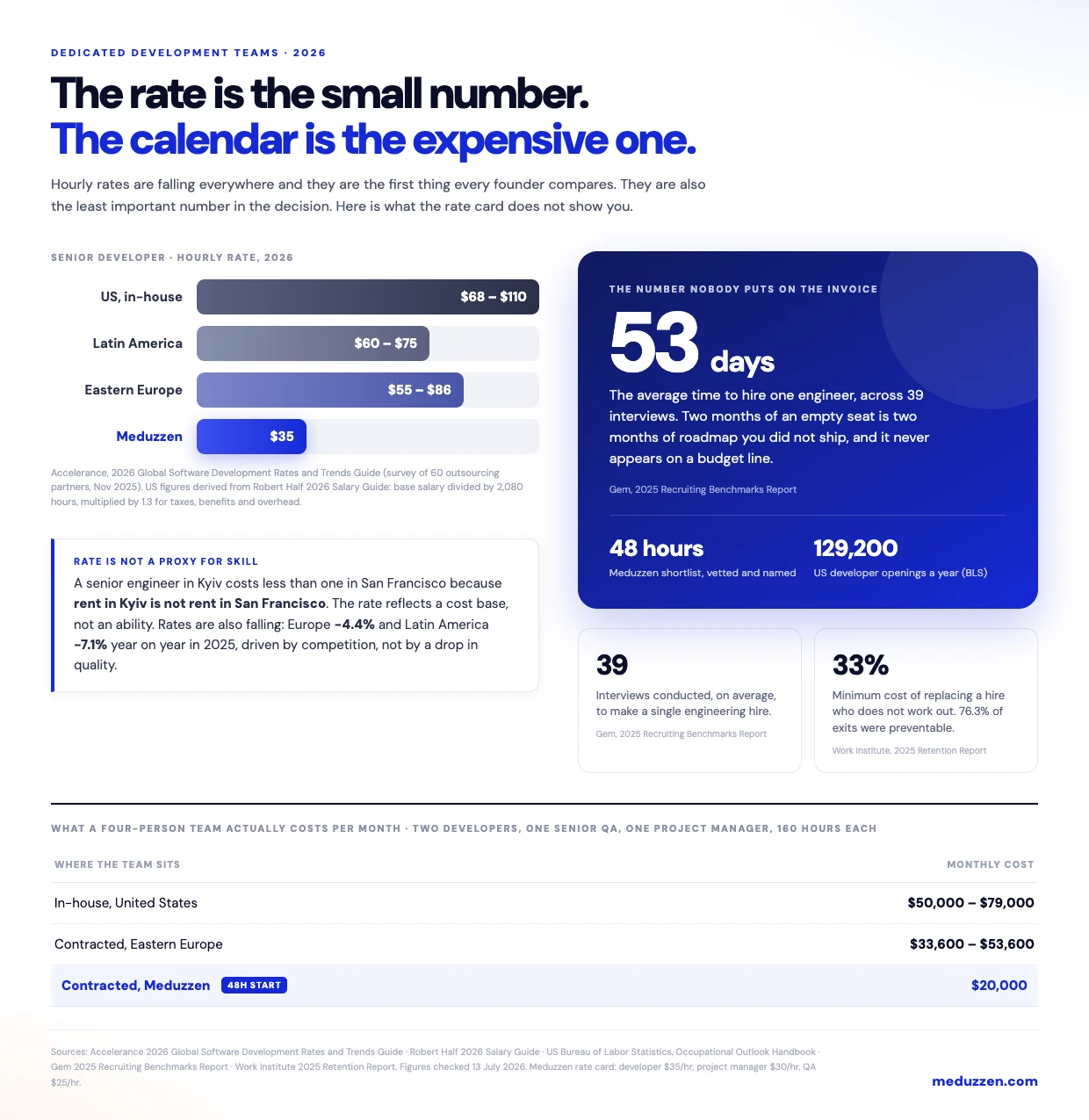
There is also a supply problem you cannot solve by hiring harder. The US Bureau of Labor Statistics projects 129,200 software developer openings a year through 2034 (BLS), and the Gem 2025 Recruiting Benchmarks Report puts the average time to hire an engineer at 53 days across 39 interviews. A dedicated team is often the difference between shipping this quarter and shipping next year.
Recognize these signals:
- Your internal team lacks specialized skills in AI, cloud architecture, or emerging technologies
- Workload fluctuates unpredictably, making permanent hires risky
- You need to launch quickly but can’t compromise on quality
- Scaling your in-house team would take six months or more
For projects involving machine learning, IoT platforms, or cloud-native applications, dedicated teams provide instant access to niche expertise that’s difficult to recruit locally. Rather than spending months searching for a senior Python engineer with experience in real-time data processing, you can onboard a specialist within weeks.

Pro Tip: Consider dedicated teams for AI, cloud, or IoT projects to gain instant expertise without the overhead of permanent hiring and lengthy onboarding cycles.
Startups in FinTech, Healthcare, and Logistics particularly benefit from this model. Regulatory complexity and technical depth require engineers who understand both the technology and the domain. A dedicated team with relevant industry experience reduces risk and shortens time to market. For guidance on structuring your project, review these software development steps for startups.
How to assemble your dedicated development team
Building an effective dedicated team follows a structured process. Start by defining your technical requirements with precision. Document the technologies you’re using, the problems you’re solving, and the skills you need. Vague requirements lead to mismatched talent and wasted time.
Getting this wrong is expensive. The Work Institute’s 2025 Retention Report puts the cost of replacing an employee at a minimum of 33% of base salary, and found 76.3% of 2024 exits were preventable. On a $150,000 engineer that is $50,000 you spend twice.
- Define project scope and technical needs: List required technologies, integrations, and performance benchmarks
- Research and shortlist vendors: Focus on top-rated providers with verified client reviews and relevant case studies
- Review candidate profiles: Assess technical skills, domain experience, and communication abilities
- Conduct technical interviews: Test problem-solving skills and cultural alignment through practical scenarios
- Finalize contracts and SLAs: Establish clear deliverables, communication protocols, and performance metrics
- Onboard the team: Share documentation, grant access to tools, and schedule regular sync meetings
The composition of your team depends on project complexity and phase. Early-stage products need versatile engineers who can build quickly. Mature platforms require specialists who optimize performance and maintain stability.
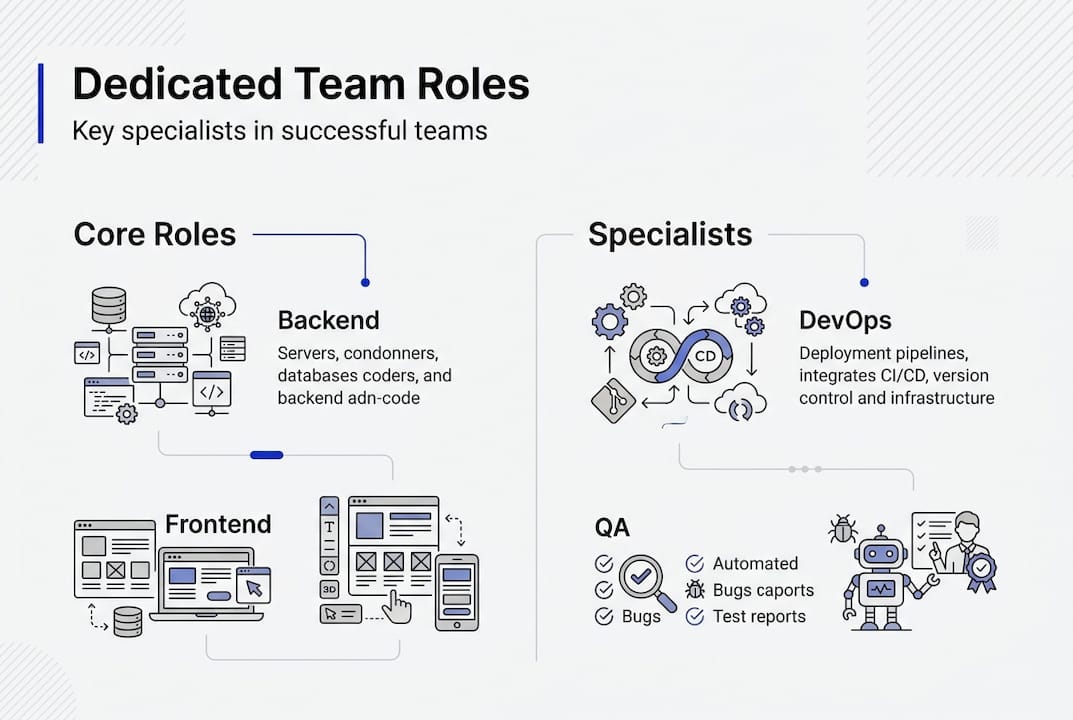
| Role | Core Responsibilities | Key Skills |
|---|---|---|
| Backend Engineer | API development, database design, server logic | Python, Node.js, PostgreSQL, Redis |
| Frontend Engineer | User interface, client-side logic, responsive design | React, TypeScript, CSS frameworks |
| DevOps Engineer | CI/CD pipelines, infrastructure, monitoring | Docker, Kubernetes, AWS, Terraform |
| QA Engineer | Test automation, quality assurance, bug tracking | Selenium, Jest, performance testing |
| Project Manager | Sprint planning, stakeholder communication, delivery | Agile methodologies, Jira, risk management |
Pro Tip: Insist on cultural and time zone compatibility. Communication equals velocity. A team that overlaps with your working hours by at least four hours enables real-time collaboration and faster decision-making.
For industry-specific needs, explore specialized team structures like fintech team examples or connect directly with Meduzzen Talent Lab for customized team assembly.
Cost considerations and budgeting
Almost every article on this topic quotes a monthly price without saying how many people are in the team, where they sit, or how many hours they work. That makes the number worthless. Below is the actual math, with every assumption stated and every source linked, so you can check it instead of trusting us.
What a dedicated team actually costs per hour
Market rates come from the Accelerance 2026 Global Software Development Rates and Trends Guide, published 24 November 2025 from a survey of 60 outsourcing partners.
US figures come from the Robert Half 2026 Salary Guide: annual base salary divided by 2,080 working hours, then multiplied by 1.3 to cover payroll taxes, benefits and overhead. That is the true cost of a seat, not the salary line.
| Role | US (in-house, loaded) | Eastern Europe | Latin America | Meduzzen |
|---|---|---|---|---|
| Mid-level Developer | $59 to $103/hr | $45 to $66/hr | $48 to $60/hr | $30/hr |
| Senior Developer | $68 to $110/hr | $55 to $86/hr | $60 to $75/hr | $35/hr |
| DevOps Engineer | $74 to $109/hr | not published | not published | $35/hr |
| Senior QA | not published | $50 to $76/hr | $60 to $71/hr | $25/hr |
| Project Manager | $43 to $63/hr | $50 to $87/hr | $53 to $75/hr | $30/hr |
As a cross-check, Clutch’s pricing data puts US software development agencies at $50 to $99 per hour, which sits inside the loaded in-house range above. Two independent sources, same answer.
By comparison, teams that hire developers in Ukraine pay closer to $35 per hour for senior engineers, which is why Eastern Europe sits at the cost-effective end of that range.
One detail worth your attention: rates are falling. Accelerance recorded a 4.4% year-on-year drop in Europe and 7.1% in Latin America through 2025. If a vendor tells you rates are climbing, ask for their source.
What that means for a real team
A four-person team (two developers, one senior QA engineer, one project manager) at 160 billable hours each per month:
| Monthly cost | |
|---|---|
| In-house, United States | $50,000 to $79,000 |
| Contracted, Eastern Europe | $33,600 to $53,600 |
| Contracted, Meduzzen | $20,000 |
That is 40% to 63% below the Eastern European market benchmark for the same four roles, and roughly a third of the cost of employing the same team in the United States. The benchmark is published at the Accelerance link above. Go and check it. That is why we linked it.
The gap is widest on QA. The European market bills $50 to $76 an hour for an automation QA engineer. We bill $25. Nobody should be paying a premium for the person who finds the bugs.
A reality check you will not get from a vendor
Clutch’s platform data puts the average monthly spend on software development at $10,209, across an average total project cost of $132,480 over roughly thirteen months.
That is below every team figure above, and the gap is worth explaining rather than hiding. Clutch blends small fixed-price projects into the same average as long-running retainers, so it is not like-for-like with a dedicated team. But it does mean this: if a vendor quotes you $15,000 a month, you are entitled to ask why you are paying 50% above the platform-wide average, and to get a straight answer.
The hourly rate is the wrong thing to optimise
Olivier Poulard, Managing Director of Global Software Engineering Strategies at Accelerance, says it plainly:
“Hourly rates are a poor measure of the true cost of software development.”
He is right, but not in the way most vendors want you to hear it. A high rate is not a proxy for quality. A senior engineer in Kyiv costs less than one in San Francisco because rent in Kyiv is not rent in San Francisco, not because the code is worse. What actually drives cost per outcome is time: the US average is 53 days to hire one engineer, and every one of those days is roadmap you did not ship. The rate is the smallest number on the page. The calendar is the expensive one.
The costs nobody puts in the quote
Time to hire. The Gem 2025 Recruiting Benchmarks Report puts the average time to hire an engineer at 53 days, across 39 interviews. SHRM puts the cross-industry median at around 45 days. Two months of an empty seat is two months of unshipped roadmap, and it never appears on a budget line.
Recruiting fees. Typically 15% to 25% of first-year salary. On a $150,000 engineer that is $22,500 to $37,500, paid once, before day one.
The wrong hire. The Work Institute’s 2025 Retention Report puts the cost of replacing an employee at at least 33% of base salary, and found 76.3% of 2024 exits were preventable.
Platform markup. Marketplaces take a cut of every hour, sometimes from both sides.
Meduzzen charges no recruiting fee and no platform fee, delivers a vetted shortlist in 48 hours rather than 53 days, and you keep 100% of the IP.
Managing and scaling your dedicated team
Effective management transforms a capable team into a high-performing unit. Establish clear communication rhythms from day one. Daily standups keep everyone aligned on priorities. Weekly retrospectives surface blockers and process improvements. Monthly reviews assess progress against strategic goals.
The gap between well-run and badly-run engineering teams is not marginal. Google’s DORA research finds elite performers deploy 182 times more frequently than low performers, with lead times 127 times faster and change failure rates 8 times lower (DORA). Process is not overhead. It is the product.
Essential management practices:
- Define measurable KPIs: Track velocity, code quality, deployment frequency, and bug resolution time
- Implement sprint planning: Break work into two-week cycles with clear deliverables and acceptance criteria
- Maintain transparent documentation: Use shared wikis, decision logs, and architecture diagrams accessible to all team members
- Schedule regular one-on-ones: Build relationships, address concerns, and gather feedback on process improvements
- Conduct code reviews: Ensure quality standards, knowledge sharing, and continuous learning across the team
Scaling requires intentional planning. When adding new roles, consider how they integrate with existing workflows. A new frontend engineer should pair with your current team for at least a week to absorb coding standards and architectural decisions. Rushed onboarding creates technical debt and communication gaps.
Key scaling strategies:
- Vertical scaling: Add senior specialists to deepen expertise in critical areas like security or performance optimization
- Horizontal scaling: Expand team size to increase output capacity while maintaining quality standards
- Modular scaling: Create sub-teams focused on specific features or services, enabling parallel development streams
“Agile and collaborative culture isn’t optional for distributed teams. It’s the foundation that turns individual contributors into a cohesive unit capable of solving complex problems together.”
For practical frameworks on managing distributed engineering teams, explore agile management tips and learn how to structure cloud project scaling for maximum efficiency.
Top-rated dedicated team providers in 2026
Choosing the right provider determines your project’s trajectory. Focus on verified reviews, technical specialization, and cultural alignment. The best providers demonstrate consistent delivery, transparent communication, and deep expertise in your required technologies.
| Provider | Hourly rate | Min project | Clutch rating | Time to start |
|---|---|---|---|---|
| Meduzzen | $25 to $49/hr | $1,000+ | 5.0 | 48 hours |
| Netguru | $50 to $99/hr | $50,000+ | 4.4 | Weeks |
| BairesDev | $50 to $99/hr | $50,000+ | 4.9 | 2 to 4 weeks |
| Toptal | $60 to $150+/hr | – | 4.8 | 48 hours |
| Turing | $100 to $200/hr | – | Not rated | Days |
Selection best practices:
- Verify client reviews: Read detailed case studies on platforms like Clutch, not just star ratings
- Assess technical depth: Request code samples, architecture diagrams, or technical whitepapers from past projects
- Evaluate communication: Conduct video calls with potential team members to gauge English proficiency and responsiveness
- Check time zone overlap: Ensure at least four hours of daily overlap for real-time collaboration
- Review security practices: Confirm SOC 2 compliance, NDA protocols, and data protection measures
Providers with 4.8-5.0 ratings typically maintain rigorous vetting processes, ongoing training programs, and established quality assurance frameworks. These factors directly impact your project’s success rate and long-term maintainability.
“Hiring is a bet on a stranger. The entire industry exists to sell you a better bet: a harder test, a stricter filter, a smaller percentage. We do not sell you a bet. We send you people we have already been right about.” – Iryna Iskenderova, CEO, Meduzzen
For specialized technology needs, consider providers with proven expertise in your stack. If you’re building on .NET, explore .NET development specialists.
Get started with a high-performing dedicated team
You now understand how dedicated teams accelerate product development, when to deploy this model, and how to assemble the right talent. The next step is finding a partner who aligns with your technical needs and business objectives.
Meduzzen specializes in building dedicated development teams for startups and growing companies across FinTech, Healthcare, Logistics, and SaaS. With over 10 years of experience and 150+ pre-vetted engineers, we deliver scalable solutions in Python, AI, DevOps, Cloud, and modern web technologies. Our teams integrate seamlessly into your workflow, ensuring fast onboarding, transparent communication, and predictable delivery.
Whether you need a full product development team or specialized engineers to augment your existing capacity, we provide talent that matches your technical requirements and cultural expectations. Our engineers don’t just write code. They solve problems, suggest improvements, and take ownership of outcomes.
Explore our custom web services for end-to-end product development or review our staff augmentation services to fill specific skill gaps. Ready to discuss your project? Consult with Meduzzen to start building your dedicated team today.
Frequently asked questions
What is the difference between a dedicated development team and staff augmentation?
A dedicated team works exclusively on your project with full commitment, while staff augmentation adds individual specialists to your in-house team, typically for temporary needs or specific skill gaps.
How do I choose the right tech stack for my dedicated team?
Consider your project’s long-term goals, required expertise, and provider specialization. Compare stack recommendations during vendor interviews and prioritize technologies with strong community support and proven scalability.
How quickly can a dedicated team start delivering value?
Top providers ramp up teams in as little as 2-4 weeks, depending on requirements and region. Onboarding speed increases when you provide clear documentation, defined processes, and immediate access to development environments.
Can I scale my dedicated team up or down over time?
Yes, dedicated teams are built for flexible scaling to fit growth and changing project priorities. You can add specialists as new features emerge or reduce capacity during maintenance phases without long-term commitments.
What are the main risks of working with a dedicated development team?
Primary risks include misaligned expectations, communication gaps, and inadequate technical oversight. Mitigate these by establishing clear KPIs, maintaining regular communication rhythms, and conducting thorough code reviews throughout the engagement.