In this article
AI-Assisted Localization at Scale: From Content Platform to Multi-Tenant Frontends
AI & Automation
For a multi-tenant platform, AI localization is not just a translation task, it is an architecture problem. Here is how we built it into the CMS as the source of truth: translation states, HTML-aware handling, protected values, and delivery to multi-tenant frontends, with humans still in control.

Key takeaways
| Takeaway | The short version |
|---|---|
| Localization at scale is an architecture problem | For a multi-tenant platform, AI localization is not just a translation task. It touches content management, frontend delivery, SEO, publishing, and quality control. |
| Standalone translation tools are not enough | A content manager needs the translated value connected to the right entity, field, language, tenant, and state, not just “this paragraph in another language.” |
| The CMS stays the source of truth | AI generates translation drafts inside the content model. Translated content joins the same CMS data flow as manual content, with no disconnected spreadsheets to reconcile. |
| Different content needs different handling | A button label, a meta title, a long HTML page, and a promo terms block each require their own prompt strategy and protected-value rules. |
| Translation needs state, not just strings | Processing, origin, and editorial states matter. When the source changes, existing translations are marked for review instead of silently staying “done.” |
| AI-assisted, not fully automated | AI removes repetitive work. Humans keep control of legal, compliance, SEO, and market-specific wording. Frontends consume localized values per tenant and locale, and never call the AI. |
Localization for multi-tenant digital platforms is rarely just a translation task. It is an operational challenge that touches content management, frontend delivery, SEO, publishing processes, and quality control. This is why AI localization at scale is an engineering problem before it is a language problem.
In this article, a tenant represents an independently configured digital product or brand with its own supported languages, content, and publishing rules. The content platform refers to the broader system used to manage multilingual content, while the CMS layer acts as the operational source of truth.
A single source text may need to appear across several markets, frontend applications, SEO pages, promotional campaigns, navigation menus, banners, product descriptions, and interface labels. Each content type has its own structure. Some fields are short and simple. Others contain rich HTML, links, metadata, calls to action, or legal and compliance content that must keep its formatting intact.
This is where AI becomes useful: not as a standalone translation shortcut, but as part of a structured localization process. The goal is not to replace content managers or editors, but to reduce repetitive work, speed up localization, and keep humans in control of what reaches customer-facing frontend sites.
Why standalone translation tools are not enough
Basic translation tools are useful for quick understanding, but they do not solve the operational problem of managing multilingual content at scale.
A content manager does not just need “this paragraph in another language.” They need the translated value to be connected to the right entity, field, language, tenant, and content state.
A CMS may contain translations for:
- dictionary keys used across the interface;
- landing pages and static content pages;
- SEO titles, descriptions, and rich SEO blocks;
- promotions and campaign pages;
- homepage banners and CTA buttons;
- categories, product records, providers, and navigation items;
- reusable content sections and tenant-specific modules.
Each translated field must remain editable and traceable, while the frontend receives only the localized value required for the selected tenant and language.
The CMS as the source of truth for AI localization
In our approach, the CMS remains the central source of truth for multilingual content. AI is integrated into the localization flow, but it does not bypass the content model.
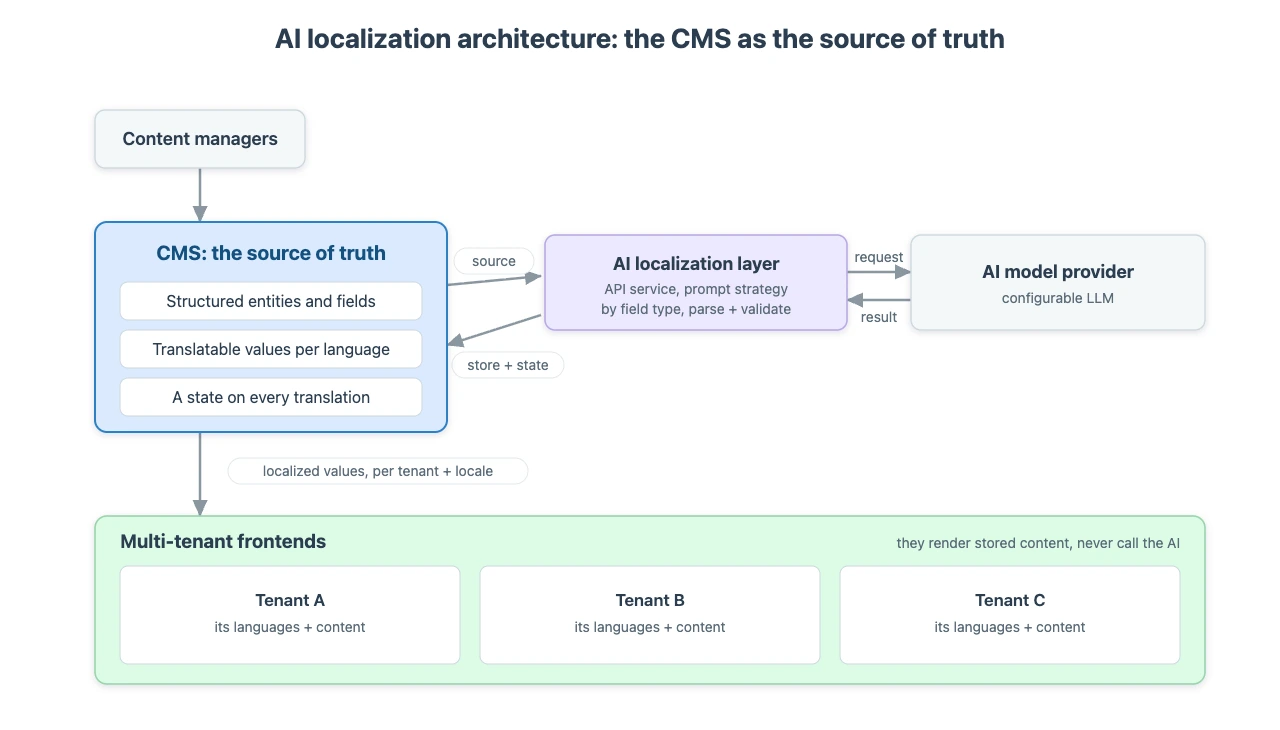
Managers work with structured entities such as pages, promotions, banners, SEO fields, dictionary items, navigation items, and other content types. Each entity has a defined set of translatable fields. For every supported language, the system stores the localized value together with its current state.
This gives the team a clear operational model:
- what content exists;
- which fields are translatable;
- which languages are supported for a tenant or brand;
- which translations are missing;
- which translations were generated by AI;
- which translations may need review or retranslation.
The AI localization layer generates translation drafts inside this model. Once saved, translated content becomes part of the same CMS-managed data flow as manually entered content. There is no separate spreadsheet, browser extension, or disconnected translation document that later has to be reconciled with production data.
How the AI-assisted process works
The AI layer is integrated as an API-driven service. When a manager requests translation for a field, a group of fields, or fields matching a selected content state, the CMS prepares the source content and chooses the appropriate prompt strategy. It then sends the request to a configurable AI model provider, parses the structured result, and stores the result in the database.
The system supports different translation modes. Managers can generate drafts for all fields, only missing fields, fields that are not yet translated, or fields marked as needing retranslation. This avoids unnecessary overwrites and makes the feature practical for day-to-day content operations.
For example, a manager can open a promotion, generate only its missing locale values, review the AI-generated drafts, edit the fields that need tenant-specific wording, and save the result through the existing CMS process. The localized promotion can then appear on the frontend without copying content between external tools and the admin platform.
One practical problem was that updating a promotion or page in the source language did not automatically mean that all localized versions were still valid. A translation could technically exist while already being outdated. Treating this as a lifecycle problem, rather than only checking whether a value was present, made the process more reliable.
When a source-language value changes, existing localized values can be marked as requiring review or retranslation instead of silently remaining in a completed state.
Handling UI text, SEO content, HTML, and protected values
Not all content should be translated the same way. A short button label, a meta title, a long HTML page, and a promotional terms block all require different handling.
Plain text fields can be processed directly. Rich HTML content requires stricter instructions: preserve tags, attributes, formatting, and document structure, while translating only the designated text content. The response also needs to be structured enough for the CMS to parse reliably.
This matters because customer-facing pages often contain formatted content. Headings, paragraphs, links, lists, tables, and inline styles may all be part of the final frontend output. A translation process that breaks HTML creates frontend bugs, layout issues, or publishing delays.
For long HTML content, the system can split the source into manageable chunks along structural boundaries instead of arbitrary text positions. Each chunk is translated separately and then merged back into one localized value, reducing the risk of broken tags while keeping large content blocks manageable.
We also learned that longer prompts were not always better. Simple interface labels usually need direct translation, while HTML content and promotional text require stricter instructions. The prompt strategy therefore has to depend on the field type instead of using one universal template for everything.
The same principle applies to non-translatable values such as URLs, template variables, tracking parameters, product names, currency codes, and internal identifiers. These values should be treated as protected context, not as ordinary text to rewrite. Even when the AI model produces the draft, the CMS process remains responsible for preserving the structure that the frontend expects.
Translation lifecycle and states
A production localization flow needs more than translated strings. It needs state. This lifecycle-driven approach is what separates continuous localization from a batch translation workflow.
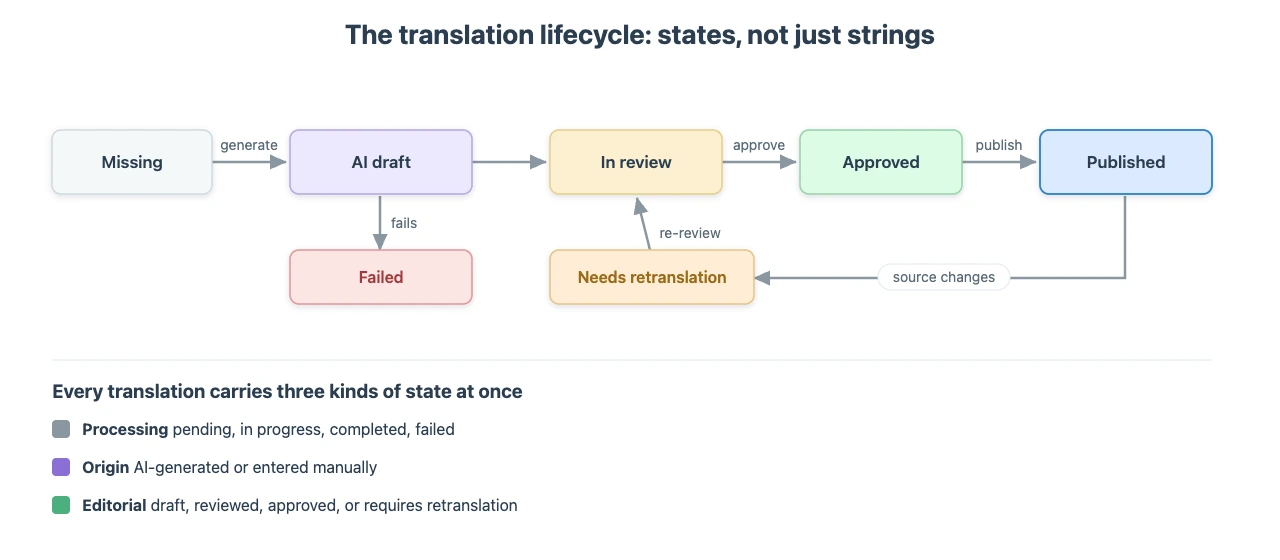
In practice, several state dimensions matter at the same time. Processing state describes whether a translation request is pending, in progress, completed, or failed. Content origin indicates whether the value was AI-generated or entered manually. Editorial state describes whether the value has been reviewed, edited, approved, or marked as requiring retranslation.
Even if these dimensions are represented differently in the underlying data model, separating them conceptually helps teams reason about the localization lifecycle. A failed API request, an AI-generated draft, and a reviewed final translation are different states with different operational meanings.
The AI service returns a structured translation result. The CMS parses the response and assigns the appropriate state based on the outcome. If the result cannot be parsed or the generation fails, the system records the failure explicitly instead of silently publishing incomplete content.
Validation, failure handling, and human review
AI responses should be treated as external input. A successful API response does not automatically mean the generated content is valid or ready for production.
Before a generated value is accepted by the CMS, the system validates the response shape, confirms that the translated value can be stored, and follows a clear failure path when the response is invalid or incomplete. For structured content, the localization flow also needs to protect markup and other values that should not be translated.
Human review remains important for legal and compliance wording, promotional terms, highly visible SEO content, short UI labels without enough context, market-specific tone, and ambiguous product terminology.
This is why the system is designed as an AI-assisted process rather than full automation. Managers can accept generated drafts, edit them, regenerate them, or leave fields marked for later review. AI reduces repetitive work, while the CMS keeps the publishing process under control.
Delivering localized content to multi-tenant frontends
The customer-facing frontend does not need to call an AI service. Its responsibility is to render localized content for the current tenant and locale.
The CMS prepares and stores translations. The frontend consumes them through the existing localization layer: dictionaries, page content, SEO metadata, banners, navigation, promotions, and other tenant-specific content.
This separation keeps the frontend clean and keeps localization logic where it belongs: in the content operations platform. It also makes the setup scalable. New tenants, languages, and content keys can be added without redesigning the entire localization process.
Business and operational impact
For a single small website, manual translation may be manageable. For a multi-tenant platform, it quickly becomes a bottleneck.
Every new market increases the amount of content work. Every campaign creates more fields to translate. Every SEO update can affect several languages. Every design or product change may introduce new dictionary keys, banners, labels, or pages.
AI-assisted localization helps teams move from fragmented manual translation requests to a centralized process. Managers work with translations in one place, while developers get a consistent data model and predictable interfaces for frontend delivery.
Speed was only one part of the benefit. In day-to-day work, having clear ownership, visible translation states, and fewer disconnected tools was just as important.
Lessons learned building AI localization at scale
In practice, the most useful AI features were not the most visible ones. The real value came from removing repeated manual steps from work that content managers were already doing every day.
In this case, the AI localization layer is useful because it is surrounded by the right system:
- a CMS that understands translatable entities;
- tenant, brand, and language configuration;
- field-level content states;
- prompt strategies for different content types;
- HTML-aware processing;
- manual editing and review;
- direct delivery to customer-facing frontend sites.
AI alone does not create a localization platform. It becomes useful when it is connected to real content structures, predictable failure handling, and a place for human review.
Conclusion
AI-assisted localization is not about replacing translators, editors, or content managers. It is about giving them better tools.
For multi-tenant digital platforms, the challenge is not only to translate faster. It is to translate in a way that stays structured, editable, reviewable, and ready for production.
By integrating AI localization directly into the CMS layer, companies can move from manual, fragmented translation work to a controlled localization pipeline. Content managers keep ownership of quality. Developers keep a clean frontend architecture. Customer-facing sites receive localized content faster.
The main lesson was simple: AI became useful only after it was integrated into the existing content model and publishing process. This is the kind of content-operations engineering we build at Meduzzen: not a translation tool bolted onto a site, but a multi-tenant localization pipeline wired into the content model behind it.
FAQ
What is AI localization?
AI localization is the use of AI models to adapt content for different languages, markets, and tenants as part of a structured content process, not as a standalone translation tool. In a production setup, the AI generates translation drafts inside the CMS, which stays the source of truth, and humans review what reaches customer-facing sites.
How does AI-assisted localization actually work?
The AI layer runs as an API-driven service. When a manager requests translation for a field or group of fields, the CMS prepares the source content, picks a prompt strategy based on the field type, sends the request to a configurable AI model provider, parses the structured result, and stores it in the database with a state. Managers then review, edit, or regenerate drafts before publishing.
What is the difference between AI localization and machine translation?
Plain machine translation gives you “this text in another language.” AI localization, done properly, connects that translated value to the right entity, field, language, tenant, and state, handles HTML and protected values, tracks whether a translation is missing, AI-generated, reviewed, or stale, and delivers it to the correct frontend. The translation is the easy part; the operational model around it is the hard part.
Does AI replace translators and content managers?
No. The process is AI-assisted, not fully automated. AI removes repetitive work, but human review stays important for legal and compliance wording, promotional terms, highly visible SEO content, market-specific tone, and ambiguous terminology. Managers can accept, edit, regenerate, or flag any draft.
How do you handle HTML and SEO content in AI translation?
Different content types get different handling. Plain text is processed directly. Rich HTML requires stricter instructions to preserve tags, attributes, and structure while translating only the visible text, and long HTML is split along structural boundaries and merged back to avoid broken markup. URLs, variables, tracking parameters, product names, and IDs are treated as protected values the AI must not rewrite.
Where should localization live: in the CMS or a separate tool?
For a multi-tenant platform, the CMS should stay the source of truth. Keeping AI localization inside the content model means translated content joins the same data flow as manual content, with no disconnected spreadsheets or browser extensions to reconcile with production later. The frontend simply consumes the localized values for its tenant and locale.
How do you keep AI translations from going stale?
Treat it as a lifecycle problem, not a presence check. A translation can technically exist while already being outdated. When a source-language value changes, existing localized values are marked as requiring review or retranslation instead of silently staying in a completed state.
How does this scale across many tenants and markets?
The frontend never calls the AI. It renders stored localized content per tenant and locale, while the CMS handles preparation, translation, states, and review. New tenants, languages, and content keys can be added without redesigning the localization process, which is what keeps it manageable as markets and campaigns multiply.
Recommended
- AI development services at Meduzzen: how we build content platforms, AI integrations, and multi-tenant frontends in production.
- Hire AI developers: the engineers who build AI-assisted pipelines like the localization layer described here.
- Book a consultation: bring your localization or content-operations problem and we will give you a straight read.