In this article
Scale smarter with software architecture consulting
Business & Strategy
Unlock your startup’s potential with expert software architecture consulting. Build a scalable, efficient foundation and drive growth today!

TL;DR:
- Many startups overengineer early, rushing into microservices that slow growth and increase costs.
- Expert architecture consulting helps build simple, effective foundations aligned with current needs while supporting future scaling.
- Timely guidance prevents costly technical debt, improves team focus, and ensures systems evolve with business goals.
The fastest path to scale is rarely the most complex one. Yet many founders and CTOs assume that sophisticated microservices, layered abstractions, and distributed systems from the very beginning signal technical maturity. In practice, these choices often slow teams down, inflate costs, and create maintenance burdens that outpace business growth. Expert software architecture consulting reframes the question entirely, helping you build the right foundation for where your startup is today while keeping tomorrow’s growth firmly in view.
Key Takeaways
| Point | Details |
|---|---|
| Start simple, scale smart | Most startups do better beginning with simple monolithic architectures and evolving complexity as they grow. |
| Consulting avoids costly mistakes | Expert advice helps startups dodge common architecture traps that delay growth or increase costs. |
| Focus on fundamentals | API-first design, clear domain boundaries, and event-driven models are foundational for long-term scalability. |
| Timing matters | Premature microservices can hinder progress—engage consulting when your business or team is ready to scale. |
Why startups need architecture consulting from day one
There is a particular kind of chaos that hits fast-growing startups around the twelve to eighteen month mark. The codebase that felt manageable at launch starts to buckle. Features take longer. Deployments become risky rituals. Engineers spend more time untangling existing code than building new things. What feels like a team problem or a process problem is almost always, at its root, an architecture problem.
Most startups overengineer too early. The instinct is understandable. Founders want to build something that lasts, something that won’t need to be thrown out once they get traction. So they reach for architectures they’ve seen at bigger companies, assuming what works at scale will work before scale. That reasoning costs them months of runway and, sometimes, the entire company.
This is exactly where an architecture consultant earns their value. Not by adding more layers, but by helping you see clearly. A good consultant looks at your domain, your team size, your deployment frequency, and your actual user load, then tells you the simplest thing that will actually work. Simplicity is not a compromise. It is, in many cases, the most sophisticated choice you can make.
Early architectural decisions shape everything downstream. They influence how you onboard new engineers, how you handle database migrations, how you introduce new product lines, and how much your cloud bill grows month over month. These are not abstract technical concerns. They are direct business risks, and they compound quietly until they become impossible to ignore.
Here are the most common risks that early consulting helps you avoid:
- Premature microservices adoption that fragments your team’s focus and inflates operational overhead before you have the infrastructure to support it
- Missing domain boundaries that cause logic to bleed across modules, making future refactoring expensive and fragile
- No API strategy, leaving integrations inconsistent and difficult to maintain as your product surface grows
- Ignoring event-driven patterns early, which limits your ability to decouple systems as load increases
- Underestimating data model complexity, locking you into schemas that can’t evolve without painful migrations
As software architecture best practices for startups recommend: prioritize a simple monolith with API-first design and clear domain boundaries, and consider event-driven architecture for scalability. Avoid microservices until you reach $5 to $10M ARR or have 15 or more engineers.
This guidance points to something deeper than a checklist. It’s a philosophy: match your architecture to your current reality, not your imagined future. Consulting helps you define that reality honestly and build for startup software development success with a foundation that actually holds.
A well-advised early architecture also makes your SaaS scalability strategy exponentially easier to execute. When your foundation is clean and deliberate, scaling feels like turning a dial rather than rebuilding an engine.

Core architectural principles for scaling startups
Once you accept that simplicity is the goal, the next question is: what does that simplicity actually look like in practice? Four principles consistently appear in architectures that scale well from startup to growth stage. Understanding them gives you a shared language with your consultants and a framework for making decisions under pressure.
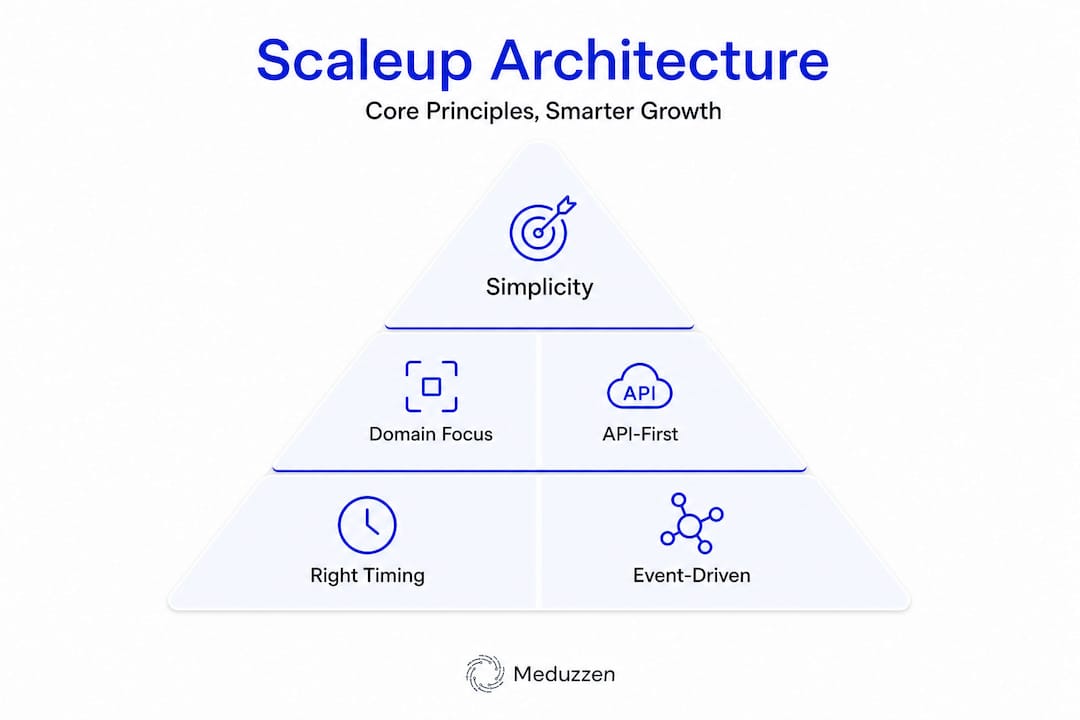
Monolith vs. microservices. A monolith is a single deployable unit where all your application’s code lives together. That sounds old-fashioned, but it has real advantages at early stages: simpler debugging, faster iteration, lower operational complexity, and easier onboarding for new engineers. Microservices, by contrast, split the application into many small, independently deployable services. This offers flexibility and independent scaling but requires significant investment in infrastructure, observability, and team coordination to do well.
API-first design. This means designing your system’s interfaces before writing implementation code. Every major capability is exposed through a well-defined, consistent API. This discipline pays dividends immediately: it forces clear thinking about boundaries, enables parallel development across teams, and makes third-party integrations straightforward from day one.
Domain-driven design (DDD). DDD is a practice of organizing your code around business domains rather than technical layers. Instead of having a “database layer” and a “service layer,” you have a “billing domain” and an “identity domain.” This alignment between business concepts and code structure makes the codebase easier to reason about and easier to evolve as the business changes.
Event-driven architecture. This pattern decouples services by having them communicate through events rather than direct calls. When a user completes a purchase, for example, instead of the purchase service calling the email service directly, it emits a “purchase completed” event. The email service listens for that event independently. This loose coupling is what allows systems to scale and evolve without cascading changes.
Here is a clear comparison to help frame decisions:
| Factor | Monolith | Microservices |
|---|---|---|
| Initial complexity | Low | High |
| Deployment overhead | Minimal | Significant |
| Team coordination required | Low | High |
| Debugging and tracing | Straightforward | Complex |
| Scaling flexibility | Limited per-service | High |
| Best for | Pre-product-market-fit to ~15 engineers | 15+ engineers, $5M+ ARR |
| Infrastructure cost | Low | Higher |
| Onboarding new engineers | Fast | Slower |
The table tells a clear story. Microservices are not inherently better. They are a tool for a specific stage of growth, and using them before that stage extracts costs without delivering benefits.
To implement API-first design and solid domain boundaries, follow these steps:
- Define your core business domains first. Before writing any code, map out the major concepts your business operates on: users, payments, orders, content, notifications. These become your bounded contexts.
- Design API contracts for each domain. Document the inputs, outputs, and behaviors of each domain’s external interface before building anything. Tools like OpenAPI make this explicit and shareable.
- Enforce domain isolation at the code level. Resist the temptation to share database tables across domains. Each domain should own its data and expose it only through its defined interface.
- Introduce event-driven communication for cross-domain workflows. When one domain needs to trigger behavior in another, use events rather than direct method calls or HTTP calls between modules.
- Validate your design with a consulting review. Have an experienced architect review your domain model before committing to implementation. This single step prevents months of rework.
Pro Tip: The clearest signal that your startup is ready for microservices is not ambition, it is pain. When a specific domain has meaningfully different scaling requirements than the rest of your system, when independent deployments are blocked by coupling, or when separate teams own distinct, well-understood capabilities, that is when decomposition earns its complexity cost. Until then, stay monolithic and invest in clean internal boundaries. Scalability solutions for startups do not always require distributing your system. Sometimes they require clarifying it.
For more context on building systems that grow with your users, the fundamentals of API-first design benefits are worth reviewing as you shape your technical roadmap.
Consulting process: How experts guide architectural decisions
Knowing the right principles is one thing. Having someone walk alongside you through implementation, trade-off analysis, and team alignment is another thing entirely. Here is what a real architecture consulting engagement actually looks like in practice.
Phase 1: Discovery. The consultant meets with founders, CTOs, and senior engineers to understand the business model, existing codebase, team structure, and growth goals. This is not just a technical audit. It is a conversation about where the company is going and what constraints are real versus assumed.
Phase 2: Diagnosis. The consultant reviews the current architecture, identifies bottlenecks, and surfaces hidden risks. This might include reviewing database schemas, deployment pipelines, test coverage, API design, and dependency graphs. The goal is an honest picture of what exists today.
Phase 3: Recommendation. Based on discovery and diagnosis, the consultant produces a clear architectural roadmap. This is not a theoretical document. It is a prioritized plan that connects technical decisions to business outcomes, with trade-off analysis and migration paths for any significant changes.
Phase 4: Implementation support. The best consulting engagements do not end at the recommendation. Consultants stay involved through implementation, providing code review, pair programming sessions, and decision support as the team executes the plan.
Here is what a typical engagement looks like:
| Milestone | Timeline | Key deliverables |
|---|---|---|
| Discovery and stakeholder interviews | Week 1 | Domain map, team structure analysis |
| Architecture audit | Week 2 | Risk register, bottleneck report |
| Roadmap and recommendations | Week 3 | Prioritized action plan, trade-off analysis |
| Team workshops and knowledge transfer | Week 4 | Shared documentation, decision frameworks |
| Implementation review | Ongoing | Code reviews, milestone check-ins |
The benefits at each stage are tangible and immediate:
- Discovery gives founders and CTOs a shared, accurate picture of their technical reality, often surfacing risks that were invisible before
- Diagnosis creates a risk register that informs hiring, sprint planning, and investment decisions
- Recommendation replaces endless internal debate with clear, evidence-backed direction
- Implementation support accelerates execution and prevents teams from reverting to old habits under deadline pressure
Following this process is part of what a solid engineering checklist for scaling looks like in action. The consulting engagement gives that checklist meaning and context.
Pro Tip: To get the most from your consulting engagement, do three things before the first session. One, document your current architecture as honestly as you can, including the parts you are embarrassed about. Two, align your leadership team on what “success” means for this engagement. Three, assign a technical lead from your team who can champion the recommendations internally. A consultant can see clearly, but they can only change things with your team’s buy-in.
The most impactful consulting relationships happen when founders approach them as partnerships, not audits. Bring your real problems, your actual constraints, and your honest fears about the codebase. That honesty is what allows a consultant to help you build a startup software workflow that actually scales with your growth. And if you’re still clarifying what scalability means for your SaaS, a SaaS scalability growth guide can provide useful context before your first consulting session.
Common pitfalls and how consulting helps you avoid them
The mistakes startups make with architecture are remarkably consistent. They do not reflect a lack of intelligence. They reflect the pressure of moving fast, the influence of conference talks and blog posts, and the very human tendency to solve tomorrow’s problems at today’s expense.
Here are the most damaging patterns we see repeatedly:
- Jumping to microservices before product-market fit, creating distributed system complexity without the team or tooling to manage it
- Tight coupling between business domains, meaning a change in one area requires changes in five others, and nobody knows where the ripple will end
- Skipping API contracts, leading to inconsistent integrations that become impossible to refactor without breaking clients
- Neglecting observability from the start, so when things break in production, diagnosing root causes takes days instead of hours
- Treating the database as a shared communication layer, having multiple services write to and read from the same tables, which kills your ability to evolve either independently
- No clear ownership of architectural decisions, resulting in inconsistent patterns across the codebase that multiply technical debt over time
Research into startup architecture best practices consistently finds that premature complexity is the single most common cause of stalled engineering velocity in early-stage companies. The cost is not just technical. It delays product launches, frustrates engineering teams, and erodes investor confidence.
What consultants do in these situations goes beyond pointing at problems. They bring perspective from having seen these patterns play out across dozens of companies, in different industries, at different stages. They can distinguish between a problem that needs fixing now versus one that can wait, and that triage is enormously valuable when your team is already stretched.
They also bring something harder to quantify: credibility. Sometimes a CTO knows exactly what needs to change but can’t get organizational buy-in. An experienced external consultant saying the same thing carries different weight with boards, co-founders, and engineering teams alike.
What most founders underestimate is the compounding cost of architectural debt. A bad decision made in month three might not feel painful until month eighteen. By then, it has shaped every feature built on top of it, every engineer who joined and adapted to it, and every customer integration that relies on it. Avoiding that debt is not a technical concern. It is a business survival concern.
This is also why choosing top SaaS platforms for scale matters less than having the architecture to use them well. And when you’re growing fast, thinking carefully about hiring developers for startups with architecture awareness becomes part of the solution too.
Our take: Why well-timed architecture consulting trumps hype-driven “innovation”
We have watched the architecture conversation in the startup world for over a decade. And one pattern stands out more than any other: the startups that scale fastest are not the ones with the most sophisticated architectures. They are the ones with the most honest architectures.
Here is the misconception that does the most damage: that architectural complexity signals ambition and capability. That choosing Kubernetes, service meshes, and event streaming from the very beginning shows technical seriousness. In our experience, it usually shows the opposite. It shows a team optimizing for the architecture they wish they needed rather than the one they actually do.
The most “innovative” architectural choices we have seen at early-stage startups have often been the ones that slowed growth most dramatically. Distributed systems introduce failure modes that monoliths simply do not have. They require specialized knowledge to operate, observability stacks to monitor, and significant engineering discipline to keep consistent. Asking a team of five to manage that while also shipping product is not ambitious. It is a recipe for burnout and stagnation.
What actually works, time and again, is business-aligned consulting. Not advice that follows industry trends or replicates what large engineering organizations do at a fraction of their resources. Advice that starts with your specific domain, your specific team, and your specific stage of growth, then builds the minimum architecture that can carry you to the next stage cleanly.
We have seen this play out in real startup growth stories across FinTech, Healthcare, and EdTech. The companies that invested early in thoughtful architecture review, that resisted the urge to decompose prematurely, and that held clear domain boundaries consistently outpaced peers who chose complexity for its own sake.
The right time to seek architecture consulting is not when your system is broken. It is before you lock in decisions that will shape the next two years of your product. Constraint sharpens creativity. A well-timed outside perspective sharpens your architecture. Both of those things make your startup more resilient, more focused, and ultimately more successful.
Connect with expert architecture consultants for your next stage
Architecture decisions made early tend to echo for years. Getting them right is not just a technical exercise. It is one of the most consequential investments a founder or CTO can make.
At Meduzzen, we work with startups and growing businesses across the US and Europe who are ready to build with clarity and confidence. Whether you need a focused architecture review, help scaling your SaaS development consulting roadmap, or engineers who integrate seamlessly into your existing team, we bring over ten years of experience and 150+ pre-vetted engineers to your next phase. Our web architecture solutions are shaped around your business goals, and our staff augmentation support ensures you have the right talent at every stage of growth. Let’s build something that lasts.
Frequently asked questions
What is the ideal time for a startup to engage a software architecture consultant?
Startups should engage a consultant before committing to complex designs or when planning to scale beyond a basic MVP, since early guidance prevents costly architectural debt. As industry best practices confirm, the decisions made before $5M ARR shape nearly every engineering constraint that follows.
Should all startups start with microservices?
No. Most startups should delay microservices until they have at least 15 engineers and $5 to $10M ARR, as the operational complexity far outweighs the benefits at earlier stages. A well-structured monolith with clear domain boundaries serves most startups better and longer than they expect.
What core elements should sustainable startup architecture have?
Sustainable architecture for startups should include clear domain boundaries, a consistent API-first design strategy, and event-driven patterns that allow services to be decoupled as load grows. These foundational elements provide flexibility without requiring a full distributed systems overhaul.
How does consulting reduce risk in startup software projects?
Consulting provides experienced architectural judgment that prevents overengineering, surfaces hidden risks early, and ensures technical decisions align with actual business needs rather than theoretical future scale. An outside perspective helps teams see trade-offs they are too close to the work to notice on their own, and expert guidance consistently reduces both time-to-market and rework costs.