In this article
How to hire developers for your startup: a step-by-step guide
Business & Strategy
Learn how to hire developers for your startup with our step-by-step guide. Hire right and avoid costly mistakes that can derail your growth!

TL;DR:
- Hiring the wrong developer during critical startup phases can cause product delays, financial loss, and investor doubts.
- Effective hiring requires clear needs, realistic evaluation of skills and culture fit, and a structured remote process.
- Focusing on attitude, adaptability, and honesty about challenges attracts resilient talent capable of scaling with your startup.
Hiring the wrong developer at a critical moment in your startup’s growth doesn’t just slow you down. It can derail an entire product launch, burn your runway, and shake the confidence of investors watching closely. The stakes feel impossibly high, especially when you’re moving fast and working with limited resources. This guide is built for founders and product managers who need to cut through the noise and hire developers who can handle ambiguity, scale with the product, and genuinely care about what gets built. From defining your needs to onboarding for retention, every step is here.
Key Takeaways
| Point | Details |
|---|---|
| Plan before hiring | Define precise skills and team needs before you begin sourcing candidates. |
| Choose the right model | Select between direct hire, staff augmentation, or outsourcing based on your startup’s goals and timeline. |
| Evaluate both hard and soft skills | Assess technical abilities and cultural fit to maximize productivity and retention. |
| Standardize interviews | Use a clear, repeatable remote interview process with structured tasks and timely feedback. |
| Invest in onboarding | Effective onboarding leads to faster integration and long-term developer success. |
Define your startup’s development needs and team structure
Once you’ve recognized the risk and necessity of hiring right, the first crucial step is to clarify exactly who you need before starting your search. Skipping this step is one of the most expensive mistakes a startup can make. You end up writing a vague job description, attracting mismatched candidates, and wasting weeks on interviews that go nowhere.
Start with your product goals. What are you actually trying to build in the next six to twelve months? If you’re launching an MVP, you probably need someone who can ship fast across the full stack rather than a deep specialist who optimizes one narrow layer of the system. If you’re scaling a platform that’s already gaining traction, you may need a backend engineer focused on performance or a DevOps engineer who can stabilize your infrastructure. Your roadmap shapes your hiring plan, not the other way around.
Next, break down the technical skills your product actually requires. Think in terms of layers:
- Frontend: React, Vue, or Angular developers for user-facing interfaces
- Backend: Python, Node.js, or Go engineers for APIs, business logic, and data handling
- Full-stack: Generalists who can move between layers, useful in early-stage teams
- DevOps and cloud: Engineers who manage infrastructure, CI/CD pipelines, and deployment reliability
- AI and data: Specialists for machine learning, NLP, or data pipeline work
- QA engineers: Often overlooked early but critical for sustained velocity
Beyond technical skills, list the soft skills your environment demands. Startup engineers need to thrive with incomplete information. They need to communicate clearly without a manager guiding every decision, and they need to care about outcomes rather than just tasks. Include these in your evaluation criteria from the start, not as an afterthought.
Finally, decide on scale. Are you hiring one generalist to carry the early build? Or do you need a startup development planning approach that includes a small dedicated team covering multiple disciplines? Getting this wrong means either under-resourcing a critical phase or overspending before product-market fit arrives.
Pro Tip: Build two lists before you post any job description. One for absolute must-haves and one for nice-to-haves. This prevents scope creep in your hiring criteria and keeps your process focused on what will actually move the product forward.
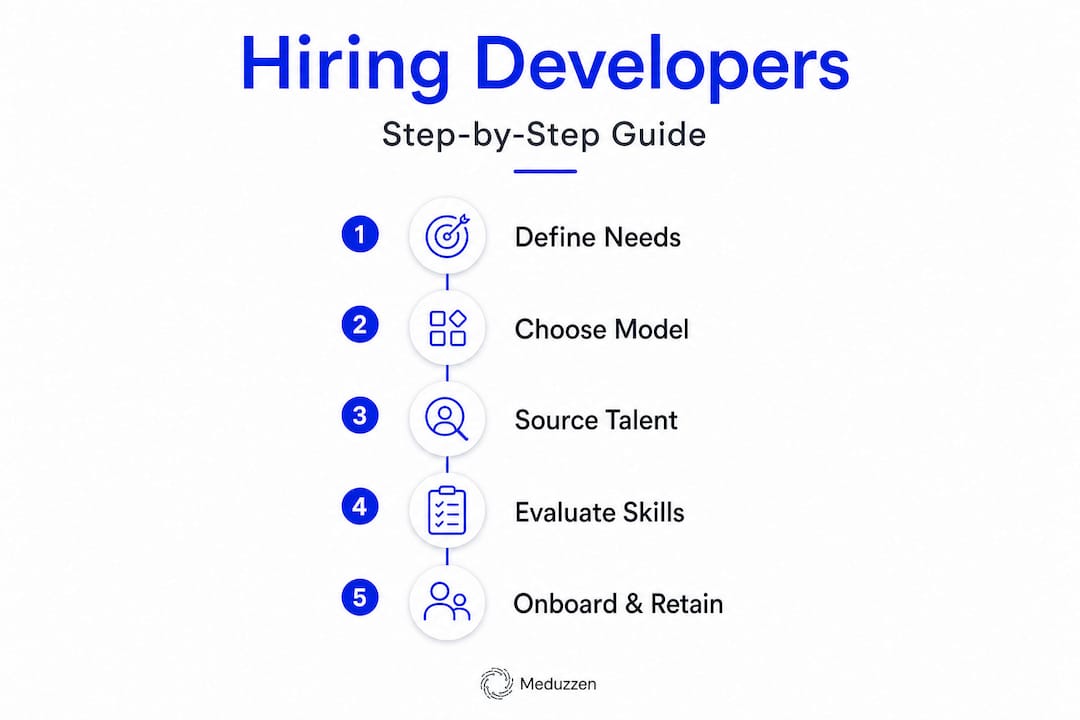
Choose the right hiring model and sourcing platforms
With a clear picture of your needs, the next decision is how and where to find the right developers for your startup. There is no universal answer. The best model depends on your stage, budget, urgency, and how much management bandwidth you have.
Here’s a comparison of the three most common models:
| Hiring model | Best for | Cost | Speed to hire | Flexibility |
|---|---|---|---|---|
| Direct hire | Long-term, core team roles | High (salary + benefits) | Slow (4-12 weeks) | Low |
| Staff augmentation | Scaling quickly, specialized roles | Medium | Fast (1-3 weeks) | High |
| Project outsourcing | Defined-scope deliverables | Variable | Medium | Medium |
Staff augmentation means bringing pre-vetted engineers into your team on a dedicated basis. They work inside your workflows, attend your standups, and operate as genuine team members rather than outside contractors. For most startups navigating the gap between seed funding and Series A, this model offers the best balance of speed, cost-efficiency, and control. You can explore startup hiring models in depth to understand which approach fits your current growth stage.
Project outsourcing works well when you have a clearly scoped deliverable, such as building a specific integration or completing a defined module. It breaks down when requirements are fluid, which is almost always the case in early-stage startups.
Direct hiring makes sense for your founding technical team or key leadership roles. But expect the process to take longer, cost more, and demand significant recruiting effort on your part.
When it comes to sourcing, here are the most reliable channels ranked by startup suitability:
- Specialized agencies and team augmentation partners for pre-vetted talent and faster match accuracy
- Referrals from your network for candidates with implicit trust signals already attached
- Technical job boards like Stack Overflow Jobs, We Work Remotely, and Remote OK for inbound applicants
- Freelance platforms for short-term or trial engagements before committing to longer terms
- LinkedIn recruiter outreach for senior roles where passive candidates often hide
Remote dedicated teams are particularly powerful for outsourcing for SaaS startups, where you need to scale rapidly, iterate constantly, and maintain product quality without the overhead of building an internal HR function from scratch. If your stack involves Python, it’s worth understanding the Python development hiring models that align with common SaaS architectures.
Pro Tip: When using agencies or augmentation partners, ask specifically how they vet engineers technically. Look for partners who use coding challenges, peer reviews, and live technical interviews rather than just reviewing resumes. The quality of the vetting process upstream directly determines what lands in your interview funnel.
Evaluate developer skills and cultural fit effectively
Once you’ve sourced candidates through your preferred channels, robust evaluation is vital to avoid expensive mismatches down the road. Too many startups run a single phone screen, glance at a GitHub profile, and make an offer. The result is a hire who looks great on paper but can’t navigate the ambiguity of a real startup environment.

Your evaluation process should have two parallel tracks running simultaneously: technical and behavioral.
On the technical side, focus on practical signal rather than theoretical knowledge. A whiteboard question about sorting algorithms tells you very little about whether someone can debug a failing API at midnight before a launch. Instead, design your assessments around your actual codebase and product problems. Keep them short enough to respect the candidate’s time but specific enough to reveal real capability.
Useful technical evaluation methods include:
- Take-home coding challenges with a time limit, reflecting a real feature or bug type from your product
- Live code review sessions where you and the candidate walk through existing code together
- System design discussions appropriate to your product’s scale (not enterprise-level complexity for an early MVP)
- Portfolio and pull request reviews for candidates with open-source contributions or previous relevant work
You can find structured full-stack interview questions that mirror real-world scenarios and keep your technical bar consistent across candidates.
Beyond code, lean into scenario-based behavioral questions. These surface how someone actually thinks and responds under startup conditions. Try questions like:
- “Tell me about a time you had to ship something with incomplete requirements. What did you do?”
- “Describe a situation where you disagreed with a technical decision. How did you handle it?”
- “How do you prioritize when you have three urgent things and no clear guidance?”
For a deeper look at evaluating developer skills in a practical context, the principles apply across stacks: look for clarity of thought, ownership of outcomes, and genuine curiosity about the product they’d be building.
“The developers who thrive in startups aren’t necessarily the most technically brilliant people in the room. They’re the ones who stay calm when the requirements change on a Thursday afternoon and still ship something meaningful by Friday.”
For remote and asynchronous evaluation, be intentional about communication quality. A candidate’s written responses during async assessments, their email clarity, and their ability to ask good clarifying questions all reveal how they’ll perform in a distributed team setting.
Pro Tip: Add a short async communication task to your evaluation process. Ask candidates to review a brief technical spec and send back a set of clarifying questions. You’ll learn more about their thinking and communication style than most technical interviews can reveal.
Structure the remote interviewing and hiring process
With strong candidates identified, organizing your remote interview funnel is key to a smooth and decisive process. Without structure, interviews become inconsistent, decision-making drags on, and good candidates accept competing offers while you’re still deliberating.
Here’s the typical hiring sequence that works well for remote developer roles in startups:
- Async application review (Day 1-3): Screen resumes and portfolios against your must-have criteria
- Intro call (30 minutes): Confirm mutual interest, explain the role and startup stage, get a sense of communication style
- Technical screening (45-60 minutes): Live problem-solving or code review, aligned to your stack
- Take-home challenge (2-4 hours max): A practical task that mirrors real work, compensated when possible
- Culture and values interview (45 minutes): With a founder or team lead, focused on soft skills and alignment
- Reference checks (2-3 contacts): Former managers or senior colleagues who can speak to work quality and attitude
- Paid trial project (1-2 weeks, optional but powerful): A small real-world task to confirm fit before a full offer
| Step | Owner | Typical duration | Tools |
|---|---|---|---|
| Intro call | Hiring manager | 30 min | Zoom, Google Meet |
| Technical screening | Senior engineer | 45-60 min | CoderPad, Loom |
| Take-home challenge | Candidate | 2-4 hours | GitHub, Notion |
| Culture interview | Founder | 45 min | Zoom |
| Reference checks | Hiring manager | 2-3 days | Email, phone |
| Trial project | Candidate + team | 1-2 weeks | Slack, Jira, GitHub |
Structured backend technical interviews can help your engineering leads run consistent, fair assessments without reinventing the process for each candidate.
The most important principle is speed with deliberateness. Good developers are off the market quickly. Move fast between stages, but don’t sacrifice rigor. A same-day response after each stage signals that your startup is organized and respectful of people’s time, which itself attracts better talent.
Trial engagements before a full commitment are one of the more reliable ways to de-risk a developer hire, and the mechanics matter. A marketplace like Upwork gives founders access to freelance professionals across frontend, backend, DevOps, and AI and machine learning roles, with quality signals like Job Success Score, Top Rated, and Expert-Vetted badges surfaced on each profile. That means the vetting work the article recommends is already partly done before the first conversation.
The other advantage is speed from decision to working code. Job posts, proposals, contracts, milestones, and payments all live on the platform, so a short trial project can start within days instead of stretching into weeks of coordination over email. AI-assisted matching, through Best Match insights and the Job Post Generator, helps narrow a wide applicant pool to the few candidates actually worth interviewing, which is where most founders lose time.
Timely feedback matters more than founders realize. A candidate left waiting three days between stages may assume your team is disorganized or disinterested. That impression sticks. Clear communication about timelines, even when the answer is “we need a few more days,” keeps the relationship intact and your pipeline warm.
The transition from offer to contract to effective developer onboarding is the last mile of your hiring process and often the most neglected. Get this right.
Pro Tip: Decide in advance the exact criteria that would move a candidate forward at each stage. Write it down before you start interviewing. It prevents the common trap of retroactively adjusting standards to justify decisions you’ve already made emotionally.
Onboarding and retaining developers for long-term success
Hiring doesn’t end with a contract. Ensuring your new developer integrates, delivers, and stays requires thoughtful onboarding and a genuine commitment to their growth inside your team. High developer turnover in a startup doesn’t just cost you time and money. It breaks product momentum and can demoralize the people who remain.
Start with a structured onboarding checklist. New engineers should never arrive to find a vague Slack message and a GitHub invite. Give them documented context: the architecture overview, the product roadmap, the key decisions that have already been made and why, and the tools they’ll use daily. This kind of documentation is how you build stability out of chaos.
Strong onboarding practices include:
- Day one orientation: Access to all tools, accounts, and communication channels confirmed and working
- Codebase walkthrough: A senior engineer or tech lead takes them through the repo, explaining structure and key design choices
- Buddy system: Assign a go-to person for questions that feel “too small” to ask the CTO but are critical for daily progress
- 30/60/90 day goals: Clear, written expectations for what the new developer should accomplish in their first week, first month, and first quarter
- Early wins: Assign a meaningful but achievable task in the first week so they can contribute and feel the satisfaction of shipping
The 30/60/90 day framework is particularly valuable for remote teams because it replaces the ambient visibility of a physical office with deliberate structure. By day 30, a developer should understand the codebase and have shipped at least one feature. By day 60, they should be contributing independently to sprint planning. By day 90, they should be mentoring others on at least one area of the system they’ve mastered.
Retention is where most startups drop the ball. They invest heavily in hiring and almost nothing in keeping people. The developers who stay long-term at startups aren’t usually there because of the salary alone. They stay because they feel trusted, see growth ahead of them, and believe in the mission they’re building toward.
Review the custom development onboarding practices that help distributed teams ramp up faster and maintain that momentum through the product’s most critical growth phases.
Pro Tip: Hold a two-week check-in with every new developer, not to review performance but to ask what’s confusing, what’s missing, and what would have helped them get up to speed faster. This conversation improves your onboarding process and signals to the new hire that their experience genuinely matters.
Why most startups struggle with developer hiring and what actually works
After walking through the end-to-end process, it’s worth stepping back and being honest about the deeper reasons so many startups hire poorly. The tools exist. The frameworks are documented. Yet the mistakes repeat with remarkable consistency, company after company, round after round.
The most common error is rushing. A founder feels the urgency of a missed deadline or an investor’s expectation and compresses the hiring process into something barely functional. They extend an offer after two conversations, skip reference checks, and onboard someone who was never truly understood. Constraint sharpens creativity in product work. But in hiring, urgency is corrosive. It bypasses judgment and replaces it with anxiety.
The second mistake is over-valuing keyword matching on resumes. Startups list ten technologies in a job description and then screen for candidates who listed ten technologies on their resume. The actual question, whether this person can solve problems and grow in a fast-moving environment, never gets asked. Some of the most effective startup engineers we’ve seen came from backgrounds that looked unconventional on paper and proved extraordinary in practice.
The third and perhaps most counterintuitive mistake is presenting a polished, idealized version of your startup to candidates. Founders think this makes the opportunity more attractive. It actually filters out the wrong people in the wrong direction. The developers who thrive in early-stage environments are drawn to honesty about the chaos. They want to know the real challenges because they believe they can help solve them. Describing your startup’s actual state, with its gaps and rough edges, attracts more resilient, more motivated engineers than a glossy pitch ever will.
What actually works is hiring for attitude and adaptability at least as much as for current technical skills. Specific frameworks and languages can be learned. The willingness to own a problem, communicate clearly about uncertainty, and stay steady when the requirements shift overnight cannot be trained in weeks. The lessons captured in full-cycle hiring lessons reinforce this consistently: small, highly aligned teams outperform larger, misaligned ones at every stage of a startup’s journey.
The real competitive advantage in startup hiring isn’t finding the most technically impressive candidate. It’s building a team where everyone, regardless of their seniority level, believes in what they’re building and trusts the people they’re building it with.
Get expert help to hire top remote developers for your startup
If you need support transforming these hiring insights into action, Meduzzen can accelerate your developer recruitment process. Over more than a decade, we’ve helped startups across FinTech, Healthcare, EdTech, and Logistics build and scale the engineering teams that power their core products.
Our staff augmentation services connect you with pre-vetted engineers across Python, JavaScript, AI, DevOps, and UI/UX design who integrate into your team within days rather than months. Whether you need one senior engineer or a complete dedicated team, we match your technical requirements and culture with precision. If you’re looking for web development experts to build or scale your product, we’re ready to help you move faster without sacrificing quality. Reach out to get a curated shortlist for your next role or to schedule a consultation with our hiring specialists.
Frequently asked questions
What is the best hiring model for a tech startup?
Staff augmentation and dedicated remote teams offer flexibility and speed for most early-stage startups, making them ideal when you need to scale quickly without the overhead of full-time hiring. Direct hires suit longer-term, core positions where deep organizational alignment matters most.
How can startups assess developer skills remotely?
A mix of coding challenges, practical technical interviews, and scenario questions that mimic real startup needs is ideal, paired with proven online assessment techniques for developers. Async communication tasks also reveal how candidates perform in distributed team settings.
What interview questions should I ask when hiring developers for a startup?
Focus on scenario-driven questions about problem-solving under pressure, working with incomplete information, and collaborating across time zones. Structured assessment techniques for developer talent for startup needs confirm that soft skills and adaptability matter as much as technical expertise.
How quickly can I hire a developer for my startup?
With the right process and a reliable talent source, the timeline from initial interview to offer can often be completed in two to four weeks for remote roles. Using a pre-vetted talent partner can compress this significantly by eliminating the early sourcing and screening stages.