In this article
Startup MVP development: why 90% of first versions fail
Business & Strategy
Master startup MVP development to attract early adopters! Learn how to validate your idea and gain feedback, ensuring your product’s success.

TL;DR:
- An MVP in 2026 is a focused learning tool to test hypotheses and validate demand.
- Clear objectives and measured feedback are crucial for successful MVP development and iteration.
- Modern user expectations demand higher quality, emphasizing smarter, value-driven MVPs over speed alone.
Most founders pour months of effort, thousands of dollars, and enormous emotional energy into building what they believe users desperately want, only to launch to silence. The product is polished, the roadmap is ambitious, and the demo looks great. But adoption is slow, feedback is thin, and the runway keeps shrinking. A well-executed Minimum Viable Product (MVP) exists precisely to prevent this scenario. In 2026, building a smart MVP isn’t about cutting corners. It’s about learning faster than your competition, validating real demand before it’s too late, and giving early adopters exactly the reason they need to say yes.
Key Takeaways
| Point | Details |
|---|---|
| MVPs reduce risk | Building lean helps you test assumptions and avoid wasted effort. |
| Speed to feedback wins | Launching early to real users gives faster insight than chasing a perfect product. |
| Quality matters in 2026 | Modern users expect useful, reliable solutions even from an MVP. |
| Continuous learning | Iterating on real feedback turns a basic product into something users love. |
Why MVPs matter: Avoiding the founder’s trap
Before you can build an effective MVP, it’s important to understand its true purpose and why it remains a proven framework in today’s SaaS environment.
The term “MVP” gets misused constantly. Some founders treat it as an excuse to ship a buggy prototype. Others treat it as a polished version-one that took fourteen months to build. Neither approach is right. In 2026, a SaaS MVP is the smallest, most focused version of your product that allows you to test a specific hypothesis with real users, collect meaningful data, and make a confident decision about what to build next.
It is not a half-baked product. It is a deliberate learning tool.
The misconceptions surrounding MVPs are worth addressing head-on. One common belief is that an MVP is synonymous with “cheap and fast.” Another is that launching early will hurt your brand. Both are rooted in fear rather than evidence. The truth is that shipping something incomplete is far less damaging to your reputation than spending a year building something nobody wants.
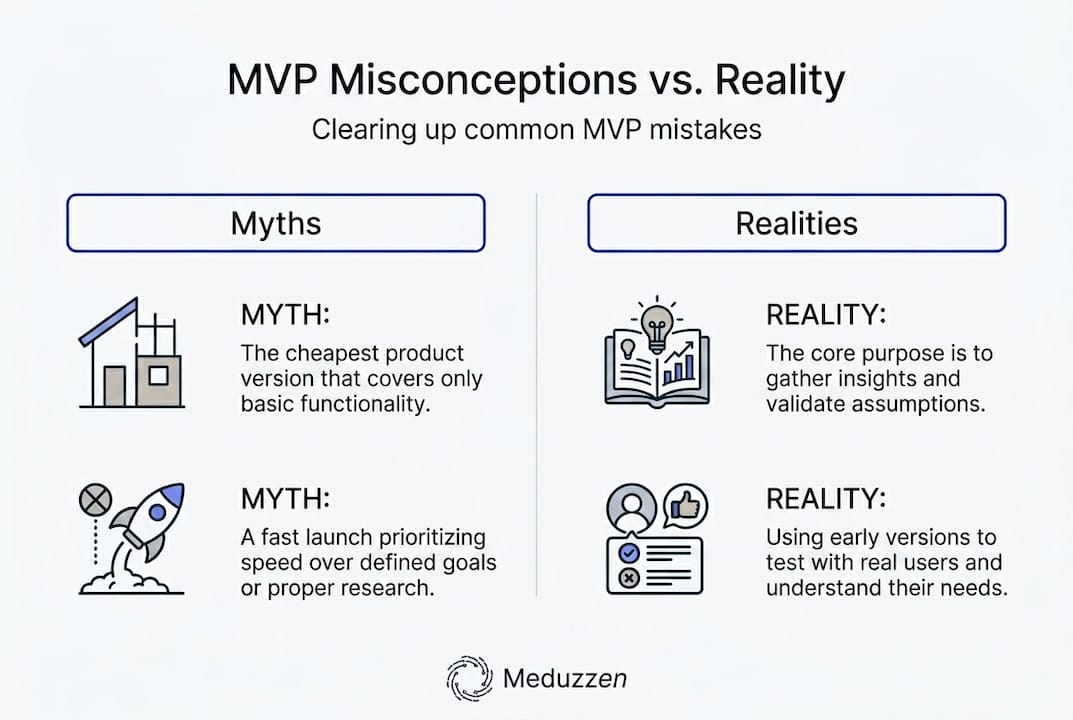
The “founder’s trap” is a pattern we see repeatedly. A founder has a vision, builds in isolation, makes dozens of assumptions about user behavior, and only encounters reality at launch. By then, the cost of being wrong is enormous. An MVP breaks that pattern. It forces you to confront reality sooner, when it is still relatively inexpensive to change course.
Here is what makes MVPs so powerful in practice:
- They constrain scope, which sharpens focus on the single most important user problem
- They generate real user data instead of opinions and guesses
- They reduce the financial risk of building the wrong thing
- They create an early community of engaged users who feel invested in your product’s evolution
- They accelerate the feedback loop between what you build and what users actually need
The most well-known framework for thinking about this is the Build-Measure-Learn loop, which forms the foundation of Eric Ries’s Lean Startup methodology. Founders build the smallest product that tests a hypothesis, measure user behavior with actionable metrics, and learn whether to pivot or persevere. This loop, repeated with discipline, is how great SaaS companies are built.
What separates successful MVP teams from struggling ones is not technical skill alone. It is the willingness to treat the MVP as a question rather than an answer. You are not building a product. You are running an experiment.
Understanding the principles behind startup software development success makes it easier to see why the MVP stage is not just a phase. It is a mindset shift. And understanding the right product development services for startups helps you choose the right approach for your specific context.
“The only way to win is to learn faster than anyone else.” Eric Ries, The Lean Startup
That quote holds up in 2026 as much as it did when it was written. The market moves fast. Your competitors are shipping. The founder who learns fastest wins.
Preparing for MVP success: Goals, hypotheses, and essentials
Understanding the “why” is only the first step. Now, let’s break down how to prepare for an MVP that stands out amid high expectations.

The single biggest mistake founders make during the preparation phase is skipping clear objective-setting. “We want to launch something” is not an MVP goal. A real MVP objective sounds more like: “We want to test whether mid-market HR teams will pay $49/month to automate onboarding document collection.” That is specific, measurable, and tied to a real hypothesis.
Setting a SMART goal (Specific, Measurable, Achievable, Relevant, Time-bound) for your MVP keeps the entire team aligned. It also makes the decision to pivot or persevere much easier when the data comes in. Without a clear hypothesis, all feedback feels important. With one, you can separate signal from noise almost immediately.
Hypothesis creation is where user research becomes indispensable. Before writing a single line of code, talk to at least ten potential users. Ask about their current workflow, their biggest frustrations, and what they have already tried. You are not validating your idea yet. You are understanding the problem deeply enough to form a strong hypothesis.
Some founding teams use landing pages to validate demand before building. Others run concierge MVPs, where they manually deliver the service to a small group of users to understand what the automated version actually needs to do. Both approaches generate data without requiring a production-ready product.
Speed to feedback beats over-planning in nearly every case, but that does not mean rushing without direction. The goal is structured speed. Know what you are testing. Know how you will measure success. Then move as quickly as discipline allows.
Here is a practical checklist for what you need before starting your build:
| MVP essential | Purpose | Recommended tools |
|---|---|---|
| Clear problem statement | Defines the user pain you are solving | User interview notes, Jobs-to-be-Done framework |
| Validated hypothesis | Gives your build a testable goal | Notion, Miro, Typeform surveys |
| Core tech stack decision | Determines speed and scalability | Python/Django, Node.js, or no-code tools |
| Feedback collection system | Captures real user reactions | Intercom, Hotjar, Typeform |
| Analytics setup | Measures user behavior objectively | Mixpanel, Amplitude, Google Analytics 4 |
| Early adopter list | Gives you a user base at launch | Email waitlist, LinkedIn outreach |
The table above represents the minimum you need before your first commit. Notice what is not on the list: a complete feature set, a polished brand identity, or a marketing funnel. Those come later.
Focusing on your core value proposition is not just good advice. It is survival strategy. Feature bloat at the MVP stage is one of the most common reasons startups miss their learning window. When you build too much, you dilute your hypothesis, extend your timeline, and make it nearly impossible to understand why users did or did not engage.
Understanding frameworks and scaling strategies from the beginning helps you design an architecture that can grow without requiring a full rebuild six months after launch.
Pro Tip: Before writing any code, set up a simple landing page with a waitlist form. Drive 200 to 300 targeted visitors to it using LinkedIn posts or a small paid ad budget. If fewer than 5% sign up, your messaging needs work. If more than 15% sign up, you have strong demand signal. This test costs less than a week of developer time and tells you something no amount of internal debate can.
The modern web app development steps for SaaS founders in 2026 increasingly emphasize this kind of pre-build validation. It is not slowing you down. It is saving you from building the wrong thing at full speed.
Step-by-step: Building your MVP
With your goals defined and essentials in place, you’re ready for the heart of MVP development: the build phase.
Building an MVP is not the same as building a product. The rules are different. The priorities are different. And the mistakes are different. Here is a six-step process that works across industries and team sizes.
- Identify must-have features. Use your hypothesis to define the one or two features that directly test your core assumption. Everything else goes on a backlog. Be ruthless here. If a feature does not directly serve the hypothesis, it does not belong in the MVP.
- Design a simple user flow. Map the shortest path from user signup to the moment they experience your product’s core value. This is called the “activation moment,” and your entire MVP design should optimize for reaching it as quickly as possible. Fewer screens, fewer decisions, less friction.
- Choose the leanest tech stack. This is where many technical founders over-engineer. The goal is to ship something testable, not something elegant. Python with Django or FastAPI is excellent for backend-heavy SaaS MVPs. For frontend speed, React or Next.js works well. If you want to move even faster, no-code tools like Bubble or Webflow can handle surprising complexity.
- Build only the core. Write code for the must-have features. Use open-source libraries to avoid reinventing standard functionality. Resist the temptation to add “just one more feature” because a user might want it. The Build-Measure-Learn loop only works when you actually stop building and start measuring.
- Integrate tracking and analytics from day one. Amplitude or Mixpanel should be configured before you onboard your first user. You need to know which features are being used, where users drop off, and what the activation rate looks like in real time. Launching without this is like flying blind.
- Launch to your first users. Not the public. Not Product Hunt. Start with the ten to twenty people from your validation interviews who showed genuine interest. They are your early adopters. Their feedback is gold.
Here is a comparison that helps many founders make the critical build decision:
| Approach | Pros | Cons | Best for |
|---|---|---|---|
| Custom code MVP | Full control, scalable, no platform limits | Slower, needs developer expertise, higher cost | Technical teams, complex workflows |
| No-code/low-code MVP | Faster to build, cheaper, great for UI-heavy products | Limited scalability, harder to customize logic | Non-technical founders, early validation |
| Hybrid (no-code front, code back) | Speed with flexibility, good middle ground | Requires coordination, can create technical debt | Mixed teams, marketplace products |
Tools that genuinely speed up SaaS MVP development include Bubble for no-code interfaces, Retool for internal tools, Django and FastAPI for Python-based backends, and Supabase for real-time database needs. Each one has tradeoffs, but all of them help you ship something testable faster than starting from scratch.
Understanding full cycle software development helps you make informed decisions about where custom code adds value and where standard tooling is sufficient. Similarly, knowing the custom software development steps that experienced teams follow prevents the most common architectural mistakes at this stage.
Pro Tip: Use open-source authentication libraries like Auth0 or Clerk instead of building user management from scratch. Do the same for payment processing with Stripe. These components alone can save two to four weeks of development time, which is significant when your runway is finite.
Constraint sharpens creativity. That is not a platitude. Every great SaaS MVP was built under pressure, with less time and money than felt comfortable. That pressure is what forces clarity.
Testing, metrics, and iterating: Making MVP feedback count
A quality MVP isn’t complete when it’s deployed. How you learn from first users determines long-term success.
Collecting feedback is only valuable when you know what to do with it. Too many founders gather responses, feel overwhelmed by conflicting opinions, and either freeze or chase every suggestion. Neither works. The discipline of interpreting feedback objectively is where most of the real work happens.
Start with your analytics. The numbers tell you what users actually did, not what they said they would do. Set up event tracking for every meaningful user action: signup completion, first feature use, return visits within seven days, and subscription conversion if you are charging. These are your activation and retention signals.
The metrics that matter most for a SaaS MVP are:
- Activation rate: What percentage of signups complete the core action that delivers your product’s value?
- Day-7 retention: Of users who activated, how many came back within a week?
- Feature engagement: Which specific features are being used, and how often?
- Qualitative satisfaction: What do users say when you ask them what they would miss most if the product disappeared?
That last question is a powerful one. It is borrowed from Sean Ellis’s product-market fit survey, and it cuts through noise faster than almost any other single question you can ask.
Speed to feedback outperforms polished launches in terms of learning velocity, which is the variable that matters most at the MVP stage. But speed without structure creates chaos. Structure your feedback process so every insight maps back to your original hypothesis.
Here are signs that tell you what move to make next:
- Pivot: Users consistently misunderstand the core value, engagement drops after the first session, or the problem you are solving turns out to be less painful than a related problem you discovered along the way
- Iterate: Users are engaging but dropping off at a specific point in the flow, the activation rate is low despite positive qualitative feedback, or users love the idea but hate one specific interaction
- Persevere: Retention is strong, users are recommending the product without being asked, and activation rates are improving with minor UX adjustments
“Fall in love with the problem, not the solution.” This is advice that sounds simple but requires real discipline to follow when you have already invested months in a specific approach.
One real-world warning: small sample sizes create dangerous confidence. If three users say they love a feature, that is encouraging, but it is not a green light to rebuild your roadmap around it. The Build-Measure-Learn loop requires enough data to make statistically meaningful decisions. For most SaaS MVPs, that means at least fifty to one hundred active users before making major architectural changes.
Be especially careful of the “loudest user” problem. Some users will email you daily with detailed feature requests. Their passion is valuable, but their preferences may not represent your broader target market. Weight feedback by user behavior, not user volume.
Aligning your metrics strategy with proven SaaS growth strategies from the beginning ensures your MVP learning translates directly into a scalable go-to-market motion.
Perspective: Why MVP dogma needs to evolve in 2026
Here is an uncomfortable truth: the “launch fast, break things” approach that worked a decade ago is actively hurting some founders today.
User expectations have shifted dramatically. In 2026, people have access to beautifully designed, highly functional software in every category. When they encounter something broken, confusing, or incomplete, they do not give it a second chance. They leave. And they tell their network. The tolerance for rough edges has narrowed significantly, especially in B2B SaaS where the product is part of someone’s professional workflow.
Traditional launch-fast approaches are failing more often now precisely because the standard of “viable” has risen. What passed as an MVP in 2015 would be dismissed as unfinished today. This does not mean you should wait until everything is perfect. Perfection is still the enemy of learning. But it does mean the bar for “viable” has risen, and founders need to factor that into their planning.
The hard-won lesson from founders who burned through their runway chasing pure speed is this: velocity without quality destroys trust, and trust is the hardest thing to rebuild. Once a user’s first impression is negative, no amount of iteration will win them back.
The answer is not slower MVPs. It is smarter ones. Deeper pre-build validation, tighter hypothesis formation, and a sharper focus on solving one problem exceptionally well rather than several problems passably. Building scalable SaaS development practices into your foundation from day one means you are not just launching, you are building something with staying power.
Build to learn, yes. But build with the quality your users deserve.
Get expert help: Take your MVP from plan to traction
If you’re ready to accelerate your MVP journey and want expert guidance, specialized support can make the difference.
Building an MVP that genuinely attracts early adopters takes more than a good idea. It takes the right team, the right approach, and the experience to avoid the pitfalls that slow most startups down. Many founders reach this stage knowing exactly what they want to build but needing trusted technical partners to help them build it right.
At Meduzzen, we work with SaaS founders and product managers across the US and Europe to turn validated ideas into functioning, testable products. Our web development services cover everything from architecture decisions to deployment, and our Python MVP development team specializes in shipping lean, production-quality backends that scale without rewrites. Whether you need a dedicated team or targeted augmentation to fill a skill gap, we bring 10 years of startup-focused experience to every engagement. Reach out for a discovery call and let’s map out your MVP together.
Frequently asked questions
What is the main purpose of a startup MVP?
An MVP lets you test your idea with real users, collecting feedback and data before investing in a full-scale product. As the Lean Startup methodology describes, the goal is to learn what users actually need, not what you assume they want.
How is MVP development different in 2026?
Users now expect higher product quality, so validating ideas and solving real problems is essential before launch. Traditional launch-fast approaches are showing diminishing returns as the standard for “viable” continues to rise.
What are the most important metrics for SaaS MVPs?
Focus on activation, retention, and user engagement to see if your MVP delivers value and keeps users coming back. Founders who measure user behavior with actionable metrics make better decisions about whether to pivot or persevere.
How quickly should you ship an MVP?
Aim to launch as soon as you can test your main hypothesis, but don’t compromise on solving the core problem well. Speed to feedback beats perfection, but structured speed beats reckless speed every time.