In this article
Why Startups Pay for UX Research Twice — Just Later
UI & UX Design
Picture an engineer building a bridge without testing the ground beneath the piers. He trusts the blueprint, the materials, the load calculations — and starts construction. The problem doesn’t surface during the build. It surfaces after the bridge opens to traffic. That’s exactly what product development without UX research looks like: a team confident in […]

Picture an engineer building a bridge without testing the ground beneath the piers. He trusts the blueprint, the materials, the load calculations — and starts construction. The problem doesn’t surface during the build. It surfaces after the bridge opens to traffic. That’s exactly what product development without UX research looks like: a team confident in its vision, building fast and technically clean — while the cracks appear only after launch, when the cost of fixing them has already multiplied.
UX Research Is Not a Phase — It’s an Insurance Policy for Your Product
There’s a principle in product development rarely said out loud: the cost of fixing a mistake grows exponentially with every stage where it goes unnoticed. A flaw caught during research costs an hour of discussion. The same flaw caught in code costs a sprint. Caught after launch, it costs users who have already moved to a competitor and won’t come back to give a second chance.
UX research functions like an insurance policy: you pay a small, predictable amount upfront to avoid an unpredictable, much larger loss later. The difference is that insurance gets purchased deliberately, while startups skip UX research without realizing they’re leaving the product uninsured against the most expensive kind of risk — misalignment with how real people actually behave.
“We Already Know Our Users” Is the Phrase That Costs Millions
This line comes up in startup meeting rooms more often than any other justification for skipping UX research, and it’s almost always a trap built into the nature of expertise itself. The deeper a founder is embedded in a product, the more likely they are to confuse their own understanding of the product’s logic with how a first-time user actually perceives it.
A classic example: a fintech startup whose team spent months debating the internal architecture of account-to-account transfers. To them, every step of the form was self-explanatory, because they’d invented the sequence themselves. Usability testing with real users told a different story — people dropped off at step three, unable to understand why a field they considered an obvious technical parameter was even there. Without research, that step would have stayed in the product indefinitely — not because users needed it, but because the people who built it understood it.

The economics of attention make this worse. A user has zero obligation to decode logic nobody explained to them. They just close the tab. And the more decisions a team makes on the basis of “we already know,” the more of these invisible losses accumulate — until someone finally calculates the actual cost of every user who reached sign-up and never finished it.
The Cascade Effect: How One Unvalidated Assumption Breaks Product Architecture
Technical debt is a familiar concept for any development team: code written quickly that will need rewriting later. UX research prevents a parallel, less visible kind of debt — product debt. This is what happens when a solution’s architecture is built around an untested assumption, and every new feature gets stacked on top of that shaky foundation instead of correcting it.
The difference between technical and product debt is that technical debt is visible in the code — it can be refactored locally. Product debt hides inside the interaction logic, and it can’t be patched with a point fix. If a core assumption about how users make decisions inside the product turns out to be wrong, an entire chain of connected decisions needs revisiting: notifications, status logic, access permissions, and analytics that have already been collecting data against the wrong model.
The cascade effect is well illustrated by a SaaS platform for teams that assumed, at launch, that the account administrator would always be the person paying the bill. It seemed like a reasonable assumption, and nobody validated it with research. Months later, it turned out that for a significant share of clients, the finance department paid the invoice while someone else entirely managed the product. Restructuring roles meant reworking authorization, billing, notifications, and even the database schema — all because of one unvalidated hypothesis that a five-user research round would have caught a week before development started.
What a “Saved” Week Without Research Actually Costs
Let’s count this in concrete line items rather than in the abstract. The first and most obvious cost is rebuilding already-written code once it turns out the flow doesn’t work the way the team assumed. The second, less obvious cost is marketing spend wasted acquiring users who never made it through a confusing onboarding flow and never converted, even as a trial.
The third cost is reputational, and it’s the most expensive one over the long run. A startup’s earliest users are usually its most forgiving audience, willing to overlook rough edges. If the product disappoints exactly the people whose word-of-mouth and reviews matter most at that stage, rebuilding that trust is harder than fixing the code ever was.
Typical hidden costs that stem from skipped UX research include:
- rebuilding core flows once real usage data reveals they don’t match expectations;
- wasted ad spend on traffic that never converts because of a confusing interface;
- lower lifetime value from users who stay but engage far less than they could;
- reputational damage among early adopters whose experience shapes the product’s public perception.
These costs rarely show up in a single line of a financial report — they’re scattered across different budget categories, which is exactly why teams often fail to connect a skipped research phase at launch to weak metrics six months later.
Why Investors Read Your Retention Curve as a UX Research Detector
Experienced investors rarely ask directly whether a team conducted UX research. Instead, they look at the retention curve and activation rate for new users — and those numbers answer the question more accurately than any pitch deck slide. A sharp drop-off in week two or three of usage is almost always a signal that the product never went through real validation before it shipped.
For a startup raising a round, this creates a dangerous paradox: the team rushes development to show growth metrics sooner, but that same rush — skipping research — is often exactly why the metrics come out weak and hard to explain in front of a fund partner. Speed gained by skipping research tends to produce a slower, more painful path to a product that actually retains its audience.
A useful contrast comes from two early-stage teams launching similar products around the same time. The team that ran a round of interviews and tested a prototype before development starts two or three weeks later than its competitor. But that same team achieves higher activation from its very first release, while the competitor who rushed ends up spending those same weeks later on an emergency onboarding redesign — after losing a chunk of an audience that won’t come back a second time.

A Minimal Research Toolkit That Actually Fits Startup Timelines
UX research doesn’t require a dedicated department or a months-long process — what matters for a startup is choosing the minimum viable scope of validation rather than attempting a full academic study. The core principle: validate the problem hypothesis, not the interface, before a single screen gets designed.
A practical approach looks like this: start with a short round of in-depth interviews that confirms or disproves whether the target audience actually has the problem the product is meant to solve. Follow with rapid usability testing of a low-fidelity, clickable prototype on a handful of respondents, catching the biggest drop-off points before development invests real resources into them. Finally, run a short validation check right after the first release to see whether the original hypotheses held up against real usage data.
A minimal but effective UX research toolkit for a time-constrained team includes:
- in-depth interviews with 5–8 representatives of the target audience before design begins;
- usability testing of a low-fidelity prototype against real use-case scenarios;
- behavioral analysis of competitors operating in an adjacent market segment;
- a short validation pass immediately after the MVP launch.
This scope fits into one to two weeks — a timeframe that only looks significant until you compare it to the months typically spent rebuilding a product after a failed launch.
From Research Findings to UI/UX Design: Where the Real Translation Happens
Research findings only create value once they’re translated into UI/UX design decisions — and this translation step is where many teams quietly lose everything the research just proved. It’s common for a team to run solid interviews, catch a genuine insight about user behavior, and then hand it off to design as a vague note rather than a concrete constraint. The result is a UI/UX design process that references the research in a kickoff meeting and then drifts back toward the same assumptions the research was meant to challenge.
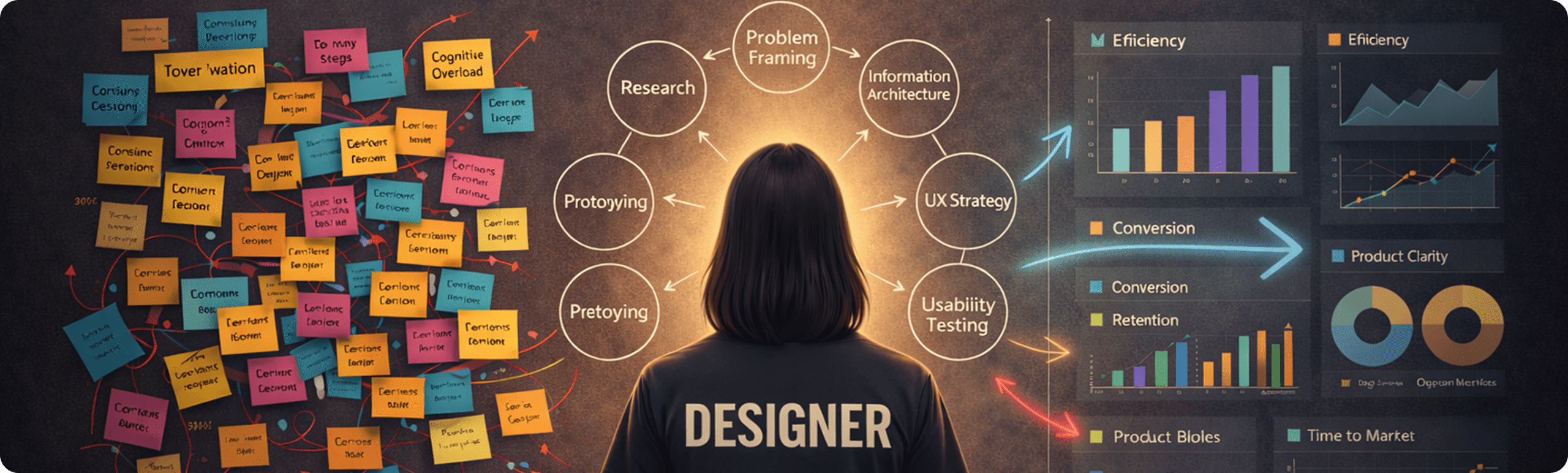
Good UI/UX design treats research output as a specification, not inspiration. If usability testing shows that users abandon a flow because a field’s purpose is unclear, the design response isn’t a cosmetic tweak — it’s a structural decision about what information architecture actually needs to exist on that screen, and in what order. This is where UX research and UI/UX design stop being sequential phases and start functioning as one continuous feedback loop: research defines the problem with evidence, design proposes a solution, and a fast round of prototype testing checks whether that solution actually closes the gap the research identified.
The startups that get the most value out of UX research are rarely the ones that research the most — they’re the ones with the tightest loop between research and UI/UX design. A two-day gap between a usability finding and a design iteration keeps the insight sharp. A two-week gap, buried in a backlog ticket, almost guarantees the finding gets diluted or forgotten by the time anyone acts on it.
Where this loop tends to break down — and what keeps it intact — usually comes down to a few concrete practices:
- pairing every major research finding with a specific, testable UI/UX design change, not a general recommendation;
- looping designers into interviews and usability sessions directly, instead of relaying findings through a report;
- validating each design iteration against the original research question, not just against internal aesthetic preference;
- treating UI/UX design as a hypothesis to be tested again, not a final deliverable once research is “done.”
Where an External Team Sees What an Internal Team Has Stopped Noticing
A team that works on the same product every day gradually loses the ability to see it the way a first-time user does — that’s not a competence issue, it’s a normal effect of immersion. This is exactly why a fresh perspective from an external development team often catches problems an internal team stopped noticing months ago, simply because they got used to the product’s existing logic.
An external partner with UX research experience brings more than methodology — interviews, prototype testing, competitive analysis. It brings process discipline: research runs in parallel with technical planning instead of being treated as a separate phase that’s the first thing cut under deadline pressure. That’s what allows a startup to ship a validated product without extending the overall development timeline.
This matters most for teams where UX research has no clear owner internally — the responsibility gets diffused between a designer already stretched across interface work and a product manager already stretched across backlog prioritization. In that situation, research either happens superficially or doesn’t happen at all, even when the team agrees, in principle, that it matters.
The Most Expensive Mistake Is the One Nobody Saw Coming
UX research before development isn’t a brake on a startup’s speed — it’s what determines whether that speed is pointed in the right direction. The most expensive mistakes in product development aren’t the ones that are obvious immediately. They’re the ones buried inside logic nobody questioned before launch. The cost of research is known in advance. The cost of skipping it shows up later, scattered across engineering time, marketing spend, and eroded user trust — which is exactly why it’s so hard to see until it’s no longer cheap to fix.
For a startup operating under real time and budget constraints, this isn’t a question of process philosophy — it’s a direct financial outcome. A team that builds UX research into its development cycle from the first sprint pays less for fixes and ends up with a product capable of keeping its earliest users instead of quietly losing them. That difference — not raw shipping speed — is ultimately what decides whether a startup finds its market, or spends its team’s limited resources searching for something a week of research would have already shown them.
Author