


In this article
What is agile software development: A startup guide
Business & Strategy
Mar 27, 2026
11 min read
Discover what agile software development really means for startups. Learn core mechanics, avoid common pitfalls, and scale agile practices effectively for project success.

Many startup founders believe agile software development means no planning or documentation. That’s a costly misconception. Agile is actually a disciplined, iterative approach that prioritizes customer collaboration, working software, and adaptive planning over rigid processes. This guide demystifies agile for startup founders, product managers, and CTOs who need scalable project management frameworks. You’ll learn core concepts, practical mechanics, common pitfalls, and how to measure success as your tech team grows.
Key Takeaways
| Point | Details |
|---|---|
| Agile basics | Agile is an iterative, customer focused approach that prioritizes collaboration and adaptability over heavy upfront planning. |
| Sprint driven work | Scrum uses fixed length sprints with defined roles and ceremonies to structure work and feedback. |
| Continuous feedback loops | Backlog reviews and sprint retrospectives create ongoing opportunities to adjust plans based on real results. |
| Backlog guided delivery | A prioritized product backlog guides what teams build next and helps manage scope, risk, and technical debt. |
Understanding agile software development basics
Agile software development is a family of iterative frameworks based on the 2001 Agile Manifesto, prioritizing individuals and interactions, working software, customer collaboration, and responding to change over traditional processes. The Agile Manifesto emerged when 17 software developers met to challenge the rigid, documentation-heavy Waterfall model that dominated the industry. They recognized that tech projects rarely follow linear paths.
The manifesto established four core values that still guide agile practice today. First, individuals and interactions matter more than processes and tools. Second, working software trumps comprehensive documentation. Third, customer collaboration beats contract negotiation. Fourth, responding to change is more valuable than following a fixed plan. These aren’t rejections of the items on the right, they’re prioritizations.
Agile contrasts sharply with traditional Waterfall approaches where you define all requirements upfront, build everything, then test at the end. Waterfall works for construction projects where changing a foundation mid-build is catastrophic. Software is different. Customer needs evolve, markets shift, and technical constraints emerge during development. Agile embraces this reality.
Startups and innovative tech environments benefit most from agile because uncertainty is your constant companion. You’re validating product-market fit, iterating on user feedback, and pivoting when data demands it. Agile’s flexibility lets you adjust course without scrapping months of work.
The agile family includes several frameworks:
- Scrum uses fixed-length sprints with defined roles and ceremonies
- Kanban visualizes workflow and limits work in progress
- Extreme Programming emphasizes technical practices like pair programming
- Lean software development focuses on eliminating waste
Each framework shares agile’s core values but implements them differently. Most startups begin with Scrum because its structure provides guardrails while you learn. You can explore software development technologies that support agile workflows and enable rapid iteration.
Core components and mechanics of agile frameworks
Core mechanics include iterative cycles (sprints 1-4 weeks), backlog management, incremental delivery, and continuous feedback loops via reviews and retrospectives. Understanding these mechanics transforms agile from abstract philosophy to concrete practice.

Scrum uses 2-week sprints as default with teams of 5-12 members. Shorter sprints create tighter feedback loops but increase planning overhead. Longer sprints reduce meeting frequency but delay course corrections. Most teams find two weeks hits the sweet spot for balancing planning costs against adaptability benefits.
Here’s how a typical sprint unfolds:
- Sprint planning: Team selects high-priority backlog items and commits to deliverables
- Daily standups: 15-minute syncs to surface blockers and coordinate work
- Development work: Team builds, tests, and integrates features incrementally
- Sprint review: Demonstrate working software to stakeholders and gather feedback
- Sprint retrospective: Reflect on process improvements for the next cycle
Backlog management is where strategy meets execution. Your product backlog is a prioritized list of features, fixes, and technical debt. Product owners continuously refine this backlog, breaking large epics into smaller user stories. Prioritization techniques like MoSCoW (Must have, Should have, Could have, Won’t have) or RICE scoring (Reach, Impact, Confidence, Effort) help you make tough tradeoff decisions.
Incremental delivery means shipping small, working increments instead of big-bang releases. Each sprint produces potentially shippable software. This approach surfaces integration problems early, validates assumptions quickly, and delivers value sooner. Users see progress, stakeholders stay engaged, and your team maintains momentum.
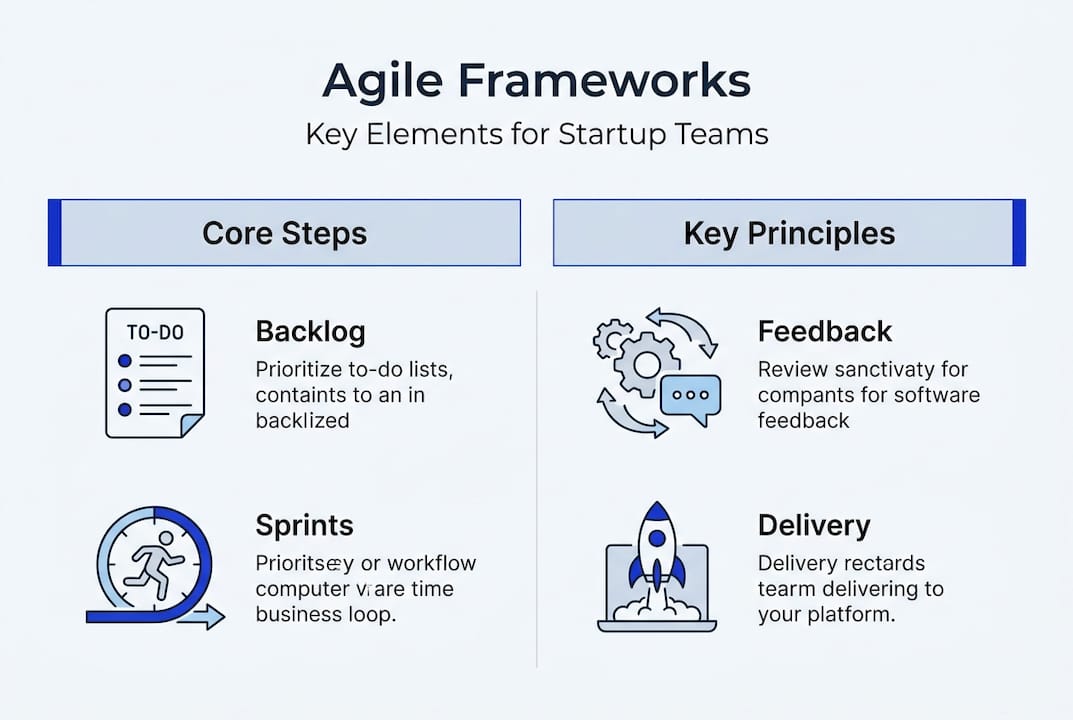
Continuous feedback drives improvements through agile ceremonies. Sprint reviews let customers validate that you built the right thing. Retrospectives help teams inspect their process and adapt practices. Daily standups catch coordination issues before they compound. This feedback intensity feels overwhelming at first but prevents the bigger pain of discovering problems months later.
| Framework | Workflow | Roles | Best For |
|---|---|---|---|
| Scrum | Fixed sprints | Product Owner, Scrum Master, Team | Feature development with clear milestones |
| Kanban | Continuous flow | Flexible | Support, maintenance, unpredictable work |
Pro Tip: Maintain sustainable pace by limiting work in progress and respecting sprint commitments. Teams that overcommit burn out and deliver less. Velocity naturally increases as the team gels and removes impediments. Quality software QA and testing services integrated into each sprint prevent technical debt accumulation.
Common misconceptions and nuanced realities of agile adoption
Agile is not a lack of planning but adaptive planning via backlogs and roadmaps. It values working software over comprehensive documentation, meaning documentation exists but stays lean. Hybrids like Water-Scrum-Fall are common, and agile fails in large organizations without discipline or with rigidly predictable projects.
The biggest misconception is that agile means no upfront thinking. Wrong. Agile teams do extensive planning, they just distribute it across the project lifecycle instead of frontloading everything. You create a product vision, map a high-level roadmap, and maintain a prioritized backlog. The difference is you revise these artifacts as you learn, rather than treating them as immutable contracts.
Documentation gets streamlined, not eliminated. You document enough to enable understanding and maintenance without creating shelf-ware that nobody reads. User stories replace hundred-page requirements documents. Architecture decision records capture key technical choices. API documentation stays current because it’s part of your definition of done. The test is simple: would this documentation help someone six months from now?
Hybrid models like Water-Scrum-Fall emerge in organizations transitioning to agile. Requirements gathering stays Waterfall. Development uses Scrum sprints. Deployment reverts to big-bang releases. These hybrids sacrifice many agile benefits but help teams adopt practices incrementally. They’re training wheels, not permanent solutions.
Agile struggles in contexts demanding rigid predictability. Regulated industries with fixed compliance deadlines, projects with immovable external dependencies, or teams lacking discipline to self-organize all face challenges. Large organizations often fail at agile because middle management resists the autonomy shift, silos prevent cross-functional collaboration, or leadership demands detailed long-range plans that agile explicitly avoids.
Startups and tech teams overcome scaling challenges by:
- Starting small with one team and proven practices
- Investing in technical excellence to maintain velocity
- Building psychological safety so teams surface problems early
- Aligning incentives around outcomes, not activity
“Success hinges on team autonomy and customer feedback loops, not ceremonies. Measure what matters: velocity, cycle time, and customer satisfaction over lines of code.”
The path forward involves scaling agile workflows thoughtfully as your organization grows, adapting practices to your context rather than following prescriptive playbooks.
Measuring success and scaling agile for growing tech teams
Success hinges on team autonomy and customer loops, not ceremonies. Measure velocity, cycle time, and customer satisfaction over lines of code. Scale via SAFe or Scrum of Scrums for teams over 50 people, but avoid rigid adoption and adapt to your context.
Velocity tracks how many story points your team completes per sprint. It’s not a performance metric for comparing teams because point scales differ. Instead, use velocity for sprint planning. If your team averages 40 points per sprint, commit to roughly 40 points next sprint. Velocity stabilizes after 3-5 sprints as estimation accuracy improves.
Cycle time measures how long work items take from start to finish. Shorter cycle times mean faster feedback and quicker value delivery. Track cycle time trends to spot process bottlenecks. If cycle time creeps up, investigate whether work items grew too large, dependencies increased, or quality issues forced rework.
Customer satisfaction remains your north star. Deploy features, gather usage data, and validate that you solved real problems. Net Promoter Score, feature adoption rates, and support ticket trends tell you whether your software delivers value. Technical excellence without customer impact is waste.
Quantitative metrics need qualitative context. A team hitting velocity targets while accumulating technical debt is failing. High cycle time might reflect complex problem domains, not inefficiency. Pair metrics with regular retrospectives where teams discuss what numbers mean and how to improve.
Scaling frameworks help coordinate multiple agile teams:
| Framework | Team Size | Structure | Pros | Cons |
|---|---|---|---|---|
| SAFe | 50-1000+ | Hierarchical with program increments | Comprehensive guidance | Heavy process overhead |
| Scrum of Scrums | 10-50 | Federated teams with coordination meetings | Lightweight, flexible | Requires strong communication |
| LeSS | 10-100 | Single product backlog, multiple teams | Simplicity, minimal roles | Less prescriptive guidance |
SAFe (Scaled Agile Framework) introduces program increments where multiple teams synchronize on 8-12 week planning cycles. It works for large enterprises needing coordination across dozens of teams but adds considerable ceremony. Scrum of Scrums uses representative meetings where team members coordinate dependencies and resolve impediments. It scales more organically but requires disciplined communication.
Pro Tip: Maintain team autonomy even as you scale. Centralized decision making kills agility. Empower teams to choose tools, define processes, and make technical decisions within architectural guardrails. Your role as a leader shifts from directing to enabling.
Best practices for scaling agile in startups:
- Keep teams small (5-9 people) and cross-functional
- Minimize dependencies between teams through modular architecture
- Invest in automation for testing, deployment, and monitoring
- Create clear interfaces and contracts between team domains
- Foster a culture of experimentation and learning from failure
You can explore scalable enterprise agile approaches that balance structure with flexibility as your organization matures.
How Meduzzen supports your agile software development journey
Implementing agile effectively requires more than methodology knowledge. You need experienced engineers who understand iterative development, automated testing, continuous integration, and collaborative workflows. Meduzzen offers tailored software development services aligned with agile principles, helping startups and growing businesses scale with pre-vetted engineers.
Our expertise spans web services and JavaScript software development, enabling rapid prototyping and iterative feature development. We provide flexible team augmentation that integrates seamlessly into your existing agile processes, whether you’re running Scrum, Kanban, or a hybrid approach. Our custom DevOps services establish the automation infrastructure that makes continuous delivery possible.
With over 10 years of experience and 150+ engineers, we’ve helped startups implement agile practices that scale from initial MVP through hypergrowth. Our engineers bring technical excellence in Python, AI, cloud technologies, and modern web frameworks, ensuring your sprints deliver working software that meets quality standards.
Pro Tip: Choose a development partner experienced in agile methodologies, not just technical skills. Teams that understand sprint planning, backlog refinement, and continuous integration accelerate your time to market and reduce coordination friction.
What is agile software development?
What are the main benefits of agile compared to Waterfall?
Agile delivers working software faster through iterative cycles, enabling early value delivery and course correction. Waterfall defers testing and integration until the end, increasing risk of costly late-stage discoveries. Agile’s continuous feedback loops keep teams aligned with evolving customer needs.
How long is a typical agile sprint?
Most teams use two-week sprints as the default. One-week sprints work for mature teams with stable velocity but increase planning overhead. Four-week sprints reduce meeting frequency but delay feedback. Two weeks balances planning costs against adaptability for most contexts.
Can agile work in large organizations?
Yes, but it requires cultural shifts and scaling frameworks. Large organizations succeed with agile by empowering autonomous teams, breaking down silos, and using frameworks like SAFe or Scrum of Scrums to coordinate across teams. Leadership must embrace adaptive planning over detailed long-range forecasts.
What are key metrics to track agile success?
Velocity shows sprint capacity for planning. Cycle time reveals process efficiency. Customer satisfaction validates you’re solving real problems. Track these trends over time rather than obsessing over individual sprint numbers. Qualitative retrospective insights complement quantitative metrics.
How do I start implementing agile in my startup?
Begin with one team using basic Scrum practices: two-week sprints, daily standups, sprint reviews, and retrospectives. Focus on delivering working software each sprint and gathering customer feedback. Invest in automated testing and continuous integration early. Adapt practices based on what works for your context. Explore scaling agile workflows as your team grows beyond 10 people.