


In this article
Developer onboarding guide for startup founders and CTOs
Business & Strategy
Mar 23, 2026
13 min read
Learn proven developer onboarding strategies that reduce turnover by 82% and accelerate productivity. A practical guide for startup founders and CTOs.

Nearly 22% of new developers leave within 90 days when companies lack structured onboarding. Many startup founders assume onboarding is simple: give developers access, point them to the codebase, and let them figure it out. This “just ask” approach fails remote teams and costs startups 50-200% of a developer’s salary in replacement expenses. Effective developer onboarding integrates engineers into technical environments, workflows, and team dynamics rapidly. This guide explains proven strategies to reduce early attrition, accelerate productivity, and build retention through structured onboarding tailored for technology startups.
Key Takeaways
| Point | Details |
|---|---|
| Structured onboarding | Structured onboarding rapidly integrates new engineers into technical environments workflows and team dynamics to boost early productivity and reduce attrition. |
| Day 0 readiness | Create a Day 0 checklist covering technical access account provisioning and equipment setup to prevent delays on day one. |
| Mentors and documentation | Assign mentors and ensure documentation addresses common questions to lower repetitive inquiries and accelerate ramp up. |
| Milestones and productivity | Break tasks into daily and weekly milestones with pre staging environments so first commits occur within 1 to 4 hours and ramp up remains predictable. |
Understanding developer onboarding and its importance
Developer onboarding is the structured process of integrating new software engineers into a company’s technical environment, focusing on tools, codebases, workflows, and team dynamics to achieve rapid productivity. For startups competing for engineering talent, onboarding determines whether new hires become productive contributors or frustrated departures.
Most fast-growing startups underestimate onboarding complexity. Founders often believe smart developers will independently navigate codebases, find documentation, and ask questions when stuck. This assumption breaks down in remote environments where “just asking” creates friction across time zones and async communication channels. Without structure, new engineers waste weeks deciphering undocumented systems, guessing at coding standards, and feeling isolated from team culture.
Effective onboarding covers multiple dimensions simultaneously. New developers need technical access to repositories, staging environments, and deployment pipelines before Day 1. They require context about architectural decisions, technology choices, and business logic embedded in the codebase. Understanding team workflows matters equally: how does your startup handle code reviews, testing requirements, deployment schedules, and incident response? Cultural integration rounds out onboarding by clarifying communication norms, meeting cadences, and collaboration expectations.
The “just ask” approach fails because it places burden on newcomers to identify what they don’t know and interrupt busy teammates repeatedly. Junior developers especially struggle with this unstructured method, unable to distinguish critical knowledge from nice-to-know details. Senior engineers waste time answering repetitive questions that documentation should address.
Founders and CTOs own onboarding success. You must define clear startup software workflows that new engineers can follow from day one. This means documenting not just what to do, but why decisions were made and how systems evolved. Your role includes assigning mentors, setting expectations for first-week deliverables, and personally checking in during critical early days.
Pro Tip: Create a “Day 0” checklist covering all technical access, account provisioning, and equipment setup completed before the new developer’s first day. This eliminates frustrating delays and signals organizational competence from the start.
Effective developer onboarding methodologies and best practices
Structured checklists form the foundation of repeatable onboarding. Your checklist should cover technical setup, codebase orientation, workflow education, and cultural integration across the first 30-60 days. Break tasks into daily and weekly milestones so new engineers know exactly what to accomplish and when. Elite teams achieve first commits within 1-4 hours by pre-staging environments and providing clear initial tasks.
Mentor and buddy systems accelerate integration dramatically. Assign each new developer an experienced team member as their primary resource for questions, code reviews, and cultural guidance. This relationship reduces the friction of “bothering” teammates because the buddy explicitly owns helping the newcomer succeed. Rotate buddy assignments to prevent burnout and ensure knowledge distribution across your team.
Knowledge bases centralize documentation that answers common questions without requiring synchronous communication. Your knowledge base should include architecture diagrams, coding standards, testing procedures, deployment guides, and troubleshooting playbooks. Update documentation continuously as systems evolve. Outdated docs create more confusion than no docs at all.

Pair programming builds relationships while transferring knowledge efficiently. Schedule pairing sessions during the first two weeks where new developers work alongside experienced engineers on real tasks. This hands-on approach teaches coding patterns, debugging techniques, and problem-solving approaches faster than reading documentation alone. Pair programming also humanizes remote work by creating natural collaboration opportunities.
Remote and distributed teams require async-first communication and explicit documentation over informal “just ask” approaches. Time zones make synchronous questions impractical, so new developers must find answers independently from written resources. Record video walkthroughs of complex systems. Use async standups and written status updates to keep everyone informed without requiring real-time meetings.
Tailor onboarding intensity based on experience level. Junior developers need more hand-holding, structured learning paths, and frequent check-ins. Senior engineers want autonomy to explore codebases independently with access to architectural context and business priorities. Both groups benefit from clear expectations and milestones, but juniors require more granular task breakdown and guidance.
The first week demands daily check-ins to catch confusion early. Schedule 15-minute sync-ups each afternoon to answer questions, remove blockers, and gauge confidence levels. After week one, taper to every other day, then weekly as the developer gains independence. This graduated approach balances support with autonomy.
Pro Tip: Create a “stupid questions” channel in your team chat where new developers can ask anything without judgment. Normalize question-asking by having senior engineers occasionally post their own “stupid questions” to model vulnerability and continuous learning.
Measuring onboarding success and overcoming challenges
Tracking metrics reveals whether your onboarding process actually works or just feels good. Time to first commit measures how quickly new developers contribute code to production. Elite teams achieve this in under 4 hours, average teams take 4-24 hours, and struggling teams require days. This metric exposes friction in environment setup, access provisioning, and task clarity.
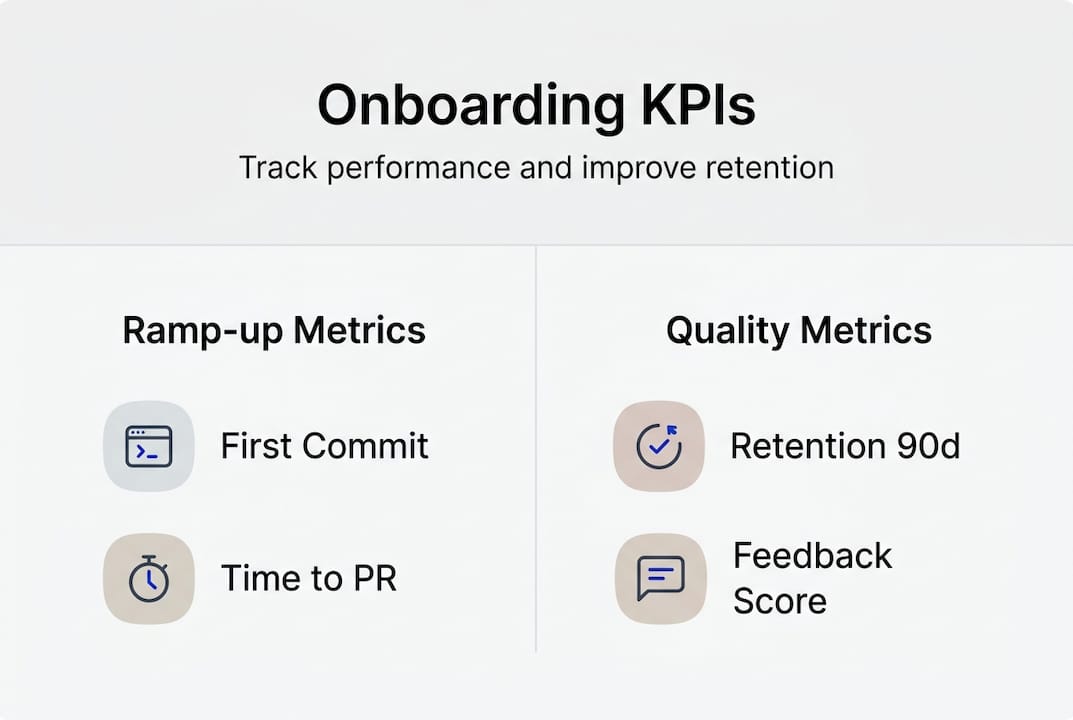
Ramp-up time tracks how long until new developers reach full productivity. Most startups see 30-90 day ramp-up periods depending on system complexity and onboarding structure. Measure this by comparing story point velocity or task completion rates between new and experienced team members. When the gap closes, ramp-up is complete.
Retention rate during the first 90 days indicates onboarding quality. Structured onboarding boosts retention by 82% compared to unstructured approaches. Track how many developers leave within their first quarter and conduct exit interviews to understand why. Early departures often cite confusion, isolation, or mismatched expectations, all preventable through better onboarding.
| Metric | Elite Performance | Average Performance | Poor Performance |
|---|---|---|---|
| Time to first commit | Under 4 hours | 4-24 hours | Multiple days |
| Full ramp-up period | 30 days | 60 days | 90+ days |
| 90-day retention rate | 95%+ | 85-90% | Under 80% |
| Replacement cost impact | Minimal | 50-100% salary | 100-200% salary |
Financial impact of poor onboarding compounds quickly. Replacing a developer costs 50-200% of their annual salary when factoring in recruiting fees, lost productivity, knowledge drain, and team disruption. For a $120,000 developer, poor onboarding that causes turnover costs $60,000-$240,000 per departure. Multiply this across multiple early exits and the business case for structured onboarding becomes overwhelming.
Common challenges include knowledge gaps in documentation, scattered information across tools, and social isolation in remote teams. New developers report unclear documentation and technical hurdles as primary barriers to productivity. They need customized information from multiple sources but lack the context to know where to look or what questions to ask.
Traditional onboarding relies on static documentation, recorded videos, and scheduled training sessions. This approach works but requires significant manual effort to keep current and struggles with personalization. AI-powered onboarding tools analyze codebases, answer questions contextually, and guide developers through setup automatically. Early data shows AI onboarding accelerates ramp-up 2x faster than documentation alone by providing just-in-time answers tailored to each developer’s current task.
“Structured onboarding with checklists, mentors, and documentation reduces early turnover by 82% and cuts ramp-up time in half compared to unstructured ‘just ask’ approaches.”
Data-driven improvements require experimentation. Survey new developers after 30, 60, and 90 days to identify friction points. Track which documentation pages get accessed most and which questions appear repeatedly in chat. Use this feedback to prioritize updates. Consider AI trends in software development that might streamline your onboarding process further.
Pro Tip: Create an onboarding retrospective template that new developers complete after their first month. Ask what surprised them, what confused them, and what they wish they’d known earlier. This structured feedback loop continuously improves your process.
Practical implementation strategies for startup founders and CTOs
Implementing effective onboarding starts with a comprehensive checklist covering all critical activities. Here’s a proven framework adapted for startups:
- Pre-Day 1: Provision all technical access including GitHub, AWS, Slack, project management tools, and staging environments. Ship equipment and verify setup works remotely.
- Day 1 morning: Welcome message from founder/CTO explaining company mission and new developer’s role. Introduction to buddy/mentor. Overview of first-week goals.
- Day 1 afternoon: Environment setup verification. First commit to a simple task (documentation update, minor bug fix) to validate full deployment pipeline access.
- Days 2-3: Architecture walkthrough covering system design, technology choices, and integration points. Review coding standards and testing requirements.
- Days 4-5: Pair programming sessions with multiple team members. Exposure to different parts of the codebase and working styles.
- Week 2: First substantial feature or bug fix assigned. Daily check-ins continue. Introduction to code review process and deployment procedures.
- Week 3: Participation in planning meetings. Understanding of sprint/workflow cadence. Reduced check-in frequency to every other day.
- Week 4: Independent work on moderate complexity tasks. Weekly check-ins begin. Integration into team culture and communication norms.
- Weeks 5-8: Full velocity on assigned work. Contribution to technical discussions. Mentoring relationship continues but becomes more peer-like.
Remote and in-person onboarding require different approaches:
| Aspect | In-Person Onboarding | Remote Onboarding |
|---|---|---|
| Communication | Spontaneous hallway conversations | Scheduled check-ins and async updates |
| Knowledge transfer | Whiteboard sessions and shoulder-surfing | Screen shares and recorded walkthroughs |
| Social integration | Lunch outings and office interactions | Virtual coffee chats and team games |
| Problem solving | Quick desk visits for help | Slack questions with potential time delays |
| Cultural absorption | Osmosis through physical presence | Explicit documentation and video culture guides |
Research shows newcomers follow a 16-step process to their first contribution, encountering barriers like unclear documentation and technical hurdles along the way. Anticipate these friction points by stress-testing your onboarding with each new hire. What took longer than expected? Where did they get stuck? Update your process continuously.
Provisioning technical access before Day 1 eliminates frustrating delays. Nothing signals disorganization faster than a new developer sitting idle because account approvals are pending. Complete all access requests during the final week before start date. Verify everything works by having a team member test the new accounts.
Daily check-ins during week one catch problems early. Best practices recommend scheduling these at the end of each day to review progress, answer questions, and adjust plans. After week one, taper to every other day, then weekly. This graduated approach balances support with autonomy as confidence grows.
Avoiding information overload requires pacing. Don’t dump the entire company wiki on Day 1. Introduce concepts just-in-time as they become relevant. Focus the first week on practical tasks that build confidence rather than comprehensive knowledge. Developers learn better by doing than by reading.
Founders and CTOs should personally participate in onboarding for key hires. Your involvement signals importance and provides direct insight into what new engineers experience. Schedule at least one pairing session or architecture discussion with each new developer during their first month. This builds relationships and demonstrates technical leadership.
Leverage your startup software workflow as an onboarding teaching tool. Walk new developers through how work flows from idea to production, highlighting decision points, quality gates, and collaboration touchpoints. Understanding the full system context accelerates independent contribution.
Consider how artificial intelligence services might enhance your onboarding process. AI tools can answer common questions, generate personalized learning paths, and provide code navigation assistance that reduces mentor burden while improving new developer experience.
Pro Tip: Create a “first commit” template task that every new developer completes on Day 1. Make it simple (update team roster, fix typo in docs) but require the full workflow: branch creation, code change, tests passing, PR submission, review, and merge. This validates their entire toolchain works and builds confidence through quick success.
Boost your developer onboarding with expert software development services
Even with structured onboarding, startups face capacity constraints when scaling engineering teams rapidly. Meduzzen’s software development services help technology companies accelerate developer productivity through pre-vetted engineers who integrate seamlessly into existing teams. Our 150+ developers across Python, AI, DevOps, and modern web technologies bring 10+ years of experience building scalable SaaS platforms and enterprise systems.
Our staff augmentation services minimize onboarding overhead by providing engineers already familiar with startup workflows, remote collaboration, and agile methodologies. Whether you need dedicated teams for long-term projects or specialized expertise in JavaScript software development, we deliver transparent communication and predictable results. Partnering with experienced development providers complements your in-house onboarding efforts, letting you scale faster without sacrificing quality or team cohesion.
Frequently asked questions about developer onboarding
What is developer onboarding?
Developer onboarding is the structured process of integrating new software engineers into a company’s technical environment, team culture, and workflows. It covers technical setup like repository access and environment configuration, knowledge transfer about architecture and coding standards, and social integration into team dynamics. Effective onboarding accelerates time to productivity and improves retention by reducing confusion and isolation that new developers commonly experience.
How long does it take for a developer to fully onboard?
Typical onboarding lasts 30-90 days depending on system complexity, experience level, and onboarding structure quality. Elite teams with strong processes achieve full productivity in 30 days, while teams with poor structure may require 90+ days. Time to first meaningful code contribution ranges from 1-4 hours for well-structured onboarding to multiple days for unstructured approaches. The difference between fast and slow onboarding often comes down to preparation, documentation quality, and mentor availability.
What are the biggest challenges in developer onboarding?
Documentation gaps and scattered information represent the most common barriers, forcing new developers to hunt across multiple tools and interrupt teammates for answers. Technical hurdles like environment setup failures and access provisioning delays create frustrating bottlenecks. Remote team isolation adds social and communication challenges, making it harder for new developers to build relationships, understand team culture, and feel comfortable asking questions. These challenges compound when companies lack structured onboarding processes.
How can startups improve remote developer onboarding?
Use asynchronous communication and explicit documentation to overcome time zone differences and enable independent problem-solving. Provide complete technical access and verified environment setup before Day 1 to eliminate delays. Schedule daily check-ins during the first week to catch confusion early, then taper frequency as confidence builds. Create recorded video walkthroughs of complex systems and encourage written questions in dedicated channels. Balance structure with personal connection through virtual coffee chats and team-building activities that humanize remote work.