In this article
AI-Assisted Lootbox Experiences at Scale: Personalization, Operations, and Player Trust
AI & Automation
AI in iGaming does not have to decide prize outcomes. This is an engineer’s guide to building AI as an assistance layer around a lootbox mechanic: personalized discovery, catalog and campaign operations, support triage, responsible-play detection, and the validation and governance that keep it trustworthy.

Key takeaways
| Takeaway | The short version |
|---|---|
| AI belongs around the mechanic, not inside it | In a lootbox or mystery-box product, the valuable AI work is discovery, catalog and campaign operations, support, and responsible-play detection, not deciding prize outcomes. |
| AI is an assistance layer, never the outcome engine | AI should not alter odds or change a player’s chance of winning. Prize mechanics stay explicit, testable, and controlled by the core game and compliance systems. |
| Personalization without manipulating prizes | AI can rank and explain boxes based on observed preferences, with simple reasons, while what happens after a box is opened never changes. |
| Responsible play is part of the product | The same signals used for personalization can flag unhealthy patterns. Risk signals feed an explicit, versioned policy engine, not an automatic decision. |
| Treat AI output as external input | Every suggestion is validated against real boxes, currencies, and campaigns, and passes through governance: generated, validated, approved, edited, or blocked. |
| It has to fail gracefully at scale | The frontend receives only approved, structured metadata. If the AI layer is unavailable, catalogs, campaigns, and the opening flow keep working. |
Lootboxes are often described as a simple entertainment mechanic: a player chooses a box, opens it, and receives a prize. In a mature digital product, however, the experience also connects catalog management, pricing, payments, reward inventory, campaigns, win presentation, post-win actions, analytics, and responsible engagement controls.
This makes lootboxes an interesting use case for artificial intelligence, but not because AI should decide prize outcomes or make randomness less transparent. The most valuable opportunities exist around the opening mechanic: improving discovery, supporting catalog and campaign operations, detecting unhealthy behavior patterns, and turning complex product data into clearer experiences.
In this article, a lootbox is a digital container that can be purchased, earned, or granted through a campaign. Its reward may be an item, digital value, cashback, or a prize requiring shipment or another action. The AI layer analyzes behavioral, content, and operational data while keeping the core prize logic controlled, auditable, and separate. The goal is not a black-box game, but a better product around a well-defined mechanic. This is a specific and responsible way to think about AI in iGaming: not AI that decides outcomes, but AI that makes the product around a controlled mechanic clearer and easier to operate.
Why iGaming lootboxes need more than randomness
A basic flow can list boxes, process a purchase, open the selected box, and display the reward. That may be enough for a prototype, but not for a product operating across multiple brands, currencies, campaigns, reward types, player segments, and regulatory expectations.
Product teams need to understand why boxes are viewed but not purchased, why shipment forms are abandoned, which campaign rewards remain unopened, which price points create payment friction, and which item pools create confusion or disappointment.
A production lootbox experience can generate useful signals from:
- catalog metadata, categories, prices, currencies, and item pools;
- browsing, favorites, demo spins, repeat visits, and purchase attempts;
- opening results, timeouts, partial failures, and insufficient-balance states;
- campaign eligibility, claims, granted boxes, recent wins, and player inventory;
- cashback, shipment, reward handling, support cases, and user-facing content.
AI becomes useful when these signals are combined into operational insight: recommendations, summaries, risk indicators, content drafts, and suggested next actions.
AI as an assistance layer, not the outcome engine
The first principle is separation. AI should not secretly alter odds, manipulate rewards, or change a player’s chance of winning based on behavior. Prize mechanics should remain explicit, testable, and controlled by the core game and compliance systems.
A responsible AI layer works around that outcome engine. It can rank boxes, explain item pools, summarize catalog performance, support campaign planning, identify risky usage patterns, and help customer service teams. It improves the experience without becoming the hidden source of truth for reward distribution.
This boundary is essential for trust. Players should see AI making the product clearer and more relevant, while operators should be able to inspect, approve, reject, and measure every suggestion. The system may answer which boxes are relevant, which flows create friction, or which cases need review, but never what a particular player should win.
Personalized discovery without manipulating prizes
Personalization is one of the most practical AI applications for a large lootbox catalog. Boxes may differ by theme, price, currency, item type, campaign eligibility, and reward handling. AI can help players navigate those choices without changing what happens after a box is opened.
For example, a player may browse physical prizes but usually choose cashback, prefer low-cost boxes, or interact mostly with campaign-based and recently added boxes. A recommendation model can use these signals to rank discovery surfaces, suggest categories, or highlight reward types that better match observed preferences.
Recommendations can appear in listing rows, category ordering, similar-box suggestions, or campaign pages. They should remain explainable through simple reasons such as “based on your favorite categories” or “similar to boxes you viewed recently.” Explainability is especially important in products involving chance-based rewards.
AI for catalog health and item pool review
Lootbox catalogs grow over time: new boxes are added, campaigns expire, prize pools change, categories become uneven, and older boxes stop performing. Manual review becomes slow and inconsistent across a large or multi-brand platform.
AI can support catalog analysis by detecting boxes with high views but low opens, high demo usage but low conversion, repeated balance failures, or wins followed by abandoned reward handling. These patterns may indicate unclear pricing, weak presentation, confusing reward types, or a mismatch between expectations and the item pool.
Instead of only displaying charts, the system can summarize likely causes and actions in plain language. It can also flag duplicate labels, unclear item names, missing images, weak alt text, and inconsistent reward classifications across markets.
These outputs should remain recommendations. Product and content managers review them, and approved changes pass through normal catalog and publishing controls.
Campaign intelligence and promotion planning
Campaigns may grant free boxes, unlock special boxes, promote categories, reward retention, or introduce new prize pools. The challenge is deciding which campaigns are useful, when they should appear, and how strongly they should be promoted.
AI can evaluate likely relevance, fatigue risk, completion behavior, and operational complexity. It can identify unclaimed or unopened rewards, campaigns that generate claims without follow-through, and mechanics that create meaningful engagement rather than short-lived spikes.
The safer model is AI-assisted planning rather than automatic promotion. The system can suggest audiences, copy variations, clearer eligibility rules, or follow-up actions, while campaign teams approve, edit, or reject the proposals and use that feedback to improve future recommendations.
Smarter win presentation and post-win actions
The opening moment carries emotional weight, but the experience does not end with the animation. After a win, the product must explain what happened and what comes next: instant credit, cashback, shipment, confirmation, or support.
AI can clarify the post-win flow without changing the reward. It can make frequently used options easier to understand, produce concise delivery instructions, identify missing address details, and explain unusual reward types. For multi-item openings, it can summarize which rewards were credited, which require action, and which can be converted.
Any generated user-facing text should be validated for accuracy, tone, restricted claims, and misleading statements about value or probability. AI can make the experience smoother, but it should not make it more aggressive or less honest.
Support summaries and operational triage
Lootbox systems contain many asynchronous states: purchase pending or failed, opening pending or timed out, reward granted or awaiting action, cashback requested, shipment pending, and more. When these states are scattered across logs and services, support cases take longer to understand.
AI can turn structured events into readable internal summaries. It may explain that a purchase succeeded, the open request timed out, no final item has been returned, and the pending reward status should be checked before compensation is considered.
AI provides context, not authority. Financial and remediation decisions remain with approved support workflows and systems of record. The same summaries can help product teams identify recurring issues such as balance friction, abandoned shipment flows, or campaign rewards that remain unopened.
Responsible play and risk detection
The same behavioral signals used for personalization can reveal potentially unhealthy patterns: rapid repeated openings, failed balance checks, escalation after losses, frequent high-count openings, or chasing behavior after a disappointing result.
AI can detect patterns that simple rules may miss, but it should not make sensitive decisions alone. Risk signals should feed an explicit, versioned policy engine that determines appropriate actions such as neutral reminders, reduced promotional intensity, cooldowns, limits on batch-opening suggestions, or manual review.
Sometimes the most responsible personalization is less personalization. When risk increases, the product should become calmer, clearer, and less promotional. Teams should measure not only conversion, but also complaints, repeated failures, abandoned reward handling, and the effectiveness of responsible-play interventions.
Validation, governance, and human review
AI output should be treated as external input. A model response may be useful, but it is not automatically safe, accurate, compliant, or ready for production.
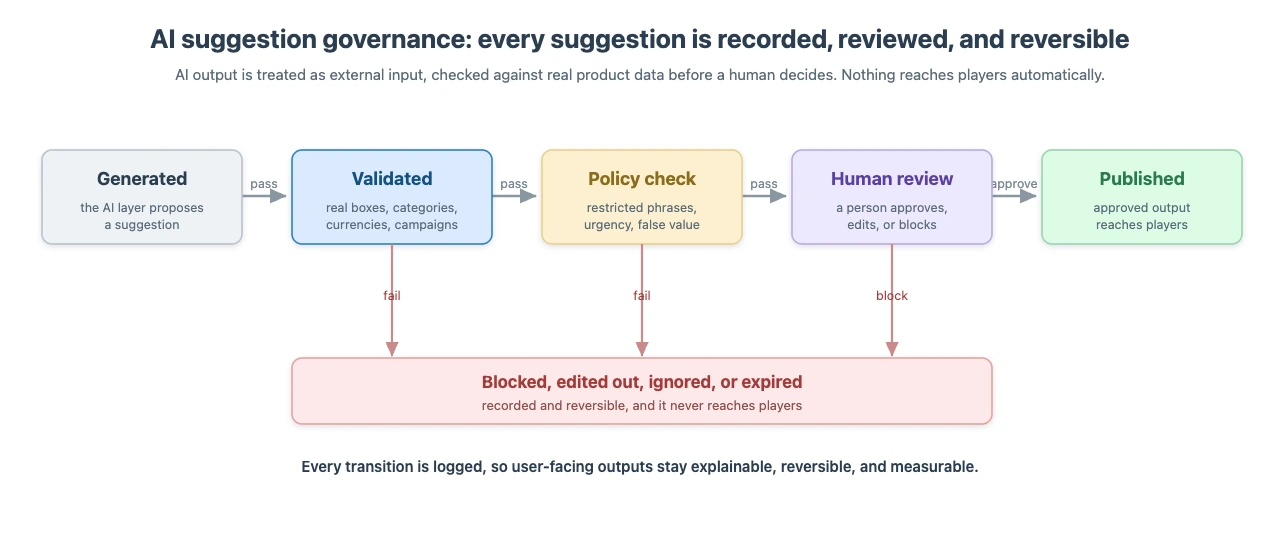
Recommendations should reference real boxes, valid categories, supported currencies, active campaigns, and available reward types. Generated text should be checked for restricted phrases, unsupported claims, broken formatting, urgency pressure, and misleading value statements. Risk scores must be traceable to documented policy actions.
A practical governance workflow records whether a suggestion was generated, validated, blocked, approved, edited, ignored, expired, or published. This creates accountability and ensures that user-facing outputs remain explainable, reversible, and measurable.
Architecture of an AI-assisted lootbox platform
A clean architecture keeps the AI layer modular. The core lootbox system manages catalogs, inventory, purchases, opening requests, reward states, campaigns, cashback, and shipment. The AI layer receives sanitized signals and returns structured recommendations or summaries.
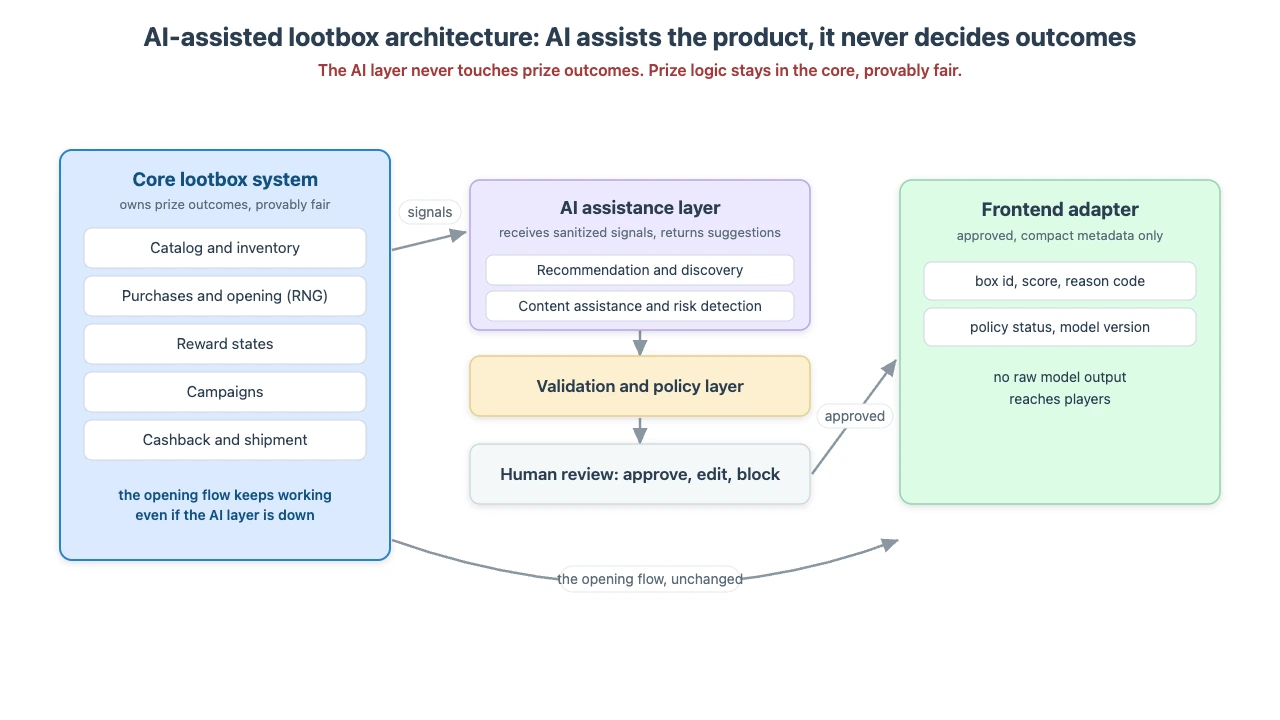
A practical architecture could include:
- an event pipeline for browsing, demo spins, opens, wins, campaigns, and reward handling;
- a privacy-aware feature builder for player and catalog signals;
- recommendation, content-assistance, and risk-detection services;
- a validation and policy layer for every AI response;
- a human review workflow for catalog, campaign, content, and policy suggestions;
- a frontend adapter that receives only approved, structured metadata.
The frontend should receive compact fields such as a box identifier, score, reason code, expiration time, policy status, and model version, not raw model output. The AI layer must also fail gracefully: if it is unavailable, the normal catalog, campaigns, recent wins, and opening flow should continue to work.
Business and product impact
The value of AI-assisted lootboxes is not limited to engagement. Product teams can identify stale boxes sooner, campaign teams can evaluate meaningful follow-through, content teams can reduce repetitive writing, support teams can understand cases faster, and compliance teams can verify that personalization does not become manipulation.
For players, the benefit is a cleaner experience: more relevant discovery, clearer prize explanations, fewer confusing post-win steps, and a product that can slow down when behavior suggests risk.
AI works best when it makes the product easier to understand and operate. In a chance-based experience, clarity and trust are part of the product’s credibility, not optional additions.
Conclusion
AI-assisted lootbox experiences are not about replacing randomness or hiding decisions inside a model. They are about improving discovery, campaign planning, content quality, support, reward handling, and responsible engagement around a controlled opening mechanic.
A well-designed AI layer can personalize without manipulating outcomes, summarize without taking authority away from teams, and detect risk without turning every signal into an automatic decision. When it respects the boundary between assistance and control, it can make the product more relevant, manageable, and trustworthy. This is the kind of AI engineering we do at Meduzzen: AI wired into a real product around a controlled mechanic, with validation, governance, and human review, not a model bolted on top of a game.
FAQ
What is AI in iGaming, in a lootbox or mystery-box context?
It is the use of AI to improve the product around a chance-based opening mechanic: personalizing discovery, analyzing catalog and campaign health, summarizing support cases, and detecting risky behavior. It does not decide prize outcomes. In a responsible design, prize mechanics stay explicit and controlled by the core game and compliance systems, and AI works as an assistance layer around them.
Does AI change lootbox odds or decide what a player wins?
No, and it should not. The first principle is separation: AI should not secretly alter odds, manipulate rewards, or change a player’s chance of winning based on behavior. Prize mechanics remain explicit, testable, and auditable. AI can answer which boxes are relevant or which cases need review, but never what a particular player should win.
How does AI personalize lootboxes without manipulating prizes?
It ranks and explains boxes based on observed preferences such as favorite categories, price range, or reward type, and surfaces them in listing rows, category ordering, or similar-box suggestions. Recommendations stay explainable (“based on your favorite categories”), and what happens after a box is opened never changes.
How can AI support responsible gambling and player protection?
The same behavioral signals used for personalization can reveal unhealthy patterns like rapid repeated openings, chasing after losses, or repeated balance failures. AI detects patterns simple rules miss, but it does not act alone: risk signals feed an explicit, versioned policy engine that decides neutral reminders, cooldowns, reduced promotion, or manual review. Sometimes the most responsible personalization is less personalization.
What does an AI-assisted lootbox architecture look like?
The core lootbox system owns catalogs, inventory, purchases, opening and reward states, campaigns, cashback, and shipment. A modular AI layer receives sanitized signals and returns structured recommendations or summaries through an event pipeline, a feature builder, recommendation/content/risk services, a validation and policy layer, and a human review workflow. The frontend receives only approved, compact metadata, and if the AI layer is down, the normal flow keeps working.
Does AI replace game, product, or support teams?
No. AI provides context, not authority. Every suggestion is reviewed, and financial or remediation decisions stay with approved workflows and systems of record. AI reduces repetitive work and speeds up understanding, while people keep control of what reaches players.
How do you keep AI suggestions safe before they reach players?
Treat AI output as external input. Validate every response against real boxes, valid categories, supported currencies, and active campaigns; check generated text for restricted phrases, unsupported claims, and misleading value statements; and record each suggestion’s state (generated, validated, blocked, approved, edited, ignored, expired, or published) so outputs stay explainable, reversible, and measurable.
Recommended
- AI development services at Meduzzen: how we build AI layers, recommendation and risk systems, and content platforms in production.
- Hire AI developers: the engineers who build assistance-layer AI like the lootbox platform described here.
- Book a consultation: bring your gaming, iGaming, or commerce product and we will give you a straight read.