In this article
Full cycle software development: what most startups get wrong
Business & Strategy
Learn the 6 stages of full cycle software development, top methodologies, DORA metrics, and expert practices to help your startup ship faster and scale smarter.

TL;DR:
- Full cycle development ensures one team owns the entire product process, reducing misalignment and rework.
- Embracing full cycle ownership accelerates iteration, improves quality, and lowers costs for startups.
- Tracking metrics like DORA metrics helps startups improve deployment speed and reliability.
Startups move fast, but speed without structure is just expensive chaos. When software teams operate in silos, passing work from one group to the next, the handoff costs pile up quietly: misaligned requirements, rework, delayed launches, and products that miss the mark. Full cycle software development covers every stage from ideation and planning through deployment and ongoing maintenance, giving teams a single thread of accountability from first idea to live product. For founders and product managers who want to compete in crowded markets, understanding this process is not optional. It is the foundation of everything that scales.
Key Takeaways
| Point | Details |
|---|---|
| End-to-end ownership | Full cycle software development gives startups more control, less misalignment, and better product outcomes. |
| Choose the right method | Agile suits dynamic startups, Waterfall fits fixed-scope projects, but hybridizing can maximize flexibility and predictability. |
| Measure for improvement | Track DORA metrics to benchmark and systematically improve your team’s speed, quality, and impact. |
| Anticipate edge cases | Managing edge cases from the start minimizes catastrophic failures and supports sustainable growth. |
| Build with best practices | Automate tests, integrate security early, and maintain living docs to future-proof your product. |
What is full cycle software development?
Now that you know why mastering the process matters, let’s define what full cycle software development really is and what sets it apart.
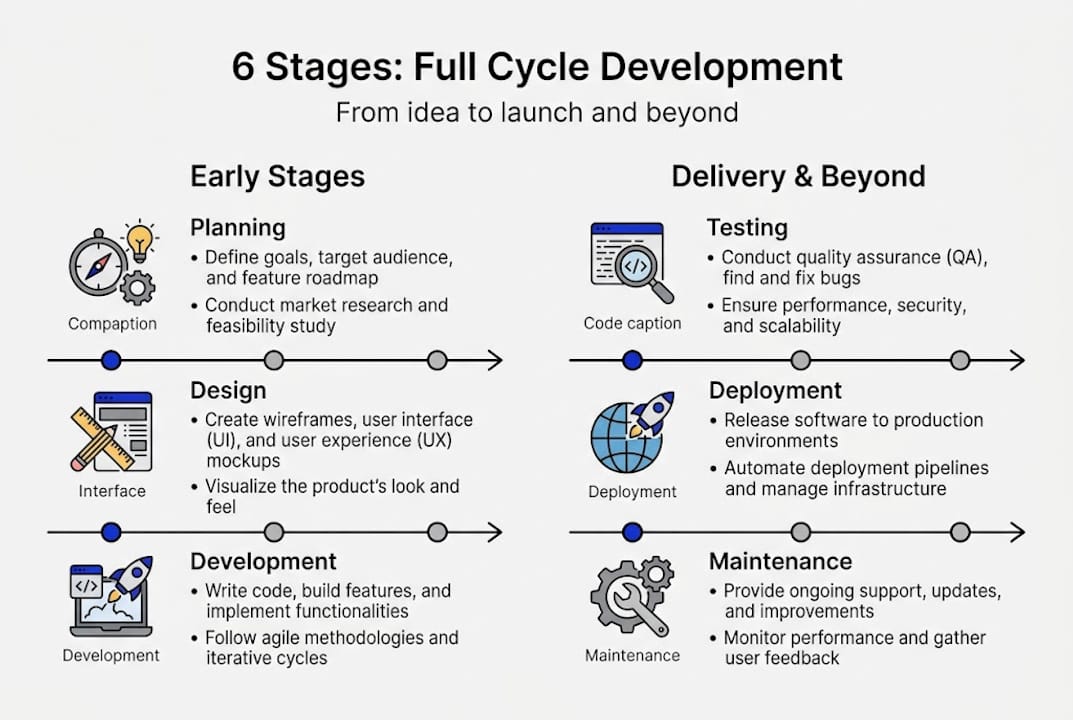
At its core, full cycle software development means one team or one tightly coordinated unit owns the entire product journey. No handoffs. No finger-pointing between design and engineering. No QA team discovering requirements they were never told about. The comprehensive SDLC spans planning, design, development, testing, deployment, and maintenance, and full cycle teams treat every one of those phases as their own responsibility.
Traditional approaches fragment this ownership. A business analyst writes specs, hands them to a designer, who hands off to developers, who pass to QA, who escalate bugs back up the chain. Every boundary is a place where context gets lost. Startups pay dearly for that lost context, usually in the form of missed deadlines and products that feel slightly off from what the customer actually needed.
Full cycle development addresses this by keeping context alive throughout. When the same team that gathered requirements is also writing code and monitoring production, they catch edge cases earlier, iterate faster, and build genuine empathy for the end user. This is not just a process preference. It is a structural advantage.
Here is a quick comparison of how the two approaches differ:
| Dimension | Traditional siloed | Full cycle |
|---|---|---|
| Accountability | Distributed across teams | Single team end to end |
| Handoff risk | High | Low |
| Iteration speed | Slow | Fast |
| Feedback loops | Delayed | Continuous |
| Misalignment risk | High | Minimal |
The benefits for startups specifically are significant. See the full cycle development steps that matter most for early-stage teams, and you will notice a pattern: speed and quality are not trade-offs when the process is owned end to end. Teams that embrace this model report faster iteration cycles, fewer production incidents, and higher confidence in their releases. For a startup racing to find product-market fit, those advantages are not incremental. They are the difference between surviving and thriving.
Key benefits of full cycle development for startups:
- Faster time to market because decisions do not wait for cross-team alignment
- Higher product quality from continuous feedback between roles
- Reduced rework when requirements are owned and understood by builders
- Greater team morale from shared ownership and visible impact
- Lower total cost over time as misalignment and late-stage bugs shrink
Key stages of the full cycle: From idea to launch (and beyond)
With a definition in hand, let’s walk step by step through each critical phase and highlight what matters most for fast-moving teams.
The SDLC phases that define full cycle development are well established: planning and requirements, design, development, testing, deployment, and maintenance. But knowing the names is not enough. What matters is how each phase connects to the next, and where startups most often stumble.
- Planning and requirements . This is where clarity is built or destroyed. Vague user stories and undocumented assumptions create downstream chaos. Teams that invest here save multiples later.
- Design . Both UX and system architecture decisions happen here. A missed scalability assumption at this stage can cost months of refactoring later.
- Development . Code is written, but also reviewed, tested in small increments, and integrated continuously. CI/CD pipelines belong here from day one.
- Testing . Not just a final gate. Testing runs throughout, including unit, integration, and end-to-end checks. Security testing, part of a DevSecOps approach, starts here too, not after launch.
- Deployment . Automated, repeatable, and monitored. A good deployment process means you can ship confidently and roll back quickly if something breaks.
- Maintenance . The phase most startups underestimate. Real users surface real edge cases, and the teams that respond fast are the ones that retain customers.
One real-world scenario illustrates the stakes well. A fintech startup skipped formal requirements review to hit a launch date. Three weeks after launch, a payment rounding error surfaced in a specific currency conversion edge case. The fix took two weeks and cost the team a major enterprise client. One missed spec, one missed test, one very expensive lesson.

Feedback loops are what separate good full cycle teams from great ones. Every stage feeds information back into the previous one. Production monitoring informs the next sprint’s priorities. User behavior shapes the next design iteration. This is not a waterfall with extra steps. It is a living system. For practical guidance on startup development essentials and how to structure these loops effectively, the principles are consistent: build in feedback from the start.
Pro Tip: Document every significant architectural and product decision using Architecture Decision Records (ADRs). These short, structured notes capture the context, options considered, and rationale behind each choice. When your team grows or a new engineer joins, ADRs prevent the costly rediscovery of past reasoning. They are one of the cheapest forms of institutional memory available. See full cycle strategies that teams use to make this documentation habit stick.
You can also look at startup product services to understand which support structures fit different stages of your cycle.
Leading methodologies: Agile, Waterfall, and finding your fit
After understanding the steps, you will need the right process for your team’s strengths and your market’s speed. Here is how today’s top methodologies stack up.
Methodology choice is not a technical decision. It is a strategic one. The wrong fit slows teams down, creates friction, and can misalign delivery with business reality. Agile is adopted by 87% of organizations, but Waterfall, Spiral, V-Model, and hybrid approaches each have distinct strengths and trade-offs worth understanding.
| Methodology | Best for | Key strength | Key risk |
|---|---|---|---|
| Waterfall | Regulated industries, fixed scope | Predictability | Inflexibility to change |
| Agile/Scrum | High-growth MVPs, evolving requirements | Speed, adaptability | Scope creep |
| Spiral | Complex, risk-heavy projects | Risk management | High overhead |
| V-Model | Safety-critical systems | Rigorous validation | Slow iteration |
| Hybrid | Scaling startups with mixed needs | Balance | Requires discipline |
For most startups, Agile is the default for good reason. Short sprints, continuous delivery, and regular retrospectives align perfectly with the need to learn fast and pivot when the market sends signals. But pure Agile without structure can drift into chaos, especially as teams grow past ten people. This is where smart hybrid elements, like borrowing Waterfall’s upfront planning for compliance-heavy features or Spiral’s risk assessment for new technical territory, add real value.
When choosing your approach, consider these factors:
- Regulatory environment . Healthcare and fintech often require documented, auditable processes closer to Waterfall or V-Model
- Team size and maturity . Smaller teams benefit from Agile’s flexibility; larger ones need more scaffolding
- Market speed . If competitors ship weekly, you cannot afford quarterly release cycles
- Technical risk . Novel architecture or integrations warrant Spiral-style risk reviews
For a deeper look at choosing your development model based on your stack and stage, the principles translate across languages and platforms. And if you want to understand agile explained for startups in practical terms, the core insight is this: Agile is not about moving fast and breaking things. It is about learning fast and fixing things before they break you. For a broader view of SDLC models overview, the landscape is rich and worth exploring with your specific context in mind.
Measuring success: DORA metrics and what high-performing teams track
Process alone is not enough. To compete at the top, you need a scoreboard. Here are the metrics that matter for the best teams and why.
The four DORA metrics are the closest thing software development has to a universal performance standard. They measure what actually matters: how fast you ship, how often you ship, how often things break, and how fast you recover.
- Deployment frequency . How often code reaches production. Elite teams ship multiple times per day.
- Lead time for changes . Time from code commit to production. Shorter means faster learning.
- Change failure rate . Percentage of deployments that cause incidents. Lower is better.
- Mean time to restore (MTTR) . How fast you recover from failures. Speed here protects user trust.
Elite DORA performance, defined as cycle time under 26 hours, deployment frequency above once per day, failure rate below 1%, and MTTR under one hour, correlates directly with 2.6x revenue growth compared to low performers. That is not a marginal difference. It is a business outcome.
| DORA metric | Elite benchmark | Industry average |
|---|---|---|
| Deployment frequency | Multiple per day | Once per month |
| Lead time for changes | Under 1 hour | 1 to 6 months |
| Change failure rate | Under 1% | 16 to 30% |
| MTTR | Under 1 hour | 1 week to 1 month |
The lesson here is simple but often skipped: measurement fuels improvement. Teams that do not track these numbers are flying blind. And teams that track them but never act on them are just collecting data for its own sake. For a broader look at metrics for team performance and how to operationalize them, the key is pairing numbers with behavior change.
Pro Tip: Run a short retrospective after every sprint focused specifically on one DORA metric. Not all four at once. Pick the one that hurts most right now, dig into the root cause, and make one process tweak. Small, targeted improvements compound quickly. Build scalable startup workflows around this habit and you will see the numbers shift within a quarter.
Edge cases, maintainability, and expert startup practices
Measurement helps reveal blind spots, but consistent quality comes from mastering the day-to-day realities, especially those hidden edge cases. Here is how top teams do it.
Edge cases are the inputs, states, or conditions that fall outside the normal operating range of your software. They are not exotic. They are inevitable. And they are where startups get hurt most, because early teams optimize for the happy path and defer the hard questions.
The consequences can be severe. Knight Capital lost $440 million in 45 minutes because of an unhandled edge case in their trading software. A single deployment flag was not reset properly, and the system began executing unintended trades at scale. That is not a horror story from another era. It is a reminder that edge cases are a business risk, not just a technical footnote.
How top teams manage edge cases:
- Build an edge case registry . Document known boundary conditions as you discover them, not after they break production
- Test at the boundaries . Zero values, maximum inputs, empty states, and concurrent requests are where bugs hide
- Automate boundary checks . Property-based testing tools can generate edge cases you would never think to write manually
- Design for graceful degradation . When something unexpected happens, the system should fail safely and informatively, not silently or catastrophically
“The best teams do not just fix edge cases. They build a culture of hunting for them before users do.” This mindset shift, from reactive to proactive, is what separates teams that ship with confidence from those that dread every release.
Maintainability is the other half of this equation. Code that works today but cannot be understood or modified tomorrow is a liability. Living documentation, regular code reviews, and scheduled refactoring sessions are not luxuries. They are the practices that keep a codebase healthy as the team and product grow. See modern development practices that embed these habits from the start, and you will build products that age well. For additional edge case strategies that go beyond the basics, the principles of defensive programming and chaos engineering offer powerful extensions to your testing toolkit.
The hidden advantage: Why startup teams must own the full cycle
Having covered the process, best practices, and pitfalls, let’s zoom out for a hard-won perspective on what truly sets winning startup teams apart.
Here is the uncomfortable truth most startup advice skips: the real competitive advantage of a startup is not speed. It is the ability to learn faster than anyone else and act on that learning without losing momentum. Full cycle ownership is what makes that possible.
When one team holds the entire thread, from the first user interview to the production alert at 2 a.m., context is never lost. The engineer who wrote the feature knows why it was built that way. The designer who shaped the UX sees how users actually interact with it. Feedback loops tighten. Decisions improve. The product gets smarter with every iteration.
Fragmented execution kills this. When you split the cycle across agencies, freelancers, and internal teams without clear ownership, you create seams where learning disappears. Each handoff is a place where nuance evaporates and assumptions harden into misunderstandings.
That said, full cycle ownership does not mean doing everything in-house. Budget constraints are real. Rare expertise is rare for a reason. The key is being intentional: delegate selectively, maintain strategic ownership of the cycle, and ensure whoever you bring in integrates deeply rather than operating at arm’s length. Building scalable SaaS development capacity this way, with partners who think like owners, is what separates startups that scale from those that stall.
You will not just build faster. You will build smarter, and that is the advantage that compounds.
Take your software development full cycle with Meduzzen
Ready to put full cycle software development into action? Here is how Meduzzen can help accelerate your startup’s journey.
At Meduzzen, we have spent over 10 years helping startups and scaling businesses own every stage of the software cycle without the overhead of building massive in-house teams from scratch. Our end-to-end development services cover the full spectrum, from product discovery and architecture through deployment and ongoing maintenance.
When you need to move fast or fill a critical skill gap, our scalable staff augmentation model puts pre-vetted engineers into your team within days, not months. And if you are building a SaaS product, our SaaS development expertise brings deep experience across FinTech, Healthcare, EdTech, and more. We do not just deliver code. We integrate, communicate, and stay accountable to your outcomes. That is the full cycle promise.
Frequently asked questions
The main stages are planning and requirements, design, development, testing, deployment, and ongoing maintenance. Each phase feeds into the next, creating a continuous loop of improvement rather than a one-time linear process.
Agile reduces project duration by up to 40%, cuts costs by 50%, and reduces rework by 76%, making it particularly well suited for startups that need to learn and adapt quickly without wasting resources on features that miss the mark.
DORA metrics measure deployment frequency, lead time, change failure rate, and MTTR, and elite DORA performance correlates with 2.6x higher revenue growth, giving teams a direct link between engineering health and business outcomes.
Edge cases represent boundary conditions that can cause catastrophic failures if unhandled. Knight Capital lost $440M in 45 minutes from a single unhandled edge case, illustrating how technical oversights translate directly into business losses.
Startups should embed security early using DevSecOps principles, automate CI/CD pipelines and testing from day one, document decisions with ADRs, and prioritize code maintainability through regular reviews and refactoring sessions.