In this article
Custom Voice AI Solutions: Why Integration Wins
AI & Automation
A convincing synthetic voice is no longer a competitive advantage. Any team with an API key can get natural-sounding speech, sub-second responses, and a cloned brand voice in an afternoon. Yet most voice AI projects still stall between a slick demo and a system that survives real callers. The reason is consistent: the voice is […]

A convincing synthetic voice is no longer a competitive advantage. Any team with an API key can get natural-sounding speech, sub-second responses, and a cloned brand voice in an afternoon. Yet most voice AI projects still stall between a slick demo and a system that survives real callers. The reason is consistent: the voice is the part you rent, while the integration layer — telephony, tools, state, consent, observability — is the part you have to build, and it is where custom voice AI solutions succeed or fail.
This article looks at custom voice AI development from that angle: when a custom build is justified, how scope shapes architecture, what voice AI integration actually involves, and why voice cloning integration is now as much a compliance pipeline as an audio feature.
The Voice Is Rented; the System Is Yours
The speech layer has commoditized faster than almost any other part of the AI stack. Speech-to-text, LLM reasoning, and text-to-speech are all available as streaming APIs, and managed voice-agent platforms bundle them into a configurable product with a phone number attached. For a narrow, standard workflow — an FAQ line, appointment reminders, a basic intake script — that bundle is often the right answer, and building from scratch would be wasted effort.
Custom voice AI solutions earn their cost when the value sits outside the bundle. That happens when the agent must act inside proprietary systems, follow domain rules a generic platform cannot express, meet compliance requirements on data residency or audit, or run at a call volume where per-minute platform pricing becomes the dominant line item. In each case, the differentiator is not how the agent sounds but what it is connected to and how reliably it behaves when those connections misbehave.
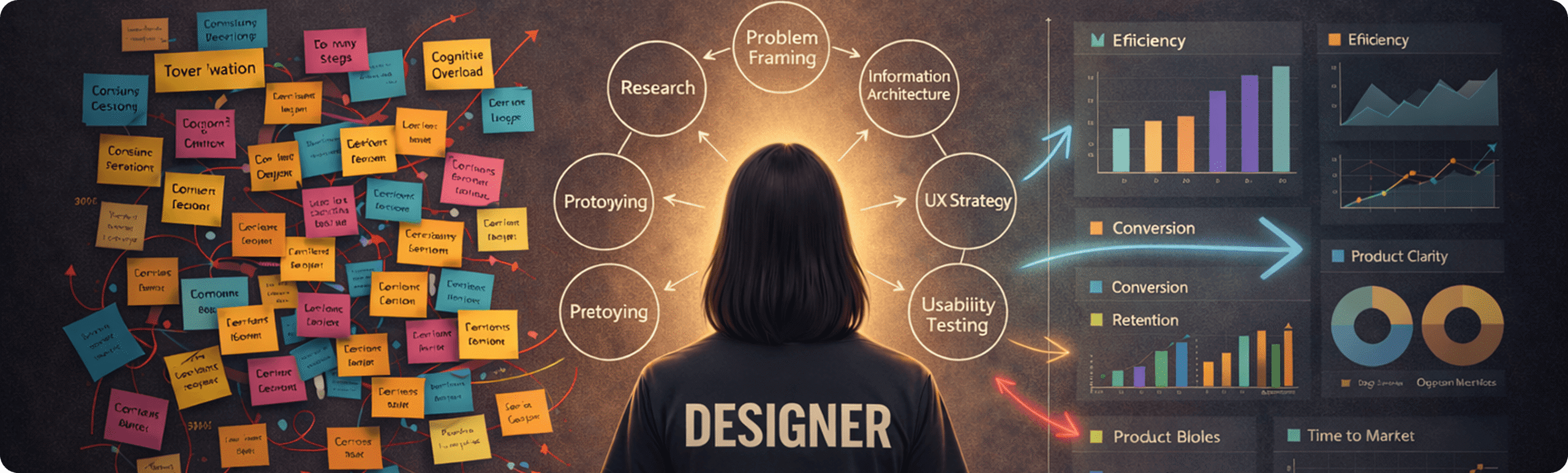
That reframes the build decision. The question is not “can we make it talk?” — every vendor can. The question is “who owns the orchestration, the tool contracts, the data, and the failure modes?” If the honest answer is “we need to,” you are in custom territory.
Voice Bot or Voice Assistant: Scope Decides the Architecture
Teams often use “voice bot” and “voice assistant” interchangeably, but the distinction drives very different engineering. Voice bot development targets a bounded job: a phone agent that books, qualifies, confirms, or routes. The conversation space is narrow, success is binary (the booking exists or it does not), and the hard problems are telephony, turn-taking, and reliable tool calls under latency pressure.
Voice assistant development is broader. An assistant embedded in an app, a device, or an internal platform handles open-ended requests across several domains, keeps context across sessions, and often has to authenticate the user before acting on their data. Here the hard problems shift toward retrieval, memory, permissions, and graceful refusal when a request falls outside what the assistant is allowed to do.
Getting this classification right early prevents the most common scoping mistakes:
- Building an open-ended assistant when the business needed a reliable three-intent bot, and paying for flexibility nobody uses.
- Shipping a scripted bot into a context where users expect an assistant, and watching escalation rates climb on every off-script request.
- Underestimating identity and authorization, which a bot can often skip and an assistant almost never can.
Cascaded or Speech-to-Speech: Choose the Pipeline Your Integrations Can Live With
The first architectural fork in any custom voice build is the pipeline. A cascaded design chains speech-to-text, an LLM, and text-to-speech, passing text between stages. A speech-to-speech (S2S) model maps audio in to audio out in a single model; OpenAI’s realtime models, Google’s Gemini Live, and Amazon’s Nova Sonic are the best-known examples.
On paper, S2S wins on speed. One 2026 comparison puts typical warm time-to-first-audio at 300–500 ms for S2S versus 600–1,200 ms for a cascade (Future AGI). In practice the gap narrows: a tuned cascade with streaming TTS can match or beat some S2S models, and independent live-call benchmarks have found well-assembled cascades reacting faster than native models once endpointing is counted (Inworld, Codebridge).

The stronger argument is control. A text layer lets you run the strongest reasoning model, log every word the agent heard, redact PII before it reaches storage, and validate a tool call before it fires. That matters: a March 2026 benchmark of 278 simulated support calls found S2S agents completing 26–38% of tasks under background noise and varied accents, against 85% for a text-based agent on the same tasks (JustCall). Unsurprisingly, the cascade remains the production default for most voice-agent workloads (Deepgram).
The pragmatic pattern is hybrid: keep the cascade wherever the agent touches tools, transcripts, or regulated data, and reserve S2S for short, conversational paths where naturalness is the product. Whatever you choose, keep each stage behind an interface so you can swap vendors as prices and models shift every few months.
Voice AI Integration Is Where Projects Succeed or Stall
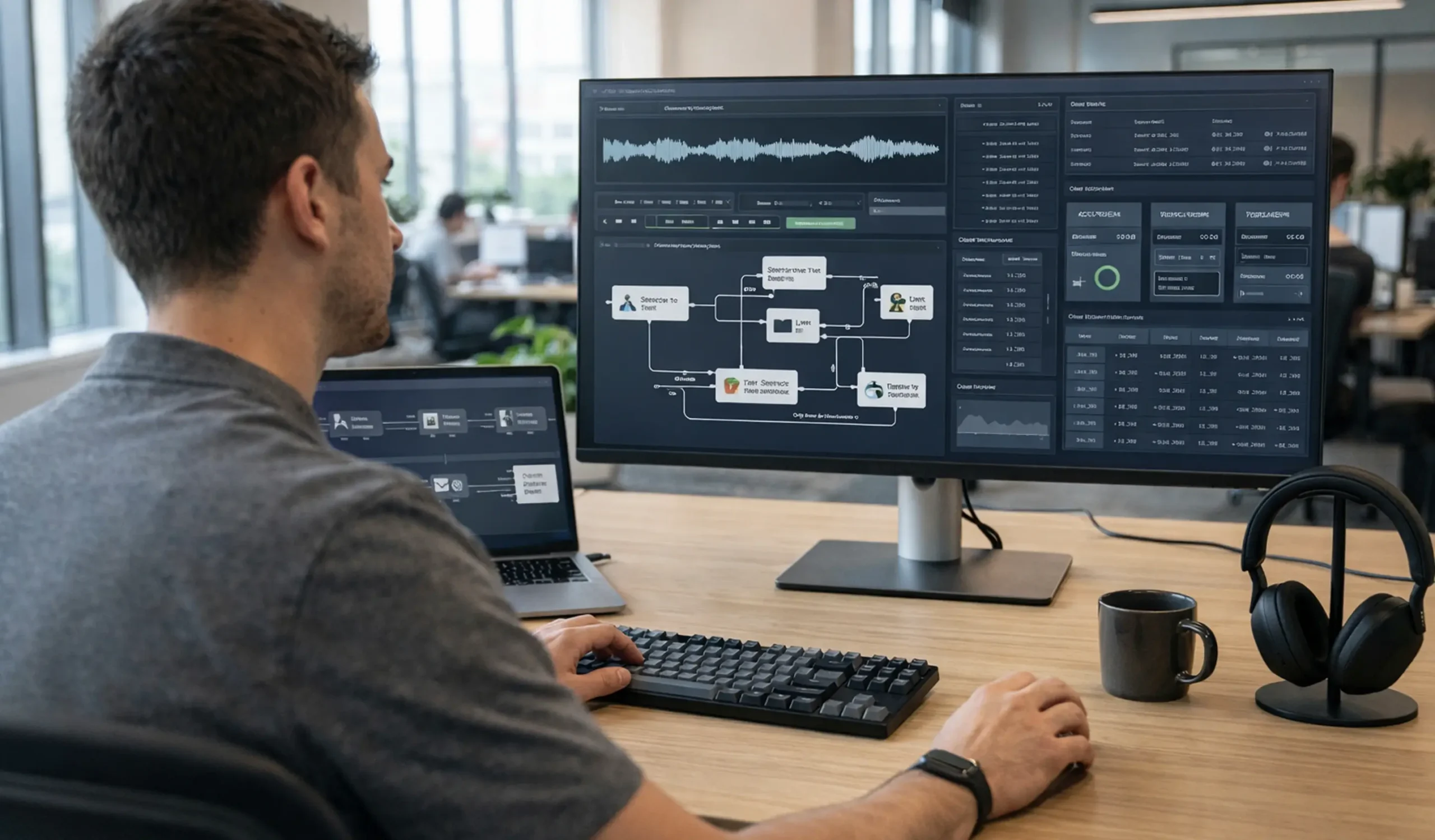
A voice agent that cannot change state in your systems is an expensive answering machine. Voice AI integration is the work of turning speech into reliable actions, and it is consistently the largest share of effort in a custom build. It spans four layers, each with its own failure modes.
Telephony and transport. Phone traffic arrives over SIP trunks or carrier APIs; in-app voice usually runs over WebRTC. The integration has to handle codec conversion, DTMF fallback, warm transfers to human agents with context attached, and call recording that respects consent rules per jurisdiction. Endpointing and barge-in live here too, and they shape perceived latency more than any model choice.
Tools and business systems. Every action — check availability, create a booking, update a CRM record, open a ticket — is a tool call against a real API. Those calls need strict schemas, idempotency keys so a retried booking does not become two bookings, timeouts sized to the conversation, and a plan for what the agent says while a slow backend responds. A two-second CRM lookup is invisible in a web app and painfully audible on a call.
State and context. The agent has to hold conversation state, reconcile it with system state, and recover cleanly when a downstream write fails mid-dialogue. For assistants, this extends to authentication, session memory, and permission checks before reading or changing user data.
Observability and evaluation. Production voice systems need per-turn traces: what was heard, what the model decided, which tool fired, how long each stage took at P50 and P95. Transcripts become your regression suite, and task-completion and escalation rates become your health metrics.
A practical integration checklist before any voice agent goes live:
- Every tool call is schema-validated, idempotent, and has a defined timeout and fallback phrase.
- Human handoff carries the transcript, captured intent, and collected fields.
- PII is redacted before transcripts reach logs or analytics.
- Latency is measured end to end, from the caller’s last word to the agent’s first audio.
- A replayable test corpus of real (anonymized) calls runs on every prompt or model change.
Voice Cloning Integration Is a Consent Pipeline With Audio Attached
Voice cloning has become technically trivial. Instant cloning works from seconds of audio, while professional cloning fine-tunes a model on longer recordings for more consistent results (ElevenLabs). For brands, the appeal is clear: a recognizable spokesperson voice across support lines, onboarding flows, and product content, without booking studio time.
The engineering challenge has moved from the model to the process around it. Major providers now gate cloning behind verified consent: ElevenLabs requires a consent attestation for every clone and a recorded verification statement for professional clones, and Speechify switched off unverified cloning entirely in September 2026 in favor of a challenge phrase the speaker reads aloud (Speechify docs). If your product lets end users clone voices, you inherit that obligation and need consent capture in your own flow.

Regulation reinforces the point. Since 2 August 2026, Article 50 of the EU AI Act requires providers of systems generating synthetic audio to mark outputs in a machine-readable, detectable way, and requires deployers to disclose deepfake audio; systems already on the market before that date have until 2 December 2026 for the marking duty (Morgan Lewis). The same article requires people to be told when they are interacting with an AI system. In the US, the FCC’s February 2024 ruling confirmed that AI-generated and cloned voices count as “artificial” under the TCPA, so outbound calls using them need the same prior consent as any prerecorded call (Cooley).
In practice, voice cloning integration means building these components alongside the TTS call:
- Verified, recorded consent from the voice owner, stored as an auditable record linked to the voice ID.
- Contractual scope: where the voice may be used, for how long, and what happens when the relationship ends.
- Retention and deletion flows that remove the voice model and samples on request.
- Output marking or watermarking, and a clear AI disclosure at the start of every interaction.
- Access controls so only approved workflows can synthesize speech in the cloned voice.
This section summarizes public guidance and is not legal advice; confirm obligations for your jurisdiction with counsel.
Build, Buy, or Compose: Match the Approach to Where Your Value Lives
The choice is rarely a pure build or a pure buy. Most successful custom voice AI solutions are composed: rented models for speech and reasoning, an open-source or managed orchestration layer, and custom code where the business logic, integrations, and compliance controls live. The useful question is which layers you must own.
| Approach | Fits when | Main trade-off |
| Buy a managed voice-agent platform | Standard workflow, few integrations, fast launch matters most | Limited control over latency, data flow, and per-minute cost at scale |
| Compose on an orchestration framework | Custom tools and business rules, swappable STT/LLM/TTS vendors | Your team owns telephony, monitoring, and on-call |
| Build the full stack | Strict data residency, on-prem or self-hosted models, very high volume | Highest upfront cost and the longest path to production |
A few signals push decisively toward a custom or composed build: the agent writes to more than two core systems, calls involve regulated data such as health or financial records, you need a cloned or proprietary brand voice under your own consent controls, or projected volume makes platform per-minute pricing the largest cost in the business case.
A Delivery Roadmap That Survives Real Callers
Voice AI projects fail in production for predictable reasons: demos built on clean audio, integrations tested only on the happy path, and no baseline to measure improvement against. A staged rollout addresses each of those risks before it becomes an incident.
- Discovery. Pull real call recordings or support logs, map the top intents by volume, and define what “done” means for each one: a booking created, a ticket filed, a transfer completed.
- Dual prototype. Build the same two or three flows on a cascade and, if latency or naturalness is critical, on a speech-to-speech model. Compare them on your own audio, not on vendor benchmarks.
- Integration hardening. Wire the real APIs with idempotency, timeouts, and fallbacks. Test failure paths deliberately: slow CRM, double submit, caller hangs up mid-write.
- Shadow and partial launch. Run the agent on a small share of traffic or after hours, with human handoff always available, and review transcripts daily.
- Scale and iterate. Expand intents as task-completion rates hold, and treat prompts, tools, and voice settings as versioned code with regression tests.
The Competitive Edge Lives in the Plumbing, Not the Voice
Every competitor can buy the same speech models, the same latency, and the same convincing voices. What they cannot buy is your integration layer: the tool contracts that reflect your business rules, the state handling that survives failed writes, the observability that shows exactly why a call went wrong, and the consent pipeline that makes a cloned voice an asset rather than a liability. That is where custom voice AI solutions create durable value.
Start from scope (bot or assistant), pick the pipeline your integrations and compliance needs can live with, invest most of the budget in voice AI integration, and treat voice cloning integration as a governed process from day one. Teams that do this ship voice agents that hold up under real callers; teams that start from the voice usually end with a great demo.
Author