In this article
Computer Vision for Sports Video in 2026: Our Review of the Tools That Matter
Tech & Infrastructure
Sports video analytics has matured a lot in the last few years. Open-source detectors, trackers and calibration models now cover most of the building blocks, and ball and pitch tracking for soccer is one of the most common requests we get from clients. But each tool has clear strengths and blind spots, and how you […]
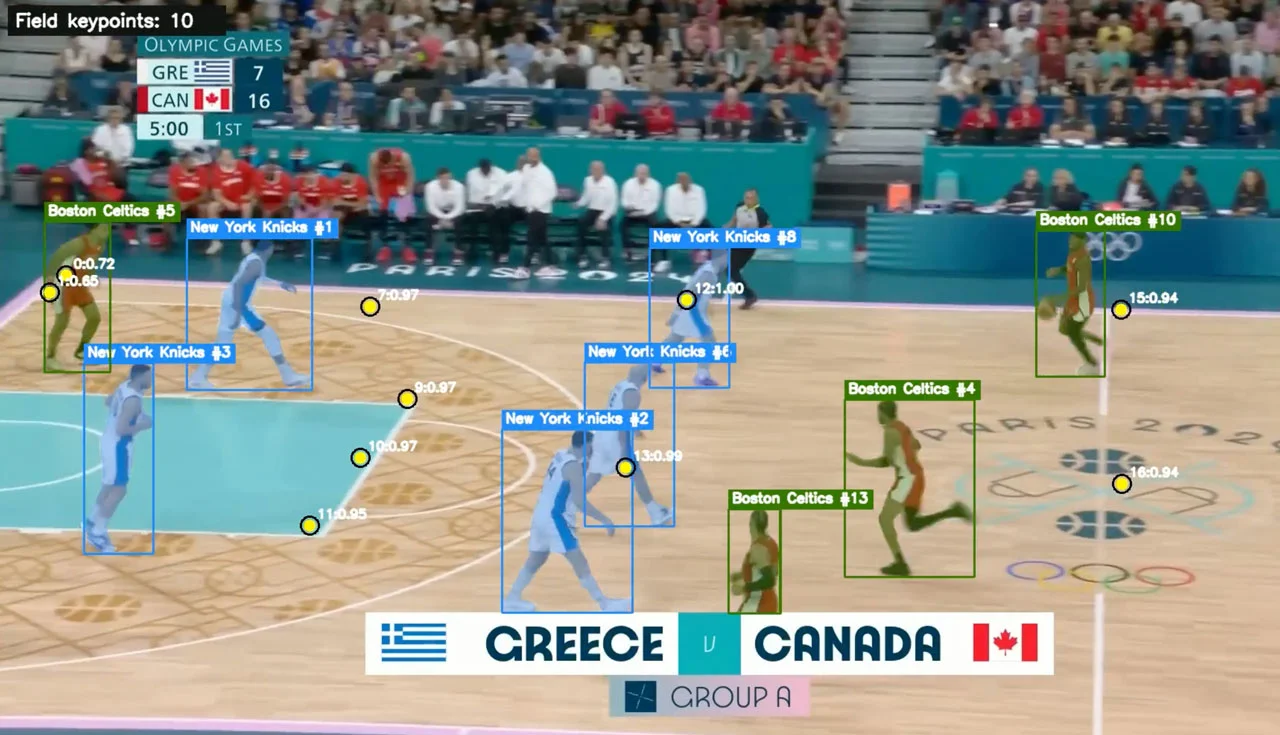
Sports video analytics has matured a lot in the last few years. Open-source detectors, trackers and calibration models now cover most of the building blocks, and ball and pitch tracking for soccer is one of the most common requests we get from clients. But each tool has clear strengths and blind spots, and how you combine them matters more than which one you pick.
Below is our review of the five tools we rely on most, along with results from our own tests comparing different setups on real broadcast footage, deliberately built from the hard parts of a match: zooms, coach close-ups, replays and crowded penalty boxes.
Roboflow: the best starting point, not the finish line
What it is: open-source models, datasets and the roboflow/sports stack for ball and player detection and pitch keypoints.
Where it shines: getting a working baseline in hours. On clean wide shots, the pretrained ball detector and keypoint model give convincing results out of the box.
Where it’s weaker: broadcast footage it hasn’t seen. The off-the-shelf ball detector loses the ball on zooms and in crowded scenes, and pitch keypoints are often a few pixels off, which on a wide shot means meters on the pitch.
Our tests: fine-tuning the Roboflow ball detector on a few hundred hand-labeled frames from the target footage raised ball recall from 62% to 85%. That was the single biggest improvement in the whole pipeline. Pretrained is a baseline; your own labels are what make it production-grade.
PnLCalib: our pick for camera calibration
What it is: a calibration method that estimates camera parameters from both pitch points and lines.
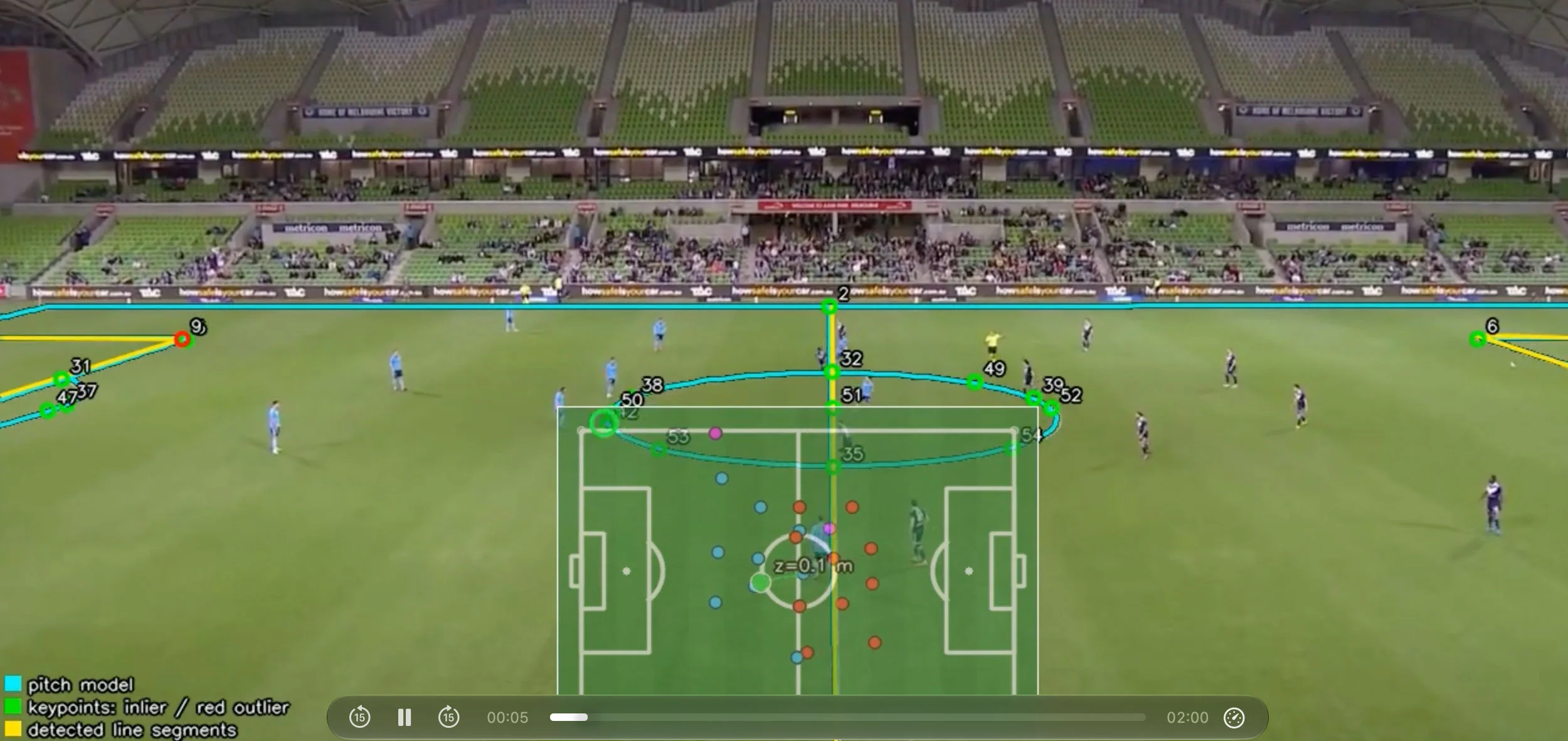
Where it shines: zoomed and partial views. When only a few keypoints are visible, lines such as the touchline, box edges and center circle still constrain the camera, so calibration holds where keypoint-only homography fails.
Where it’s weaker: used as-is, it doesn’t fix small misalignments, and it needs per-frame quality checks to catch bad fits.
Our tests: we compared three setups:
| Setup | Pitch-position error |
| Raw keypoint homography (baseline) | 5–8 m |
| PnLCalib as-is | Better coverage on zoomed shots, but visible line misalignment |
| PnLCalib + Roboflow keypoints, refined by snapping projected lines to the real white lines | 0.15–0.4 m |
The refinement step is what makes the difference: the painted lines are visible ground truth in every frame, so aligning the projected pitch to them removes most of the error. Running PnLCalib alone and adding only quality metrics on top gives you a report on how good the calibration is, not a better calibration.
ByteTrack vs. OC-SORT: players, not the ball
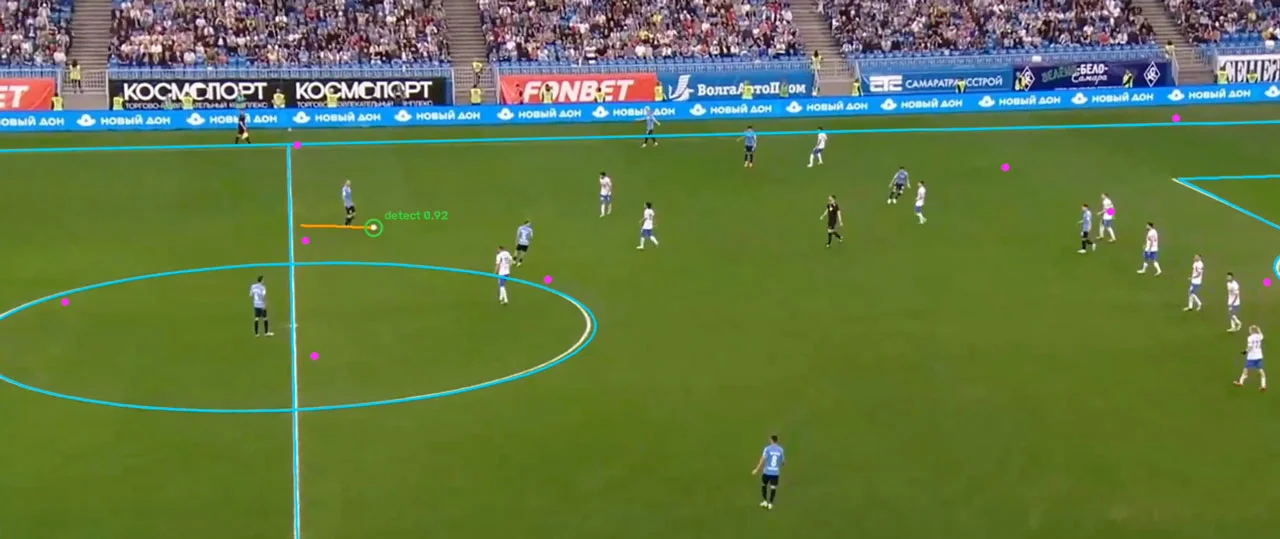
Detecting a player in a single frame is only half the job. To turn video into analytics, the system has to recognize that the player in frame 1,000 is the same person as in frame 1,001, and keep that identity through tackles, crowded corners and camera pans. This is called multi-object tracking. Without it, you can’t measure distance covered, build heatmaps or link a pass to the player who made it.
There is one important caveat. Neither ByteTrack nor OC-SORT is designed to track the ball. The ball is tiny, moves much faster than players, changes direction with every kick and is often hidden behind legs. It needs a dedicated tracking step of its own. Player tracking still plays a key role here: when the ball disappears into a group of players, their tracks show where it is most likely to reappear. In practice, reliable player tracking is what helps the system find the ball again after it has been lost.
We tested both trackers on the same difficult broadcast fragments. Each has a clear area where it performs best:
| ByteTrack | OC-SORT | |
| Best at | Wide shots, general play | Crowded scenes: set pieces, box scrambles |
| Strength | Fast; keeps identities through partial occlusion by using low-confidence detections | Handles sharp direction changes and longer occlusions |
| Weakness | More ID switches in dense clusters | Slightly heavier, little gain in open play |
Our recommendation: use ByteTrack by default and switch to OC-SORT for crowded segments. This combination gives accurate tracks where they matter most without paying the higher computing cost for the whole match.
One more practical point. Many tracking systems also identify people by appearance, a method known as ReID (re-identification). In soccer it adds little value, because teammates wear identical kits and look almost the same on camera. Instead of spending budget on it, we rely on motion patterns, pitch position and, where needed, jersey numbers or team assignment. The result is more reliable tracks at a lower cost.
SoccerNet: data and a reality check
What it is: the largest public collection of soccer datasets and benchmarks, covering calibration, tracking and event spotting.
Where it shines: pretraining data and an external reference point for every stage of the pipeline.
Where it’s weaker: benchmark scores don’t transfer automatically. Models that do well on SoccerNet can degrade on a new broadcaster’s footage.
Our approach: SoccerNet for training and benchmarking, plus hand-labeled ground truth from the client’s own video for the numbers that actually matter.
What separates a demo from a working system
Across all our tests, the tools themselves turned out to be less decisive than the engineering around them:
- Test on the hard fragments. Two clean wide clips without zooms or cuts will make any pipeline look good.
- Classify shots first. Calibrating a close-up of a coach gives a confident but wrong result. Label such frames instead.
- Filter the noise: spare balls outside the pitch, broadcaster watermarks, scoreboards.
- Use the refined calibration everywhere, including the final visualization, not raw keypoints.
- Measure against your own ground truth, with strict train/test separation and label QA. Every reported metric should be reproducible from the output files. A pipeline with “pending” metrics is not finished.
Beyond the Pitch: Where the Same Computer Vision Stack Pays Off
The building blocks reviewed above are not specific to soccer. Detection, multi-object tracking and camera calibration together answer one question: what is where, and how does it move, in real-world units. In other sports, the main change is the training data. Basketball, hockey, tennis and rugby use the same detector-plus-tracker logic, and court or rink markings serve as calibration references the same way pitch lines do. Broadcasters, sports data providers, clubs and federations use this to cut highlights automatically, generate live stats and feed coaching tools without manual tagging.
In retail and other physical spaces, the same pipeline counts visitors, measures dwell time and maps queues. Calibrating ceiling cameras to the floor plan turns pixel positions into meters, so heatmaps show actual store zones instead of camera angles. Tracking that survives occlusion, the problem OC-SORT solves in a crowded penalty box, is what keeps people counts accurate at peak hours. We described a real deployment in our case on AI video analytics for retail.
Logistics, manufacturing and smart-city projects follow the same pattern. Warehouses track forklifts and pallets to find bottlenecks and safety violations. Production lines detect defects and verify assembly steps. Traffic systems measure vehicle speed and flow from calibrated street cameras. In each case, the lessons from soccer apply directly: pretrained models are a baseline, hard footage shows the real error, and a system is finished only when its metrics are measured against your own ground truth. The industry changes, but the engineering discipline that turns video into reliable data stays the same.
From our practice: We used the same approach for a European retail chain with 40+ stores in three countries. A YOLOv8 detector and ByteTrack, the tracker we use for soccer players, turned existing CCTV into real-time people counting, zone alerts and after-hours intrusion detection, all running on-site, with no new cameras and no facial recognition. In a three-store pilot, the system processed 30+ FPS per stream with counting accuracy above 95%. Read the full case →
From Prototype to Production: AI Development with Meduzzen
Every result in this review came from engineering decisions, not from the choice of library. Ball recall rose from 62% to 85%, and position error fell from 5–8 m to 0.15–0.4 m. That is the work our Artificial Intelligence services team does for clients. We build custom models trained on the client’s own footage, set up data pipelines and labeling with quality control, and integrate the results into the products and dashboards the client already uses.
We usually start with a short discovery phase on your video. We select the difficult fragments, label a ground-truth set and benchmark open-source baselines against it. This shows you what accuracy is realistic before you commit a larger budget. After that, we fine-tune, refine and harden the pipeline. We also keep monitoring it in production, because models degrade when cameras, broadcasters or lighting conditions change.
You might need ball and player tracking, people analytics for physical locations, or a custom vision system for an industrial process. In every case, the approach is the same: measurable results on your data, reproducible metrics and a pipeline your team can rely on. If you have video data that should be working harder for your business, let’s discuss your use case.
Summary: The Right Stack for Computer Vision in Sports Video
| Tool | Use it for | Watch out for |
| Roboflow | Baseline detection and keypoints | Fine-tune on your own footage (+23 percentage points recall in our tests) |
| PnLCalib | Camera calibration on zoomed/partial views | Refine against real white lines (5–8 m → 0.15–0.4 m) |
| ByteTrack | Player tracking in general play | ID switches in dense clusters |
| OC-SORT | Crowded scenes | Little gain in open play |
| SoccerNet | Training data and benchmarks | Always validate on your own footage too |
This combination is what we deliver to clients in production: per-frame ball coordinates in meters, field lines for every calibrated frame, and an explicit status on every frame. That is the foundation for everything more advanced in soccer analytics, from possession and passing networks to event detection.
The main takeaway from our tests is simple. In computer vision for sports video, no single tool decides the outcome. Open-source models provide a fast start, but production accuracy comes from fine-tuning on your own footage, refining calibration against the real pitch, and checking every frame against reliable ground truth. Teams that skip these steps get a convincing demo. Teams that follow them get data they can build products on.
The toolset will keep changing in 2026 and beyond. New detectors, trackers and calibration methods appear every few months, and some of the tools in this review will be replaced. The method will not change: test on the hardest fragments, measure honestly and treat every metric as something that must be reproducible. That discipline is what turns sports video into a dependable source of analytics, whether the end goal is live statistics, scouting, broadcast graphics or automated match analysis.
Author