In this article
SaaS application development: A practical guide for startups
Business & Strategy
Learn the full SaaS application development lifecycle, team models, frameworks, and scaling strategies to build and grow your product without costly mistakes.

TL;DR:
- Structured development phases in SaaS reduce risk and improve efficiency.
- Choosing the right team model impacts speed, control, and long-term success.
- Effective scaling relies on proactive architecture, DevOps, and organizational practices.
Most founders believe their SaaS product is six months away from launch. Then reality sets in. Scope expands, architecture decisions get deferred, and the team structure that felt right at ideation starts showing cracks under pressure. The truth is, structured development phases reduce risk and improve efficiency, yet most early-stage teams skip the scaffolding in pursuit of speed. This guide walks through the full SaaS application development journey, from lifecycle stages and team models to frameworks, architecture choices, and scaling strategies. Whether you’re a founder mapping your first product or a CTO refining your delivery process, you’ll find concrete, actionable steps here, along with the pitfalls that quietly derail even well-funded teams.
Key Takeaways
| Point | Details |
|---|---|
| Structure reduces SaaS risks | Following proven stages accelerates release and avoids costly missteps. |
| Dedicated teams speed delivery | A dedicated development team ramps up faster and provides continuity for complex SaaS. |
| Pick the right framework | Agile, Scrum, or Kanban should fit your team’s workflow and product phase. |
| Architect for scaling early | Microservices and horizontal scaling prepare your SaaS for growth with fewer bottlenecks. |
| Solving bottlenecks drives growth | Proactive DevOps, monitoring, and regular reviews help overcome growth challenges. |
Understanding the SaaS development lifecycle
Building a SaaS product isn’t a single sprint. It’s a sequence of decisions, each one shaping the next. Getting that sequence right is what separates teams that ship reliably from those that constantly firefight.
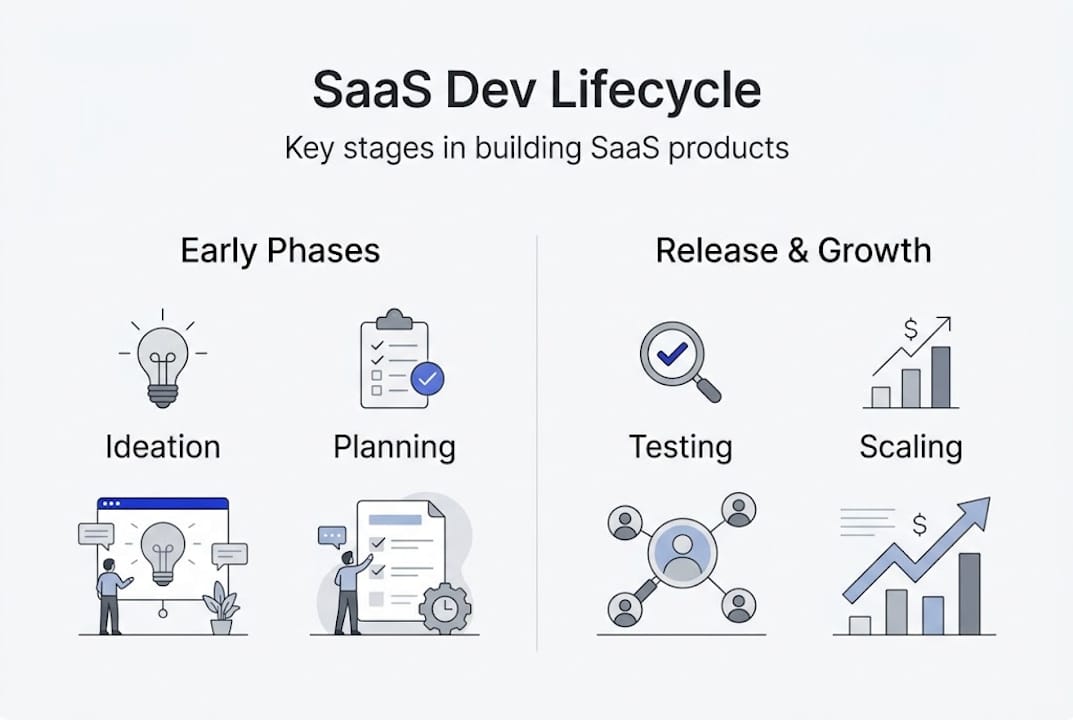
The core stages of SaaS application development follow a deliberate order:
- Ideation and discovery. Define the problem, validate demand, and map out your core user journey. This is where assumptions get stress-tested before a single line of code is written.
- Planning and architecture. Choose your tech stack, design the system architecture, and break work into trackable milestones. Decisions made here echo through every future sprint.
- MVP build. Focus on the smallest version of your product that delivers real value. End-to-end development discipline matters here: every feature should connect directly to a user outcome.
- Testing and QA. Automated and manual testing should run in parallel with development, not after it. Catching bugs late is exponentially more expensive than catching them early.
- Deployment. A well-structured CI/CD pipeline makes releases predictable. Cloud development for SaaS can cut time-to-market significantly when infrastructure is treated as code from day one.
- Scaling and iteration. Post-launch is where most technical debt surfaces. Regular architecture reviews and performance monitoring keep the product stable as user load grows.
Each stage fits naturally into Agile cycles. Ideation and planning anchor the start of a release cycle, while testing and deployment close it. The key is treating each phase as a gate, not a formality. Python for SaaS scalability is one example of how technology choices at the planning stage shape how smoothly you move through later phases.
Why does structure matter so much? Because structured lifecycle phases reduce risk and improve efficiency in measurable ways. Teams that skip planning or compress testing consistently face overruns, rework, and frustrated stakeholders.
Pro Tip: Build a pre-launch checklist that covers infrastructure readiness, test coverage thresholds, rollback procedures, and monitoring setup. Teams that use these checklists avoid the class of issues responsible for nearly 45% of budget overruns on SaaS projects.
Choosing the right team structure: In-house, agency, or dedicated team?
Who builds your SaaS matters as much as how you build it. The wrong team model creates friction that slows every decision, every release, and every pivot.

Here’s how the three main models compare:
| Factor | In-house | Agency | Dedicated team |
|---|---|---|---|
| Ramp-up time | 3 to 6 months | 2 to 4 weeks | 2 to 4 weeks |
| Cost | High (salaries, benefits) | Project-based | Predictable monthly |
| Control | Full | Limited | High |
| Continuity | High | Low (project-based) | High |
| Best fit | Core product teams | Short-term or fixed scope | Long-term SaaS scaling |
In-house teams ramp up in 3 to 6 months, while dedicated teams are operational in 2 to 4 weeks and offer the continuity that long-term SaaS projects demand. That difference compounds over time. A six-month delay in assembling your team is a six-month delay in learning from real users.
The right model depends on your situation:
- Choose in-house when you’re building a core technical capability that defines your competitive advantage and you have the runway to hire and onboard slowly.
- Choose an agency when the project is well-defined, time-boxed, and unlikely to require ongoing iteration after delivery.
- Choose a dedicated team when you need speed, flexibility, and continuity on a product that will evolve for years. This is the model most SaaS development experts recommend for growth-stage startups.
The most common mistake we see is founders choosing a model based purely on upfront cost. An agency might look cheaper for the first quarter, but if your product needs constant iteration and the agency rotates team members between projects, you pay for that instability in lost context, rework, and slower releases.
Pro Tip: Regardless of team model, assign a dedicated technical lead who owns continuity. This person carries institutional knowledge across phases and is your best defense against the knowledge loss that happens when team members turn over.
Agile, Scrum, and Kanban: Frameworks for SaaS velocity
Knowing who will build your SaaS is one thing. Knowing how they’ll organize their work is another. Methodology isn’t bureaucracy. It’s the operating system your team runs on.
Here’s a quick orientation on the main frameworks:
| Framework | Strengths | Weaknesses | Best for |
|---|---|---|---|
| Scrum | Structured sprints, clear velocity | Rigid cadence | Feature-heavy SaaS builds |
| Kanban | Flexible, visual flow | Less predictable delivery | Ops, support, continuous updates |
| Scrumban | Hybrid flexibility | Requires team maturity | Mixed SaaS teams |
| SAFe Agile | Enterprise-scale coordination | Heavy process overhead | Large multi-team SaaS orgs |
Agile and Scrum provide structure for feature sprints, while Kanban suits continuous operations. Scrumban, a hybrid of the two, has become common in SaaS teams that handle both product development and ongoing platform maintenance simultaneously.
Here’s how a typical SaaS sprint unfolds in practice:
- Sprint planning. The team pulls prioritized items from the backlog, estimates effort, and commits to a two-week scope.
- Daily standups. Fifteen minutes to surface blockers, align on progress, and keep work flowing.
- Development and review. Features are built, tested, and reviewed within the sprint. Nothing ships untested.
- Sprint retrospective. The team reflects on what slowed them down and what to change next cycle.
“Use velocity with Scrum and WIP limits in Kanban to optimize SaaS team output.” Tracking these metrics honestly is what separates teams that improve from teams that just stay busy.
The real insight is that no single framework works perfectly for every phase. Early-stage SaaS teams benefit from Scrum’s structure. As the product matures and the team shifts toward platform stability and incremental improvements, Agile in SaaS frameworks naturally evolve toward Kanban or Scrumban. The teams that struggle are the ones that lock into one approach and refuse to adapt.
Architecting for scalability: Monoliths, microservices, and horizontal scaling
Once your delivery approach is clear, the next challenge is building something that won’t buckle under growth. Architecture is the foundation, and like any foundation, fixing it after the fact is painful and expensive.
| Architecture | Dev speed | Cost | Maintenance | Scaling |
|---|---|---|---|---|
| Monolith | Fast initially | Lower upfront | Grows complex | Vertical, limited |
| Microservices | Slower initially | Higher upfront | Modular, cleaner | Horizontal, flexible |
Monoliths speed up MVP development, while microservices are better suited for scale. This isn’t a permanent choice. Many successful SaaS products start as monoliths and migrate to microservices as specific components need independent scaling.
Scaling challenges tend to cluster around a few recurring pressure points:
- Database performance. As query volume grows, poorly indexed tables and unoptimized queries become your biggest bottleneck.
- DevOps resource allocation. Teams that treat infrastructure as an afterthought hit walls when they try to scale deployments. Key bottlenecks include database performance and DevOps allocation.
- Service dependencies. In microservices environments, cascading failures become a real risk without proper circuit breakers and observability.
- State management. Horizontal scaling requires stateless services. If your app carries session state in memory, scaling out breaks user sessions.
The benchmarks are worth knowing. Median SaaS growth rates run 19 to 28% annually, with revenue per employee at $129,000 to $173,000. AI-native SaaS companies reach 100% growth in their early stages. These numbers matter because they define the load your architecture needs to absorb.
The SaaS scalability guide principle we return to again and again: design for the scale you expect in 18 months, not the scale you have today. It costs less to build in headroom than to retrofit it under pressure. Pairing strong architecture with solid DevOps services for SaaS is what keeps releases smooth as load increases.
Scaling SaaS for growth: Overcoming technical and organizational bottlenecks
Architecture gets you ready to scale. Operations keep you scaling. The gap between the two is where most SaaS products quietly accumulate risk.
The recurring bottlenecks we see across SaaS teams at growth stage:
- Database performance degradation. Read replicas, query optimization, and caching layers are not optional at scale. They’re structural requirements.
- DevOps inefficiency. Manual deployments and inconsistent environments slow release cycles and introduce human error. SaaS scaling challenges consistently include DevOps gaps as a top contributor to instability.
- Team communication overhead. As teams grow, coordination costs rise. Without clear ownership and documented processes, decisions slow down and context gets lost.
- Insufficient test coverage. Shipping fast without automated tests is borrowing against future stability. The debt comes due at the worst possible moment.
The metrics that matter at scale: growth rate (target 19 to 28% annually for healthy SaaS), revenue per employee ($129,000 to $173,000 is the benchmark range), and monthly customer churn (anything above 2% signals a retention problem worth investigating immediately).
Quick wins that compound over time:
- Automate your test suite to cover at least 70% of critical paths before each release.
- Set up real-time monitoring and alerting from day one, not after the first outage.
- Use staged rollouts and feature flags to reduce blast radius when something goes wrong.
- Schedule quarterly architecture reviews with your CTO scalability guide framework in mind.
Pro Tip: Invest in SaaS DevOps solutions before you feel the pain. Teams that build CI/CD pipelines and infrastructure automation early spend far less time firefighting and far more time shipping features that matter to users.
SaaS development lessons most teams learn too late
After working with hundreds of SaaS teams across FinTech, Healthcare, EdTech, and Logistics, patterns emerge. Not just in what teams do right, but in what they consistently get wrong, often at the exact moment it hurts most.
The biggest one: rushing from MVP to scale without addressing technical debt. It feels like momentum. It’s actually a slow leak. The codebase becomes harder to change, onboarding new engineers takes longer, and every new feature costs more than the last. The teams that build well from the start spend less time managing chaos later.
Choosing a team model for cost rather than fit is the second most common mistake. A cheaper agency that rotates staff leaves you rebuilding context every few months. That’s not a savings. It’s a hidden tax on your velocity.
Here’s something counterintuitive: SaaS success is less about the perfect tech stack and more about the speed of your learning cycles. Teams that ship, measure, and adjust quickly outperform teams with better technology but slower feedback loops. As end-to-end SaaS lessons consistently show, the discipline of connecting every build decision to a user outcome is what separates products that grow from products that stall.
Most teams also wish they had documented deployments earlier, automated more from the start, and built monitoring in from day one rather than bolting it on after the first incident. “Structured pre-launch checklists can slash overruns by 45%.” That number is real, and the teams that dismiss it are usually the ones who end up living it.
How Meduzzen helps you build and scale your SaaS
Putting these strategies into practice takes more than a good plan. It takes the right people, working in the right structure, with the experience to anticipate what comes next.
At Meduzzen, we’ve spent over 10 years helping startups and growth-stage companies build and scale SaaS products across Python, AI, DevOps, and cloud technologies. Our dedicated teams integrate directly into your workflow, bringing fast onboarding, transparent communication, and the kind of technical depth that keeps your product moving forward. Whether you need Meduzzen SaaS services for a full product build, custom DevOps solutions to stabilize your infrastructure, or staff augmentation for SaaS to fill specific gaps in your team, we work with you to match the right model to your actual situation. If you’re ready to build something that scales, let’s talk.
Frequently asked questions
What are the main stages of SaaS application development?
The critical stages are ideation, planning and architecture, MVP or initial build, testing, deployment, and ongoing scaling or maintenance. Sequential lifecycle phases reduce risk and improve delivery efficiency at every step.
How do I choose between in-house, agency, or dedicated development teams?
If control and continuity matter most, in-house is the right call. For faster ramp-up and long-term flexibility, a dedicated team ramps in 2 to 4 weeks compared to 3 to 6 months for in-house hiring, making it the stronger fit for evolving SaaS products.
Which development methodologies are best for SaaS projects?
Agile and Scrum are preferred for structured sprints and rapid feature releases, while Kanban suits continuous flow and operational updates. Many mature SaaS teams blend both through Scrumban.
What are the critical challenges in scaling a SaaS application?
Common hurdles include database bottlenecks, DevOps inefficiencies, insufficient test coverage, and planning for horizontal scaling before you actually need it.
What are SaaS industry benchmarks for growth and efficiency?
Median SaaS growth rates run 19 to 28% annually, with average revenue per employee between $129,000 and $173,000 per year, giving you a baseline to measure your own trajectory.