


In this article
What is software scalability? SaaS growth guide for CTOs
Business & Strategy
Apr 8, 2026
510 min read
Learn what software scalability really means for SaaS, compare architectures, study real benchmarks, and get a practical checklist for founders and CTOs in 2026.

Scaling a SaaS product feels like building a plane while flying it. You’re shipping features, onboarding customers, and somewhere in the background, your infrastructure is quietly accumulating debt. Many founders and CTOs make the same expensive mistake: they treat scalability as a fire to put out later, not a foundation to build on now. Software scalability is often confused with simply adding servers when traffic spikes, but that misses the real cost and system design trade-offs entirely. This guide breaks down what software scalability actually means for SaaS teams, which architectural choices hold up under pressure, and how to apply these lessons without over-engineering your product from day one.
Key Takeaways
| Point | Details |
|---|---|
| Scalability means more than growth | It’s about handling more users while keeping speed, reliability, and costs in check. |
| Architectures have trade-offs | Monolith, microservices, and hybrids each fit different SaaS growth stages. |
| Empirical data matters | Always measure your own system’s limits—benchmarks beat assumptions. |
| Start modular, scale deliberately | Begin with modular code, move to microservices only at proven pain points. |
| Cloud and DevOps multiply impact | Modern cloud and DevOps tooling makes scaling smoother, but only with smart design up front. |
Defining software scalability in SaaS
Let’s be precise. Software scalability is the ability of a system to handle increased load, whether that’s users, data, or transactions, by adding resources while maintaining performance, reliability, and cost-efficiency. That last part matters more than most teams realize. Scaling without cost control is just burning money faster.
“Scalability isn’t about surviving a traffic spike. It’s about growing without your unit economics falling apart.”
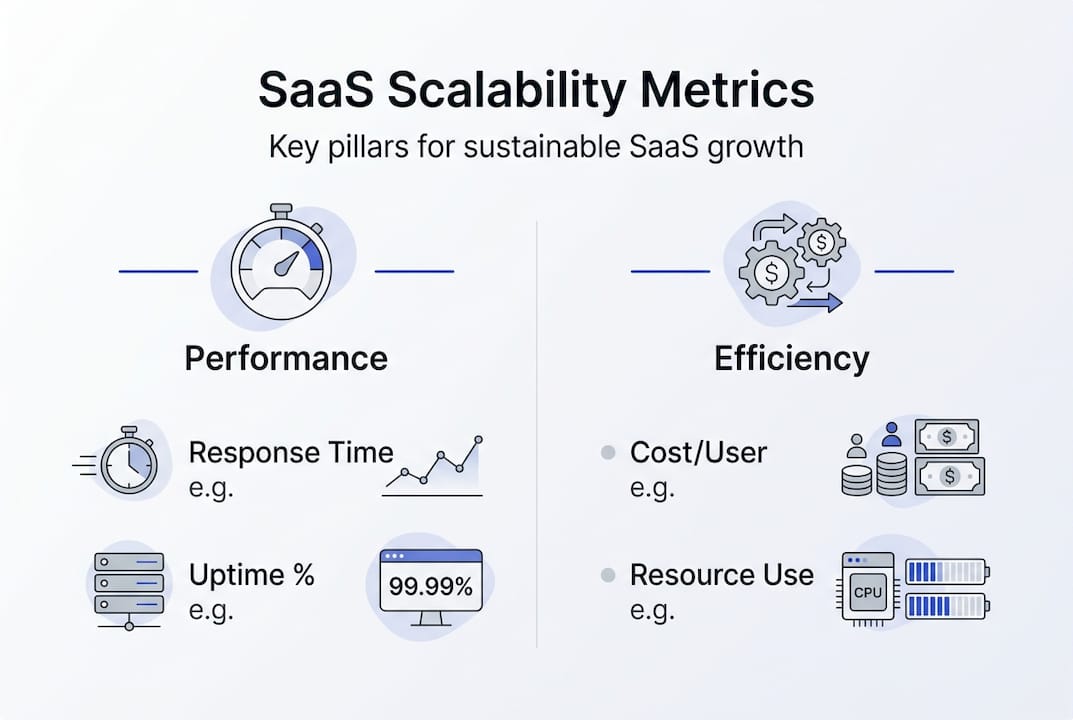
For SaaS specifically, three pillars define whether your system is truly scalable:
- Capability: Can your system absorb new load without degrading response times?
- Cost-efficiency: Does your cost per customer stay flat or decrease as you grow?
- Reliability: Does uptime hold steady as usage scales?
These pillars connect directly to the metrics that matter: response time, uptime percentage, and cost per active user. When any one of them breaks down, you feel it in churn, support tickets, and infrastructure bills. One common trap is mistaking elasticity for scalability. Auto-scaling handles dynamic load, but it doesn’t fix a poorly designed database schema or a monolithic bottleneck. For a deeper look at how this plays out in larger systems, enterprise app scalability offers useful context on design decisions that compound over time.
Core methodologies and architectural choices
With a working definition in hand, let’s unpack the methodologies that make scalable systems possible. There are three primary approaches, and choosing the right one depends on where your product is today, not where you hope it will be in three years.
| Scaling type | Resource needs | Risk level | Cost profile |
|---|---|---|---|
| Vertical (scale-up) | Single powerful server | High (single point of failure) | Steep, hits ceiling fast |
| Horizontal (scale-out) | Many smaller nodes | Medium (distributed complexity) | Gradual, more predictable |
| Diagonal (hybrid) | Mix of both | Managed (if designed well) | Flexible, context-dependent |
Primary methodologies include vertical scaling, horizontal scaling, and diagonal or hybrid approaches, each paired with principles like statelessness, caching, database sharding, and cloud elasticity. Here’s how to think about the design principles behind them:
- Statelessness: Each request carries all the context it needs. No server holds session memory. This makes horizontal scaling methods dramatically simpler.
- Caching: Store frequently accessed data closer to the user or application layer. Reduces database pressure significantly.
- Database sharding: Split large datasets across multiple database instances. Prevents a single database from becoming the bottleneck.
- Microservices: Break the application into independently deployable services. Powerful, but adds operational overhead.
Pro Tip: If you’re an early-stage SaaS team, a modular monolith is often the smarter starting point. It gives you clean internal boundaries without the operational complexity of microservices. You can explore scalable enterprise architecture and DevOps scaling tactics when the pain points actually appear.
Real-world SaaS scalability: case studies and benchmarks
So, how do these approaches play out in the real world? Let’s examine the numbers. Real benchmarks cut through theory fast.

| Company | Approach | Result |
|---|---|---|
| Keycloak | Horizontal scaling | Scaled to 12,000 req/s linearly |
| Zendesk | Graviton migration | 30% performance gain, 42% cost reduction |
| Notion | Serverless vector search | 10x scale, 90% cost reduction |
These aren’t outliers. They’re the result of deliberate architectural decisions made before the crisis hit. Notion’s vector search result is particularly striking: a 90% cost reduction isn’t a tweak, it’s a rethink. The lesson isn’t to copy their stack. It’s to understand that the right abstraction at the right time creates compounding returns.
The practical takeaways from these cases are consistent:
- Monitor for bottlenecks continuously, not just during incidents
- Optimize iteratively, not in one massive refactor
- Balance technical improvements with product delivery cycles
For founders building on modern stacks, Python SaaS scalability and cloud-driven SaaS scaling offer practical paths that align with these benchmarks. If you want to see how scalable SaaS platforms are structured from the ground up, the patterns are more accessible than most teams expect.
Architectural trade-offs: monolith, microservices, and modular monoliths
Now that you’ve seen empirical results, let’s get hands-on with architectural choices founders face. This is where a lot of teams go wrong, not because they lack knowledge, but because they follow trends instead of context.
Monolithic architecture is simpler and faster for small teams, while microservices enable independent scaling but add significant complexity. The modular monolith sits in between, offering a hybrid path that many growing SaaS teams underestimate.
Here’s an honest breakdown:
- Monolith pros: Fast to build, easy to test, simple deployment pipeline
- Monolith cons: Hard to scale individual components, risky large deployments
- Microservices pros: Independent scaling, isolated failures, team autonomy
- Microservices cons: Network overhead, distributed tracing complexity, higher DevOps cost
- Modular monolith pros: Clean boundaries, single deployment, easier refactoring path
- Modular monolith cons: Requires discipline to maintain module separation
The classic error is moving to microservices too soon. Teams see the Netflix architecture and assume it’s the goal. But Netflix built microservices to solve problems at a scale most SaaS companies will never reach. Complexity introduced before it’s needed doesn’t protect you. It slows you down.
“The best architecture is the one your team can actually operate and evolve without burning out.”
Pro Tip: Before splitting any service, trace your data flow and transaction boundaries. If two services share a database or call each other synchronously in a tight loop, splitting them creates more problems than it solves. Explore scalable AI SaaS patterns for examples of how modular design holds up under real product pressure.
Hidden challenges and expert pitfalls in scaling
Beyond the usual advice, the road to practical scalability is full of hidden traps. Here’s what technical leads need to watch for.
Vertical scaling hits hardware limits quickly, while horizontal scaling introduces network complexity, CAP theorem trade-offs, and data consistency problems. Microservices add their own layer of risk: error masking, cold starts, and dependency fan-out that’s hard to debug under load.
The less obvious bottlenecks that trip up SaaS teams include:
- Network latency: Distributed systems introduce round-trip costs that compound under load
- Single points of failure: A shared cache or message queue that nobody monitors until it goes down
- CAP theorem trade-offs: You can’t have consistency, availability, and partition tolerance all at once. Choosing wrong for your use case causes subtle data bugs
- Cold starts: Serverless functions that haven’t been invoked recently add latency spikes at the worst moments
- Error masking: In microservices, a failing downstream service can silently degrade the whole user experience
The difference between scalability and elasticity is worth repeating here. Elasticity is dynamic resizing in response to load. Scalability is structural capacity. You need both, but they solve different problems. Stress-test at realistic loads before launch, not after. Your DevOps challenges will surface faster in a controlled test than in a production incident.
Best practices and first steps for SaaS founders and CTOs
To wrap up, here’s how to put all these lessons into action for your SaaS venture. The goal isn’t perfection on day one. It’s building a system that can grow without requiring a full rewrite every 18 months.
Proactive modularity and cloud-native design can cut operating costs by 25% and raise performance 6 to 10 times before you ever need a full re-architecture. That’s not a small number. That’s the difference between a product that scales gracefully and one that becomes a liability.
Here’s a practical five-step checklist for founders and CTOs:
- Audit your current bottlenecks before adding any new infrastructure. Measure first, build second.
- Choose your architecture based on team size and product stage, not on what large companies use.
- Implement observability early: logging, tracing, and alerting should be in place before you need them.
- Design for statelessness wherever possible. It makes horizontal scaling far less painful later.
- Review your scalability posture quarterly, not just when something breaks. Treat it like a product health check.
Pro Tip: Start modular, avoid premature optimization, and refactor only at true pain points. The teams that scale well aren’t the ones who planned for everything. They’re the ones who built systems that were honest about their current constraints. Explore scalability best practices for a deeper technical reference, and consider working with a SaaS development partner when the complexity outgrows your current team’s bandwidth.
How Meduzzen helps SaaS companies scale with confidence
If you want an experienced partner to help you implement and accelerate these best practices, Meduzzen can help. We’ve spent over a decade working with SaaS founders and CTOs who are navigating exactly these decisions, from choosing the right architecture at the start to untangling systems that grew faster than their design could handle.
Our engineers specialize in web and SaaS apps, cloud-native design, modular architecture, and the kind of DevOps discipline that keeps systems stable under pressure. Whether you need to augment your existing team through team staff augmentation or build out custom DevOps solutions from scratch, we integrate quickly and work transparently. Choosing the right technical partners early can shortcut years of costly trial and error. We’d rather help you build it right the first time.
Frequently asked questions
How does software scalability differ from elasticity?
Scalability is structural capacity to grow and maintain performance, while elasticity is the system’s ability to automatically adjust resources in response to dynamic load. Both matter, but they solve different problems.
When should a SaaS startup move from monolith to microservices?
Move when you hit real pain points like deployment blockers or scaling limits, not before. Microservices add complexity that small teams often can’t absorb without slowing down.
What are signs my system isn’t scalable?
Rising latency, downtime under new user load, and growing infrastructure costs per customer are the clearest signals that your system’s scalability is under strain.
What’s a common trap SaaS teams fall into when scaling?
Moving to microservices too early is the most common mistake. The operational overhead often outweighs the benefits for teams that haven’t yet hit the scaling limits a monolith creates.
Can adopting cloud technologies improve scalability instantly?
Cloud tools lower the barrier, but auto-scaling alone won’t fix code or database bottlenecks. Good system design has to come first for cloud infrastructure to deliver its full value.