


In this article
Python now powers the backend of countless SaaS platforms, accelerating time to market and enabling data-driven innovation. Modern frameworks deliver 60% of typical SaaS backend features out of the box, cutting development timelines by weeks. This guide shows you how Python drives scalable architectures, AI capabilities, and operational efficiency for your SaaS business in 2026.
Key takeaways
| Point | Details |
|---|---|
| Rapid MVP delivery | Python frameworks provide mature tooling that accelerates SaaS product launches by weeks. |
| Scalable multi-tenancy | Python enables flexible tenant isolation strategies that reduce operational complexity and data leakage risk. |
| AI-driven innovation | Strong machine learning libraries empower SaaS platforms to embed intelligent features quickly. |
| Operational automation | Python scripting reduces manual tasks and maintenance overhead by up to 60% in data workflows. |
| Performance clarity | Misconceptions about Python scalability often ignore effective async programming and horizontal scaling patterns. |
Introduction to Python in SaaS
Software as a Service delivers applications via cloud subscription models, requiring backends that support rapid iteration, multi-tenancy, and seamless integrations. Python is a high-level, versatile programming language recognized for clean syntax and extensive libraries, making it ideal for backend development. Its interpreted nature and dynamic typing accelerate prototyping, allowing SaaS teams to validate business models faster than with compiled languages.
Python aligns naturally with SaaS business models that prioritize speed to market and continuous feature deployment. You can pivot quickly, test hypotheses, and integrate third-party APIs with minimal friction. The language’s rich ecosystem includes frameworks, database connectors, and cloud SDKs that reduce boilerplate code and let engineers focus on business logic rather than infrastructure plumbing.
The Python community is massive and active, providing a steady stream of packages, tutorials, and support. This vibrant ecosystem means you rarely build from scratch. Whether you need payment processing, authentication, or real-time notifications, a mature library likely exists. Explore Python technology overview to understand how this ecosystem supports modern SaaS architectures.
Key strengths driving Python’s SaaS adoption:
- Rapid development cycles that compress time from concept to production
- Extensive libraries for web frameworks, databases, caching, and messaging
- Strong integration capabilities with cloud platforms and third-party services
- Developer-friendly syntax that reduces onboarding time for new team members
Python frameworks optimized for SaaS MVP development
Choosing the right framework shapes your MVP velocity and long-term maintenance burden. Django is a batteries-included framework offering built-in admin panels, ORM, authentication, and form handling. This comprehensive toolkit provides 60% of typical SaaS backend features out of the box, letting you launch faster with proven patterns. Django’s monolithic approach suits teams prioritizing rapid MVP delivery over microservices complexity.
FastAPI is a modern asynchronous framework designed for high-performance APIs and microservices. It leverages Python’s async/await syntax, delivering response times comparable to Node.js while maintaining Python’s readability. FastAPI auto-generates OpenAPI documentation and performs request validation with Pydantic models, reducing boilerplate and catching errors early. You gain microservices flexibility without sacrificing developer experience.
| Framework | Key Features | Best Use Case | Developer Productivity |
|---|---|---|---|
| Django | Admin panel, ORM, authentication, templating | Monolithic SaaS MVPs needing rapid feature delivery | High for full-stack teams |
| FastAPI | Async support, auto docs, type validation | API-first platforms and microservices architectures | High for backend-focused teams |
Pro Tip: Choose Django when you need an admin interface and rapid feature rollout for your MVP. Pick FastAPI if you’re building API-first SaaS with separate frontend frameworks or planning microservices from day one.
Both frameworks integrate seamlessly with modern Python web development tools like Celery for async tasks, Redis for caching, and PostgreSQL for relational data. Understanding SaaS end-to-end development helps you architect systems that scale beyond the MVP phase. Dive deeper into the Django SaaS MVP stack for practical implementation guidance.
Python’s role in AI and data-driven SaaS
Python dominates AI and machine learning, giving SaaS platforms a decisive edge in embedding intelligent features. Libraries like TensorFlow and PyTorch enable recommendation engines, fraud detection, and predictive analytics without requiring specialized data science infrastructure. You can prototype ML models locally, validate them with real user data, and deploy them to production within weeks.

Natural language processing libraries such as spaCy and Hugging Face Transformers power chatbots, sentiment analysis, and document extraction. These capabilities transform static SaaS products into adaptive platforms that learn from user behavior. Embedding AI differentiates your offering, increases customer lifetime value, and creates competitive moats that pure-functionality competitors struggle to replicate.
The speed of AI experimentation in Python directly impacts your innovation cycle. Data scientists and engineers speak the same language, reducing friction between research and production. Models trained in Jupyter notebooks transition smoothly to production APIs, accelerating time from insight to customer value. Learn how AI shaping small businesses demonstrates this trend across industries.
Key AI capabilities Python enables in SaaS:
- Recommendation systems that personalize user experiences and boost engagement
- Predictive analytics for churn prevention and revenue forecasting
- Natural language interfaces that improve accessibility and user satisfaction
- Computer vision features for document processing and visual search
Explore Python technology overview and AI services for SaaS to see how these capabilities integrate into modern platforms.
Operational efficiency through Python automation and data analysis
Python excels at automating repetitive operational tasks that drain engineering time. Scripts handle database migrations, environment provisioning, log analysis, and alert routing with minimal code. You can schedule nightly data reconciliation, generate customer reports, and monitor system health using straightforward Python utilities. This automation reduces time for exploratory data tasks by up to 60% when combined with AI-assisted tools.
AI-powered Python libraries like AutoML frameworks and code assistants further compress data workflows. Engineers spend less time on boilerplate analysis and more time extracting business insights. This efficiency gain directly impacts your burn rate and operational leverage, letting smaller teams manage larger infrastructures. SaaS development cycles shortened by 30% through Python-based automation demonstrate measurable ROI.
DevOps and maintenance overhead drop when infrastructure as code lives in Python. Tools like Ansible, Fabric, and custom deployment scripts centralize operational knowledge in version-controlled repositories. New team members onboard faster because they read familiar Python syntax instead of arcane bash scripts or proprietary DSLs.
Pro Tip: Leverage Python’s scripting versatility to build internal tools that automate customer onboarding, data exports, and compliance reporting. These utilities compound efficiency gains as your SaaS scales.
Operational automation benefits:
- Reduced manual intervention in deployments and data pipelines
- Faster incident response through automated diagnostics and remediation
- Lower maintenance costs as teams manage more infrastructure per engineer
- Improved reliability through consistent, repeatable operational processes
Explore data analytics services to see how Python powers business intelligence workflows. Check AI bookkeeping tools for automation examples in adjacent domains.
Multi-tenancy and scalability in Python SaaS architectures
Multi-tenancy is foundational to SaaS economics, letting you serve thousands of customers from shared infrastructure. Python frameworks support multiple tenant isolation strategies, each balancing data security, operational simplicity, and cost. Schema-per-tenant architecture improves multi-tenancy isolation, reducing data leakage risk while simplifying code maintenance.
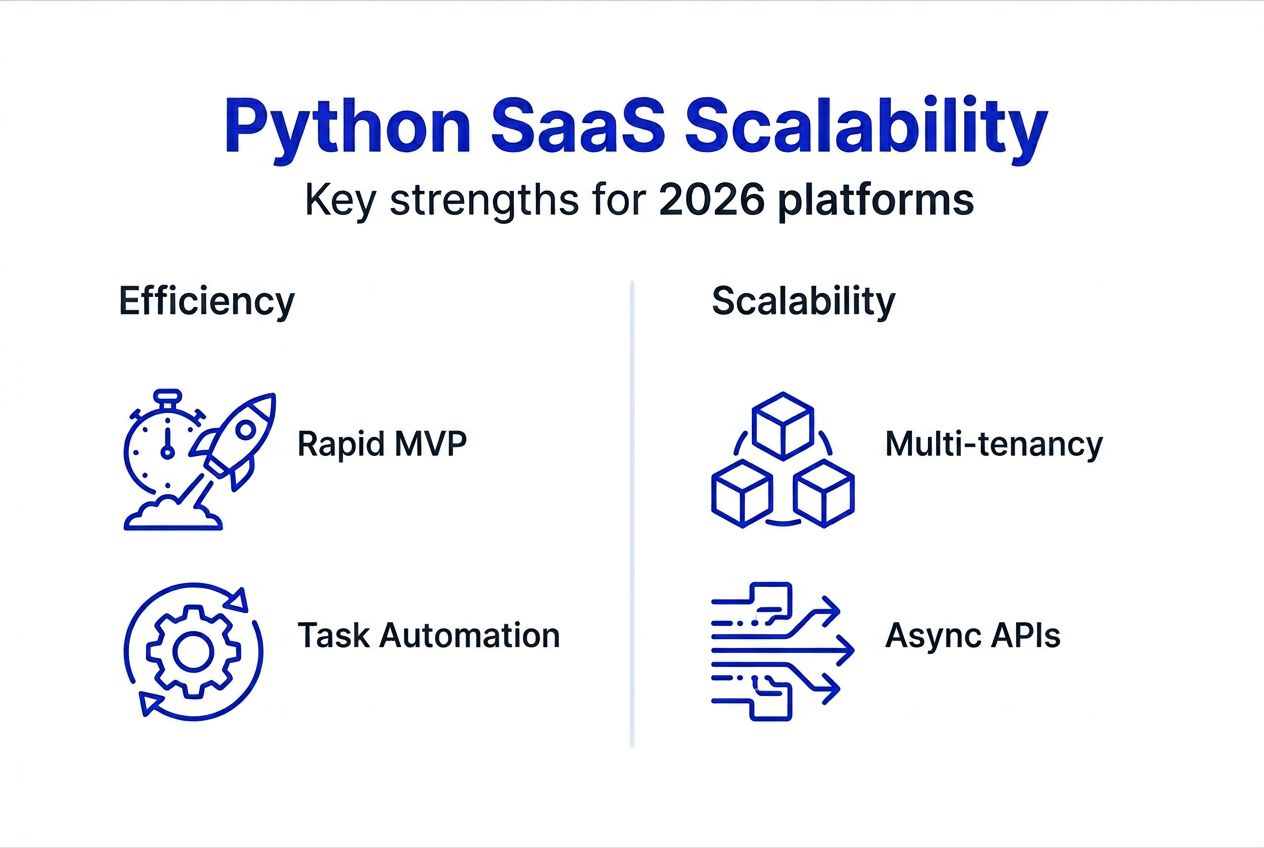
Django-tenants and similar libraries abstract tenant context, automatically routing database queries to the correct schema based on request metadata. You write business logic once and the framework handles tenant switching transparently. This pattern scales to thousands of tenants without rewriting application code, preserving engineering velocity as customer count grows.
| Approach | Isolation Level | Operational Complexity | Cost Efficiency | Best For |
|---|---|---|---|---|
| Shared schema | Low | Low | High | Early-stage SaaS with uniform customer needs |
| Schema per tenant | Medium | Medium | Medium | Mid-market SaaS balancing isolation and cost |
| Database per tenant | High | High | Low | Enterprise SaaS requiring strict data residency |
Scalability concerns often focus on vertical limits, but Python SaaS platforms typically scale horizontally. You add application servers behind load balancers, distribute background jobs across worker pools, and cache aggressively with Redis or Memcached. This approach mirrors how cloud-native platforms achieve massive scale regardless of implementation language.
Tenant isolation strategies:
- Middleware automatically injects tenant context into every request
- Database routers direct queries to appropriate schemas or connections
- Caching layers incorporate tenant IDs to prevent cross-tenant data leaks
- Background task queues partition work by tenant for fair resource allocation
Discover how SaaS application development services implement these patterns in production. Understand cloud accounting importance for real-world multi-tenant security requirements.
Common misconceptions about Python performance and scalability
The Global Interpreter Lock often surfaces as the primary Python scalability objection, but this concern misunderstands modern SaaS architectures. The GIL prevents multiple native threads from executing Python bytecode simultaneously within a single process, but asynchronous programming and multiprocessing sidestep this limitation entirely. Most SaaS bottlenecks occur in I/O operations like database queries and API calls, which async frameworks handle elegantly without hitting GIL constraints.
Async programming with asyncio and frameworks like FastAPI delivers concurrency through cooperative multitasking. Your application handles thousands of concurrent connections within a single thread, yielding control during I/O waits. This pattern matches typical SaaS workloads where network latency dominates compute time, making Python’s async model highly effective for real-world scenarios.
Multiprocessing spawns separate Python interpreters, each with its own GIL, enabling true parallel execution for CPU-intensive tasks. Background job processors like Celery distribute work across worker processes, scaling horizontally as demand increases. This architecture mirrors containerized deployments where you run many Python processes across multiple machines.
Performance tradeoffs in SaaS favor developer productivity over raw speed. Python’s readability reduces bug density and accelerates feature delivery, directly impacting revenue. The cost of adding application servers typically pales compared to engineering salaries, making Python’s developer efficiency a net economic win.
Performance realities:
- Async frameworks deliver sub-millisecond response times for typical API endpoints
- Horizontal scaling with containers and load balancers handles millions of requests daily
- Profiling tools identify actual bottlenecks, which usually live in database queries or external APIs
- The ecosystem maturity provides battle-tested solutions for caching, queuing, and optimization
Evaluating Python vs other languages for SaaS development
Choosing a backend language impacts hiring, velocity, and operational costs for years. Python offers unmatched library breadth and developer ergonomics but trades raw performance compared to compiled languages. Node.js delivers similar async capabilities with JavaScript across the stack, appealing to frontend-heavy teams. Java provides enterprise-grade tooling and performance but carries steeper learning curves and verbosity.
Talent availability tilts toward Python and JavaScript, with deep pools of developers comfortable in both ecosystems. Java expertise concentrates in enterprise environments, potentially limiting your hiring pipeline if targeting startup engineers. Python’s simplicity reduces onboarding time, letting mid-level developers contribute productively within weeks rather than months.
Ecosystem maturity varies across domains. Python dominates data science and machine learning, while Node.js excels in real-time applications and JavaScript-heavy workflows. Java shines in large-scale enterprise systems requiring strict type safety and rigorous testing. Your SaaS domain and feature requirements should guide language choice more than abstract performance benchmarks.
| Factor | Python | Node.js | Java |
|---|---|---|---|
| Hiring pipeline | Large, growing | Large, stable | Moderate, enterprise-focused |
| Time to market | Fast | Fast | Moderate |
| AI/ML ecosystem | Dominant | Emerging | Limited |
| Async performance | Excellent | Excellent | Good |
| Enterprise tooling | Good | Moderate | Excellent |
Cloud-native alignment:
- All three languages integrate seamlessly with AWS, Azure, and Google Cloud
- Container deployment is standard practice regardless of language choice
- Managed services abstract infrastructure, reducing language-specific operational differences
- Developer productivity and feature velocity often matter more than raw runtime performance
Hiring and scaling Python development teams for SaaS
Python developer demand outpaces supply, especially for engineers with SaaS and AI expertise. Senior developers in US markets command salaries exceeding $120,000, reflecting competition from tech giants and AI companies. This tight labor market makes strategic hiring and team augmentation critical for maintaining development velocity without unsustainable burn rates.
Staff augmentation lets you scale engineering capacity flexibly, adding specialized Python talent for specific projects or growth phases. You avoid long-term commitments while accessing senior engineers with production SaaS experience. This approach works particularly well for teams needing rapid scaling to hit product milestones or expand into new technical domains like machine learning.
Hiring developers without SaaS or cloud-native experience creates hidden costs. You spend months teaching multi-tenancy patterns, deployment pipelines, and scalability principles that experienced SaaS engineers bring day one. Prioritize candidates who have built and operated production SaaS platforms, even if their Python expertise is slightly less deep than pure language specialists.
Pro Tip: Prioritize candidates combining Python skills with SaaS product sense and cloud platform knowledge. Engineers who understand subscription economics and customer lifecycle management contribute beyond code, accelerating product-market fit discovery.
Python developer demand continues to outpace supply specifically in SaaS and AI domains, complicating hiring but underscoring Python’s central role in modern technology stacks.
Team building strategies:
- Use senior Python developer talent lab to find vetted candidates
- Leverage Python software development services for project-based needs
- Consider Python tech lead developer jobs to establish technical leadership
- Monitor data analytics demand trends to anticipate hiring shifts
Explore expert Python development services for SaaS success
Building scalable SaaS platforms requires balancing speed, reliability, and operational efficiency. Meduzzen brings over a decade of Python expertise, delivering SaaS solutions across FinTech, Healthcare, and Logistics industries. Our pre-vetted engineers integrate seamlessly into your team, accelerating development cycles while maintaining code quality and architectural discipline.
Whether you need dedicated Python teams, staff augmentation, or end-to-end product development, our 150+ engineers bring battle-tested experience in Django, FastAPI, AI integration, and cloud-native architectures. We focus on long-term partnerships and predictable delivery, ensuring your SaaS platform scales alongside your business. Explore professional Python software development to see how we accelerate time to market. Discover our web development services for comprehensive platform solutions. Learn about staff augmentation services to scale your team flexibly.
Frequently asked questions
What are the main Python frameworks suited for SaaS?
Django is excellent for rapid MVPs with built-in admin panels, ORM, and authentication that accelerate feature delivery. FastAPI suits asynchronous microservices and high-performance APIs requiring modern async patterns and auto-generated documentation.
How does Python handle SaaS scalability despite the GIL?
Async programming with asyncio and frameworks like FastAPI bypass GIL limitations for I/O-bound workloads typical in SaaS. Multiprocessing and horizontal scaling with containers enable true parallelism and massive scale across distributed infrastructure.
What should CTOs consider when hiring Python developers for SaaS?
Prioritize candidates with SaaS and cloud-native experience who understand multi-tenancy, deployment pipelines, and scalability patterns. Look for Python expertise combined with AI and data skills to maximize feature velocity and competitive differentiation. Consider staff augmentation to scale teams quickly and flexibly without long-term hiring commitments.