

In this article
What Is End-to-End Development? 30% Faster SaaS Delivery
Tech & Infrastructure
Mar 7, 2026
13 min read
Learn what end-to-end development means for SaaS and AI startups. Discover how unified teams manage the complete software lifecycle for 30% faster delivery.

Many founders believe end-to-end development simply means hiring full-stack engineers who can code both frontend and backend. This misconception causes startups to miss the strategic value of unified lifecycle management. True end-to-end development coordinates every phase from initial concept through ongoing maintenance, eliminating the friction that fragmented teams create in scalable SaaS and AI projects.
Key Takeaways
| Point | Details |
|---|---|
| Unified Team Approach | End-to-end development assigns one cross-functional team to manage the entire software lifecycle, improving efficiency and product consistency. |
| Complete SDLC Coverage | This model spans requirement analysis, design, development, testing, deployment, and continuous maintenance without handoff delays. |
| Speed and Quality Gains | Unified teams reduce time-to-market by eliminating coordination overhead while maintaining higher quality through integrated testing. |
| Agile and DevOps Integration | CI/CD pipelines and agile practices enable rapid iteration and market responsiveness critical for competitive SaaS and AI products. |
| Common Misconceptions | E2E is not simply full-stack coding or outsourcing fragments; it requires coordinated ownership across all development stages. |
Introduction to End-to-End Development
End-to-end development manages the entire SDLC from ideation to maintenance under a single, accountable team. For startups building scalable SaaS platforms or AI-driven solutions, this unified approach prevents the integration nightmares that plague fragmented development models. When different vendors handle requirements, design, coding, and deployment separately, miscommunication creates gaps that delay launches and compromise quality.
Cross-functional teams in end-to-end models include developers, designers, QA engineers, and DevOps specialists working together from day one. This structure eliminates the classic “throw it over the wall” mentality where one team finishes their work and hands off incomplete context to the next group. Instead, everyone shares responsibility for the product vision and execution quality.
For JavaScript applications or IoT systems, maintaining architectural consistency across phases becomes critical. End-to-end teams ensure that early design decisions support later scalability requirements rather than creating technical debt. They also adapt faster when market feedback demands pivot adjustments because the same people who built initial features understand how to evolve them.
Key characteristics of end-to-end development include:
- Single point of accountability across all project phases
- Continuous communication replacing formal handoff ceremonies
- Integrated quality assurance from requirements through production
- Shared ownership of both technical and business outcomes
- Unified tools and processes supporting seamless workflows
This strategic approach proves essential for web and SaaS applications where user expectations demand rapid feature iteration and reliable performance. Understanding these fundamentals helps CTOs make informed decisions about team structure and development partnerships.
Phases of the Software Development Life Cycle in End-to-End Development
The SDLC includes requirement analysis, design, coding, testing, deployment, and maintenance managed by a unified team. Each phase flows naturally into the next without coordination delays or context loss. Here’s how these phases integrate:
- Requirement Analysis: The team collaborates with stakeholders to document functional and technical needs. Everyone participates in clarifying success criteria rather than just business analysts capturing requirements in isolation.
- Architecture and Design: System architects work alongside UI/UX designers to create blueprints that balance user experience with technical feasibility. Database schemas, API contracts, and interface mockups evolve together.
- Development: Engineers write code while maintaining direct communication with designers and QA. This parallel work prevents the rework that happens when developers discover design gaps late in implementation.
- Testing: QA engineers participate from requirements onward, creating test plans as features take shape. Automated testing runs continuously rather than waiting for a separate testing phase, catching defects when they’re cheapest to fix.
- Deployment: DevOps practices enable automated delivery pipelines that push tested code to production safely. The same team that built features also configures monitoring and rollback procedures.
- Maintenance: Post-launch support includes bug fixes, performance optimization, and feature enhancements. The original development team handles these updates because they understand the codebase deeply.
This integrated approach contrasts sharply with waterfall models where each phase completes entirely before the next begins. Modern end-to-end teams often work on multiple phases simultaneously, applying agile sprints to deliver incremental value. For complex detailed SDLC implementations, this flexibility proves crucial when market conditions shift or technical challenges emerge.
Benefits of End-to-End Development for Startups and CTOs
Adopting end-to-end development delivers measurable improvements across time, quality, collaboration, and scalability dimensions. Unified teams accelerate time-to-market by minimizing handoffs and aligning everyone under a shared vision. When the same engineers who gather requirements also deploy features, they eliminate the translation errors that slow traditional models.

Product quality improves because integrated testing catches issues earlier. Instead of discovering that frontend assumptions conflict with backend realities during late-stage integration, end-to-end teams validate interfaces continuously. This prevents the cascading defects that plague projects where separate teams work in isolation.
Statistic Alert: Companies using agile E2E development report 30% faster response time to market changes. This agility advantage compounds over multiple release cycles, letting startups outmaneuver competitors.
Collaboration benefits extend beyond speed gains:
- Reduced miscommunication through daily standups and shared tools
- Faster decision-making when everyone understands full context
- Better technical decisions informed by business priorities
- Stronger team cohesion reducing turnover and knowledge loss
For SaaS platforms requiring continuous evolution, scalability becomes a natural outcome. End-to-end teams architect systems with growth in mind because they’ll maintain those systems long-term. They choose technologies and patterns that support adding features without exponential complexity increases.
DevOps integration further amplifies these benefits by automating deployment pipelines and infrastructure management. Teams can push updates multiple times daily when automated testing provides confidence and rollback procedures minimize risk. This rapid iteration cycle proves essential for validating product-market fit through real user feedback.
Pro Tip: Track deployment frequency and mean time to recovery as key metrics when implementing end-to-end development. These indicators reveal whether your unified team actually achieves the promised agility or still operates with hidden handoffs.
Common Misconceptions About End-to-End Development
Several persistent myths prevent organizations from adopting end-to-end development effectively. Understanding these misconceptions helps CTOs avoid implementation pitfalls.
E2E equals full-stack development: Full-stack developers possess coding skills across frontend and backend layers. End-to-end development encompasses much more, including requirements analysis, architecture design, QA processes, deployment automation, and ongoing maintenance. A full-stack engineer might contribute to an E2E team but doesn’t embody the entire model.
E2E means outsourcing everything to one vendor: Some assume end-to-end development simply consolidates multiple outsourcing relationships into one contract. True E2E requires coordinated lifecycle ownership where the same team maintains continuity from planning through operations. Vendor consolidation without process integration misses the point.
E2E ends at initial deployment: Believing that end-to-end responsibility stops when code goes live ignores the maintenance phase. Software evolution through bug fixes, performance tuning, and feature additions represents a significant portion of total lifecycle cost. Effective E2E teams plan for ongoing stewardship.
Additional myths include:
- Thinking E2E requires fewer specialists when it actually demands diverse skills unified effectively
- Assuming E2E eliminates documentation needs rather than emphasizing clear communication
- Believing E2E works only for large projects when small startups benefit from reduced coordination overhead
Pro Tip: When evaluating development partners, ask how they handle post-launch support and feature requests. True end-to-end providers integrate maintenance into their initial engagement rather than treating it as a separate service requiring new negotiations.
Frameworks and Best Practices for Implementing End-to-End Development
Successful implementation requires deliberate attention to team organization, process definition, and technology practices. Clear role definition and continuous documentation minimize bottlenecks as teams scale beyond initial members who share implicit knowledge.
Start by documenting responsibilities across the SDLC. While team members collaborate across phases, someone must own each deliverable. Product owners drive requirements prioritization, architects validate technical feasibility, and release managers coordinate deployment schedules. These roles can overlap, especially in small teams, but accountability must stay clear.
Agile methodologies provide the iterative structure that makes E2E practical. Two-week sprints with demos and retrospectives create feedback loops that course-correct before problems compound. Daily standups surface blockers quickly when the full team attends rather than cascading messages through management layers.
CI/CD pipeline automation improves reliability and feedback speed by running tests on every code commit. When automated checks validate that new features don’t break existing functionality, teams gain confidence to deploy frequently. This technical foundation enables the rapid iteration that defines effective end-to-end development.
Essential practices include:
- Version control with branch strategies supporting parallel feature development
- Automated testing covering unit, integration, and end-to-end scenarios
- Infrastructure as code for reproducible environments across development, staging, and production
- Monitoring and alerting that provide visibility into production health
- Regular architecture reviews ensuring scaling decisions align with business trajectory
For DevOps integration, establish clear handoff procedures between development and operations even within unified teams. Code reviews, security scans, and performance testing should gate deployments automatically.
Pro Tip: Invest in comprehensive onboarding documentation early. When your startup scales and needs team augmentation, clear process documentation lets new engineers contribute productively within days rather than months.
Consult detailed E2E implementation guides and modern CI/CD patterns to avoid common setup mistakes that undermine the benefits unified teams should deliver.
Comparison: End-to-End vs Fragmented Development Models
Evaluating these approaches side by side clarifies why end-to-end development suits scalable startups better than fragmented alternatives.
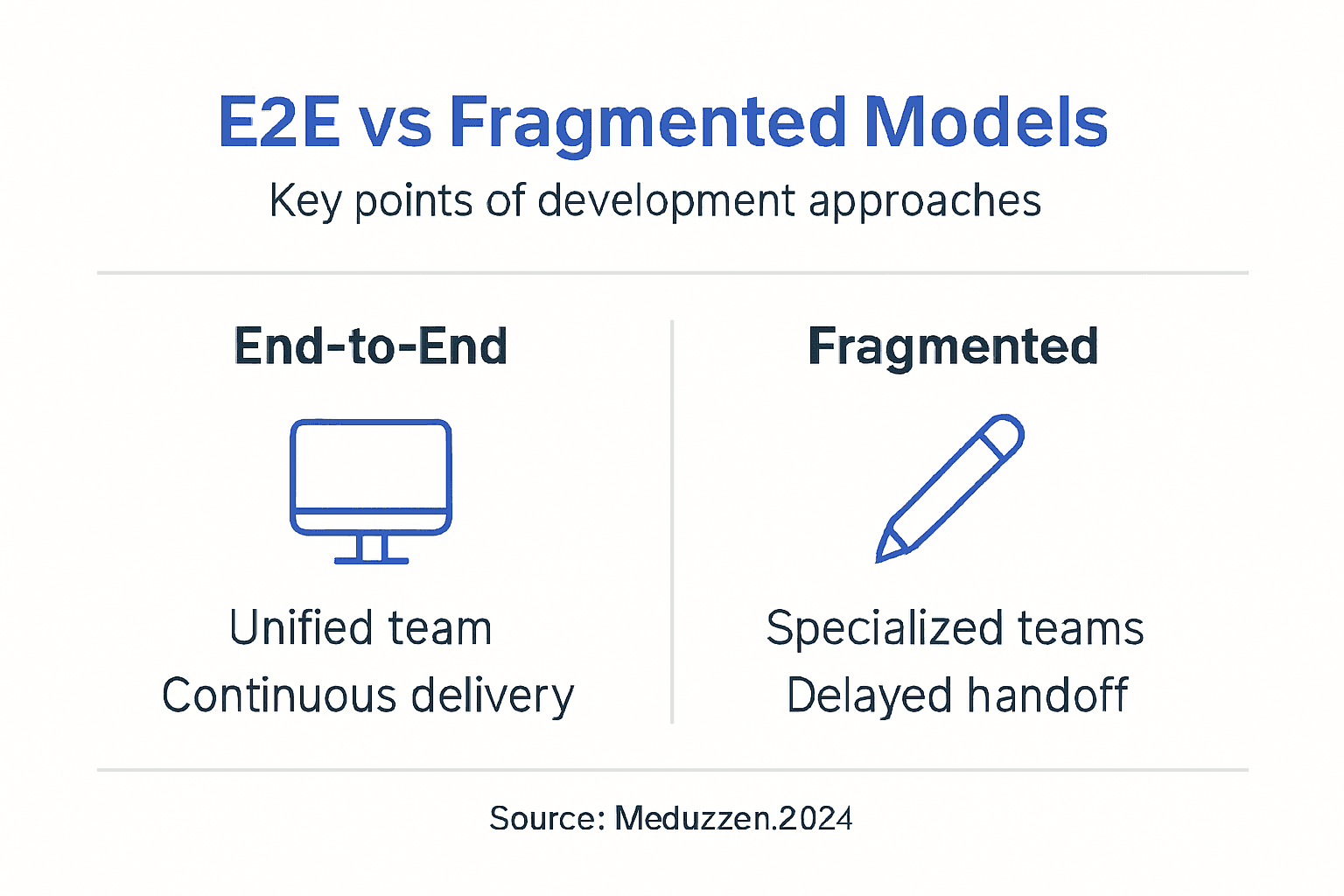
| Dimension | End-to-End Development | Fragmented Development |
|---|---|---|
| Team Structure | Single cross-functional team with shared accountability | Multiple specialized vendors handling isolated phases |
| Integration Quality | Continuous validation preventing interface mismatches | Late-stage integration revealing design conflicts |
| Communication Overhead | Direct collaboration through daily standups and shared tools | Formal handoffs requiring documentation and meetings |
| Time to Market | Faster due to parallel workflows and minimal context switching | Slower from sequential phases and coordination delays |
| Defect Rates | Lower through integrated testing and early feedback | Higher from assumptions that don’t match between teams |
| Change Adaptability | Rapid pivots with full team understanding context | Slow adjustments requiring renegotiation across vendors |
| Cost Predictability | Upfront investment in team setup, lower rework costs | Lower initial commitment, higher risk of budget overruns |
| Scalability Support | Architected for growth by teams maintaining long-term | Ad hoc patterns from teams lacking continuity incentives |
Fragmented models appeal when organizations lack capacity to manage unified teams or need highly specialized skills unavailable internally. However, coordination costs often exceed the perceived savings from hiring narrow specialists. Each vendor optimizes their deliverables without accountability for overall system performance.
For Ruby applications or .NET systems, maintaining consistency across technology stacks becomes difficult when different teams choose conflicting libraries or patterns. End-to-end teams establish standards that simplify maintenance and knowledge transfer.
SaaS and AI startups particularly benefit from E2E advantages:
- Rapid experimentation cycles testing product hypotheses
- Unified data pipelines supporting both application features and ML models
- Consistent security practices across all components
- Single escalation path when production issues occur
While fragmented development might work for fixed-scope projects with stable requirements, modern software demands the adaptability that only end-to-end teams deliver reliably.
Applying End-to-End Development to SaaS and AI Projects
SaaS platforms and AI applications present unique challenges that end-to-end development addresses effectively. AI projects require tight integration between data pipeline management and model lifecycle processes. When separate teams handle data engineering, model training, and application development, inconsistencies emerge. Models trained on different data schemas than production uses fail unpredictably. End-to-end teams coordinate these elements from initial data collection through deployed inference.
For scalable SaaS applications, rapid iteration based on user feedback determines competitive success. Unified teams can test pricing experiments, launch features for beta cohorts, and roll back problematic updates within hours rather than days. This agility requires everyone understanding both the technical architecture and business metrics being optimized.
Key strategies for SaaS and AI contexts:
- Implement feature flags enabling gradual rollouts and A/B testing without deployment overhead
- Establish monitoring dashboards tracking both technical metrics like latency and business KPIs like conversion rates
- Automate model retraining pipelines that detect performance drift and trigger updates
- Design multi-tenant architectures supporting customer isolation and independent scaling
- Plan for data governance requirements that AI regulations will impose through 2026 and beyond
Many startups lack the diverse skills required for E2E execution across SaaS and AI domains. Team augmentation services address this gap by embedding specialists who integrate into existing workflows. Augmented engineers contribute to sprints, participate in architecture decisions, and share knowledge that builds internal capabilities over time.
The maintenance phase proves especially critical for AI systems where model accuracy degrades as real-world data distributions shift. End-to-end teams monitoring production ML performance can trigger retraining jobs automatically and validate new model versions before deployment. This continuous lifecycle management prevents the quality erosion that plagues AI products built with fragmented handoffs.
Discover Expert End-to-End Development Services for SaaS and AI
Translating these concepts into production-ready systems requires experienced engineering partners. Meduzzen specializes in comprehensive SaaS application development managing projects from initial architecture through scaling optimizations. Our 150+ pre-vetted engineers bring expertise across Python, cloud platforms, DevOps automation, and modern web frameworks that power successful SaaS products.
When your startup needs to accelerate development without sacrificing quality, our AI services and staff augmentation provide the specialized skills that complete your end-to-end capabilities. We integrate seamlessly into existing teams, adopting your processes while sharing best practices refined across hundreds of projects. Partner with engineering experts who understand that true end-to-end development demands both technical excellence and business alignment.
Frequently Asked Questions about End-to-End Development
What distinguishes end-to-end development from full-stack development?
Full-stack development refers to individual engineers skilled in frontend and backend coding. End-to-end development describes a team management approach coordinating all SDLC phases including requirements, design, testing, deployment, and maintenance. A full-stack developer might work within an E2E team but doesn’t represent the complete model.
How does end-to-end development improve software scalability?
Unified teams architect systems with long-term growth in mind because they maintain those systems through scaling phases. They choose technologies, database designs, and API patterns that support adding users and features without requiring rewrites. Continuous ownership incentivizes technical decisions that reduce future maintenance costs.
What role does continuous integration play in E2E development?
CI pipelines automate testing on every code change, providing rapid feedback that prevents defects from reaching production. This automation enables the frequent deployments that E2E teams use to iterate quickly based on user feedback. CI also enforces code quality standards consistently across all team members.
Can startups implement end-to-end development with small teams?
Yes, E2E works effectively at small scale. A five-person team covering product management, frontend, backend, QA, and DevOps can coordinate more efficiently than those functions split across vendors. Small teams actually benefit more from reduced coordination overhead since everyone participates in all decisions.
How should we measure success when adopting end-to-end development?
Track deployment frequency, lead time from commit to production, mean time to recovery from failures, and change failure rate. These metrics reveal whether unified ownership actually improves delivery speed and reliability. Also monitor team satisfaction through retrospectives since collaboration quality determines whether E2E advantages materialize.