In this article
API development services: build scalable solutions for growth
Tech & Infrastructure
Learn how contract-first design, RESTful best practices, and smart scaling strategies help startups build APIs that grow without breaking. Practical guide for CTOs and founders.

Most startup founders assume that once their API works, the hard part is over. Ship it, iterate fast, and worry about architecture later. That mindset builds technical debt faster than it builds product. The truth is that API design decisions made in week two of development can either open doors to rapid scaling or quietly strangle growth six months down the road. Poor versioning, brittle integrations, and undocumented contracts cost engineering teams enormous time in rework. This guide covers the methodologies, practical frameworks, and risk mitigation strategies that help startups build APIs that grow with them, not against them. Whether you’re a CTO evaluating your current stack or a founder planning your next product phase, what follows is built for your reality.
Key Takeaways
| Point | Details |
|---|---|
| Start contract-first | Begin API design with OpenAPI specs so teams can work in parallel and integration bugs are caught early. |
| Anticipate edge cases | Handle unreliable services, rate limits, and retries up front to prevent surprise outages. |
| Scale at the right time | Don’t modularize or microservice until you hit real performance limits; start with solid architecture basics. |
| Invest in API documentation | Keep API and changelogs up to date for developer clarity and faster onboarding. |
| Use gateways and edge deployment | API gateways and edge hosting improve scalability and reduce user latency as you grow. |
What makes robust API development services?
Not all API development services are created equal. The difference between a service that helps you scale and one that quietly creates bottlenecks often comes down to a handful of non-negotiable features. Understanding these features is the first step toward making smarter architectural decisions.
Scalability is the most obvious requirement, but it’s also the most misunderstood. Understanding scalability means more than just handling more traffic. It means designing systems that can absorb new features, new consumers, and new data models without requiring you to rewrite core logic. A truly scalable API is built on contracts, not assumptions.
Here are the core features that define robust API development services:
- Scalability by design: Resource-based architecture that separates concerns and allows horizontal growth
- Reliability and uptime guarantees: Error handling, retries, and graceful degradation built in from day one
- Clear, living documentation: OpenAPI specs that stay in sync with the actual codebase
- Monitoring and observability: Request tracing, error rate tracking, and latency dashboards
- Versioning strategy: URL path versioning (e.g., “/v1/
,/v2/`) with a clear deprecation policy - Extend-don’t-mutate responses: Adding fields to responses rather than changing or removing them
The last point matters more than most teams realize. When you mutate an existing response, every downstream consumer breaks silently. When you extend it, old clients keep working and new clients gain capability. That discipline alone prevents dozens of integration bugs per quarter.
Statistic: Core methodologies for scalable API development include contract-first design using OpenAPI specs, RESTful principles with resource-based nouns and proper HTTP methods, versioning via URL paths, and extend-don’t-mutate responses.
The contract-first approach formalizes this discipline. Instead of letting the API shape emerge from code, you define the contract first and let code follow. This shifts the conversation from “what did we build?” to “what did we agree to build?” That shift is small in words but enormous in practice.
Your scaling checklist for any API project should include all six features above before a single endpoint goes to production. Retrofitting these later is possible, but it’s painful and expensive.
Pro Tip: Design your API to grow with your business, not for the feature you’re shipping this sprint. Every shortcut in contract design compounds into rework that slows your team down at the worst possible moment.
Core methodologies: Contract-first, OpenAPI, and RESTful best practices
Once you understand the must-have features, it’s essential to look at the proven methodologies that underpin successful, scalable API projects. Two approaches dominate the conversation: contract-first and code-first. Choosing the right one at the right stage is one of the most consequential decisions a CTO can make.

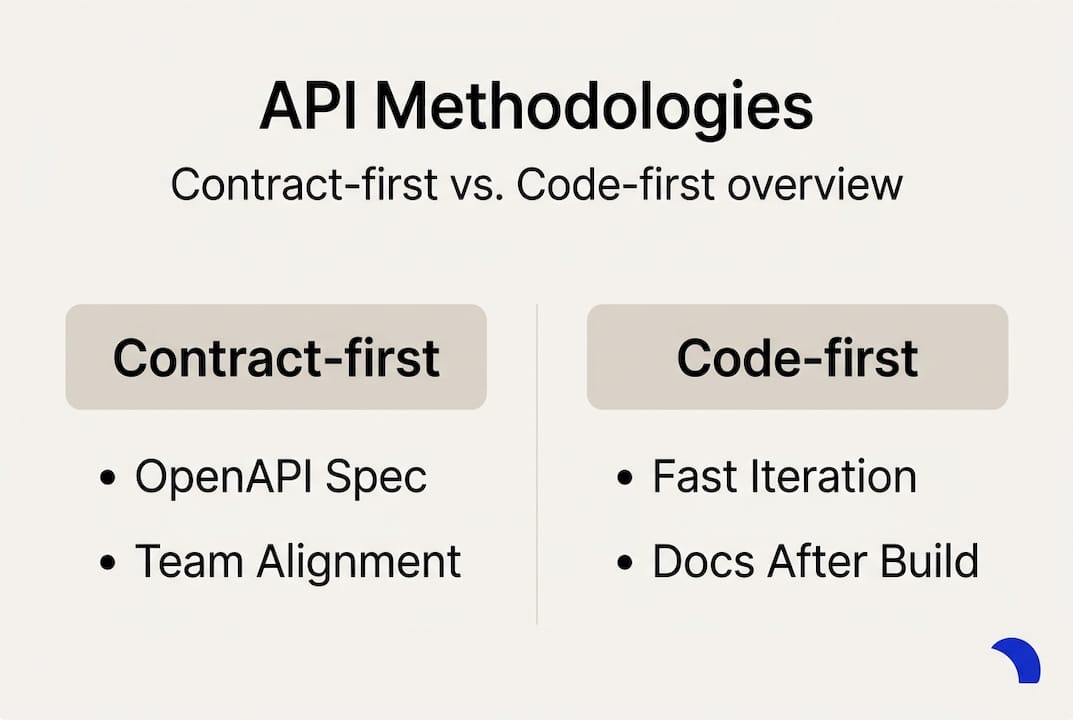
Contract-first development means writing the API specification (typically an OpenAPI or AsyncAPI document) before writing any implementation code. The spec becomes the source of truth. Frontend teams, backend development teams, and third-party consumers all work from the same document simultaneously. This enables parallel frontend/backend development and prevents the kind of integration surprises that derail sprints.
Code-first development means building the implementation and generating documentation from it afterward. It’s faster for solo developers and early prototypes, but it carries a real risk: documentation drift. When the code evolves faster than the spec, consumers start working from outdated contracts. That gap causes bugs that are hard to trace and expensive to fix.
Here’s how the two approaches compare across the dimensions that matter most to growing teams:
| Dimension | Contract-first | Code-first |
|---|---|---|
| Best for | Multi-team coordination, external APIs | Early prototypes, solo projects |
| Speed to first endpoint | Slower (spec first) | Faster (code first) |
| Documentation accuracy | High (spec is source of truth) | Risk of drift over time |
| Integration bug risk | Low | Higher as teams grow |
| Onboarding new developers | Easier (clear contract) | Harder without updated docs |
| Refactoring risk | Lower | Higher |
Contract-first excels in multi-team coordination and catches issues early. Code-first moves faster for prototypes but risks documentation drift as complexity grows. For startups moving from MVP to Series A, the shift from code-first to contract-first is often the single biggest quality-of-life improvement an engineering team can make.
For RESTful best practices, a few rules consistently separate clean APIs from chaotic ones. Follow these numbered steps when designing any new resource:
- Use plural nouns for resource endpoints (
/users,/orders, not/getUseror/createOrder) - Map operations to proper HTTP methods (GET for reads, POST for creates, PATCH for partial updates, DELETE for removals)
- Use cursor-based pagination instead of offset pagination for large datasets (offsets break under concurrent writes)
- Return consistent error shapes with machine-readable codes and human-readable messages
- Version via URL path (
/v1/) not headers, so clients can test versions in a browser
Reviewing development model comparisons can help you align your API methodology with your broader engineering model. And if you’re bringing new engineers into an API-heavy codebase, a strong onboarding process for CTOs makes contract-first even more valuable since the spec itself becomes a living orientation document.
The custom software steps that work for product development apply here too: define before you build, validate before you ship.
Pro Tip: Early contract alignment between frontend and backend teams reduces rework by a significant margin. A 30-minute spec review before development starts is worth more than three days of post-integration debugging.
Handling edge cases and technical pitfalls in API design
Solid methodology reduces friction, but even great APIs can trip up on technical pitfalls if edge cases and real-world issues aren’t anticipated. This is where many well-intentioned API projects quietly fall apart.
The most common edge cases that disrupt scaling aren’t exotic. They’re predictable. And yet they catch teams off guard repeatedly because they only surface under real production conditions.
Here’s a practical breakdown of the most impactful edge cases and how to handle them:
| Edge case | Root cause | Scaling-safe solution |
|---|---|---|
| Unreliable third-party services | External dependency with no fallback | 3-state validation: valid / invalid / unavailable |
| Rate limiting under load | No throttle controls on consumers | Token bucket or sliding window rate limiting |
| Duplicate POST requests | Network retries without idempotency | Idempotency keys on all mutating endpoints |
| Deep nesting in responses | Convenience-driven design | Flatten responses, use sparse fieldsets |
| Cascading failures | Tight coupling between services | Circuit breakers and timeout budgets |
Edge cases include handling unreliable services with 3-state validation, rate limiting, graceful degradation, deep nesting avoidance, and idempotency for retries. Each of these is a solvable problem. The damage comes from ignoring them until they hit production.
The VIES VAT validation service is a real-world example worth studying:
“VIES returns false for valid VAT numbers during outages. Cache ‘unavailable’ results for 5 minutes only, never treat them as invalid, and surface the uncertainty to the user clearly.”
This pattern generalizes to any third-party dependency. When an external service goes down, your API should not silently fail or return incorrect data. It should communicate uncertainty honestly and degrade gracefully.
Here are the key mitigations every startup API should implement:
- Idempotency keys: Assign unique keys to POST and PATCH requests so retries don’t create duplicate records
- Fallback design: Define what your API returns when a dependency is unavailable, not just when it’s available
- Short-term caching: Cache external results with tight TTLs (time-to-live values) to absorb brief outages without serving stale data indefinitely
- Circuit breakers: Stop calling a failing service after a threshold of errors and resume after a cooldown period
- Timeout budgets: Set explicit timeouts on every outbound call so one slow dependency can’t freeze your entire request
For teams building microservice API solutions, these mitigations become even more critical because failure modes multiply with each service boundary.
Pro Tip: Always separate your internal database models from your API data transfer objects (DTOs). If your API response mirrors your DB schema directly, every schema migration becomes an API breaking change. That separation is a small discipline with enormous long-term payoff.
Scaling APIs: When to modularize, implement gateways, or go microservices
Avoiding traps is vital, but knowing when and how to adapt your API architecture for real-world scaling is just as essential. The most common mistake isn’t choosing the wrong architecture. It’s choosing the right architecture at the wrong time.
Here are the signals that tell you it’s time to act:
- A single team’s changes regularly break another team’s work
- Deployment of one feature requires deploying the entire application
- Response times are degrading under load despite infrastructure scaling
- Your API codebase has become too large for any one engineer to hold in their head
- You need to expose different API surfaces to different consumer types (mobile, third-party, internal)
When these signals appear, the answer isn’t always microservices. Often, the right first move is modularization within a monolith. A well-structured modular monolith gives you clean boundaries, independent deployability within modules, and a clear path to extraction later without the operational overhead of distributed systems today.
When you do need to transition toward microservices, follow these steps deliberately:
- Identify the bottleneck: Profile actual traffic and latency. Don’t guess. Extract the service that causes the most pain.
- Define the contract first: Before extracting any service, write its OpenAPI spec. This prevents the new service from inheriting the old monolith’s design problems.
- Implement an API gateway: Tools like KrakenD or API management tools like Zuplo sit in front of your services and handle routing, authentication, rate limiting, and observability in one layer.
- Extract incrementally: Move one bounded context at a time. Validate it in production before extracting the next.
- Deploy at the edge when latency matters: Edge deployment reduces round-trip time for geographically distributed users and is increasingly accessible through modern API gateway platforms.
Prioritize contract-first with OpenAPI for evolvability, avoid premature microservices, use modular monoliths until real pain emerges, and leverage API gateways like KrakenD or Zuplo for scaling and edge deployment to cut latency.
For teams already working with API processing microservices, the gateway layer becomes the single most important investment you can make. It gives you control over your API surface without touching individual services.
Pro Tip: Don’t microservice prematurely. Every distributed system adds operational complexity that your team has to maintain forever. Monitor actual bottlenecks, scale what hurts, and keep everything else simple until the evidence demands otherwise.
What most API guides get wrong about startup scalability
Here’s a candid perspective based on what most guides miss when it comes to APIs at startup scale.
Most API guides treat microservices as the destination and everything else as a stepping stone. That framing is backwards for startups. Microservices solve organizational scaling problems as much as technical ones. They make sense when you have multiple teams that need to deploy independently without stepping on each other. If you have one team and one product, microservices add complexity without adding proportional value.
The real competitive advantage in API development isn’t architecture. It’s discipline. Teams that practice contract-first design, maintain honest documentation, and version their APIs carefully build systems that are genuinely evolvable. They spend less time firefighting and more time shipping. That discipline compounds over time in ways that no framework or tool can replicate.
We’ve seen this pattern across many projects at Meduzzen. The startups that scale smoothly aren’t the ones that chose the trendiest stack. They’re the ones that got their contracts right early, documented their decisions, and resisted the urge to over-engineer. Constraint sharpens creativity. A well-defined API contract is a creative constraint that makes every downstream decision easier.
Chasing microservice case studies before your team is ready is a form of premature optimization dressed up as ambition. The most scalable thing you can do right now is build stability out of your current chaos, one clear contract at a time.
Accelerate your growth with expert API development services
If this guide has surfaced gaps in your current API strategy, you’re not alone. Most startups discover these issues mid-sprint, when the cost of fixing them is highest.
At Meduzzen, we build APIs the way this guide describes: contract-first, versioned from day one, with edge-ready deployment and monitoring built in. Our team of 150+ engineers has delivered scalable API infrastructure for FinTech, Healthcare, Logistics, and SaaS products across the US and Europe. Whether you need a dedicated team to own your web API services end-to-end or engineers who integrate into your existing squad to accelerate delivery, we have an engagement model that fits your stage. From MVP through Series B scaling, our SaaS app development practice is built around long-term partnerships and predictable results. Let’s build something that grows with you.
Frequently asked questions
What is contract-first API development and why does it matter for startups?
Contract-first API development starts with designing the API contract (typically an OpenAPI spec) before writing any code, enabling parallel work across teams and preventing integration bugs. Contract-first design enables parallel development and reduces costly rework for fast-growing teams.
When should a startup switch from a monolith to microservices for APIs?
Switch when your single application creates real scaling bottlenecks or slows independent team delivery, not before those problems actually appear. Avoid premature microservices and use modular monoliths until the operational pain genuinely justifies the added complexity.
How do you handle unreliable third-party services in API integration?
Use 3-state validation (valid, invalid, unavailable) and cache unavailable results for a short window, typically around five minutes, to avoid propagating incorrect data. VIES-style outages show why treating “unavailable” as “invalid” creates serious downstream errors.
What tools help scale and secure APIs as startups grow?
API gateways like KrakenD and Zuplo handle routing, authentication, rate limiting, and observability in a single layer with minimal overhead. KrakenD and Zuplo are among the top-rated API management tools for teams scaling in 2026.