In this article
Digital product development: frameworks and scaling strategies
Business & Strategy
Discover how to choose the right frameworks and scale your digital product team effectively. A practical guide for startup founders and CTOs in 2026.

TL;DR:
- Successful digital product development depends on choosing appropriate frameworks for each phase.
- Remote teams should blend Lean for discovery and Agile for execution to optimize efficiency.
- Flexibility and honest reassessment of frameworks are vital for adapting to stage changes and scaling.
Most founders assume their digital product is failing because the team isn’t moving fast enough. It’s a reasonable conclusion, and it feels actionable. Hire more engineers. Shorten the sprint. Push harder. But speed rarely fixes a product that’s built on the wrong foundation. The real culprits are usually a mismatched framework, a poorly structured team, or a scaling approach that was never designed for the stage you’re actually in. This guide walks through the core frameworks shaping digital product development in 2026, compares their strengths and blind spots, and gives you practical strategies for building and scaling a remote team that delivers. If you’ve ever felt like your team is running fast in the wrong direction, this is for you.
Key Takeaways
| Point | Details |
|---|---|
| Framework choice matters | Selecting and mixing frameworks like Lean, Agile, and Design Thinking is key for successful digital product development. |
| Remote scaling advantages | Remote teams offer long-term cost effectiveness and scalability, especially for startups expanding globally. |
| Adaptation beats blind adherence | Startup success depends on adapting processes to team and market needs, not rigidly following any one method. |
| Iterate and measure | Continuous feedback loops and clear metrics are crucial when moving from pilot to product-market fit. |
What is digital product development? Foundations and modern realities
Digital product development is the process of taking an idea from concept to a working, scalable software product. It covers everything from early user research and validation to architecture decisions, execution, and post-launch iteration. Simple in theory. Wildly complex in practice.
The process typically moves through four core phases:
- Discovery: Understanding the problem, user needs, and market context.
- Validation: Testing assumptions quickly and cheaply before committing resources.
- Execution: Building the actual product in iterative cycles.
- Scaling: Growing the infrastructure, team, and user base without losing velocity or quality.
Each phase demands a different mindset and, critically, a different set of tools. What works in discovery can actively slow you down in execution. What keeps execution humming can make scaling a nightmare if you never documented anything.
The modern reality adds another layer. Teams are no longer co-located by default. Async communication, distributed engineers across multiple time zones, and global hiring have fundamentally changed how digital products get built. A product team today might have its CTO in Berlin, its backend engineers in Kyiv, its UX designer in Lisbon, and its QA specialist in Nairobi. Coordination rituals matter more than ever. So does the clarity of your documentation.
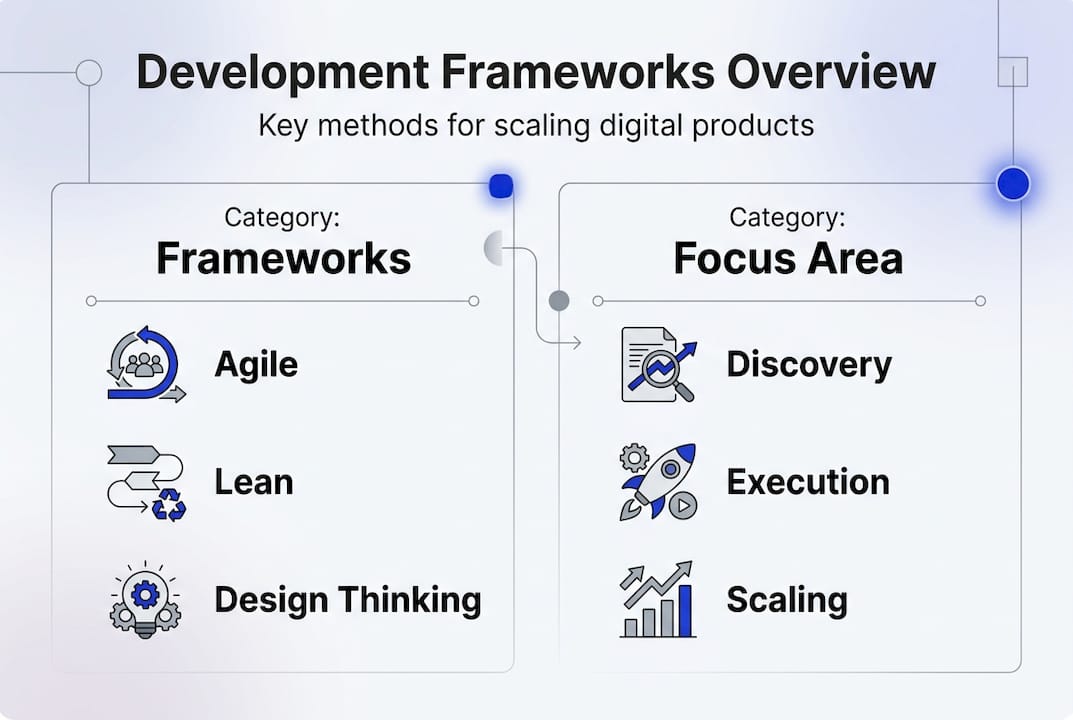
This shift also raises the stakes around framework selection. Digital product development core frameworks differ in strengths, with Agile excelling at execution while Lean and Design Thinking shine in discovery. That’s not a minor distinction. It’s the difference between shipping the right product and shipping the wrong one very efficiently.
One of the most common mistakes we see in startup software development success stories is the assumption that one framework covers all phases. It doesn’t. The teams who build great products are the ones who recognize which phase they’re in and choose their tools accordingly.
Pro Tip: Before your next sprint, ask yourself honestly: are you in discovery, validation, execution, or scaling mode? The honest answer should shape everything from your rituals to your tooling.
Comparing Agile, Lean, and Design Thinking for technology startups
Understanding the fundamentals, the next hurdle is selecting and sequencing the right framework. This is where a lot of early-stage teams get tangled. They adopt Agile because it’s popular, run two-week sprints, and wonder why they’re building features nobody asked for.
Here’s a clean breakdown:
Agile organizes work into short, iterative cycles called sprints. It’s built for execution. The daily standups, backlog grooming, and retrospectives create rhythm and accountability. But Agile assumes you already know what to build. That’s a significant assumption.
Lean Startup focuses on validated learning. Build the smallest viable experiment, measure real behavior, and decide whether to pivot or persist. It’s rigorous about not wasting resources on unvalidated ideas. However, it can feel slow once the product direction is clear and speed becomes the priority.
Design Thinking puts the user at the center of every decision. It’s phenomenal for discovery, surfacing insights that quantitative data alone would miss. The challenge is that Design Thinking doesn’t naturally hand off into execution. Teams can stay in ideation mode indefinitely if there’s no external forcing function.
| Framework | Discovery | Execution | Scaling |
|---|---|---|---|
| Agile | Weak | Strong | Moderate |
| Lean Startup | Strong | Moderate | Weak |
| Design Thinking | Very Strong | Weak | Weak |
Pure Agile optimizes execution but ignores what to build, while Design Thinking excels at discovery but stalls at scaling. This isn’t a criticism of any single methodology. It’s an honest look at what each one was designed to do.
Numbered steps for sequencing these frameworks effectively:
- Use Design Thinking to surface the real user problem before writing a single line of code.
- Apply Lean principles to validate your riskiest assumptions with low-cost experiments.
- Transition into Agile sprints once the direction is clear and the team needs structured execution.
- Revisit Lean when product-market fit signals shift or new feature territory is uncertain.
“The teams that win aren’t the ones with the most disciplined Agile practice. They’re the ones that know when to stop building and start learning again.”
For a deeper look at how Agile specifically applies to early-stage teams, the agile software development guide covers the mechanics in practical detail. And if you’re weighing different service models, understanding the product development service types available to startups in 2026 can help you match structure to need.
In remote contexts, framework adaptability becomes even more critical. When your team operates across time zones, the communication overhead of a poorly chosen framework can silently kill velocity. Asynchronous-friendly documentation, shared definitions of done, and clear sprint goals aren’t best practices. They’re survival tools.

The journey from discovery to execution: Strategies for success
Once the framework is chosen, the real challenge is applying it across the product lifecycle. The biggest trap isn’t picking the wrong framework. It’s getting stuck in one phase too long.
Here’s how effective teams move from ideation to a working MVP without losing their minds:
- Fix the problem statement first. Vague problems produce vague products. Write a one-sentence user problem that your whole team can recite without looking it up.
- Timebox discovery. Set a hard deadline for research and ideation. Without a forcing function, discovery expands to fill all available time.
- Identify your riskiest assumption. This is the single belief your entire product depends on. If it’s wrong, everything else is wrong. Test it first.
- Build the smallest possible experiment. Not a prototype. Not an MVP. A test. A landing page, a manual workflow, a concierge service. Something that generates real signal without a full build.
- Transition deliberately into execution. When you have enough validated signal, shift into Agile. Define your backlog. Assign ownership. Set your sprint rhythm.
- Schedule retrospectives as business decisions, not just team rituals. Every sprint retrospective should ask whether you’re still building the right thing, not just whether the team worked well together.
Design Thinking excels at discovery but can struggle when scaling, while Agile is strong for execution but weak on what to build. This tension is healthy when managed intentionally. It becomes destructive when teams aren’t aware of it.
Remote teams face a unique version of this challenge. Without hallway conversations, the handoff between discovery insights and execution decisions has to be documented explicitly. If a discovery finding only lives in someone’s memory, it won’t survive the sprint handoff.
Pro Tip: Create a single shared document called your “Product North Star” that captures your validated problem statement, target user, and top three assumptions. Every sprint planning session should start by reading it aloud.
For teams working through a SaaS growth strategy, the discovery-to-execution transition is often the moment where momentum is won or lost. And if you’re building the scalable startup workflow from scratch, this is exactly the inflection point that deserves your sharpest attention. The framework comparison by Ideaplan is a useful reference when deciding where to invest process energy at each phase.
Scaling digital product teams: Onsite vs. remote models
Scaling up introduces a set of organizational and cultural questions that no sprint board can answer alone. How you structure your team matters as much as the technology you choose.
The debate between onsite and remote models has matured significantly. It’s no longer about preference. It’s about tradeoffs that scale differently depending on your stage, geography, and budget.
Onsite teams offer fast synchronization. You can read the room, whiteboard in real time, and resolve ambiguity in minutes. The cost, both financial and geographic, is real. Competitive engineering salaries in major US and European cities have risen sharply, and physical proximity constrains your talent pool.
Remote and distributed teams open access to world-class engineers at competitive rates. Scaling headcount is faster because you’re not limited by local hiring markets. The tradeoff is coordination complexity, which is manageable but not free.
| Dimension | Onsite | Remote |
|---|---|---|
| Cost | High | Lower long-term |
| Onboarding speed | Fast | Moderate |
| Scaling efficiency | Limited by location | High |
| Talent pool | Local | Global |
| Communication overhead | Low initially | Requires systems |
Onsite models deliver faster initial sync but remote teams are more cost-effective for scaling long-term. This plays out consistently across the startups we work with. The friction of remote coordination is real in the first few weeks. After that, the advantages compound.
Common scaling traps and how to avoid them:
- Scaling headcount before validating process: More engineers amplify both your strengths and your weaknesses. Fix the process first.
- Neglecting documentation: What gets built in your head does not survive a team of ten. Write it down.
- Skipping onboarding structure: A new engineer who spends two weeks figuring out your codebase is a hidden cost. Invest in onboarding docs.
- Confusing activity with progress: Remote teams can look busy while moving slowly. Track outcomes, not output.
For teams working through the engineering checklist for scaling, these traps are worth reviewing explicitly. And if you’re still clarifying what end-to-end development actually means for your team’s structure, getting that definition right before you scale is time well spent.
From pilot to product-market fit: Measuring success and staying adaptable
Grasping scale, founders must next turn to measuring what truly matters. Product-market fit is less a destination and more a signal you have to keep reading. The metrics that matter at the pilot stage are different from the ones that matter at growth stage.
Three metrics that actually predict health at each stage:
Activation rate measures whether new users reach the moment where your product delivers its core value. Low activation usually points to onboarding friction, not product failure. Fix the path before changing the product.
Retention is the most honest signal you have. If people come back, you’ve built something worth returning to. If they don’t, no acquisition strategy will save you.
Iteration velocity tracks how quickly your team moves from a problem signal to a deployed solution. Remote teams can struggle here if the feedback loop between user insight and engineering action is too long.
Top feedback signals at each phase:
- Discovery: Qualitative user interviews, observed behavior, support ticket themes.
- Validation: Landing page conversion rates, waitlist signups, concierge service usage.
- Execution: Sprint velocity, bug resolution time, feature adoption rates.
- Scaling: Net Promoter Score trends, cohort retention curves, support volume per user.
Choosing an approach that fits your stage is essential for digital product success. This is not a one-time decision. As your product evolves, the framework mix that served you in early execution may need recalibration when you hit a growth plateau or enter a new market segment.
Remote teams measure success differently in one key way: they have to be more deliberate about surfacing the signal. When you’re not co-located, the quiet signals that would surface in a shared office, an offhand comment from a customer, a designer’s hesitation during a walkthrough, require intentional structures to capture. Weekly async updates, shared dashboards, and regular cross-functional reviews are not overhead. They’re how distributed teams stay calibrated.
If your team is also focused on organic growth, pairing product iteration velocity with SaaS technical SEO performance gives you a more complete picture of product-market resonance across channels.
Why blending frameworks beats orthodoxy: A founder’s reality
Here’s something most framework guides won’t tell you: the teams that build the best digital products are almost never the ones who follow a single methodology the most faithfully.
Orthodoxy is comfortable. It gives you language, rituals, and a sense that you’re doing things right. But rigid adherence to one framework creates blind spots, and blind spots are expensive. A pure Agile team that never questions what to build will execute with precision on the wrong thing. A pure Design Thinking team can spend six months in discovery and produce beautiful insights that never ship.
What actually works is sequencing with intention and adapting with honesty. Use Design Thinking when you need to understand your user deeply. Shift to Lean when you need to test an assumption cheaply. Move to Agile when the direction is clear and velocity is the priority. Then stay honest about when each phase is actually done.
Remote teams reward this blended approach because they reward clarity above all else. When your team is distributed, ambiguity doesn’t just slow things down. It creates parallel realities where different engineers are solving different versions of the same problem. Documentation isn’t bureaucracy in this context. It’s shared reality.
The guide to software development success that actually holds up over time is the one that treats frameworks as tools, not identities. The founders and CTOs we’ve seen build enduring products are the ones who stay curious, stay honest about where they are in the journey, and build teams that can hold ambiguity without falling apart.
Constraint sharpens creativity. And the discipline of choosing the right tool for the right phase is one of the most underrated skills in product leadership.
Unlocking next-level digital product development with Meduzzen
For founders ready to operationalize these strategies, working with the right partner is crucial. Building stability out of chaos requires more than good intentions. It requires engineers who’ve done it before and a structure that supports your specific stage.
At Meduzzen, we work with startups and scaling businesses across Europe and the US to build remote digital product teams that actually integrate. Our 150+ pre-vetted engineers bring expertise in Python, AI, DevOps, and modern web technologies, and they slot into your workflow without the typical onboarding drag. Whether you need web product development services to launch a new product or staff augmentation to extend an existing team, we build for long-term partnership, not short-term placements. If you’re ready to stop running fast in the wrong direction, let’s talk about what the right team structure looks like for your stage.
Frequently asked questions
What are the main phases of digital product development?
The main phases are discovery, validation, execution, and scaling. Each phase requires a different set of processes, team structures, and success metrics to move forward effectively.
Which framework is best for remote product teams?
A combination of Lean for discovery and Agile for execution is most effective for most remote teams. Pure Agile optimizes execution but misses the “what to build” question that Lean and Design Thinking answer first.
Is remote development more cost-effective than onsite?
Remote development scales more cost-effectively over the long term, though onsite models tend to allow faster initial synchronization in the early weeks of a project.
How often should startups reassess their frameworks?
Startups should reassess at each phase milestone, such as moving from validation to execution, or when significant team changes or market shifts occur. Frameworks should serve your current stage, not the stage you were in six months ago.