In this article
Startup software development for scalable SaaS success
Business & Strategy
Discover practical frameworks for startup software development: choose the right methodology, handle edge cases, and scale your SaaS engineering team effectively.

TL;DR:
- Startup SaaS development requires balancing speed, quality, and resource constraints to prevent growth stalls.
- Choosing the right methodology depends on team size, delivery rhythm, and communication style.
- Prioritizing early edge case handling and automation is key to reducing user churn and scaling efficiently.
Rapid SaaS growth sounds like a straight line up and to the right. The reality is messier. Median B2B SaaS growth dropped from 47% to 28% annually, and customer churn now sits at 16.25%. Those numbers tell a story most pitch decks skip. Building a scalable SaaS product is not just about shipping fast. It is about shipping smart, managing quality under pressure, and knowing when your process is the bottleneck. This guide walks through the practical frameworks that separate startups that scale from those that stall. From choosing the right development methodology to handling edge cases and growing your engineering team, you will find actionable guidance grounded in how SaaS actually works in 2026.
Key Takeaways
| Point | Details |
|---|---|
| Speed meets quality | Startup software development requires rapid iteration without sacrificing reliability, especially to reduce churn. |
| Fit your workflow | Matching development methodology to team size and phase unlocks faster, less stressful scaling. |
| Edge case focus | Address critical edge cases with automation and prioritization for stable SaaS releases. |
| Scale smart | Leverage small, AI-driven teams and augment only as needed to keep culture and budgets healthy. |
What makes startup software development unique?
Startup software development is its own discipline. It is not enterprise development with fewer resources, and it is not agency work with a recurring client. It sits at the intersection of speed, uncertainty, and consequence. Every decision you make in the first 18 months shapes the architecture, the team culture, and the product’s ability to survive contact with real users.
Enterprise teams have the luxury of long planning cycles and dedicated QA departments. Agencies optimize for delivery within a defined scope. Startups have neither. You are building stability out of chaos, often with a small team, a shifting roadmap, and a runway that measures time in months, not years. That constraint sharpens creativity, but it also raises the stakes for every technical choice.
The core tension in startup development essentials is the tradeoff between speed and flexibility on one side and resource limits on the other. Move too fast and you accumulate technical debt that slows you down later. Move too cautiously and a competitor ships first. Finding that balance is not a formula. It is a judgment call you make repeatedly, informed by data and experience.
SaaS products face a specific set of challenges that make this even harder:
- Product-market fit is a moving target. What users want in month three is rarely what they wanted at launch.
- Integrations multiply complexity. Every third-party API or data source adds failure points you did not plan for.
- Concurrency and scale expose hidden bugs. Features that work perfectly for ten users break under a thousand.
- UX friction drives churn faster than pricing. A confusing flow or a slow page load costs you customers before they ever reach support.
“Edge cases and rapid iteration are among the most vital and underestimated challenges for SaaS startups building at speed.”
Fixing a UX bug after it has driven churn is expensive in two ways. You lose the customer, and you spend engineering time on reactive work instead of forward momentum. The startups that build resilient products from the start treat edge case discovery as a core development activity, not an afterthought.
Choosing the best workflow and methodologies
Once you understand why the startup context is unique, the next step is choosing a development process that actually fits your team. The wrong methodology is not just inefficient. It actively slows you down and frustrates your engineers.
Three approaches dominate the conversation for SaaS startups: Agile, Kanban, and minimal process. Each has a place, and none is universally correct. Developer experience on Reddit consistently shows that Agile provides structure but can become process-heavy, Kanban is lighter and better suited for continuous flow, and minimal process works best for very small teams that communicate constantly.
| Methodology | Best for | Strengths | Watch out for |
|---|---|---|---|
| Agile (Scrum) | Teams of 5+ with defined sprints | Clear structure, predictable delivery, stakeholder visibility | Ceremony overhead, sprint rigidity can slow pivots |
| Kanban | Continuous delivery, support-heavy teams | Flexible, visual, low overhead | Can lack prioritization discipline without strong leads |
| Minimal process | Solo devs or teams of 2 to 3 | Fast, adaptive, zero waste | Hard to scale, depends heavily on communication |
Choosing the right methodology comes down to where you are in your journey. Here is a practical sequence for making that call:
- Assess your team size. Two engineers sharing a desk do not need sprint planning. Five engineers across time zones do.
- Map your delivery rhythm. If you ship continuously, Kanban fits naturally. If you work in defined release cycles, Agile gives you structure.
- Identify your biggest bottleneck. Is it unclear priorities, slow feedback loops, or context switching? Each methodology addresses different friction points.
- Test for four weeks, then adjust. No methodology survives first contact with your actual team unchanged. Build in a review point.
- Protect engineering flow. Whatever process you choose, minimize interruptions. Deep work is where the real output lives.
You can explore scalable SaaS workflows and compare best startup dev models to find what fits your stack and stage.
Pro Tip: Match your methodology to your developers’ natural working style, not just the textbook recommendation. Engineers who thrive in autonomous, flow-based work often deliver more under Kanban than under rigid sprint structures.
Tackling edge cases, automation, and quality assurance
After you have your process in place, the next layer is building a product that holds up under real conditions. This is where many startups lose ground quietly. Not through dramatic failures, but through a slow accumulation of small breakages that erode user trust.

Edge cases are the scenarios your happy path testing never reaches. Boundary inputs. Concurrent requests hitting the same record. Network timeouts mid-transaction. Users doing something you never imagined. Addressing edge cases early with automation and data-driven prioritization is the most reliable way to prevent the UX-related churn that kills retention.
Here is how edge case categories typically rank by risk and impact for SaaS products:
| Edge case category | Risk level | Churn impact | Priority |
|---|---|---|---|
| Concurrency and race conditions | High | High | Immediate |
| Authentication and session edge cases | High | High | Immediate |
| Boundary input and data validation | Medium | Medium | Sprint 1 |
| Third-party API failures | Medium | High | Sprint 1 |
| Network interruption handling | Medium | Medium | Sprint 2 |
| UI rendering on edge devices | Low | Medium | Backlog |
Automation is not optional here. Manual QA at startup speed is a losing battle. The tools that give you the most leverage include:
- Pytest and Jest for unit and integration coverage across Python and JavaScript stacks
- Playwright or Cypress for end-to-end browser testing that catches UI regressions
- Postman or k6 for API contract testing and load simulation
- Sentry or Datadog for real-time error tracking in production
- Feature flags to test risky changes with a subset of users before full rollout
The business case for this investment is direct. Net Revenue Retention above 110% is the benchmark for scalable SaaS, and smaller AI-leveraged teams consistently outperform larger ones on growth metrics. Quality is not a cost center. It is a growth lever.
You can go deeper on AI-powered QA methods or review QA tools for startups that fit lean engineering teams.
Pro Tip: For MVPs, do not try to cover every edge case. Rank them by probability multiplied by impact, then address the top 20%. That narrow focus prevents the most damaging failures without slowing your release.
Scaling your SaaS engineering team for growth
Once product quality is managed, the final piece is building and growing the right engineering team. This is where many founders either over-hire too early or wait too long and let the team become a bottleneck.
Scaling an engineering team is not just a headcount decision. It is a structural one. Here is a step-by-step approach that works for lean SaaS teams:
- Define the skill gaps first. Before posting a job, map what your current team cannot do well. Backend scale? Frontend performance? DevOps? Hire for the gap, not for general capacity.
- Onboard with context, not just tasks. New engineers need to understand the product vision and the technical decisions already made. A structured developer onboarding process cuts ramp time significantly.
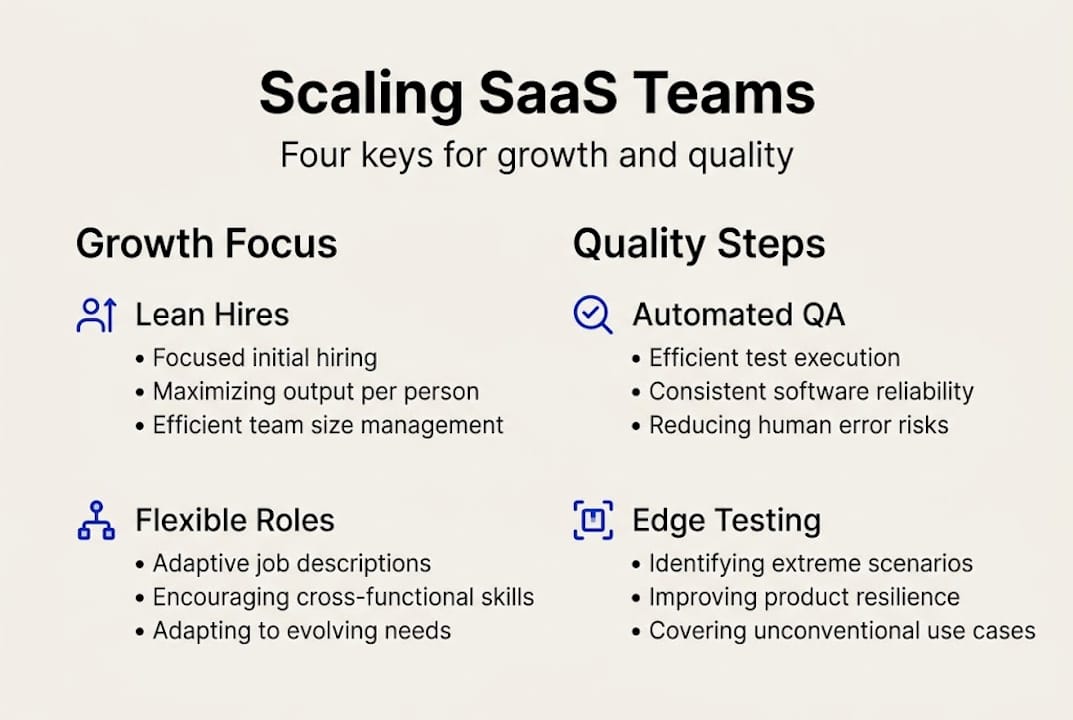
- Automate before you hire. Every manual process you automate is a hire you do not need yet. This is not about cutting corners. It is about staying lean while you validate growth.
- Use staff augmentation for surge capacity. When a specific feature or integration needs more hands for a defined period, augmentation is faster and more cost-effective than a full-time hire.
- Protect culture during growth. Every new person changes the team dynamic. Hire for values alignment, not just technical skill.
Knowing when to augment or restructure is as important as knowing how. Watch for these signals:
- Shipping velocity has dropped despite no change in scope
- Engineers are regularly context-switching across too many domains
- A critical skill (security, ML, infrastructure) is entirely absent from the team
- Customer-facing bugs are increasing as the codebase grows
- A major new market or feature requires a technology your team has not worked with
Hiring developers for startups and exploring SaaS scaling platforms can help you think through the right structure for your stage.
For SaaS growth metrics, the targets are clear: NRR above 110% and CAC payback under 18 months. Smaller teams that use AI effectively hit these benchmarks more often than larger teams that do not. And as a16z’s greenfield analysis shows, AI-native startups with blank-slate strategies hold a real structural advantage over incumbents carrying legacy systems.
Pro Tip: If you are building a new SaaS product with no legacy constraints, treat that as a strategic asset. Design your architecture and team structure for AI-native workflows from day one. That greenfield advantage disappears once you have technical debt to manage.
Why most startups get software development scale wrong
Here is the uncomfortable truth: most founders scale their engineering teams the way they think scaling should look, not the way the data says it works.
The conventional playbook says hire fast, build fast, and figure out efficiency later. But smaller AI-leveraged teams consistently outperform larger ones on the metrics that actually matter for SaaS. Headcount is not a proxy for output. It is often the opposite.
Over-hiring creates its own gravity. More engineers mean more coordination, more code review, more conflicting opinions on architecture, and slower decisions. Capital that could fund product experiments or customer acquisition gets absorbed by salaries for engineers who spend a meaningful part of their week in meetings.
The founders who scale well tend to share a few habits. They treat their budget as a constraint that sharpens creativity rather than a problem to solve by raising more. They use AI tooling not as a novelty but as genuine leverage, automating the repetitive work so their best engineers can focus on hard problems. And they build AI-powered scaling insights into their product strategy from the start, not as an afterthought.
Greenfield startups have a window. Legacy competitors are burdened by old architecture, old processes, and teams trained on old assumptions. A small, focused team with modern tooling and clear priorities can move faster and build better. But that window closes. The startups that use it well are the ones that resist the urge to grow before they are ready, and instead build the kind of foundation that makes growth sustainable when it comes.
Get expert help scaling your SaaS development
Building a scalable SaaS product is one of the most demanding things a founder can take on. The frameworks in this guide give you a clearer map, but the terrain still requires experienced hands.
At Meduzzen, we work with SaaS startups and growing product teams who need more than a vendor. They need a partner who understands the pressure of runway, the cost of churn, and the value of shipping right the first time. Our staff augmentation solutions connect you with pre-vetted engineers who integrate into your team quickly, communicate clearly, and deliver predictably. From web development services to custom cloud solutions, we bring the depth and flexibility that lean startup teams need to scale without losing control. If you are ready to move faster and build smarter, we are ready to help.
Frequently asked questions
What is the main challenge in startup software development?
The main challenge is rapidly building, testing, and scaling software while controlling churn from product quality issues. Customer churn at 16.25% and the reality that early edge case handling directly prevents UX-driven losses make quality a survival issue, not just a technical one.
Which software development methodology works best for startups?
Lean Agile or Kanban usually fit best because they balance speed and adaptability, but very small teams often perform better with minimal process. Agile and Kanban are preferred by experienced developers, though the right choice depends on team size, delivery rhythm, and communication style.
How can startups reduce customer churn through better development?
By automating edge case testing and prioritizing the highest-impact failure scenarios, startups catch bugs before they reach users and improve retention measurably. Handling edge cases early is one of the most direct levers for reducing UX-driven churn.
When should a SaaS startup augment its engineering team?
Augment when market demand or a specific skill gap outpaces what your in-house team can handle, but exhaust automation and tooling options first. Smaller AI-leveraged teams consistently outperform larger ones, so adding headcount should be a deliberate, targeted decision rather than a default response to growth pressure.