In this article
Essential guide to startup software development success
Business & Strategy
Discover proven methodologies, AI tradeoffs, and team strategies to scale your startup software product faster. Backed by real data from funded startups.

Most founders are told to write clean code, avoid shortcuts, and build for the long term from day one. That advice sounds right. But the data tells a different story. The most successful VC-backed startups often move fast, ship messy, and clean up later. Conventional wisdom about perfection is frequently wrong in early-stage software development, and clinging to it can cost you the market window that matters most. This guide walks through the methodologies, tradeoffs, and team strategies that actually drive results, drawing on real benchmarks from funded startups, AI productivity research, and scaling playbooks used by engineering teams across FinTech, SaaS, and beyond. If you are a founder or CTO trying to build something that lasts, start by questioning what you think you already know.
Key Takeaways
| Point | Details |
|---|---|
| Lean and Agile hybrid | Combining Lean for early validation and Agile for scaling is proven to help startups succeed. |
| Strategic debt management | Accepting and tracking technical debt at high velocity can improve funding chances. |
| AI coding tradeoffs | AI speeds up individual coding but increases technical debt and requires careful review. |
| Scaling benchmarks matter | Financial discipline, product metrics, and the right team are key to scaling software. |
| Team fit over skill alone | Hiring for both technical strength and cultural alignment builds high-performing software teams. |
Core methodologies: Lean, Agile, and hybrid startup strategies
Having set the stage with why speed sometimes trumps perfection, let’s demystify which development frameworks actually drive results in startups.
Lean and Agile are the two most influential methodologies in startup software development, but they serve different purposes at different stages. Lean is about ruthless validation. You build the smallest possible version of your idea, get it in front of real users, measure what happens, and decide whether to pivot or push forward. The goal is to eliminate waste before it compounds. Agile, by contrast, assumes you have something worth building and focuses on delivering it in short, iterative cycles called sprints, with constant feedback loops baked into the process.
The distinction matters because applying the wrong methodology at the wrong stage is a common and costly mistake. Lean and Agile hybrid use is now the dominant pattern, with Lean driving pre-product-market-fit validation and Agile powering iterative building once direction is confirmed. Understanding Agile software development basics helps teams avoid the trap of running sprints before they even know what they are sprinting toward.
The numbers are striking. 87% of organizations now use Agile in some form, and around 55% of startups begin their development journey with Agile frameworks. Yet 42% of startups fail not because of bad code, but because of no market need. That statistic is a direct argument for Lean first. Validate the need before you invest in elegant architecture.
“The biggest waste in early-stage software is building the right thing perfectly for the wrong problem. Lean keeps you honest. Agile keeps you moving.”
Here is a practical comparison to help you decide which approach fits your current stage:
| Methodology | Best context | Use case | Pros | Cons |
|---|---|---|---|---|
| Lean | Pre-PMF, idea validation | MVP, user interviews, pivot decisions | Reduces waste, fast learning | Limited structure for larger teams |
| Agile | Post-PMF, iterative growth | Sprint-based feature delivery | Predictable cadence, team alignment | Can create scope creep without discipline |
| Hybrid | Transition or scaling phase | Validate then build in cycles | Flexible, stage-appropriate | Requires experienced team to manage |
For startup product development services, the hybrid model is increasingly the default. You run Lean experiments to confirm direction, then shift into Agile delivery once you have signal. The key is knowing when to make that transition. Most teams wait too long, running experiments on a product that already has paying users. Others jump into sprints before they have a single confirmed assumption.
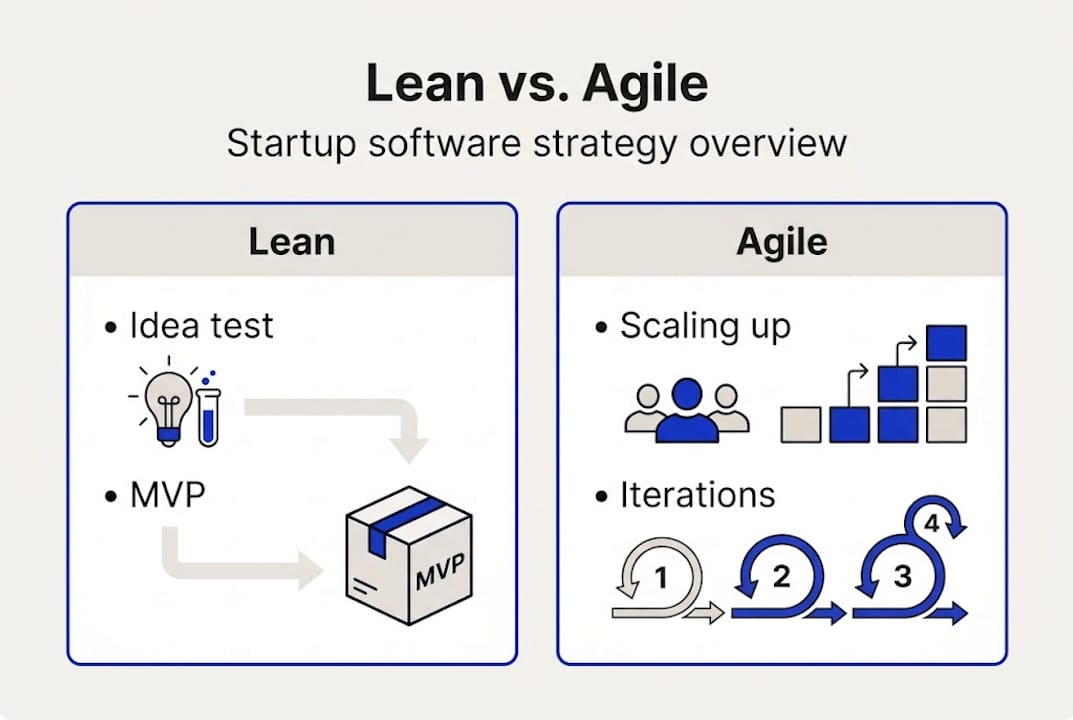
If you are mapping out custom software development steps, think of Lean and Agile not as competing schools of thought but as sequential tools. One helps you find the right door. The other helps you build what is behind it. Choosing the best development model for startups is less about ideology and more about reading where your product actually stands.
Technical debt, velocity, and funding: What startups really trade off
With your core methodology in place, the next challenge is how to balance speed and code quality. Let’s look at what the data says about this perennial dilemma.
Technical debt is a term that sounds alarming but describes something almost every startup accumulates intentionally. It simply means writing code that works now but will need to be improved later. Think of it as borrowing time from your future engineering team. You ship faster today, but tomorrow someone has to pay the interest.

Here is where conventional wisdom breaks down. Most advice tells founders to minimize debt. But startups with high technical debt and high velocity actually raised funding more successfully, with a 60.6% success rate compared to 54% for lower-debt counterparts. The correlation between debt and velocity is statistically negligible, meaning debt alone does not slow you down. What slows you down is unmanaged debt with no tracking system.
| Quadrant | Technical debt level | Velocity | Funding success rate |
|---|---|---|---|
| High debt, high velocity | High | Fast | 60.6% |
| Low debt, high velocity | Low | Fast | 58.2% |
| High debt, low velocity | High | Slow | 47.1% |
| Low debt, low velocity | Low | Slow | 44.3% |
The pattern is clear. Velocity is the real driver of funding outcomes. Debt is only a problem when it kills speed. A scalable startup workflow accounts for this by treating technical debt as a managed resource, not a moral failure.
Pro Tip: Build for today’s scale, not tomorrow’s ambition. Startups that over-engineer early often run out of runway before they find product-market fit. Write the simplest code that works, document the shortcuts you take, and schedule debt repayment sprints once you have revenue to justify them.
Strategic debt tolerance is sometimes rewarded more than perfection. Investors do not fund clean codebases. They fund traction, learning velocity, and teams that ship. The key development steps that matter most to investors are the ones that prove the product works and users want it.
To manage debt without letting it become a liability, keep a living debt log in your project management tool. Flag every shortcut with a brief note explaining what was skipped and why. Run quarterly audits to prioritize which items are compounding risk. This turns an invisible problem into a planned line item, which is exactly how experienced engineering teams handle it.
Leveraging AI in startup software development: Power and pitfalls
While technical debt is one key tradeoff, the rise of AI tools introduces new accelerators and risks into the mix.
AI-assisted coding tools like GitHub Copilot and similar platforms have changed what a small engineering team can accomplish. The productivity numbers are real. AI tools boost developer productivity by 25 to 39% on individual coding tasks. For a startup with three engineers trying to move at the speed of ten, that is a meaningful advantage.
But the full picture is more complicated. End-to-end delivery slows by 19% when AI tools are used across the full software lifecycle. AI-generated code carries 30 to 41% more technical debt than human-written code, and produces 1.7 times more issues per pull request. A striking 88% of engineering teams report a negative impact on debt levels from AI adoption.
So the tool that speeds up writing also slows down reviewing, testing, and maintaining. That tradeoff is manageable, but only if you go in with open eyes.
When AI coding tools work well:
- Generating boilerplate code and repetitive patterns
- Writing unit tests for well-defined functions
- Drafting documentation from existing code
- Accelerating prototyping during early validation sprints
- Helping junior engineers move faster on familiar patterns
When to be cautious:
- Security-critical code paths and authentication logic
- Complex business logic with many edge cases
- Database schema design and migration scripts
- Any code that will be difficult to audit later
Pro Tip: Pair every AI-assisted pull request with static analysis tooling and assign a senior engineer to review AI-touched code specifically. Treat AI output like a first draft from a capable but overconfident junior developer. It needs editing, not just approval.
“The teams winning with AI are not the ones using it everywhere. They are the ones using it deliberately, with guardrails that catch what the model misses.”
For founders tracking AI software development trends, the pattern is consistent. AI amplifies your team’s strengths and weaknesses in equal measure. If your review culture is strong, AI makes you faster. If it is weak, AI makes your debt worse.
Scaling your product and team: Financial, technical, and talent strategies
With tech tradeoffs managed and the right tools in play, scaling means mastering financial and human elements as much as code.
Scaling is not just a technical challenge. It is a financial discipline. Without clear benchmarks, founders make decisions based on optimism rather than evidence. Seed-stage startups typically burn $75,000 to $100,000 per month, target 18 months of runway, maintain a 75% gross margin on SaaS revenue, and aim for monthly churn below 3.5%. These are not aspirational targets. They are survival thresholds.
Knowing your numbers changes how you hire, how you prioritize features, and how you structure your engineering team. A startup burning $90K per month with 12 months of runway makes very different decisions than one with 24 months. The math shapes the roadmap.
Here is a step-by-step approach to scaling your team efficiently:
- Define your core team. Identify the three to five roles that are mission-critical for the next six months. These are full-time hires who own product outcomes.
- Extend with augmentation. Use staff augmentation to fill specialized gaps without long-term headcount commitments. This is especially effective for DevOps, AI, and cloud infrastructure roles.
- Set clear milestones. Every team member, whether full-time or augmented, should have a defined contribution tied to a product or revenue milestone.
- Build culture deliberately. Remote and hybrid teams drift without intentional culture investment. Weekly syncs, async documentation standards, and shared retrospectives keep distributed teams aligned.
- Avoid overhiring. Hiring ahead of revenue is one of the most common scaling mistakes. Each new hire extends your burn rate and compresses your runway.
For founders exploring top SaaS platforms and SaaS application development, the financial and technical decisions are deeply connected. The platform choices you make at seed stage affect your gross margin at Series A. Build with scalability in mind, but not at the cost of shipping.
When it comes to hiring startup developers, the most expensive mistake is hiring for today’s problem and ignoring tomorrow’s scale. Think one stage ahead, not three.
Building your dedicated software team: Best practices for founder-CTO hiring
Having mapped the financial landscape, let’s finish with concrete tactics for building the team that will turn your startup plan into a scalable reality.
The team is the product, at least in the early stages. Every technical decision, every architectural choice, and every customer interaction flows through the people you hire. Getting this right is not just an HR exercise. It is a strategic one.
High performance comes from team fit, specialized skills, and culture add, not just technical strength alone. That distinction matters. A brilliant engineer who cannot communicate, collaborate, or adapt to a startup’s pace can do more damage than a slower hire who fits the team’s rhythm.
What every founder and CTO should look for in core hires goes beyond the resume. You want people who have shipped real products under constraint, who ask questions before writing code, and who treat ambiguity as a challenge rather than a blocker.
Key interview practices for scaling teams:
- Ask candidates to walk through a past technical decision they regret and what they learned from it
- Give a small paid project that mirrors actual work, not abstract whiteboard problems
- Assess communication quality, not just technical output, especially for remote roles
- Involve at least two team members in every final-round interview to check for team fit
- Ask how they handle disagreement with a technical lead or product manager
For remote and hybrid teams, structure compensates for the absence of physical proximity. Weekly video standups, shared async documentation in tools like Notion or Confluence, and regular retrospectives keep distributed engineers aligned and engaged. Without this structure, remote teams fragment quietly and slowly.
Team structuring for investor milestones requires thinking backward from the outcome. What does your team need to deliver in the next 90 days to hit the metric that unlocks your next round? Build the team around that answer. The team hiring best practices that matter most are the ones tied directly to product and revenue outcomes, not generic hiring frameworks.
Why speed, not perfection, defines startup software success
After working with startups across FinTech, Healthcare, and SaaS for over a decade, one pattern stands out more than any other. The teams that win are rarely the ones with the cleanest codebases. They are the ones that get product into users’ hands first and learn faster than everyone else.
Conventional advice says minimize debt, write perfect code, and build for scale from the start. The data disagrees. Rapid iteration and pragmatic tradeoffs consistently outperform textbook code quality in early-stage companies. Perfection is a form of delay, and delay is the one thing a startup cannot afford.
AI tools add a new layer to this. The early winners are not the teams using AI everywhere. They are the ones using it deliberately, with oversight built in. A scalable software workflow treats AI output as a starting point, not a finished product.
The smartest founders we have worked with view every technical decision as a compounding bet. They are not trying to be right forever. They are trying to stay in the game long enough to find out what right actually looks like. Instead of fearing debt, they track it. They buy optionality until product-market fit arrives, then they clean up.
No one ships a perfect product at launch. Champions get something real into users’ hands, listen hard, and iterate faster than the competition. That is the edge that actually compounds.
Boost your startup’s product with expert development teams
Ready to put proven software strategies into action? The gap between a solid development plan and a product that actually scales often comes down to one thing: the team behind it.
At Meduzzen, we build dedicated software development teams for startups and growing businesses that need to move fast without losing control. Whether you need web development services, specialized JavaScript development, or flexible staff augmentation to fill critical gaps, our pre-vetted engineers integrate into your team with minimal ramp-up time. We have spent over 10 years helping founders across FinTech, SaaS, and Healthcare ship products that scale. If you are ready to build at startup speed with the technical depth to back it up, let’s talk about what your next stage actually needs.
Frequently asked questions
What is the best software development methodology for startups?
Most startups benefit from a Lean and Agile hybrid: use Lean for early validation before product-market fit, then shift to Agile for iterative building and scaling once direction is confirmed.
Should a startup try to avoid all technical debt?
Not necessarily. Data shows startups with higher debt and faster velocity raise funding more successfully, so tracking and managing debt strategically is smarter than avoiding it entirely.
How can AI coding tools help, and what are the risks?
AI tools boost productivity by 25 to 39% on individual tasks but often increase technical debt and code review burden, so use them with static analysis and senior review on all AI-generated code.
What are typical financial benchmarks for startup software teams?
Seed-stage startups typically spend $75,000 to $100,000 monthly, target 18 months of runway, maintain 75% SaaS gross margin, and aim for monthly churn below 3.5%.
How do you build a high-performing dedicated software team?
Hire for culture add and technical fit, set clear product milestones for every team member, and invest in structured communication practices especially for remote or hybrid teams.