



Startup web app projects often stumble due to fragmented workflows and unclear team collaboration, leading to missed deadlines and budget overruns. A structured modern development process cuts these delays significantly while improving both speed and product quality. This guide walks you through essential pre-planning activities, agile execution steps, team onboarding best practices, and quality assurance methods that streamline your path from concept to market.
Table of Contents
- Pre-development Prerequisites And Planning
- Core Agile Development Steps
- Team Collaboration And Onboarding Dedicated Developers
- Quality Assurance And Testing Best Practices
- Common Mistakes And Troubleshooting
- Expected Outcomes And Success Metrics
- Optimize Your Web App Development With Meduzzen
- FAQ
Key takeaways
| Point | Details |
|---|---|
| Clear requirements cut cycles | Defining requirements reduces development time by 30% and minimizes costly rework. |
| Agile speeds MVP delivery | Iterative two-week sprints typically deliver MVPs within 4 to 6 months. |
| Structured onboarding boosts collaboration | Proper onboarding cuts integration time by 40% and improves team efficiency by 25%. |
| Automated testing reduces bugs | CI/CD pipelines and automated tests prevent half of production bugs and 38% of delivery delays. |
| Plan for scalability early | Choosing the right tech stack and infrastructure prevents expensive technical debt later. |
Pre-development prerequisites and planning
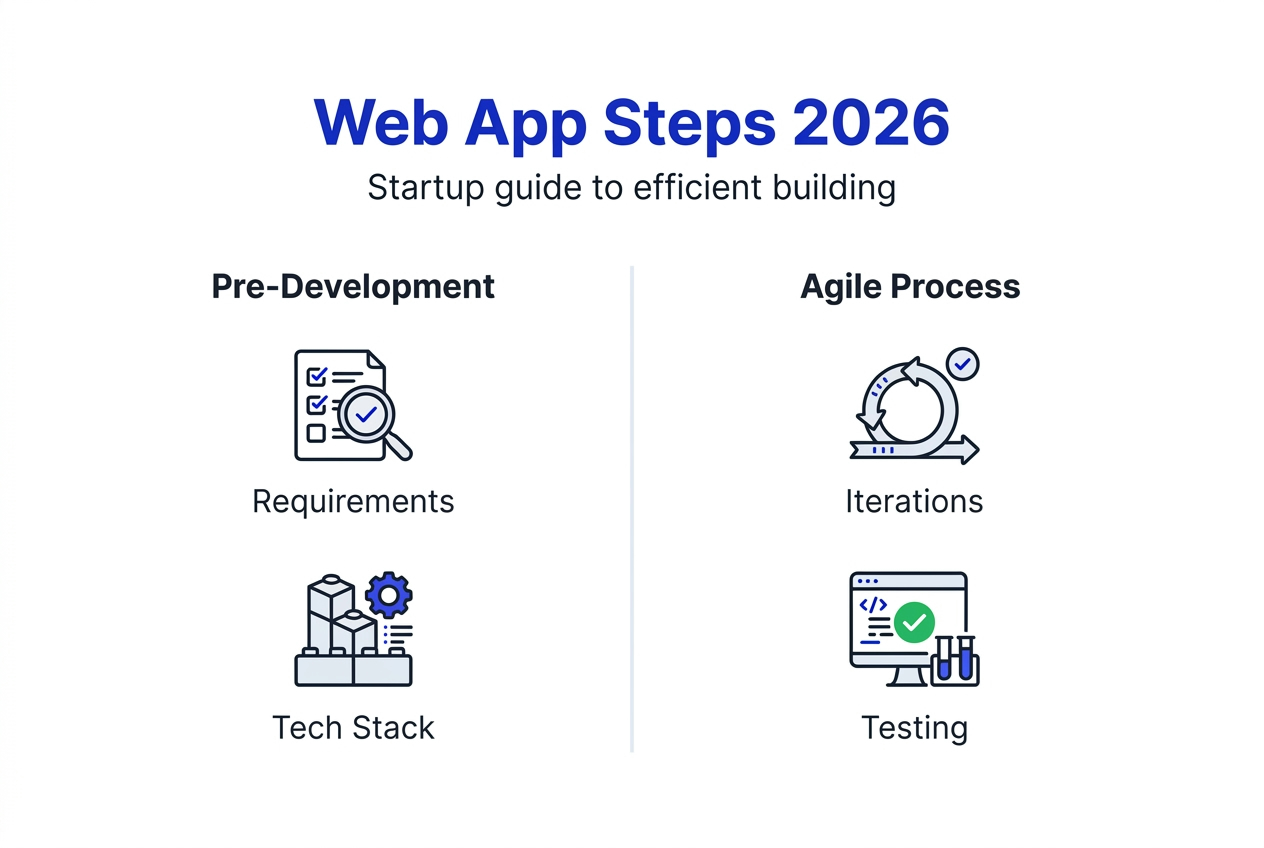
Before writing a single line of code, successful startup teams complete critical groundwork that sets their projects up for predictable delivery. Clear project requirements and detailed user stories form the foundation, ensuring every team member understands what you’re building and why. This clarity eliminates guesswork and reduces development cycles by 30%, giving your team the focus needed to move fast without breaking things.
Selecting the right technology stack requires balancing speed with long-term scalability. Popular choices for startups include React or Vue.js for frontends, Node.js or Python for backends, and PostgreSQL or MongoDB for databases. Each technology decision should align with your team’s expertise, project requirements, and growth projections. Making smart stack choices now prevents costly migrations later when your user base expands.
Setting a realistic MVP scope keeps your initial release focused on core value rather than feature bloat. Define the minimum viable features that solve your target users’ primary pain points, then establish a timeline that accounts for development, testing, and iteration cycles. Most startups benefit from a phased approach, releasing incrementally rather than attempting a perfect launch.
Early infrastructure preparation accelerates development once coding begins. Establish cloud hosting accounts, configure development and staging environments, and set up version control repositories before your first sprint. These preparations enable developers to deploy code immediately without waiting for administrative approvals or infrastructure setup.
Defining team roles clearly before development starts eliminates confusion and overlap. Identify who handles frontend, backend, DevOps, design, and project management responsibilities. For teams lacking specific skills, consider how dedicated developers can fill gaps without the overhead of full-time hires. Clear roles create accountability and streamline communication, both essential for hitting aggressive startup timelines.
Pro Tip: Create a comprehensive website checklist covering technical, design, and business requirements to ensure nothing critical gets overlooked during planning.
Core agile development steps
Agile methodology transforms chaotic development into manageable, predictable progress through structured iteration. Regular two-week sprint cycles break your project into digestible chunks, each delivering tangible features you can test and validate. This rhythm creates momentum while maintaining flexibility to adapt based on user feedback or changing market conditions.
Developing your MVP features iteratively means prioritizing ruthlessly. Start with the most critical user flows, build them to completion, then gather feedback before moving forward. This approach surfaces problems early when they’re cheap to fix, rather than discovering fundamental flaws after months of development. MVPs typically reach market in 3 to 4 months using disciplined Agile sprints, giving startups the speed advantage they need.

Continuous communication keeps distributed teams aligned despite physical separation. Daily standups lasting 15 minutes or less ensure everyone knows current priorities, blockers, and dependencies. Sprint planning sessions at the start of each cycle define exactly what the team will deliver, while retrospectives at the end identify process improvements. This communication cadence prevents misunderstandings that derail timelines.
Tracking progress using Agile metrics provides early warning of trouble. Monitor sprint velocity to understand your team’s sustainable pace, track burndown charts to spot scope creep, and measure cycle time from code commit to production deployment. When metrics trend negatively, investigate immediately rather than hoping issues resolve themselves. Modern development tools make tracking these metrics straightforward.
Building quality into each sprint rather than postponing it until later prevents technical debt accumulation. Write unit tests alongside feature code, conduct code reviews before merging, and deploy to staging environments for manual validation. Front-loading quality work feels slower initially but accelerates delivery overall by preventing bug pile-up.
Pro Tip: Build automated deployment scripts and testing frameworks during your first sprint, even before completing any user-facing features, to establish a solid foundation that saves time throughout the project.
Team collaboration and onboarding dedicated developers
Effective team collaboration starts with structured onboarding that transforms new developers into productive contributors quickly. Create comprehensive documentation covering your codebase architecture, coding standards, development workflows, and communication protocols. Pair new team members with experienced mentors for their first two weeks, ensuring they receive immediate answers to questions rather than struggling alone. Structured onboarding reduces integration time by 40%, meaning new hires contribute meaningful work within days instead of weeks.
Clearly defined roles and responsibilities eliminate the friction that slows teams down. Document who owns each system component, who makes architectural decisions, and who approves deployments to production. When everyone understands their scope and authority, duplicate work vanishes and decision-making accelerates. Teams with well-defined roles see collaboration improve by 25%, directly impacting delivery speed.
Leveraging dedicated developers strategically fills skill gaps without the commitment and overhead of permanent hires. Need a DevOps specialist to implement CI/CD pipelines? A frontend expert to polish your user interface? Dedicated developers integrate into your existing team, adopting your processes and tools while bringing specialized expertise. This flexibility proves invaluable for startups managing cash flow while scaling capabilities. Teams augmented with dedicated developers experience 40% better delivery predictability because they can maintain consistent velocity despite varying workloads.
Integrated communication tools centralize team discussions and decisions. Use Slack or Microsoft Teams for real-time chat, Jira or Linear for task tracking, and Notion or Confluence for documentation. Establish regular sync meetings at consistent times, respecting time zones for distributed teams. Record important meetings for those who cannot attend live, and summarize decisions in written form to prevent misunderstandings.
Building strong web development teams requires intentional culture cultivation beyond just processes and tools. Celebrate wins publicly, provide constructive feedback privately, and foster psychological safety where team members feel comfortable raising concerns. Strong team culture compounds over time, turning good developers into great collaborators.
Pro Tip: Document your onboarding process thoroughly and update it quarterly based on new hire feedback, continuously shortening integration time and improving the experience for future team members.
Quality assurance and testing best practices
Integrating automated testing early in each sprint cycle catches bugs when they’re easiest and cheapest to fix. Write unit tests for business logic, integration tests for API endpoints, and end-to-end tests for critical user flows. Run these tests automatically on every code commit, blocking merges when tests fail. This discipline prevents broken code from reaching production and gives developers confidence to refactor without fear.
CI/CD pipelines automate the entire journey from code commit to production deployment, eliminating manual steps where human error creeps in. Configure your pipeline to run tests, build Docker containers, scan for security vulnerabilities, and deploy to staging automatically. Production deployments should require only a single approval click after staging validation. CI/CD implementation reduces production bugs by 50%, transforming release day from a stressful event into a routine operation.
Automated testing creates a safety net that accelerates development velocity rather than slowing it down. Developers can refactor code, upgrade dependencies, and experiment with improvements knowing tests will catch regressions immediately. Automated testing prevents 38% of common delivery delays by surfacing integration issues before they compound into release-blocking problems. The upfront investment in test infrastructure pays dividends throughout your project lifecycle.
Manual testing supplements automation for scenarios requiring human judgment. UI/UX validation, exploratory testing of new features, and accessibility checks benefit from human testers who notice subtle issues automated tests miss. Allocate time at the end of each sprint for manual testing sessions, documenting findings for the development team to address.
Monitoring quality metrics continuously reveals trends before they become crises. Track test coverage percentages, bug escape rates to production, mean time to resolution for reported issues, and customer-reported defects per release. When metrics deteriorate, investigate root causes and adjust processes accordingly. Partnering with experts in custom DevOps services accelerates your journey to robust quality practices without years of trial and error.
Common mistakes and troubleshooting
Scope creep destroys startup timelines more reliably than any other factor. It begins innocently with small feature additions that seem trivial individually but accumulate into massive delays collectively. Combat scope creep with rigorous change management requiring written justification for any addition, impact analysis on timeline and budget, and explicit stakeholder approval. Defer non-critical features to post-MVP releases, maintaining laser focus on core value delivery.
Poor communication in distributed or augmented teams manifests as duplicated work, missed dependencies, and misaligned priorities. Establish explicit communication protocols defining which channels serve which purposes, response time expectations, and escalation paths for urgent issues. Assign clear ownership for each communication stream, ensuring nothing falls through cracks between team members.
Neglecting automated testing creates technical debt that compounds dangerously. Teams skipping tests initially move faster in the short term but slow dramatically as bug reports pile up and fear of breaking existing functionality paralyzes development. Reverse this pattern by allocating sprint capacity specifically for writing tests, treating test coverage as a first-class deliverable rather than optional hygiene.
Scope creep and poor communication cause 45% of startup project failures, making process discipline essential for survival.
Insufficient documentation leads to knowledge silos where only specific individuals understand critical systems. When those individuals become unavailable, progress halts. Implement documentation standards requiring architecture decision records, API documentation, and runbook creation as mandatory parts of feature completion. Review and update documentation quarterly to prevent drift from implementation reality.
Regular retrospectives spot process issues before they derail projects. Dedicate the final hour of each sprint to honest discussion of what worked, what didn’t, and what the team will try differently next sprint. Act on retrospective insights rather than letting them gather dust, demonstrating that team feedback drives real improvement. Learn from common mistakes others have made to avoid repeating them in your own projects.
Expected outcomes and success metrics
MVP delivery timelines for well-executed projects typically fall within 4 to 6 months from kickoff to market launch. This assumes a focused scope, consistent team availability, and effective Agile execution. Projects leveraging modern development practices and experienced teams often hit the shorter end of this range, while those learning as they go may extend toward six months or beyond.
Collaboration efficiency improves measurably when teams implement structured onboarding and clear role definitions. Expect approximately 25% improvement in team velocity once processes mature and team members understand their responsibilities clearly. This efficiency gain manifests as more story points completed per sprint, fewer blockers, and reduced back-and-forth clarifying requirements.
Dedicated developers elevate project delivery predictability significantly, with teams reporting 40% improvement in their ability to hit sprint commitments consistently. This predictability stems from having focused resources with specific skill sets available exactly when needed, rather than juggling competing priorities across generalist team members.
CI/CD implementation delivers quantifiable quality improvements, cutting production bugs roughly in half compared to manual deployment processes. This reduction translates directly to less firefighting, fewer emergency patches, and more development capacity available for new features rather than fixing production issues.
| Metric | Baseline | With Best Practices | Improvement |
|---|---|---|---|
| MVP time to market | 8-10 months | 4-6 months | 40-50% faster |
| Integration time | 4-6 weeks | 2-3 weeks | 40% reduction |
| Production bugs | 100 per quarter | 50 per quarter | 50% reduction |
| Sprint predictability | 60% hit rate | 85% hit rate | 40% improvement |
| Collaboration efficiency | Baseline | +25% velocity | 25% gain |
Regular monitoring using these defined metrics enables continuous improvement through data-driven decisions rather than gut feelings. Track metrics sprint over sprint, identify trends, and adjust processes when metrics trend negatively. Successful teams review metrics monthly, celebrating improvements and investigating deteriorations.
Optimize your web app development with Meduzzen
Navigating modern web app development complexity requires both proven processes and experienced execution partners. Meduzzen offers dedicated developers skilled in React, Node.js, Python, and other modern technologies who integrate seamlessly into your startup team. Our engineers bring not just coding expertise but also agile collaboration experience that accelerates your delivery from day one.
Our web development services ensure your product launches with scalable architecture, maintainable code, and robust security practices built in from the start. We’ve delivered 150+ projects across FinTech, Healthcare, and SaaS industries, giving us deep insight into what works and what wastes time. Partner with Meduzzen to implement the custom DevOps services and CI/CD pipelines that cut your bug rates in half while accelerating release cycles. Let’s streamline your development process together and get your MVP to market faster.
FAQ
What are the essential pre-development steps for a modern web app?
Define clear project requirements, detailed user stories, and select a technology stack that balances your team’s skills with scalability needs. Set a realistic MVP scope focusing on core user value rather than comprehensive features. Establish team roles, secure cloud infrastructure access, and configure CI/CD pipelines before your first development sprint begins.
How does agile methodology improve startup web app development?
Agile breaks projects into manageable two-week sprints that deliver working features incrementally, enabling continuous user feedback and rapid course correction. This iterative approach prevents costly rework by surfacing issues early when they’re cheap to fix. Most startups deliver MVPs within 4 to 6 months using disciplined Agile practices, significantly faster than waterfall approaches.
Why is structured onboarding important for dedicated developers?
Structured onboarding reduces developer integration time by 40%, transforming new team members into productive contributors within days instead of weeks. Clear documentation, mentorship, and defined workflows eliminate the confusion that typically delays ramp-up. Well-onboarded developers understand your codebase, processes, and communication norms immediately, contributing meaningfully from their first sprint.
What role do automated testing and CI/CD play in web app quality?
CI/CD pipelines reduce production bugs by 50% by automating builds, tests, and deployments, eliminating manual errors that plague release processes. Automated testing prevents 38% of delivery delays by catching integration issues and regressions immediately rather than during manual QA cycles. Together, these practices create a safety net that accelerates development velocity while improving release confidence.