In this article
Node.js developer skills: how to evaluate before you hire
Tech & Infrastructure
Master Nodejs developer skills and evaluation with our guide. Ensure your team stays resilient and scalable under real traffic demands.

TL;DR:
- Effective Node.js developers possess deep JavaScript expertise and strong understanding of asynchronous programming.
- Evaluating real-world experience, error handling, and scaling stories is more reliable than performance benchmarks.
- Prioritize candidates with practical production fixes, solid architecture judgment, and experience managing large, maintainable codebases.
Hiring a Node.js developer feels straightforward until your app starts breaking under real traffic. Most founders and CTOs default to performance benchmarks as the primary filter, running speed tests and comparing raw throughput numbers as if they tell the whole story. They don’t. The developers who keep production systems stable, who catch vulnerabilities before they become outages, and who make smart architectural calls under pressure are rarely the ones who simply scored highest on a benchmark. This guide cuts through the noise and gives you a practical, nuanced framework for evaluating Node.js talent the way scaling startups actually need.
Key Takeaways
| Point | Details |
|---|---|
| Ecosystem maturity matters | Choosing Node.js for its stability and robust ecosystem is critical for scalable web applications. |
| Evaluate practical skill | Go beyond performance tests and assess real project experience and central error handling strategies. |
| TypeScript for scaling | Mandate TypeScript for large codebases to ensure safe expansion and maintainability in startups. |
| Avoid costly pitfalls | Identify and fix risks like callback hell and poor error handling early in your evaluation process. |
| Hire for real-world resilience | Target developers who demonstrate problem-solving in production—not just textbook knowledge. |
Core Node.js developer skills for startups
After previewing the guide, we dive straight into the foundational skills every Node.js developer needs for startup success. And the first thing worth saying clearly is this: not all skills carry equal weight at different stages of growth.
JavaScript depth matters more than framework familiarity. A developer who truly understands JavaScript at the ES6+ level, including arrow functions, destructuring, Promises, and module systems, will adapt to any framework you throw at them. Someone who only knows Express but doesn’t understand the underlying language is fragile. You need engineers who can reason from first principles when things go sideways at 2 a.m.
The event loop is the heart of Node.js. It’s what makes the runtime non-blocking and efficient for I/O-heavy workloads like APIs, real-time apps, and data pipelines. Developers who can explain how the event loop processes the call stack, the callback queue, and microtasks aren’t just reciting theory. They’re showing you they can debug latency spikes and avoid blocking operations in production. Ask candidates to walk you through a scenario where the event loop could be starved. Their answer tells you everything.
The must-have skills for startup-ready Node.js developers include:
- Deep JavaScript knowledge: ES6+, closures, prototypal inheritance, and module systems
- Async/await mastery and a clear understanding of Promises vs. callbacks
- Event loop management, including how to avoid blocking the main thread
- Centralized error handling using middleware wrappers and process signal management
- npm ecosystem awareness, specifically identifying and mitigating package vulnerabilities
- Experience working with both monolithic and microservices architectures
- Familiarity with modern frameworks like Express, NestJS, and Fastify
- Understanding of environment configuration, secrets management, and deployment pipelines
Callback hell is a real problem in legacy Node.js codebases. It’s the pattern where nested callbacks create deeply indented, hard-to-read code that becomes almost impossible to debug. Async/await solved this elegantly, but you’d be surprised how many developers still write callback-heavy code out of habit. During interviews, ask candidates to refactor a callback-heavy snippet using async/await. It’s a simple exercise, but it immediately reveals their practical fluency.
Node.js is preferred for ecosystem maturity and stability at scale, which means the community, tooling, and long-term support structures are strong. This matters enormously for startups because you’re not just hiring for today’s feature sprint. You’re building a foundation that needs to hold up as your user base grows, your team expands, and your architecture evolves.
For a deeper look at what strong candidates should be able to answer, the Node.js interview questions resource at Meduzzen covers the technical ground worth covering in your hiring process. If you’re looking to move quickly, you can also hire Node.js developers who are already pre-vetted against these criteria.
Pro Tip: Always ask candidates how they’ve maintained stability in large Node.js applications. The best answers involve specific stories about error handling improvements, memory leak fixes, or architectural pivots they drove. Vague answers about “best practices” are a red flag.
One more dimension worth assessing early: how a developer thinks about scaling. Do they default to microservices because it sounds modern, or can they articulate when a well-structured monolith is the smarter call? The ability to make pragmatic architectural decisions, rather than chasing trends, is a sign of genuine experience. It’s the difference between building stability out of chaos and adding complexity for its own sake. Understanding JavaScript fundamentals deeply is what enables those pragmatic calls.
Evaluating developer proficiency: Beyond benchmarks
With the key skills outlined, let’s look at how to actually assess developer capability beyond what benchmarks show. This is where many hiring processes fall apart. Speed tests and algorithm challenges measure a narrow slice of what matters in production environments.
The first thing to understand is why ecosystem maturity trumps raw performance when you’re building a production team. Node.js doesn’t always win in raw throughput comparisons against newer runtimes. But that’s not the right question to ask when you’re hiring.
| Runtime | Ecosystem maturity | Community size | Production stability | Learning curve |
|---|---|---|---|---|
| Node.js | Very high | Very large | Proven at scale | Moderate |
| Bun | Low to medium | Growing | Still maturing | Low |
| Deno | Medium | Moderate | Improving | Moderate |
Node.js is chosen for ecosystem maturity and stability at scale despite slower raw benchmarks compared to Bun and Deno. For a startup, this means your developers have access to a massive library of battle-tested packages, a huge community for troubleshooting, and a runtime that Fortune 500 companies have trusted for years. Bun is exciting and worth watching, but betting your production infrastructure on it today is a risk most early-stage teams can’t afford.
Here’s a step-by-step process for assessing real developer proficiency:
- Start with a real-world scenario task. Give candidates a small but realistic problem, like building a rate-limited API endpoint with proper error handling and async database calls. This reveals how they structure code under practical constraints, not just how they perform on abstract puzzles.
- Review their approach to error handling. Ask them to walk you through how they’d handle uncaught exceptions and unhandled Promise rejections in a production Node.js app. Developers who mention centralized error middleware, process event listeners, and structured logging are thinking at the right level.
- Assess framework knowledge contextually. Rather than asking “what is Express?”, ask “when would you choose NestJS over Express, and what trade-offs does that involve?” This separates developers who’ve used frameworks from those who understand them.
- Request code samples from previous projects. Real code tells you more than any interview question. Look specifically for how they handle async flows, how they structure error boundaries, and whether their code is readable and maintainable.
- Probe their scaling experience. Ask about the largest application they’ve worked on in terms of traffic or team size. What broke first? What did they do about it? These stories reveal whether they’ve actually been in the trenches or just read about it.
The test-driven vs. framework-heavy distinction matters here. A developer who writes tests first tends to think about edge cases, failure modes, and contracts between components. A developer who only reaches for the framework tends to trust that the framework handles everything, which is a dangerous assumption at scale. You want engineers who use frameworks as tools, not as crutches.
For a broader picture of what scaling readiness looks like across your engineering org, the engineering scaling checklist is a useful reference. And if you’re thinking about the architecture decisions that come with growth, startup scalability solutions covers the strategic layer well.
Pro Tip: Always request code samples that specifically illustrate central error handling and async/await usage. If a candidate can’t produce these from past work, that’s a meaningful signal about their real-world experience depth.
The goal of this evaluation process isn’t to find perfect developers. It’s to find developers who have built real things, encountered real problems, and developed real judgment. That judgment is what scales. Strong JavaScript development skills form the backbone of this capability, and they’re what you should be probing throughout every stage of your evaluation.
Advanced criteria: Frameworks, scalability, and codebase management
Now that proficiency evaluation is clear, let’s focus on advanced criteria that reveal how developers handle scaling and complex tech decisions. This is where good developers separate from great ones.
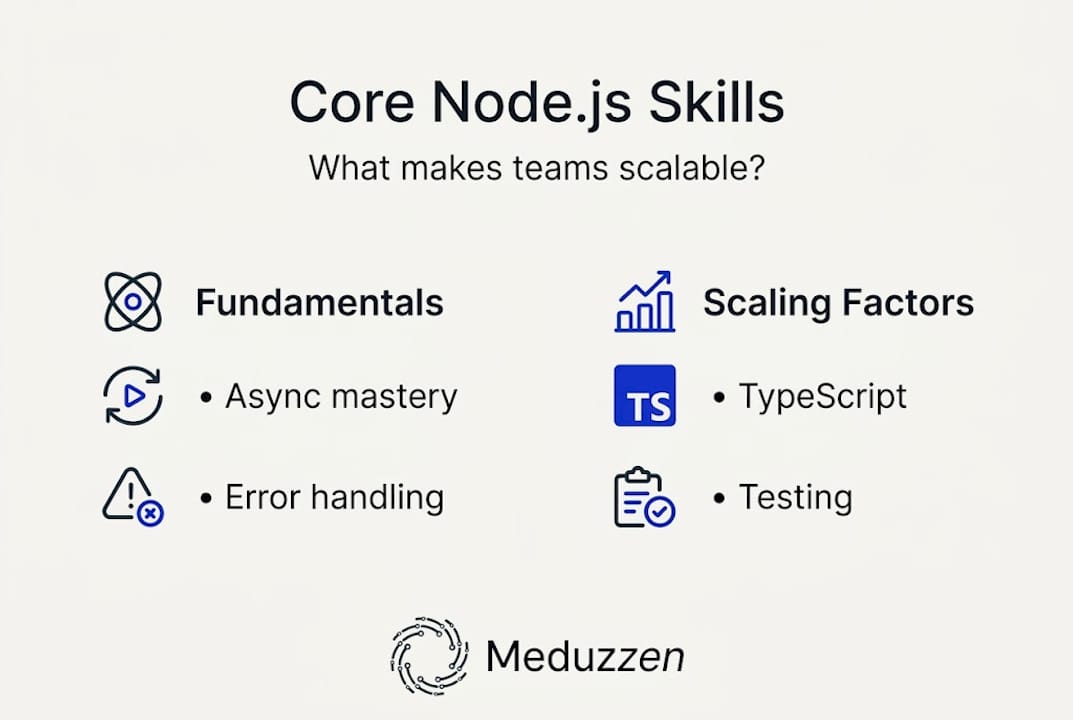
Framework familiarity is table stakes, but framework judgment is rare. Most Node.js developers have worked with Express. Fewer have used NestJS. Even fewer have made a deliberate, informed choice between them based on project requirements. When you’re evaluating senior or lead Node.js engineers, you want to understand their reasoning process, not just their resume.
Express is lightweight and unopinionated, which makes it fast to start with but potentially messy at scale without strong conventions. NestJS brings Angular-inspired structure with decorators, dependency injection, and a modular architecture that scales well for large teams. Fastify offers excellent performance with a plugin-based architecture that sits between the two in terms of structure. The NestJS vs Express guide breaks down these trade-offs in detail if you want to go deeper before your next interview round.
The microservices vs. monolith question is one of the most revealing you can ask. Strong candidates don’t have a default answer. They ask clarifying questions: How large is the team? What’s the deployment infrastructure? What’s the expected traffic pattern? A monolith is often the right starting point for an early-stage startup because it’s faster to build, easier to debug, and simpler to deploy. Microservices make sense when you have clear domain boundaries, independent scaling needs, and a team large enough to own separate services. Developers who push microservices on a 5-person team are often optimizing for resume building, not product success.
TypeScript adoption by codebase scale:
| Codebase scale | TypeScript recommendation | Primary reason |
|---|---|---|
| Small projects (under 10k lines) | Optional | Overhead may slow early iteration |
| Medium projects (10k to 50k lines) | Strongly recommended | Type safety catches bugs early |
| Large projects (50k+ lines) | Mandatory | Prevents systemic refactoring failures |
TypeScript is mandatory for large codebases while remaining optional for smaller projects. This distinction matters enormously for startups because your codebase will grow faster than you expect. Hiring developers who resist TypeScript or treat it as optional overhead is a decision that compounds negatively over time. The TypeScript benefits for scaling teams are well documented, and they go beyond just catching type errors.
What to look for in codebase management for scalable teams:
- Consistent folder structure and naming conventions across modules
- Clear separation of concerns between routing, business logic, and data access layers
- Meaningful commit messages and pull request descriptions that tell a story
- Evidence of code review participation, not just code authorship
- Documentation practices, including inline comments for complex logic and README files that onboard new developers quickly
- Dependency management hygiene, including regular audits and version pinning strategies
- Use of environment-specific configuration to separate development, staging, and production concerns
“The developers who scale systems successfully aren’t always the ones who write the cleverest code. They’re the ones who write code that other developers can read, extend, and trust. At scale, clarity is a competitive advantage.”
This perspective reflects something we’ve seen consistently across our work with FinTech, Healthcare, and EdTech clients. The teams that move fastest at scale are the ones where any engineer can pick up any part of the codebase and understand what it does within minutes. That’s not an accident. It’s a discipline that great Node.js developers build deliberately, and it’s something you can assess directly by reviewing their past work. The Express.js expertise that many developers claim often reveals itself in how they’ve structured real applications, not just in what they say they know.
Common pitfalls and evaluation mistakes to avoid
Having detailed advanced criteria, it’s critical to recognize and prevent common mistakes that can undermine your Node.js hiring. Even experienced CTOs fall into these traps, and the cost shows up months later in production.
The most common mistake is overweighting performance tests. A developer who optimizes a benchmark algorithm beautifully may write production code that blocks the event loop, leaks memory under sustained load, or crashes on unhandled Promise rejections. Benchmarks measure a specific, isolated capability. Production systems are messy, interconnected, and full of edge cases that no benchmark captures.
“Centralized error handling prevents costly production crashes. When every part of your application handles errors differently, you lose the ability to monitor, alert, and recover consistently. Centralization isn’t just a code quality concern. It’s an operational necessity.”
Callback hell avoided via async/await, CPU-intensive operations requiring worker threads, npm vulnerabilities, and poor error handling causing crashes are the four most cited causes of production failures in Node.js applications. Each one is preventable with the right knowledge and habits.
The risks you’re accepting when you skip thorough evaluation:
- Callback hell in legacy integrations: Even if your new code uses async/await, integrating with older libraries or third-party APIs can reintroduce nested callback patterns. Developers who don’t recognize this pattern will propagate it.
- CPU-intensive operations on the main thread: Node.js is single-threaded. Running heavy computation like image processing, PDF generation, or complex data transformations directly on the main thread blocks all other requests. Developers need to know when to offload to worker threads or separate services.
- npm vulnerability blindness: The npm ecosystem is vast and powerful, but it’s also a significant attack surface. Developers who don’t run regular audits, who install packages without reviewing their dependency trees, or who ignore known vulnerabilities are creating security debt that compounds quickly.
- Inconsistent error handling across services: When different parts of your application handle errors differently, debugging becomes exponentially harder. Production incidents that should take minutes to resolve can take hours when error context is lost or inconsistent.
- Missing process signal handling: Node.js applications need to handle SIGTERM and SIGINT signals gracefully to enable zero-downtime deployments and clean shutdowns. Developers who haven’t worked in containerized or orchestrated environments often overlook this entirely.
A practical evaluation structure that minimizes these risks:
Start every technical interview with an error handling scenario before any algorithm challenge. Ask the candidate to describe how they’d structure error handling for a REST API that calls three external services, each of which can fail independently. Then ask how they’d ensure that a crash in one service doesn’t bring down the entire application. The quality of this answer tells you more than any sorting algorithm exercise.
Follow up with a code review exercise. Give candidates a short Node.js snippet with three or four intentional problems: a blocking synchronous operation, an unhandled Promise rejection, a hardcoded secret, and a missing error boundary. Ask them to identify and fix the issues. This exercise tests practical knowledge, attention to detail, and the instincts that come from real production experience.
A useful complement to this process is reviewing the common Node.js interview pitfalls that candidates and interviewers alike tend to stumble over. Structuring your evaluation to avoid these pitfalls from both sides makes the entire process more reliable and fair.
According to surveys of startup founders and CTOs, error handling failures are consistently cited as the number one post-launch risk in Node.js applications. Not performance. Not framework choice. Error handling. That single data point should reshape how you weight your evaluation criteria.
What most Node.js evaluations miss: Practical wisdom for scaling teams
Here’s the honest truth we’ve arrived at after working with over 150 engineers across more than a decade of building scalable systems for startups and enterprises alike. Resumes and technical tests are necessary. They’re not sufficient.
The best Node.js developers we’ve seen in action carry something that doesn’t show up on a resume: hard-won experience preventing production failures before they happen. They’ve been paged at midnight because a memory leak brought down a service. They’ve refactored a callback-heavy codebase while keeping the lights on for paying customers. They’ve made the call to roll back a deployment when something felt wrong, even without definitive proof. That judgment is built through exposure to real consequences, not through passing technical screens.
Most CTOs focus their evaluation on what a developer knows. We’d encourage you to shift that lens toward what a developer has fixed. Ask them about a time they diagnosed a performance regression in a live Node.js app. Ask about a vulnerability they caught before it reached production. Ask about a scaling decision they made that turned out to be wrong, and what they did next. The answers to these questions reveal whether you’re talking to someone who has genuinely operated at scale or someone who has studied it from a safe distance.
Look for candidates who share stories with specificity. Not “I improved performance” but “I identified that our database query was running synchronously inside a loop, blocking the event loop for 400ms on every request, and I refactored it to use Promise.all with connection pooling, which brought that down to 12ms.” That level of detail signals real experience.
The engineering checklist insights we’ve developed reflect this philosophy. Scaling isn’t a single decision. It’s a series of small, well-reasoned choices made by developers who understand the cost of getting them wrong.
Pro Tip: Prioritize candidates who’ve debugged and improved applications in real-world high-traffic conditions. Ask them to describe the most complex production issue they’ve ever resolved in Node.js. The specificity and humility in their answer will tell you whether they’re ready for what you’re building.
Accelerate your team with Meduzzen’s Node.js expertise
If the evaluation framework in this article resonated with you, it’s because you already sense that hiring the right Node.js talent requires more than a job posting and a coding test. It requires a process built on real engineering standards, honest assessment, and a clear picture of what scalable development actually looks like in practice.
At Meduzzen, we’ve spent over 10 years building and augmenting engineering teams for startups and growing businesses across FinTech, Healthcare, EdTech, and more. Our JavaScript development services connect you with pre-vetted Node.js engineers who’ve already proven themselves in high-load, production-grade environments. Whether you need a single senior developer to strengthen your existing team or a full dedicated squad to accelerate your roadmap, our scalable web solutions are designed to fit your stage and your goals. Let’s talk about what your team needs next.
Frequently asked questions
What are the top skills to prioritize when hiring a Node.js developer?
Prioritize deep JavaScript knowledge, async/await handling, centralized error management, and proven experience with scaling production apps. Callback hell avoidance via async/await, npm vulnerability awareness, and proper error handling are the foundational competencies that separate reliable developers from risky hires.
How do startups evaluate Node.js developers beyond technical tests?
Go beyond tests to review real project contributions, error handling strategies, and code samples tackling production issues. Test-driven vs. framework-heavy approaches and real-world scaling experience are the dimensions that reveal genuine capability.
Why is TypeScript increasingly recommended for Node.js teams?
TypeScript makes managing large codebases significantly easier and is considered mandatory for scalable startup applications. TypeScript is mandatory for large codebases because it prevents the kind of systemic refactoring failures that slow teams down as applications grow.
What mistakes should founders avoid when hiring Node.js talent?
Don’t focus solely on performance metrics; be sure to assess error handling, process knowledge, and scaling experience. Callback hell, CPU-intensive operations, npm vulnerabilities, and poor error handling are the real risks that performance benchmarks will never surface.