In this article
NestJS vs Fastify vs Express: which backend wins in 2026
Tech & Infrastructure
Compare NestJS, FastIfy, and Express for 2026 SaaS backends. Learn how benchmarks, adapters, and scaling trade-offs should guide your framework decision.

TL;DR:
- Fastify offers higher throughput and lower latency due to schema-based serialization.
- NestJS’s performance depends heavily on the chosen adapter, with Fastify providing significant speed benefits.
- Framework choice should consider team expertise, workload types, migration risks, and operational needs.
Most teams pick Express because they’ve always picked Express. It’s familiar, battle-tested, and surrounded by a rich ecosystem of middleware. But per-request overhead in Express is measurably higher than in modern alternatives, and 2026 benchmarks make that gap impossible to ignore. When your SaaS platform is processing thousands of API calls per second, that overhead compounds fast. This guide cuts through the noise and gives you a clear, honest comparison of NestJS, Express, and performance in web development so you can make a decision grounded in real trade-offs, not habit or hype. Whether you’re starting fresh or migrating an existing system, what follows is the framework analysis you actually need.
Key Takeaways
| Point | Details |
|---|---|
| Fastify’s performance edge | Fastify consistently outperforms Express in per-request benchmarks, making it ideal for high-throughput APIs. |
| NestJS adapter flexibility | NestJS 11 can run on both Express v5 and Fastify, giving you modularity and upgrade options. |
| Express v5 migration caution | Switching to Express v5 in NestJS introduces breaking changes in routing and query parsing. |
| Scalability is architectural | Real-world scalability depends more on modular design and request handling patterns than on raw framework speed. |
| Decision should fit your team | Choosing the right framework requires balancing benchmarks with developer preferences and organizational context. |
How Express, NestJS, and Fastify handle HTTP performance
With the stage set, let’s explore how each framework achieves its characteristic performance.
Express has been the backbone of Node.js web development for over a decade. Its middleware model is simple, intuitive, and supported by an enormous library of plugins. But simplicity has a cost. Express processes each request through a middleware chain without the kind of low-level optimization that newer frameworks have built in from day one. The Express.js architecture is not inherently slow, but it carries overhead that adds up under sustained, high-concurrency load.
Fastify was designed with a different philosophy. It uses a schema-based approach to route handling and serialization, which means JSON responses are compiled ahead of time rather than computed on each request. The result is a framework that consistently tops throughput benchmarks. In 2026, requests per second benchmarks confirm that Express averages around 15,000 to 18,000 req/s on a simple JSON endpoint, while a comparable implementation in pure Express averages roughly 10,000 to 12,000 req/s. The gap is real and reproducible.
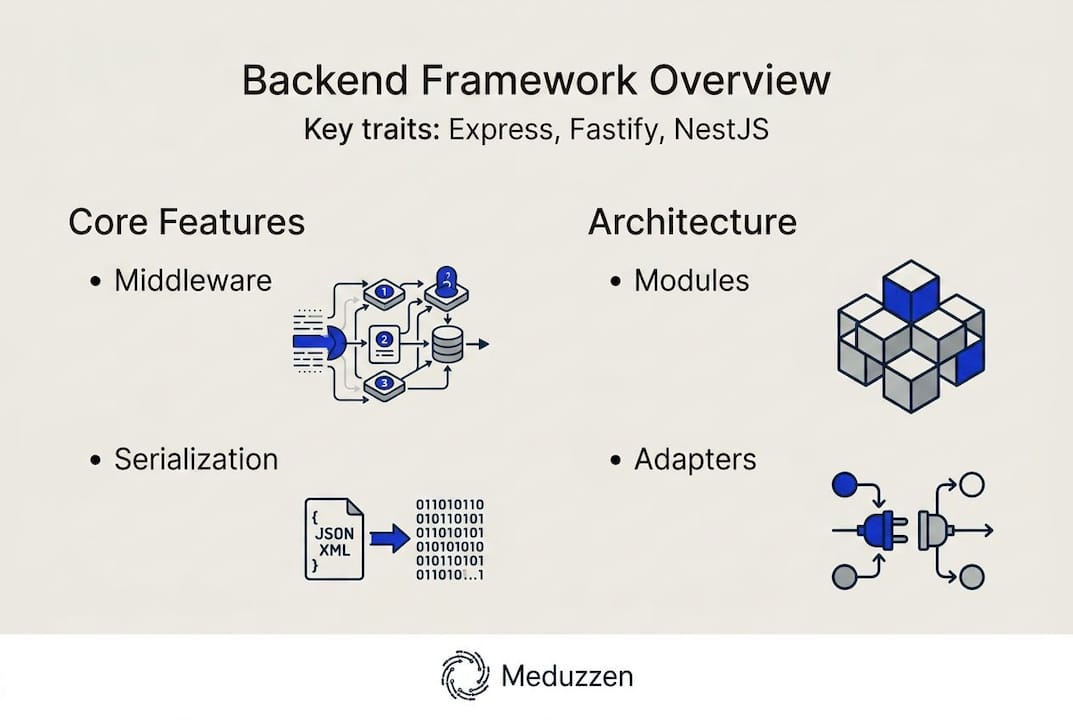
NestJS sits in a different category entirely. It is a meta-framework, meaning it does not handle raw HTTP itself. Instead, it wraps another engine, Express by default, and layers a structured architecture on top. In 2026, NestJS v11 ships with Express v5 as its default adapter. You can swap that out for a detailed benchmark comparison using the official @nestjs/platform-fastify package, which gives you NestJS’s architecture with a much faster HTTP engine underneath.
Performance comparison at a glance
| Framework | ~req/s (simple JSON) | P99 latency | Architecture style | Default in 2026 NestJS? |
|---|---|---|---|---|
| Express v5 | 10,000 to 12,000 | Higher | Linear middleware chain | Yes (via NestJS v11) |
| Pure Express | 10,000 to 12,000 | Higher | Linear middleware chain | No |
| Pure NestJS | 10,000 to 12,000 | Higher | Meta (Express adapter) | N/A |
| Pure NestJS + Fastify | ~15,000 to 18,000 | Lower | Meta (Fastify adapter) | Optional |
| Pure Fastify | ~15,000 to 18,000 | Lower | Schema-driven, low overhead | No |
A few things are worth calling out here:
- Fastify’s schema-based serialization is the primary driver of its throughput advantage
- Express’s middleware model introduces per-request overhead that scales with chain length
- NestJS’s performance is almost entirely determined by which adapter it uses
- “Hello world” benchmarks measure framework overhead, not application performance
- Real workloads introduce database calls, auth, caching, and business logic that dwarf raw HTTP overhead
Pro tip: Don’t benchmark a hello-world endpoint and call it done. Build a representative stub of your actual API, including at least one database query and one auth check, and measure that. The numbers will tell a more honest story.
The framework benchmark factors that matter most in production include middleware count, serialization strategy, and event loop utilization. Fastify wins on raw throughput. Express wins on ecosystem maturity. NestJS wins when you need structure at scale and can choose your adapter wisely.
NestJS in 2026: Architecture, adapters, and new Express v5 defaults
Understanding how frameworks perform at the HTTP level, it’s crucial to examine how NestJS structures your backend and what adapter means for real deployments.
NestJS is built around three core ideas: modules, dependency injection (DI), and adapters. modules define the boundaries of your application’s features. DI lets you inject services, repositories, and utilities without manually wiring them together. adapters are what make NestJS framework-agnostic at the HTTP level. This architecture is borrowed from Angular’s design patterns and brings a level of organizational clarity that pure Express or Fastify projects rarely achieve naturally.

The big news in 2026 is that NestJS v11 defaults to Express v5. Express v5 is not a drop-in replacement for v4. It introduces breaking changes that can catch teams off guard during migration. Understanding these changes is not optional if you’re upgrading an existing NestJS project.
Key breaking changes in Express v5 under NestJS 11
- Named wildcards in routes are now required. The old “*
wildcard no longer works as expected; you must use named patterns like*splat`. - Query string parsing behavior has changed. The default parser has been updated, which can affect how nested objects and arrays are parsed from URLs.
- Error handling middleware now requires four arguments explicitly, even if you don’t use all of them.
- Path matching is stricter, and trailing slashes are handled differently by default.
- Response finalization has subtle changes that affect how you terminate request handling in middleware chains.
If you’re evaluating whether to keep Express v5 or switch to the Fastify adapter, here’s a practical comparison:
| Factor | Express v5 adapter | Fastify adapter |
|---|---|---|
| Raw throughput | Lower | Higher |
| Migration complexity | Lower (familiar patterns) | Medium (Fastify-specific plugins) |
| Plugin ecosystem | Very large | Growing but smaller |
| Schema validation | Manual or via middleware | Built-in (JSON Schema) |
| Community support | Very mature | Strong and growing |
Switching to the Fastify adapter inside NestJS is not complicated, but it does require replacing Express-specific middleware with Fastify-compatible equivalents. The JavaScript ecosystem has matured enough that most common needs, logging, auth, rate limiting, have Fastify plugins available. The NestJS benchmark context makes clear that the adapter swap is most impactful when your API is genuinely throughput-constrained.
Pro tip: Before switching adapters in an existing NestJS project, audit every middleware and plugin you’re using. Some Express-specific packages have no direct Fastify equivalent, and discovering that mid-migration is painful.
For greenfield projects in 2026, the decision is cleaner. If your team is already comfortable with NestJS patterns and you expect high throughput requirements, starting with the Fastify adapter is a low-friction way to get both architecture and speed from day one.
Scaling strategies: Real-world considerations for high-performance APIs
Now that you know what makes the 2026 framework landscape tick, let’s address scalability as it applies to real SaaS and startup production systems.
Raw HTTP throughput is only one dimension of scalability. In production SaaS environments, the bottlenecks are almost never the framework itself. They’re in your database queries, your caching strategy, your dependency graph, and how cleanly your modules are separated. Framework choice sets the ceiling, but your architecture determines where you actually land.
NestJS’s module system is genuinely useful here. When each feature is encapsulated in its own module with clearly defined providers and exports, you can reason about load independently. A payments module that’s under heavy load doesn’t have to share state or initialization logic with your notifications module. This kind of isolation is what makes API scalability best practices achievable in practice, not just in theory.
NestJS scaling patterns emphasize that modules, dependency injection, interceptors, guards, and avoiding shared mutable state are the actual levers for scalability. These aren’t abstract concepts. They’re the difference between a system that degrades gracefully under load and one that collapses unpredictably.
Here’s what commonly goes wrong in high-throughput SaaS workloads:
- Global shared state in singleton services that wasn’t designed for concurrent access
- Non-isolated dependency graphs where a single slow service blocks unrelated request paths
- Missing interceptors for request tracing and observability, making it hard to diagnose latency spikes
- Guards that hit the database on every request without caching, turning auth into a bottleneck
- Over-relying on synchronous middleware when async patterns would release the event loop faster
“The teams that scale cleanly aren’t always using the fastest framework. They’re using the one they understand deeply enough to instrument, tune, and debug under pressure.”
Observability deserves special attention. NestJS’s interceptor system gives you a clean hook to measure request duration, log structured data, and emit metrics without polluting your business logic. Fastify has lifecycle hooks that serve a similar purpose. Express requires more manual wiring. In a high-load system, the ability to see what’s happening in real time is worth more than a few thousand extra requests per second.
Pro tip: Build your observability layer before you hit production. Add request ID propagation, structured logging, and latency histograms from day one. You’ll thank yourself when traffic spikes and you need answers fast.
For scalability strategies for startups, the right question isn’t “which framework is fastest?” It’s “which framework gives my team the clearest path to diagnosing and fixing problems at scale?” That answer depends on your team’s experience, your codebase’s structure, and your operational maturity.
Making the choice: Decision framework for your next project
With architectural, performance, and scaling logic on the table, it’s time to distill everything into an actionable decision process.
Choosing between Express, Fastify, and NestJS is not a purely technical decision. It’s a product decision, a team decision, and sometimes a political one. Here are five questions that cut through the noise:
- What is your team’s current expertise? If your engineers know Express deeply, the productivity cost of switching frameworks may outweigh the throughput gain. If they’re already familiar with Angular-style DI patterns, NestJS will feel natural.
- Is your workload genuinely throughput-constrained? For most SaaS APIs, the bottleneck is not the framework. If your p99 latency is driven by database queries, switching from Express to Fastify won’t fix it.
- Do you need strong architectural conventions? Solo developers and small teams can self-enforce structure. Growing teams benefit from the guardrails NestJS provides through modules and DI.
- Are you migrating an existing project or starting fresh? Migration introduces risk. Express v5’s breaking changes under NestJS 11 are subtle but real, and they require careful testing.
- What does your operational environment look like? If you’re running serverless functions with cold-start sensitivity, Fastify’s lower overhead is a meaningful advantage.
If throughput and latency are critical and your workload is API-heavy, Fastify (alone or as a NestJS adapter) leads benchmarks. But Express’s ecosystem and familiar patterns can still better suit some teams, especially those with large existing codebases or less Node.js specialization on the team.
For teams using NestJS 11, the Express v5 breaking changes around wildcard routes and query parsing deserve a dedicated testing pass before any production deployment. These are the kinds of subtle regressions that don’t show up in unit tests but surface immediately under real traffic.
Framework selection checklist
- Run benchmarks on a representative endpoint, not a hello-world stub
- Document every third-party middleware and plugin your app depends on
- Check Fastify plugin compatibility if considering an adapter swap
- Test wildcard routes and query string parsing if upgrading to Express v5
- Profile your actual bottlenecks before attributing latency to the framework
- Get team buy-in on the architectural conventions your chosen framework enforces
- Plan your observability and monitoring strategy before launch
Pro tip: Run your own adopting modern frameworks evaluation using production-like traffic patterns. Published benchmarks are a starting point, not a verdict.
The honest truth is that all three frameworks can power a successful SaaS product. The difference lies in how much friction you’ll encounter as your team grows, your traffic scales, and your requirements evolve.
Whichever framework you choose, you need engineers who know it deeply in production. See our complete guide on how to hire Node.js developers for evaluation tasks, cost comparisons, and hiring model options.
Our perspective: What most framework comparisons miss in 2026
Beyond the decision matrix, what do years of working with these frameworks reveal that comparisons rarely emphasize?
Benchmarks are a starting point, not a destination. We’ve seen teams spend weeks optimizing their framework choice only to discover that their primary latency driver was an unindexed database column. The benchmark caveats that expert write-ups acknowledge, effects from endpoint shape, middleware strategy, and serialization patterns, are not footnotes. They’re the main story.
The cost that comparisons consistently underestimate is migration risk. Express v5’s breaking changes are subtle enough that they won’t always surface in your test suite. Named wildcards, query parsing differences, and stricter path matching can produce bugs that only appear under specific traffic conditions. We’ve watched teams discover these issues in staging, and occasionally in production.
Developer experience matters more than most benchmarks measure. A framework that your team understands deeply, can debug confidently, and can extend without fear is worth more than marginal throughput gains. The Express.js legacy decisions that feel like constraints are often the same patterns your team can navigate blindfolded at 2am during an incident.
The myth of “best performance” distracts startups from a harder and more important question: which framework will still feel like the right choice in two years, when your team has doubled and your traffic has tripled? That’s the question worth sitting with.
Accelerate your SaaS backend with Meduzzen’s expertise
If this comparison has clarified the trade-offs but left you wondering how to apply them to your specific product, that’s exactly where we come in.
At meduzzen, we’ve helped startups and growing SaaS companies evaluate, migrate, and modernize their backend infrastructure across Express, Fastify, and NestJS. Our engineers don’t just know the frameworks. Whether you need to hire Python developers or scale a Node.js team, we match senior engineers to your stack. They know the edge cases, the migration pitfalls, and the architectural patterns that hold up under real production load. Whether you need a dedicated backend development team to build a new backend from scratch or experienced engineers to augment your existing team, our SaaS application development practice is built for exactly this kind of challenge. We also offer custom JavaScript solutions tailored to your stack, your team, and your growth trajectory. Let’s talk about what the right framework decision looks like for your product.
For a complete Node.js hiring framework including cost comparisons, evaluation tasks, and hiring models, see our guide on how to hire Node.js developers.
Frequently asked questions
Which framework is the fastest for handling simple HTTP requests in 2026?
Fastify achieves the highest throughput and lowest latency in simple HTTP benchmarks, consistently outperforming Express in controlled comparisons. Real-world performance depends on your middleware stack and workload shape.
Can NestJS use Fastify instead of Express in 2026?
Yes. NestJS 11 supports both Express v5 and Fastify as adapters, and switching to the Fastify adapter is the recommended path for throughput-sensitive applications.
What new breaking changes does Express v5 bring when used under NestJS 11?
Express v5 requires named wildcard routes and changes how query parameters are parsed by default, which can introduce subtle bugs in existing route handlers.
Are benchmarks a reliable way to choose between Express, Fastify, and NestJS?
Published benchmarks have caveats and should be treated as directional signals, not final verdicts. Real-world performance depends on workload shape, middleware, and team familiarity with the framework.