In this article
What Is Cloud Development? Cut SaaS Time-to-Market 50% in 2026
Tech & Infrastructure
Discover what cloud development really means for SaaS startups. Learn architectural patterns, security practices, and cost optimization strategies to cut time-to-market by 50% in 2026.

Over 40% of startup founders mistakenly believe cloud development means simply moving existing apps to the cloud. Real cloud development transforms how you build, deploy, and scale software from the ground up. This guide clarifies what true cloud development entails, its architectural patterns, security considerations, and actionable steps to help your SaaS platform scale efficiently while reducing time-to-market by up to 50%.
Key Takeaways
| Point | Details |
|---|---|
| Cloud development enables dynamic scaling | Applications automatically adjust resources to match real-time demand within minutes. |
| Microservices and serverless architectures enhance agility | Modular design allows independent deployment and faster feature releases for SaaS platforms. |
| Cloud-native DevOps accelerates deployment | CI/CD pipelines reduce deployment bugs by 70% and downtime by 90%. |
| Security requires proactive integration | Cloud providers secure infrastructure, but developers must implement encryption, access controls, and compliance measures. |
| Proper cloud design reduces time-to-market significantly | Strategic cloud architecture can cut SaaS product launch times by up to 50%. |
Definition and Overview of Cloud Development
Cloud development involves creating applications and services that run primarily on cloud infrastructure, leveraging on-demand resources for dynamic scaling. Unlike traditional development where you provision fixed server capacity, cloud development lets you spin up or down computing power within minutes based on actual user demand. This elasticity is fundamental for SaaS platforms experiencing variable traffic patterns.
Many founders confuse cloud development with cloud migration. Migration means lifting existing applications and moving them to cloud servers without redesigning the architecture. True cloud development means building applications specifically designed to exploit cloud capabilities like autoscaling, managed services, and distributed computing. Your app architecture changes from monolithic to modular, enabling each component to scale independently.
Cloud development relies on three foundational service models. Infrastructure as a Service (IaaS) provides virtualized computing resources you configure yourself. Platform as a Service (PaaS) offers pre-configured environments where you deploy code without managing underlying servers. Software as a Service (SaaS) delivers complete applications over the internet. Most modern SaaS startups combine these models, using PaaS for rapid development and IaaS for custom infrastructure needs.
Meduzzen’s custom cloud software development services help startups architect solutions that fully leverage cloud-native capabilities rather than simply rehosting legacy systems. When you design for the cloud from day one, you unlock agility that traditional architectures cannot match.
Key characteristics distinguish cloud-native development:
- Applications automatically distribute workloads across multiple servers for reliability
- Services communicate through APIs enabling independent updates without system-wide deployments
- Infrastructure provisioning happens through code rather than manual server configuration
- Resource usage aligns precisely with demand preventing waste from over-provisioned capacity
Architectural Patterns in Cloud Development
Microservices architecture is a primary cloud development pattern facilitating modular, independently scalable SaaS components. Instead of building one large application where all features share the same codebase, you create small services that each handle specific business functions. Your authentication service runs separately from your payment processing service, allowing you to update, scale, or troubleshoot each without affecting others.
Serverless computing takes abstraction further by eliminating infrastructure management entirely. You write functions that execute in response to events like API requests or database changes. The cloud provider automatically provisions compute resources for milliseconds when your function runs, then releases them. You pay only for actual execution time, not idle server capacity. This model suits startups with unpredictable workloads or rapid scaling needs.
Containerization packages your application code with all dependencies into portable units. Docker containers ensure your app runs identically across development laptops and production servers. Kubernetes orchestrates these containers at scale, automatically restarting failed instances and distributing traffic across healthy ones. Meduzzen’s custom Azure software development services implement containerized architectures that provide deployment consistency and operational resilience.

| Aspect | Microservices | Monolithic |
|---|---|---|
| Deployment | Independent service updates | Full application redeployment |
| Scaling | Scale individual services by demand | Scale entire application uniformly |
| Technology | Mix languages and frameworks per service | Single technology stack |
| Failure impact | Isolated to affected service | Potential system-wide outage |
| Team structure | Small teams own specific services | Large teams coordinate on shared codebase |
Pro Tip: Start with containerized microservices rather than serverless if your team lacks cloud experience. Containers provide more control and easier debugging while still enabling independent scaling. Adopt serverless for specific high-variability workloads once you understand your usage patterns.
Choosing the right pattern depends on your team size, application complexity, and scaling requirements. Most successful SaaS platforms combine approaches, using microservices for core business logic and serverless for event-driven tasks.
Benefits of Cloud Development for SaaS Platforms
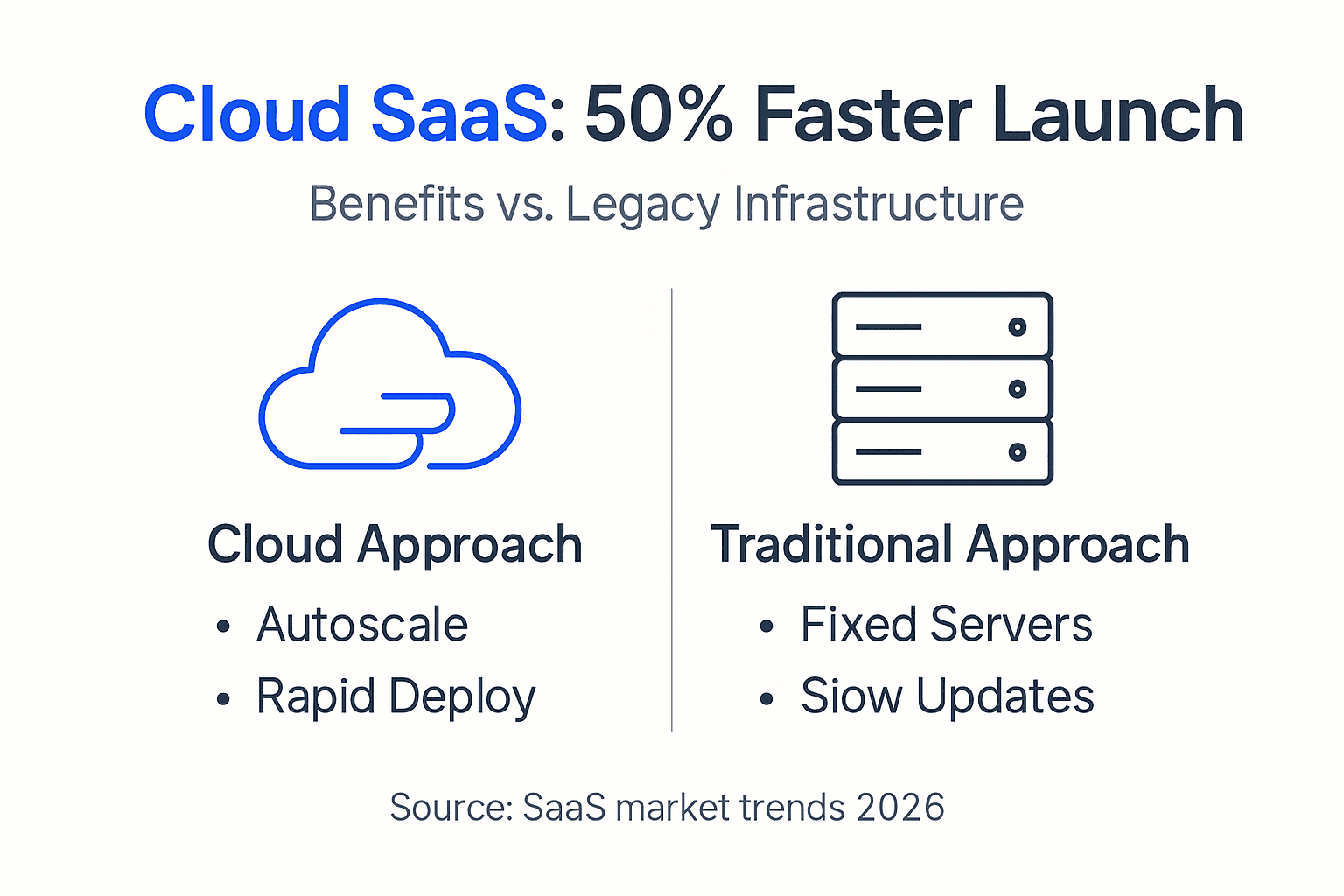
Cloud development can reduce SaaS product launch times by up to 50% compared to traditional infrastructure approaches. You eliminate months spent procuring and configuring physical servers. Development teams provision test environments in minutes rather than weeks, accelerating iteration cycles. This speed advantage compounds over time as you rapidly test features and respond to market feedback.
Pay-as-you-go pricing aligns costs directly with usage. You avoid large upfront capital expenses for servers that might sit idle. Elastic scaling automatically adds computing resources during traffic spikes and releases them when demand drops. A SaaS platform serving 1,000 users pays far less than one serving 100,000 users, but both use identical code. This cost efficiency is crucial for startups managing runway and demonstrating unit economics to investors.
Cloud infrastructure provides built-in redundancy across multiple data centers. If one server fails, load balancers automatically route traffic to healthy instances. Your application maintains uptime without manual intervention. Geographic distribution lets you serve users from nearby regions, reducing latency and improving experience. Meduzzen’s SaaS application services architect platforms with multi-region deployments ensuring 99.9% availability for mission-critical workloads.
Cloud platforms offer managed services that replace custom development:
- Managed databases handle backups, patches, and replication automatically
- Content delivery networks cache static assets globally without custom infrastructure
- Message queues coordinate asynchronous tasks between services reliably
- Identity services implement secure authentication without building from scratch
- Analytics tools provide real-time insights into application performance and user behavior
Engineering collaboration improves through cloud-based development tools. Version control systems, CI/CD pipelines, and monitoring dashboards are accessible from anywhere. Remote and distributed teams work from identical environments, eliminating “works on my machine” problems.
Pro Tip: Implement cloud cost monitoring from day one. Set up alerts when spending exceeds budgets and tag resources by team or feature. Many startups discover runaway costs months later when bills become unmanageable. Real-time visibility lets you optimize resource allocation proactively.
Integrating DevOps in Cloud Development
Cloud-native DevOps combines development and operations practices to automate software delivery pipelines. Continuous Integration (CI) automatically tests code changes whenever developers commit updates. Continuous Deployment (CD) pushes tested code to production without manual intervention. This automation reduces human error and accelerates release cycles from weeks to hours.
Implementing a CI/CD pipeline in cloud development follows these steps:
- Store application code in a version control system triggering automated builds on every commit
- Configure automated testing suites that validate functionality, security, and performance against each build
- Create staging environments mirroring production where you deploy and test builds before release
- Automate production deployments using blue-green or canary strategies that minimize downtime risk
- Implement automated rollback mechanisms that revert to previous versions if deployments fail health checks
- Integrate monitoring and logging that feed real-time metrics back to development teams
Organizations adopting cloud-native DevOps report deployment bugs reduced by 70% and downtime incidents decreased by 90%. Automated testing catches issues before they reach users. Small, frequent deployments limit the scope of potential problems compared to large quarterly releases.
Real-time monitoring provides continuous feedback on application health. You track response times, error rates, and resource utilization across all services. When metrics deviate from normal patterns, alerts notify teams immediately. This visibility lets you identify and resolve issues proactively rather than waiting for user complaints.
Meduzzen’s custom DevOps services establish end-to-end automation pipelines tailored to your SaaS platform’s specific requirements. We integrate security scanning, compliance checks, and performance testing directly into deployment workflows. Teams ship features confidently knowing every change passes through rigorous automated validation.
Collaboration tools integrated with cloud infrastructure centralize communication and decision-making. Developers, operations engineers, and product managers work from shared dashboards showing deployment status, system health, and user impact metrics. This transparency eliminates information silos and aligns teams around common objectives.
Common Misconceptions about Cloud Development
The most damaging misconception equates cloud development with simple application migration. Founders believe moving existing apps to cloud servers automatically delivers cloud benefits. Reality requires redesigning applications to use cloud-native patterns like microservices, managed services, and autoscaling. Without architectural changes, you simply run traditional apps on more expensive infrastructure.
Many assume cloud providers handle all security automatically. Providers secure physical data centers and underlying infrastructure, but you remain responsible for application security, data encryption, access controls, and compliance. This shared responsibility model catches teams unprepared. A misconfigured storage bucket or weak authentication implementation creates vulnerabilities regardless of cloud platform security.
Another false belief suggests minimal code changes bring cloud advantages. Effective cloud development means rethinking how you build, deploy, and operate software. You adopt new patterns for state management, inter-service communication, and error handling. Teams underestimating this learning curve struggle with reliability issues and cost overruns.
Typical failure points include:
- Treating cloud resources like physical servers instead of ephemeral, disposable components
- Neglecting to implement proper monitoring and alerting before production launch
- Overlooking data transfer costs between services and regions leading to unexpected bills
- Failing to design for failure by assuming cloud infrastructure never experiences outages
- Skipping load testing because autoscaling “should” handle traffic spikes automatically
Successful cloud adoption requires mindset shifts beyond technology changes. Teams must embrace infrastructure as code, automated testing, and continuous deployment practices. Organizations resisting these cultural changes gain minimal value from cloud migration despite significant investment.
Security Considerations in Cloud Development
Integrating security early in the development lifecycle, often called “shift left,” dramatically reduces breach risks and compliance costs. When you address security during design and coding phases rather than after deployment, fixing vulnerabilities costs 10 times less and prevents exposure windows.
Key security practices for cloud development include:
- Encrypt data both in transit using TLS and at rest using cloud provider encryption services
- Implement principle of least privilege where each service and user accesses only required resources
- Use multi-factor authentication and strong password policies for all accounts
- Regularly rotate credentials and use secrets management services instead of hardcoding keys
- Maintain detailed audit logs tracking all access and changes to sensitive resources
- Conduct regular security assessments and penetration testing against deployed applications
Common security pitfalls emerge when teams rely solely on cloud provider defaults. Default configurations often prioritize ease of use over security. Storage buckets may default to public access. Network security groups might allow overly broad traffic. You must explicitly review and harden every configuration setting.
Pro Tip: Adopt DevSecOps practices that automate security checks within your CI/CD pipeline. Tools scan code for vulnerabilities, test for common misconfigurations, and verify compliance requirements before deployment. Catching security issues in development prevents costly fixes later and reduces time pressure on security teams reviewing changes manually.
Regulatory compliance requirements vary significantly between US and European markets. GDPR mandates strict data protection and privacy controls for European user data. HIPAA governs healthcare information security for US-based health tech startups. PCI DSS applies to any SaaS platform processing payment card data. Your cloud architecture must accommodate these regulations through proper data residency, encryption, access controls, and audit capabilities.
SaaS startups often underestimate compliance complexity until pursuing enterprise customers or raising funding rounds. Building compliant architectures from the start costs less than retrofitting security later. Cloud providers offer compliance certifications and tools, but you remain ultimately responsible for your application’s regulatory adherence.
Cost Optimization in Cloud Development
Pay-as-you-go pricing aligns cloud costs directly with actual resource consumption. You pay only for compute hours used, storage gigabytes occupied, and data transferred. This eliminates waste from over-provisioned physical servers sitting idle. However, without active management, costs can spiral as applications scale and teams spin up resources freely.
Autoscaling mechanisms optimize resource allocation by adjusting capacity automatically based on demand. When traffic increases, the system provisions additional server instances. When traffic subsides, it terminates excess capacity. Configure autoscaling policies carefully, balancing responsiveness with cost control. Overly aggressive scaling wastes money on brief spikes. Insufficient scaling degrades user experience during peak periods.
Resource monitoring and rightsizing identify optimization opportunities:
- Analyze CPU and memory utilization to identify over-provisioned instances running at low capacity
- Review storage usage to delete obsolete data and move infrequently accessed content to cheaper tiers
- Examine network traffic patterns to optimize data transfer between services and regions
- Identify idle resources like development environments running outside business hours
- Evaluate reserved instance and savings plan options for predictable baseline workloads
| Strategy | Potential Savings | Implementation Complexity | Best For |
|---|---|---|---|
| Autoscaling | 30-50% | Medium | Variable workloads |
| Reserved instances | 40-60% | Low | Stable baseline capacity |
| Spot instances | 60-80% | High | Fault-tolerant batch processing |
| Storage tiering | 50-70% | Low | Infrequently accessed data |
| Rightsizing | 20-40% | Medium | Over-provisioned resources |
Regularly review cloud usage metrics to prevent overspending. Set up billing alerts that notify you when costs exceed thresholds. Implement tagging strategies that attribute spending to specific teams, projects, or features. This visibility enables data-driven decisions about resource allocation and helps identify cost anomalies quickly.
Startups should establish cloud cost governance early. Define approval processes for expensive resources. Require business justification for production capacity increases. Implement automatic shutdown policies for non-production environments. These practices prevent the common scenario where cloud bills grow faster than revenue as teams prioritize speed over cost consciousness.
Real-World Examples and Case Studies
A FinTech startup serving the European market achieved 5x user growth over 18 months after migrating to cloud-native microservices architecture. Their monolithic platform struggled to scale beyond 50,000 users due to database bottlenecks and deployment risks. By decomposing the application into independent services for authentication, transactions, reporting, and notifications, they scaled to 250,000 users without infrastructure rewrites. Meduzzen’s FinTech SaaS cloud success implementations follow similar patterns, enabling rapid scaling for payment processors and digital banking platforms.
The startup accelerated feature rollout from quarterly to weekly releases by implementing automated CI/CD pipelines. Development teams deployed updates to individual services without coordinating system-wide releases. This velocity let them respond quickly to regulatory changes and competitive pressures. Customer-facing features reached production 10 times faster than under their previous waterfall process.
Operational stability improved dramatically through cloud-native reliability patterns. The team implemented health checks that automatically replaced failing service instances. They deployed across multiple availability zones ensuring continuous operation during infrastructure failures. Circuit breakers prevented cascading failures when dependent services experienced issues. These patterns reduced downtime from several hours monthly to under 15 minutes quarterly.
Key lessons from their cloud adoption journey:
- Start with thorough architecture planning before migrating existing services
- Invest in team training and experimentation time to build cloud expertise
- Implement comprehensive monitoring before moving production workloads
- Adopt managed services where possible rather than building custom infrastructure
- Design for failure from day one assuming individual components will fail
- Establish cost controls and monitoring to prevent runaway spending
The financial impact proved substantial. Cloud infrastructure costs ran 40% lower than projected on-premises expansion. Development productivity increased by 60% measured by features deployed per engineer. Customer satisfaction scores improved as application performance and reliability increased. These measurable outcomes justified the initial migration investment within nine months.
Explore Meduzzen’s Cloud Development Solutions
Meduzzen specializes in building scalable cloud architectures that accelerate SaaS growth. Our engineers have deployed production systems serving millions of users across FinTech, HealthTech, and EdTech sectors. We design cloud-native solutions leveraging microservices, containerization, and managed services tailored to your specific scaling challenges.
Our custom cloud development services cover architecture design, implementation, and ongoing optimization. We establish custom DevOps services including CI/CD pipelines, infrastructure automation, and monitoring systems that reduce deployment time and improve reliability. For startups building web and SaaS application services, we provide end-to-end development from initial MVP through enterprise-scale platforms.
Our team integrates seamlessly with yours, providing expertise without lengthy onboarding delays. We focus on delivering measurable business outcomes through technical excellence and transparent communication. Schedule a consultation to discuss how cloud development can accelerate your SaaS platform’s growth trajectory.
Frequently Asked Questions About Cloud Development
What is the difference between cloud development and cloud migration?
Cloud development means designing and building applications specifically to leverage cloud capabilities like autoscaling and managed services. Cloud migration simply moves existing applications to cloud servers without redesigning architecture. Migration provides some benefits like reduced hardware maintenance, but true cloud development transforms how you build and operate software.
How does cloud-native architecture improve SaaS scalability?
Cloud-native architecture decomposes applications into independent services that scale individually based on demand. Your authentication service can handle 10,000 requests per second while your reporting service handles 100, each using appropriate resources. This granular scaling is impossible with monolithic applications that must scale all components uniformly regardless of actual needs.
What security practices are essential in cloud development?
Implement encryption for data in transit and at rest, enforce principle of least privilege for access controls, use multi-factor authentication, rotate credentials regularly, and maintain detailed audit logs. Integrate automated security scanning into CI/CD pipelines to catch vulnerabilities during development rather than after deployment. Remember that cloud providers secure infrastructure but you remain responsible for application security.
How can startups optimize cloud costs effectively?
Implement autoscaling to match capacity with demand, rightsize resources by analyzing actual utilization, use reserved instances for predictable baseline workloads, and set up billing alerts with resource tagging. Review cloud spending regularly and establish governance policies requiring justification for expensive resources. Many startups save 30-50% through systematic cost optimization without impacting performance.
What role does DevOps play in cloud development?
DevOps practices automate software delivery through CI/CD pipelines that test and deploy code changes continuously. This automation reduces deployment bugs by 70% and accelerates release cycles from weeks to hours. Cloud-native DevOps also implements monitoring and feedback loops that provide real-time visibility into application health, enabling proactive issue resolution before users experience problems.