In this article
Build a startup software workflow that scales in 2026
Tech & Infrastructure
Build scalable software development workflows for startups in 2026. Learn proven steps for Agile implementation, automation, team coordination, and success metrics.

Startup founders know the challenge: building software fast enough to capture market opportunity while maintaining quality and staying within budget. Most startups struggle to create workflows that balance speed, cost, and reliability when every delay risks losing competitive advantage. This guide walks you through proven steps to build scalable software development workflows tailored for startups in 2026, covering prerequisites, implementation, team coordination, automation, common pitfalls, and success metrics.
Key takeaways
| Point | Details |
|---|---|
| Prerequisites boost delivery | Defining budgets and timelines upfront raises on-time delivery by 25%. |
| Agile accelerates product-market fit | 70% of startups prefer Agile for rapid iteration and MVP delivery. |
| Clear roles reduce delays | Proper team definitions and communication cut project delays by 30%. |
| Automation shortens cycles | CI/CD pipelines reduce release cycles by 40% and prevent technical debt. |
| Metrics prevent missed deadlines | Tracking velocity and quality avoids 35% higher deadline misses. |
Prerequisites and planning for effective startup workflows
Successful workflows start with solid groundwork. Before designing your development process, assess your resources, budget, and team readiness. Most startup MVPs require budgets between $50K and $250K with timelines spanning 6 to 12 months. Setting these parameters early increases your chances of on-time delivery significantly.
Defining budgets and timelines upfront improves delivery rates by 25%. This planning phase prevents costly mid-project pivots and keeps teams focused on achievable goals.
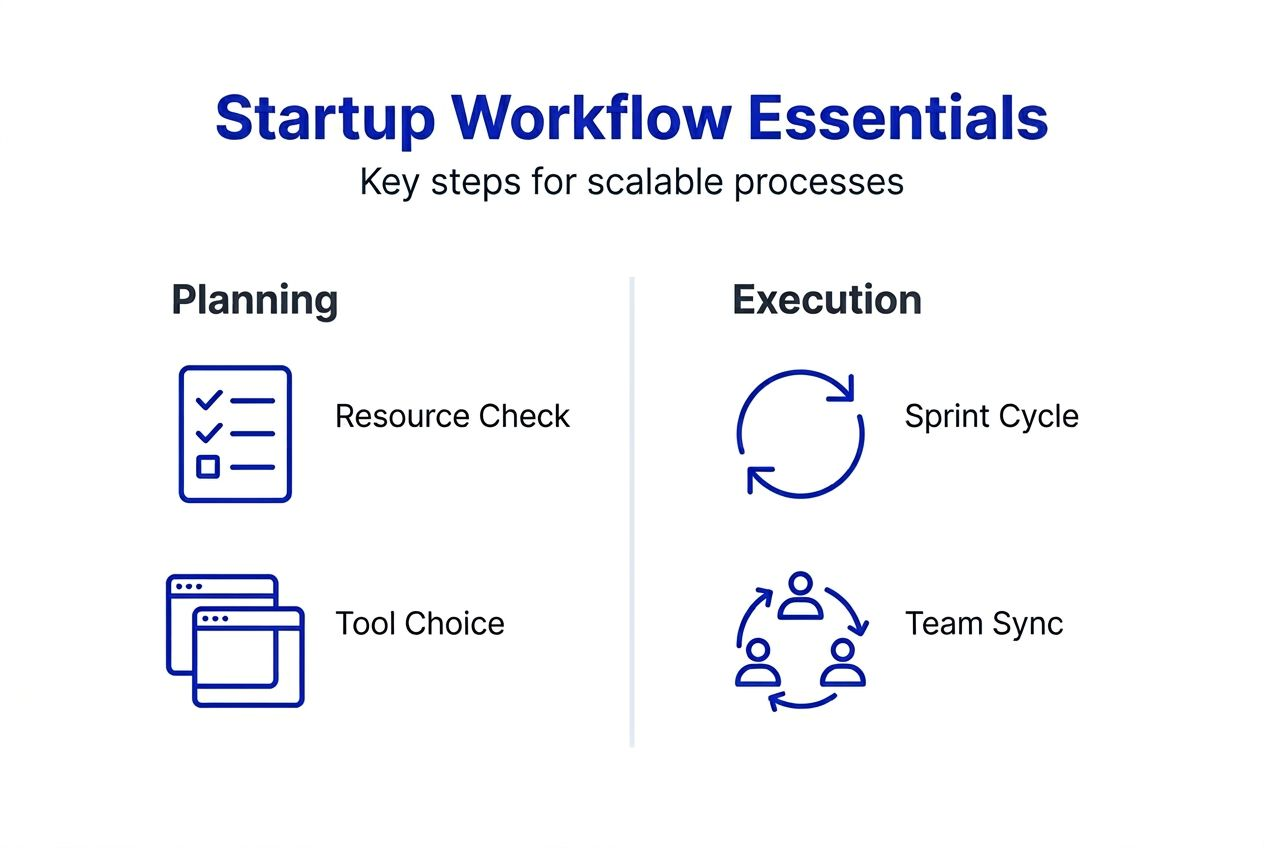
Essential preparation steps include:
- Confirm team knowledge of Agile or Lean fundamentals
- Identify available tools for CI/CD, project management, and communication
- Define clear team roles and responsibilities
- Set communication expectations and cadence
- Plan user feedback integration points early
- Assess technical infrastructure needs
Pro Tip: Before committing to expensive enterprise tools, validate your workflow with free or low-cost alternatives. Many startups successfully launch using GitHub Actions for CI/CD, Slack for communication, and Linear for project tracking. Scale your software development technologies only when growth demands it.
Resource allocation matters as much as tool selection. Map your team’s current skill set against project requirements. Identify gaps early so you can address them through training, hiring, or augmentation before development begins.
Step-by-step creation of startup-centric software development workflows
Building an effective workflow requires methodical execution. Follow these steps to create a process that balances startup speed with quality delivery.
- Establish budget and timeline boundaries. Document your financial constraints and delivery deadlines. Share these with the entire team to align expectations.
- Select Agile as your primary methodology. Agile methodology supports 70% of successful startups because it enables rapid iteration and flexibility. This approach lets you adapt quickly when market feedback demands changes.
- Define roles and communication channels. Assign clear ownership for product, engineering, design, and quality assurance. Establish daily standups and weekly retrospectives.
- Integrate CI/CD pipelines early. Automation reduces manual deployment work and catches bugs before they reach production. CI/CD implementation cuts release cycles by 40%, letting you ship features faster.
- Embed continuous user feedback loops. Schedule regular user testing sessions and product demos. Direct feedback shortens your path to product-market fit, often reducing discovery time to under 6 months.
- Measure velocity and quality metrics weekly. Track story points completed, bug rates, and deployment frequency. These indicators reveal workflow bottlenecks before they become critical.
- Adapt your workflow as you scale. What works for a 5-person team may break at 15 people. Review and refine processes quarterly.
Pro Tip: Start with two-week sprints regardless of your methodology preference. This cadence provides frequent checkpoints without excessive meeting overhead. Adjust sprint length only after you have three months of velocity data showing consistent patterns.
Your workflow should feel like a living system, not rigid rules. Encourage team members to suggest improvements based on real friction points they encounter. The best processes evolve through practitioner feedback, not theory. Explore custom software development services that align with your workflow needs.
Optimizing team coordination and communication for scaling
Clear communication separates high-performing startup teams from those stuck in endless meetings. As your team grows, intentional coordination practices become critical.
Role clarity prevents duplicate work and ownership gaps. Define who makes final decisions on architecture, design, and product priorities. Written documentation and regular syncs reduce miscommunication by 40%. Clear definitions cut project delays by 30%.
Effective coordination practices include:
- Maintain a single source of truth for project status and decisions
- Document architectural decisions and their rationale
- Hold daily 15-minute standups focused on blockers
- Conduct weekly retrospectives to surface process issues
- Use asynchronous communication for non-urgent updates
- Create onboarding documentation for new team members
Distributed teams need extra attention to documentation and synchronization. When team members work across time zones, written communication becomes your primary collaboration tool. Record key decisions, maintain updated README files, and document why choices were made, not just what was decided.
“The best communication strategy is one that makes itself obsolete. When processes are clear and documentation is thorough, teams spend less time asking questions and more time building.”
Centralized platforms improve transparency and reduce information silos. Tools like Notion, Confluence, or Linear keep everyone aligned on priorities and progress. AI-driven coordination strategies can further streamline information flow as teams scale.
Consider staff augmentation for scaling teams when coordination overhead threatens productivity. Adding experienced engineers who integrate quickly can maintain momentum without the communication debt of constant hiring.
Leveraging automation and tooling integration to accelerate delivery
Manual processes don’t scale. Automation frees your team to focus on complex problems that require human creativity and judgment.

CI/CD pipelines reduce release cycles by 40%, eliminating deployment bottlenecks that delay feature delivery. Automated testing catches regressions before they reach users. Deployment automation removes the stress and errors of manual releases.
Key automation opportunities:
- Automated testing for every pull request
- Continuous integration running on every commit
- Automated deployment to staging environments
- Scheduled security and dependency scans
- Automated code quality checks and linting
AI-driven project management tools reduce manual task overhead by 25%. These platforms predict delays, suggest resource allocation, and automate routine updates. Modern AI services for project management can analyze team velocity patterns and flag potential bottlenecks before they impact delivery.
| Tool Category | Key Benefit | Typical ROI Timeline |
|---|---|---|
| CI/CD Platforms | 40% faster releases | 1-2 months |
| AI Project Management | 25% less manual work | 2-3 months |
| Automated Testing | 60% fewer production bugs | 1 month |
| Code Quality Tools | 30% reduced technical debt | 3-4 months |
Pro Tip: Don’t automate broken processes. Fix your workflow first, then automate the optimized version. Automating dysfunction just creates faster chaos. Start with your most time-consuming manual tasks and measure impact before expanding automation coverage.
Choose tools that grow with you. Free tiers work for early-stage startups, but evaluate pricing at 10x and 100x your current scale. The cheapest option today might become prohibitively expensive as you grow. Stay updated on automation advances in 2026 to leverage emerging capabilities.
Common pitfalls in startup workflows and how to troubleshoot
Even well-designed workflows fail when teams ignore warning signs. Recognizing these patterns early prevents expensive delays.
Scope creep and unclear goals cause 50% of project delays. When requirements constantly shift without formal change management, teams waste effort building features that get scrapped. Fix this by defining clear project scope upfront and requiring documented approval for scope changes.
Lack of user feedback leads to building the wrong product. Teams assume they understand user needs, then discover after months of work that their assumptions were wrong. Fix this by embedding continuous feedback loops. Talk to users weekly, not quarterly.
Poor documentation causes miscommunication and repeated questions. When knowledge lives only in people’s heads, absences create bottlenecks and new team members struggle to contribute. Fix this with written records and regular syncs that create searchable archives.
Ignoring metrics leads to missed deadlines and accumulating technical debt. Without data on velocity and quality, teams can’t spot declining performance until crises hit. Fix this by measuring key metrics weekly and addressing negative trends immediately.
Selecting the wrong methodology harms delivery speed and quality. Not every project suits Agile. Compliance-heavy or fixed-scope projects often need more structure. Fix this by evaluating project characteristics honestly and choosing methodologies that match your constraints. Learn from avoiding pitfalls in software workflows through real project examples.
Alternative workflow approaches and their tradeoffs for startups
No single methodology fits every situation. Understanding the alternatives helps you choose the right approach for your specific context.
Agile emphasizes iterative development with frequent releases and continuous feedback. Best for projects with evolving requirements and uncertain market conditions. The flexibility allows rapid pivots based on user response. Tradeoffs include higher coordination overhead and less predictable long-term timelines.
Lean focuses on building minimum viable products and eliminating waste. Prioritizes speed over comprehensive features. Best for early-stage startups testing market hypotheses with limited budgets. Tradeoffs include potential technical debt from moving too fast and minimal documentation.
Waterfall follows sequential phases with defined gates and documentation. Best for projects with fixed scope, regulatory requirements, or external dependencies that demand predictability. Tradeoffs include inflexibility when requirements change and delayed feedback on usability.
| Methodology | Best For | Pros | Cons |
|---|---|---|---|
| Agile | Fast-changing requirements | Flexible, continuous feedback | Higher coordination needs |
| Lean | Early MVP testing | Maximum speed, minimal waste | Risk of technical debt |
| Waterfall | Fixed scope/compliance | Predictable, well-documented | Inflexible, delayed feedback |
Most successful startups blend approaches. Use Lean principles for initial MVP discovery, transition to Agile for product development, and apply Waterfall rigor to compliance-critical features. Explore DevOps services and workflow frameworks that support hybrid approaches.
Expected outcomes and success metrics for startup workflows
Set realistic expectations to measure progress and identify when adjustments are needed. Benchmarks vary by industry and team size, but these ranges represent typical successful startups.
MVP delivery timelines typically span 6 to 12 months with budgets between $50K and $250K. Complex products or regulated industries may extend these ranges. Simpler consumer apps often deliver faster.
Automation shortens release cycles by 40% or more compared to manual deployment processes. Teams with mature CI/CD pipelines deploy multiple times daily instead of monthly.
Clear role definitions cut project delays by 30%. When everyone knows their responsibilities and decision authority, teams move faster with less friction.
User feedback loops reduce product-market fit discovery time to under 6 months. Regular user contact prevents building unwanted features and validates assumptions quickly.
Key success indicators:
- Sprint velocity increases or stabilizes over time
- Bug escape rate to production decreases
- Deployment frequency increases
- Lead time from commit to production decreases
- Team satisfaction scores remain high
Startups that fail to measure velocity and quality metrics experience 35% higher missed deadlines and technical debt accumulation. Tracking these indicators weekly lets you spot problems early.
| Metric | Healthy Range | Warning Signs |
|---|---|---|
| Sprint Velocity | Stable or increasing | Declining 3+ sprints |
| Bug Escape Rate | Under 5% | Above 10% |
| Deployment Frequency | Weekly or better | Monthly or less |
| Lead Time | Under 3 days | Over 1 week |
Monitor DevOps performance metrics to validate that your workflow improvements deliver measurable results. Adjust processes when metrics show negative trends persisting beyond one sprint.
Explore Meduzzen’s software development services to scale your startup
Building effective workflows requires both process knowledge and technical execution. Meduzzen helps startups implement scalable development practices through tailored software development, AI-driven tools, and flexible team augmentation.
Our pre-vetted engineers integrate seamlessly into your existing workflows, bringing expertise in Python, AI, DevOps, and modern web technologies. We’ve delivered scalable SaaS platforms and enterprise systems for FinTech, Healthcare, and EdTech startups across 10 years and 150+ engineers.
Whether you need comprehensive web services for rapid MVP launches, JavaScript development expertise, or staff augmentation to scale your team without sacrificing quality, we provide transparent communication and predictable delivery aligned with your startup’s goals.
Frequently asked questions
What are the key tools startups need before building a software workflow?
Startups need CI/CD tools, project management platforms, and communication software to support agile and iterative development. These tools enable automation, clear tracking, and streamlined team collaboration. GitHub Actions, Linear, and Slack represent cost-effective options for early-stage teams.
How can startups avoid common software development delays?
Set clear project scope and manage changes formally through documented approval processes. Incorporate regular user feedback cycles to validate assumptions early. Maintain thorough documentation and hold regular sync meetings to prevent miscommunication and knowledge silos.
When should a startup consider switching from Lean to Agile workflow?
Lean fits early-stage MVPs with tight budgets prioritizing speed over comprehensive features. Switch to Agile when product complexity grows, requiring more iterative cycles and team coordination. This transition typically happens after initial product-market fit validation when scaling features and users.
What metrics are most important to track in startup workflows?
Track velocity to monitor development speed and predict delivery timelines. Measure quality through bug escape rates to detect defects early. Monitor delivery timelines and deployment frequency to prevent slippage. Startups that fail to measure these metrics experience 35% higher missed deadlines and technical debt accumulation.