In this article
The bottleneck in enterprise AI is not the model
AI & Automation
Gartner says 40% of AI agent projects will be canceled by 2027. We just shipped one that works. Nine months, 15 engineers, chain-of-agents logic for an Israel-based enterprise AI client. Then Dribbble named it one of 2026’s most impactful projects.
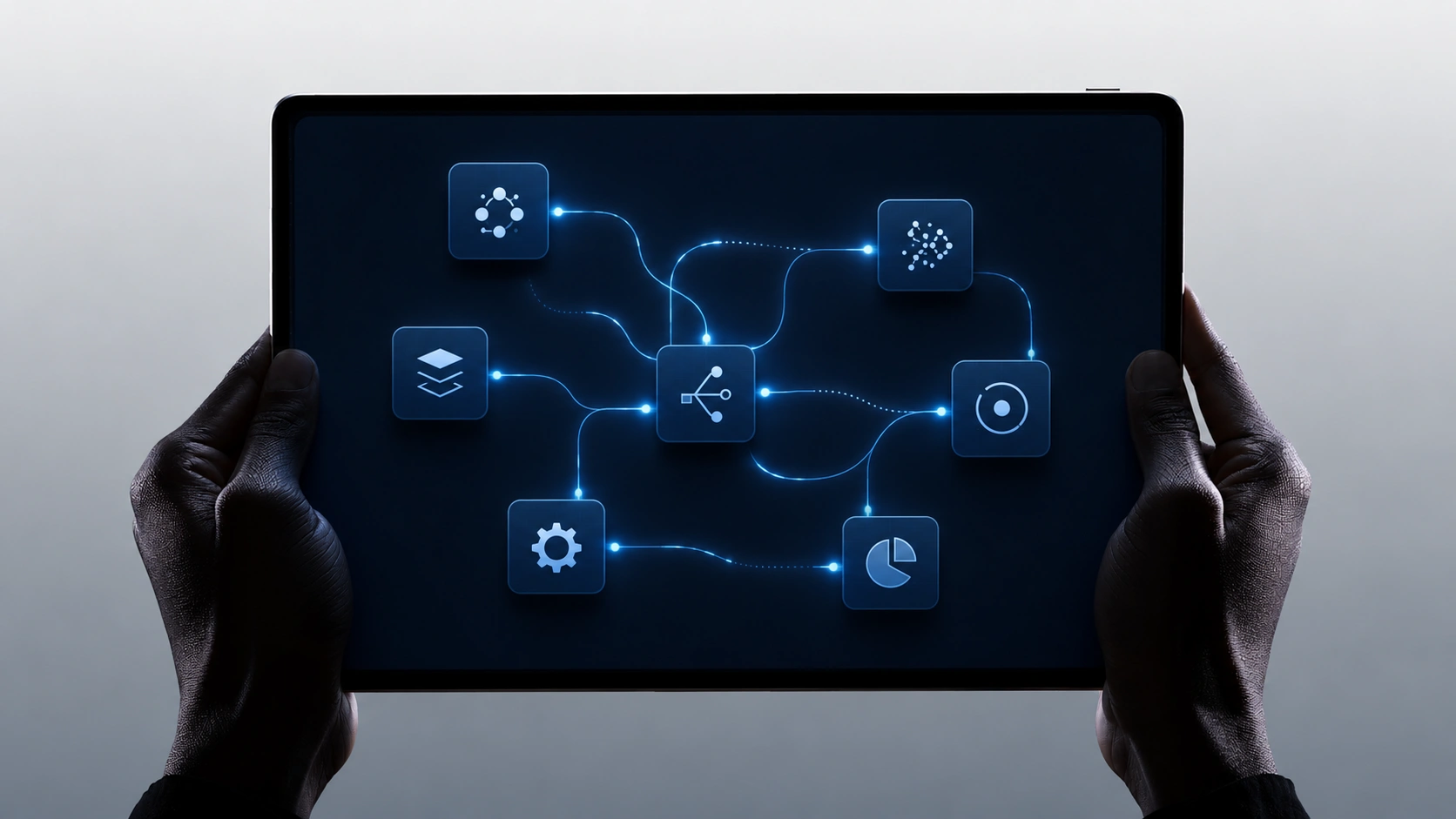
Most companies building with AI are optimizing the wrong layer.
They evaluate frontier models. They run fine-tuning experiments. They debate which LLM handles their domain better.
Then they connect two agents together.
And everything breaks.
Context disappears between sessions. One agent spawns forty unnecessary subagents. They contradict each other. The architecture that worked in staging collapses under real users and real data.
This is not a model problem.
It is an orchestration problem. And the market is only beginning to understand the difference.
The number that explains what is happening
In June 2025, Gartner published a forecast that most enterprise AI teams are still processing.
Over 40% of agentic AI projects will be canceled by end of 2027.
Not because the models are wrong. Gartner’s own analysis points to escalating costs, unclear business value, and inadequate risk controls. They estimated that roughly 130 of the thousands of self-described agentic AI vendors offer genuine capabilities. The rest are marketing.
Gartner also found that 40% of enterprise applications will embed AI agents by end of 2026, up from less than 5% in 2025. Adoption is accelerating. So is failure.
The gap between those two numbers is the orchestration layer.
Why agent systems fail in production
A single agent is a solved problem.
You give a model a system prompt. You connect it to tools. It works.
The failure shows up the moment you need two agents coordinating.
Anthropic documented their own version of this while building their internal research system. Their exact words: “Early agents made errors like spawning 50 subagents for simple queries, scouring the web endlessly for nonexistent sources, and distracting each other with excessive updates.”
Their November 2025 follow-up on long-running agents named the deeper problem.
“Imagine a software project staffed by engineers working in shifts, where each new engineer arrives with no memory of what happened on the previous shift.”
That is not a model limitation. That is an architecture problem.
Academic research confirms how often it sinks production deployments. Cemri et al. analyzed over 200 tasks across seven multi-agent frameworks in a March 2025 paper and built a taxonomy of failure modes. Specification issues accounted for 44.2% of failures. Inter-agent misalignment: 32.3%. Task verification failures: 23.5%.
Together, those numbers mean the majority of multi-agent failures have nothing to do with the quality of the underlying model.
They are coordination, memory, and verification failures. Infrastructure problems. Engineering problems.
The build versus buy reversal
In 2024, 47% of enterprise AI solutions were built internally. By 2025, 76% were purchased.
That is from Menlo Ventures’ December 2025 enterprise survey of roughly 500 U.S. decision-makers. Enterprise AI spend tripled from $11.5 billion in 2024 to $37 billion in 2025.
The market swung hard toward packaged solutions.
But Anthropic’s 2026 State of AI Agents report, which surveyed around 500 U.S. technical leaders, found something more specific about what companies actually deploy.
47% combine off-the-shelf agents with custom development. 20% build entirely their own. 21% rely fully on pre-built agents.
The dominant pattern is hybrid.
Off-the-shelf for the components. Custom for the orchestration layer.
The biggest reported barrier to deployment is not model selection. It is integration with existing systems. 46% of respondents named it as the primary obstacle.
That is the architectural gap Orbit was built for.
What off-the-shelf frameworks leave unbuilt
LangGraph, CrewAI, AutoGen, and OpenAI Agents SDK each solve a slice of the agent problem.
LangGraph gives you graph-based state machines. It handles error recovery well. Benchmarks from 2026 put its recovery rate at 96%.
CrewAI gives you role-based delegation, but production benchmarks show coordination degrades past five to ten agents. Its error recovery rate in the same benchmark: 72%.
AutoGen was moved into maintenance mode by Microsoft in October 2025. Bug fixes continue. New feature investment does not.
OpenAI Agents SDK is the newest entrant. Cloud-managed by design.
None of them ship what enterprise CTOs in Israel, the U.S., or Western Europe actually need to run a production platform:
Multi-tenant data isolation. SSO and access governance. Budget controls on runaway agent spend. Behavioral telemetry. Stateful checkpoint resumption when a long-running agent fails mid-task. A non-technical authoring layer that does not require engineering involvement for every new workflow.
You can buy the engine. You still have to build the car.
What we built
Orbit is the car.
The client is an Israel-based technology company. One of the top global providers of AI and data-driven solutions. They serve international enterprises and governmental institutions. Machine learning, large-scale data analysis, custom AI systems.
They were not new to AI. Every new use case meant another fragmented stack. Another dependency on a small group of engineers who understood that specific system. Another six-week iteration cycle that locked non-technical teams out entirely.
The brief was to build the unifying layer.
A platform where an operations lead creates an agent in natural language. Where an analyst composes a visual workflow. Where an engineer ships a hierarchical multi-agent system. All in the same product. All with shared governance.
Nine months. Ten to fifteen engineers across frontend, backend, AI/ML, DevOps, QA, and design.
The hardest technical problem was chain-of-agents logic.
Each agent in Orbit is a building block: an LLM with a system prompt, tools, and optional knowledge bases. The platform lets users compose those blocks into graphs, swarms, and hierarchical workflows. Context passes between them. Handoffs are explicit. Failures are contained rather than cascading.
Celery coordinates asynchronous tasks. Redis holds shared state. NetworkX handles graph topology. WebSocket streams the execution so users watch the chain run in real time.
None of that is visible to the person creating an agent in natural language. All of it is what keeps the chain coherent across sessions.
The client’s words at launch: “We have been working with many teams, but you were the first who were able to cover all the positions needed for the project launch.”
That sentence maps directly to the Gartner statistic. Projects fail because teams have the AI engineers but not the infrastructure engineers. Or the design but not the QA. Every gap in the team becomes a gap in the architecture.
Why this matters now
Multi-agent workflow usage on Databricks grew 327% between June and October 2025. That is from Databricks’ own platform telemetry across 20,000 customers including 60% of the Fortune 500.
The market for orchestration is not speculative. It is already happening at scale.
But shipping it requires a complete team. Not a single framework. Not a proof of concept.
A production platform has a specific property that demos do not: something a non-technical user builds on it actually runs in production. An analyst deploys it on Monday. A business unit uses it on Friday.
That is the standard Orbit was built to.
One more thing
While we were shipping Orbit, Dribbble selected it for their Most Impactful Agency Projects of 2026 and added Meduzzen to the Dribbble Select: Top Web Design Agencies directory.
Dribbble draws 11.2 million monthly visits. Their Select program explicitly vets agencies for “high-quality work and proven results on complex, large-scale projects, for real clients, not concept work.
We were not expecting that recognition.
But it points to something real about this type of work. When you solve a coordination problem at the infrastructure layer, it has to disappear completely at the interface layer. The complexity cannot leak through. The users who cannot see the chain-of-agents logic should never feel it.
On Orbit, they do not.
View the Orbit shot on Dribbble. Read the full Orbit case study on our website.
If you are building where the hard part is not the model but what sits between models, talk to us.