In this article
What team integration means and how to make it work
Business & Strategy
Learn what team integration really means for tech startups, why it drives 31% faster releases, and how to build it effectively with external development teams.

You hire an external development team, set up a Slack channel, schedule a weekly sync, and assume the collaboration will flow naturally. Many startup founders have been there. And many have watched that assumption quietly unravel over the following months, as deadlines slip, context gets lost in translation, and the external team starts building in a direction that no longer matches the product vision. The uncomfortable truth is that hiring external engineers is just the first step. What comes after, the intentional, ongoing work of true team integration, is what actually determines whether your product gets built well or gets rebuilt twice. This article explains what team integration really means, why it matters more than most founders realize, and how to make it work in practice.
Key Takeaways
| Point | Details |
|---|---|
| True team integration | It means shared goals, tools, and workflows, not just regular communication. |
| Business impact | Proper integration leads to faster delivery, fewer mistakes, and happier teams. |
| Practical steps | Unified onboarding, shared docs, and frequent retrospectives drive integration. |
| Addressing challenges | Culture fit and process alignment are the keys to overcoming most integration hurdles. |
Defining team integration in technology projects
Let’s be honest about what most people mean when they say “collaboration.” They mean communication. They mean someone answers messages, shows up to standups, and delivers work on a schedule. That’s a reasonable starting point, but it’s nowhere near integration.
True team integration means aligning your external and internal teams on processes, tools, goals, and culture so that they function as a single unit rather than two groups passing files back and forth. It’s the difference between a relay race and a rowing crew. In a relay race, each runner does their part and hands off the baton. In rowing, every person must move in perfect synchrony or the whole boat slows down.
For technology projects specifically, integration goes deeper than most people expect. It includes:
- Unified workflow: External engineers follow the same sprint cadence, branching strategy, and deployment process as your internal team
- Shared KPIs: Both teams are accountable to the same success metrics, not separate siloed targets
- Open knowledge exchange: Documentation, architectural decisions, and product context flow freely in both directions
- Psychological safety: External contributors feel safe raising blockers, questioning decisions, and proposing alternatives without fear of being dismissed
- Aligned tech stack integration: Tools, environments, and standards are consistent across all contributors
The outcomes of this kind of integration are measurable. Successful team integration leads to better project outcomes compared to basic collaboration, with teams reporting higher quality delivery, fewer rework cycles, and stronger retention of both internal and external contributors.
Consider what a collaborative team environment actually looks like in practice. It’s not a perfectly organized Notion workspace or a well-formatted Jira board. It’s an environment where an external engineer in a different time zone feels confident enough to flag a potential architectural issue before it becomes a production incident. That kind of trust doesn’t happen by accident.
“Integration is not a feature you add to a project. It’s the foundation you build the project on. Without it, every other effort is working against friction.”
A good example of this in action is the project collaboration platform approach, where external contributors are embedded into the product development lifecycle from the earliest stages, not brought in as execution resources after all the thinking is done. That distinction changes everything about how the work unfolds.

The gap between collaboration and integration is wide. Closing it requires intentional design, not just good intentions.
The business case: Why team integration matters
Understanding what team integration is, it’s important to see why it should be a top priority for tech startups and product teams. The costs of getting this wrong are real, and they compound quickly.
Disjointed teams create what you might call invisible overhead. Engineers spend time re-explaining context that should already be documented. Product managers spend energy resolving miscommunications instead of refining the roadmap. QA cycles stretch because assumptions were never aligned. None of these costs show up as a single line item, but together they can consume 20 to 30 percent of a project’s total budget without anyone noticing until it’s too late.
The contrast between integrated and non-integrated teams is stark:
| Outcome | Without integration | With strong integration |
|---|---|---|
| Time to first release | Delayed by misalignment | On schedule or ahead |
| Rework frequency | High, due to context gaps | Low, due to shared understanding |
| Communication overhead | Constant clarification loops | Streamlined async updates |
| Engineer retention | High turnover from frustration | Stronger engagement and loyalty |
| Product quality | Inconsistent, siloed output | Cohesive, well-tested delivery |
Integrated teams deliver 31% faster product releases, a number that translates directly into competitive advantage for startups racing to capture market share. Speed to market is not just a vanity metric. It’s often the difference between being first and being irrelevant.
The benefits extend beyond speed. Why team integration matters for retention is a conversation that doesn’t happen often enough. Engineers who feel like outsiders, who lack context and are excluded from key decisions, leave. And replacing them costs far more than the investment required to integrate them properly in the first place.
For startups building in cloud team integration environments or scaling fintech project integration across distributed teams, the stakes are even higher. Regulatory requirements, security standards, and performance expectations in these domains leave very little room for the kind of errors that poor integration produces.
Pro Tip: Start integration before the first line of code is written. Waiting until a project is in full swing to address process alignment is like trying to lay a foundation after the walls are already up. The earlier you invest in integration, the cheaper and more effective it becomes.
The building blocks: Key practices for effective team integration
Once you recognize the benefits, the next challenge is knowing exactly how to achieve meaningful integration. The good news is that the practices are learnable and repeatable.
Here are five core practices that consistently produce results:
- Unified project management: Use a single system, whether that’s Jira, Linear, or another tool, that both internal and external teams work from. Separate boards create separate realities.
- Joint onboarding: Bring external engineers through the same onboarding process as internal hires. Walk them through the product vision, the technical architecture, and the team culture. Don’t skip this.
- Shared documentation: Maintain a living knowledge base in a tool like Notion or Confluence that all contributors can read and write. Shared documentation systems increase onboarding speed and decrease misunderstandings significantly.
- Clear roles and responsibilities: Every contributor, internal or external, should know exactly what they own, what decisions they can make independently, and when they need to escalate.
- Regular retrospectives: Hold joint retrospectives that include external team members. This is where integration actually deepens over time, through honest reflection and shared problem-solving.
The right integration tools matter too. Slack handles real-time communication. Jira tracks work. Git manages code. Notion or Confluence holds knowledge. The key is not which tools you choose but whether everyone is using the same ones in the same way.
| Practice | Impact on onboarding | Impact on error rate | Impact on engagement |
|---|---|---|---|
| Unified project management | High | Medium | High |
| Joint onboarding | Very high | High | Very high |
| Shared documentation | High | High | Medium |
| Clear roles | Medium | Very high | High |
| Regular retrospectives | Low | Medium | Very high |
For teams working with Python team integration or other specialized stacks, shared documentation around coding standards and architectural decisions is especially critical. Inconsistent conventions across contributors are a slow-burning source of technical debt.
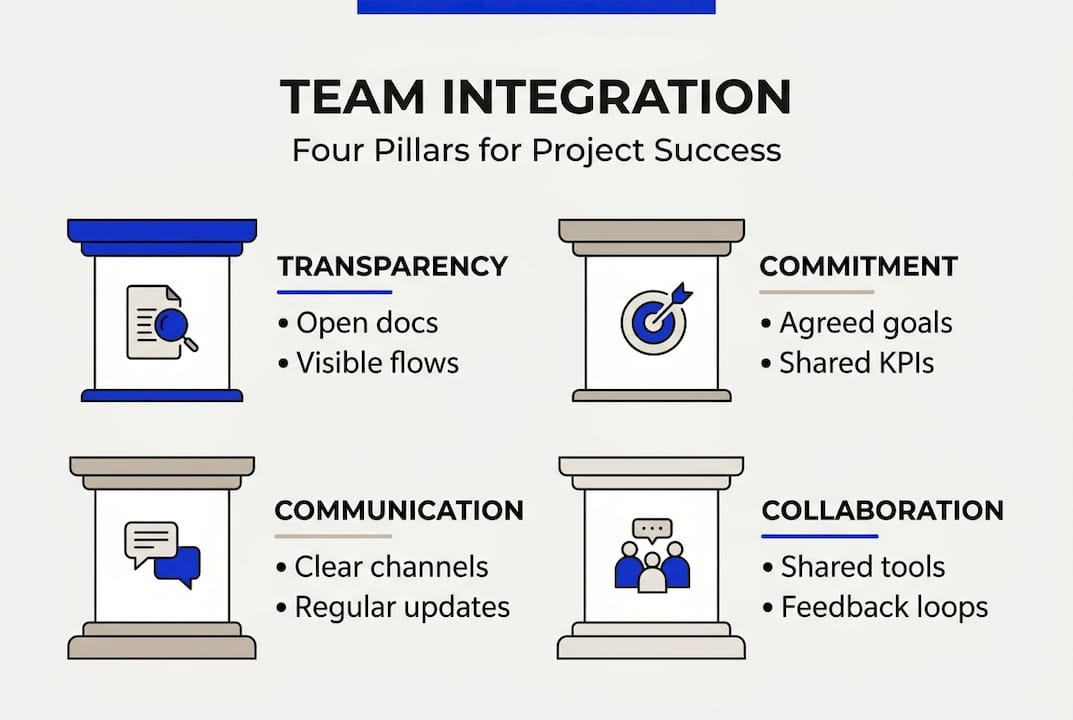
The four key elements of integrating agile teams point to transparency, inspection, adaptation, and commitment as the pillars of effective integration in fast-moving environments. These aren’t abstract principles. They’re daily habits.
Pro Tip: Make process transparency a formal part of your vendor or partner agreements. Define expected documentation standards, communication cadences, and retrospective participation upfront. What gets written into agreements gets taken seriously.
Overcoming hurdles: Common team integration challenges and solutions
Even with best practices in place, obstacles are inevitable. Here’s how to navigate the most common ones.
The most common pitfalls are cultural mismatch, tool incompatibility, and unclear accountability. These three challenges account for the majority of integration failures in tech startups, and each one requires a specific response.
Here’s how to address them directly:
- Time zone and cultural gaps: Don’t fight time zones. Design around them. Establish clear async communication norms, record key meetings, and create overlap windows that work for both sides. Cultural differences in communication style, directness, and decision-making need to be named and discussed openly, not assumed away.
- Tool misalignment: Audit your toolset before onboarding any external team. If your internal team uses GitHub and your external team defaults to GitLab, that’s a conversation to have on day one, not month three.
- Process gaps: Create an “Integration Playbook” that documents how your team works: sprint structure, definition of done, escalation paths, and communication norms. Share it before work begins.
- Unclear KPIs: Every contributor should be able to answer the question, “How do I know if I’m succeeding?” If they can’t, your KPIs aren’t clear enough.
- Ownership confusion: Use a RACI matrix or equivalent framework to map who is responsible, accountable, consulted, and informed for every major workstream. Ambiguity here is where integration quietly falls apart.
Scheduled cross-team syncs, beyond the standard standup, are underused. A bi-weekly integration health check, where both teams reflect specifically on how well they’re working together rather than just what they’re building, catches friction before it becomes a crisis.
The team integration challenges that derail projects most often aren’t technical. They’re human. They’re about trust, clarity, and the willingness to have uncomfortable conversations early.
“The teams that integrate well aren’t the ones with the best tools. They’re the ones with the highest tolerance for honest conversation and the lowest tolerance for ambiguity.”
If you’re scaling quickly, a scaling checklist and well-defined scaling workflows become essential companions to your integration efforts. Growth without structure is where integration gains get lost.
Why team integration is a culture, not a checklist
Here’s the part that most integration guides skip: you can follow every practice listed above and still end up with a fragmented team. Not because the practices are wrong, but because practices without culture are just procedures. And procedures alone don’t build trust.
We’ve seen this pattern repeatedly. A startup invests in the right tools, runs joint onboarding, and sets up a shared Notion workspace. Six months later, the external team is still treated as a vendor rather than a partner. Decisions get made without them. Context stops flowing. The integration unravels quietly, not dramatically.
The founders and product leaders who get this right share one thing in common: they model integration themselves. They ask external engineers for their opinions in planning sessions. They credit external contributors in team updates. They treat the integration not as a preliminary task to check off but as an ongoing commitment to how the team operates.
Choosing the right technologies is part of this, but it’s secondary to the leadership posture that frames how those technologies are used. Integration is a tone set at the top.
The teams that sustain strong integration over time treat it as a living practice. They revisit it in retrospectives. They adjust when something isn’t working. They don’t declare victory after the first successful sprint. Building stability out of chaos requires constant attention, not a one-time setup.
If you’re a founder or product manager reading this, the most important question isn’t “Do we have the right tools?” It’s “Do we have the right culture to make integration real?”
How Meduzzen supports seamless team integration
If you’re ready to put these strategies into practice, here’s how Meduzzen can help you streamline integration.
At Meduzzen, we’ve spent over 10 years helping startups and growing businesses build integrated development teams that actually work. Not teams that show up and execute tasks, but engineers who embed into your product culture, contribute to architectural decisions, and stay accountable to shared outcomes.
Our custom DevOps services ensure that infrastructure and deployment pipelines are consistent across internal and external contributors from day one. Our staff augmentation model places pre-vetted engineers directly into your team’s workflow, with onboarding designed to minimize friction and maximize contribution speed. And our web development services are built around the same integration principles outlined in this article: shared documentation, unified tooling, and transparent communication at every stage. The right integration partner doesn’t just deliver code. They help you build the foundation that makes everything else possible.
Frequently asked questions
What is the main difference between team integration and collaboration?
Integrated teams align on processes, tools, and shared KPIs, while collaboration typically focuses only on communication and task handoffs. Integration is deeper, more structural, and more durable.
How can startups start integrating external development teams quickly?
Begin with unified onboarding, a shared documentation system, and a single project management platform from day one. Shared documentation and onboarding accelerate integration significantly and reduce early-stage misunderstandings.
What digital tools best support team integration in tech projects?
Slack, Jira, Notion, and Git are widely used to connect workflows and share knowledge across integrated teams. The tool matters less than whether every contributor uses it consistently and in the same way.
How do you overcome cultural barriers in team integration?
Name cultural differences early, establish shared values and communication norms, and build in regular cross-team touchpoints. Cultural mismatch is one of the most common integration challenges and the one most often left unaddressed until it causes real damage.
Recommended
- Dedicated Development Team Guide: Hire, Scale, Succeed
- Hire Python Developers | Cost, Skills & Hiring Models 2026
- The essential software engineering checklist for scaling in 2026
- Platform connecting local project and business analysts with leading global software engineers – Meduzzen
- DevOps Services for Reliable, Scalable Infrastructure | Meduzzen