In this article
Real estate tech explained: tools transforming property in 2026
Business & Strategy
Discover how real estate tech and proptech tools are transforming property management, transactions, and investment decisions for professionals in 2026.

Real estate has a reputation for being slow, paper-heavy, and resistant to change. That reputation is now completely wrong. The industry is experiencing one of the fastest digital transformations of any sector, with proptech reshaping how properties are found, financed, managed, and sold. Whether you are a broker scaling a portfolio or an investor analyzing market data, understanding real estate technology is no longer optional. This article breaks down what proptech actually is, how it works across the property lifecycle, and what practical steps you can take to put it to work.
Key Takeaways
| Point | Details |
|---|---|
| Real estate tech is broad | It covers everything from search platforms to smart building systems and analytics. |
| Benefits span the lifecycle | These tools improve marketing, transactions, operations, compliance, and investment outcomes. |
| Emerging tech is mainstream | AI, IoT, analytics, and immersive tools are now part of daily real estate workflows. |
| Adoption needs planning | Selecting and rolling out technology requires attention to compliance, team training, and ROI. |
| Custom solutions create an edge | Tailored digital platforms let you meet your unique business needs and seize new opportunities. |
What is real estate tech? Core definition and evolution
Real estate tech, commonly called proptech, is straightforward at its core. Proptech applies digital tools, including software, data systems, and sometimes hardware, directly to real estate processes like buying, selling, renting, managing, and investing. It is not a single product or platform. It is a category of solutions mapped to specific problems across the property lifecycle.
“Proptech is less about a single product type and more about solving specific lifecycle problems, from search and discovery all the way through asset management and investment reporting.”
The scope has expanded dramatically over the past decade. Proptech now spans mobile and online platforms, artificial intelligence, Internet of Things sensors, virtual reality, and advanced analytics. Early proptech was mostly online listings. Today it includes integrated platforms that connect marketing, transactions, compliance, and portfolio analytics in a single workflow.
Here is how the main categories break down:
- Marketplace and search platforms: Online portals where buyers, renters, and investors discover properties
- Transaction management tools: Digital workflows for contracts, e-signatures, and closing documentation
- Marketing and lead generation: CRM systems, automated campaigns, and AI-driven content tools
- Valuation and analytics: Automated valuation models, predictive analytics, and investment dashboards
- Property and asset management: Tenant portals, maintenance tracking, and lease management systems
- Smart building and IoT: Sensors, automation, and energy management for physical assets
The technology in real estate sector has moved from solving one problem at a time to delivering end-to-end platforms that connect every stage of the property journey.
Major categories of real estate technology
Navigating the proptech landscape is easier when you understand what each category actually does and where it fits in your workflow. The table below maps the major platform types to their core features and typical use cases.
| Category | Key features | Typical use case |
|---|---|---|
| Marketplace/search | Listings, filters, map search, alerts | Buyer and renter discovery |
| Transaction automation | E-signatures, document management, compliance tracking | Closing and contract workflows |
| Marketing and CRM | Lead capture, automated follow-up, AI content | Agent and broker lead generation |
| Valuation and analytics | AVM, market data, investment modeling | Pricing and acquisition decisions |
| Property management | Tenant portals, rent collection, maintenance | Residential and commercial operations |
| Smart building/IoT | Sensors, energy monitoring, access control | Asset efficiency and tenant experience |
Real estate tech platform categories include online marketplace platforms, transaction management workflows, valuation and analytics tools, and property management systems. Each solves a distinct problem, and the best implementations connect several of them.
Here is a practical sequence for evaluating which category to prioritize:
- Identify your biggest operational bottleneck (lead volume, transaction speed, portfolio visibility)
- Map that bottleneck to the relevant technology category
- Evaluate real estate software solutions that integrate with your existing tools
- Pilot with a defined success metric before full rollout
- Expand to adjacent categories once the first integration is stable
Pro Tip: Do not chase the most talked-about tool in your market. Start with the category that directly addresses your highest-cost inefficiency. A property manager losing hours to manual rent collection gets more value from a tenant portal than from a VR tour platform.
How real estate tech works: Integration across the property lifecycle
Understanding individual categories is useful, but the real power of proptech comes from integration. Modern platforms connect marketing, documentation, compliance, analytics, and reporting into a single workflow rather than forcing teams to jump between disconnected tools.

The table below shows how technology maps to each major stage of the property lifecycle.
| Lifecycle stage | Key activities | Integrated tech solutions |
|---|---|---|
| Marketing and discovery | Listings, ads, lead capture | CRM, portal APIs, AI content tools |
| Transaction and closing | Contracts, disclosures, financing | E-signature, transaction management |
| Asset and property management | Leasing, maintenance, reporting | Property management platforms, IoT |
| Investment and analytics | Valuation, performance, forecasting | Analytics dashboards, AVM tools |
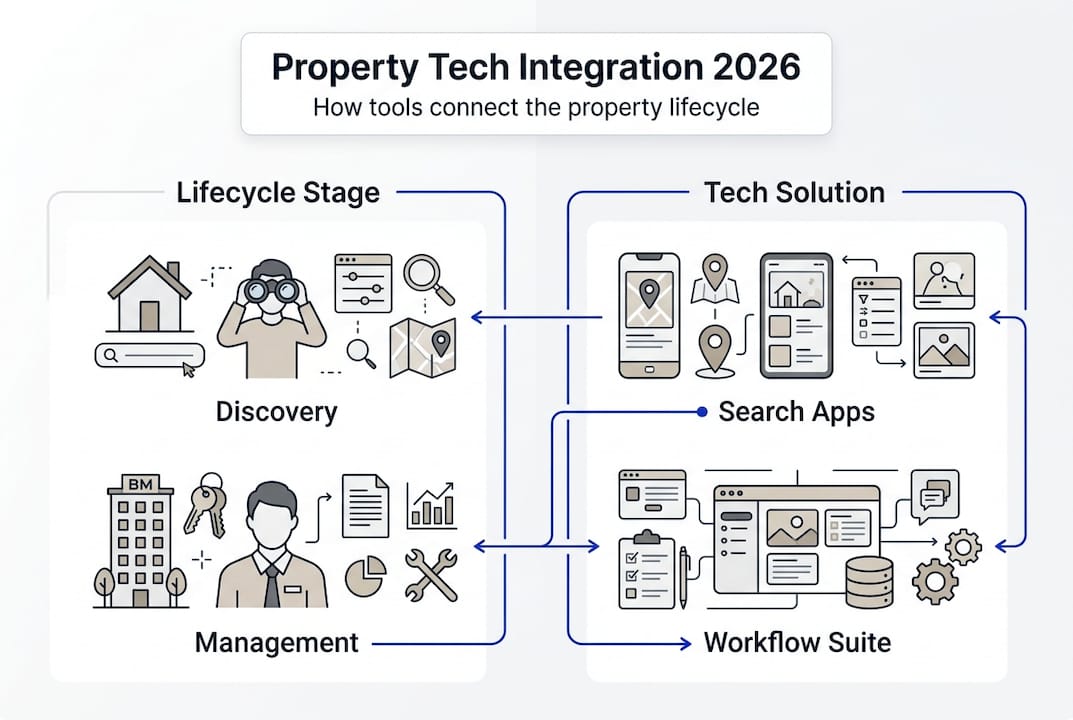
NAR’s iOi platform connects professionals to toolkits spanning marketing, operations, and asset and investment management, reflecting how the industry now expects platforms to cover the full lifecycle rather than just one slice of it.
Here is how integration delivers measurable value at each stage:
- Marketing: Automated lead scoring reduces time spent on unqualified inquiries by routing high-intent prospects directly to agents
- Transaction: Digital document workflows cut average closing times and reduce errors from manual data entry
- Compliance: Automated audit trails log every action, making regulatory reviews faster and less stressful
- Asset management: Real-time dashboards from real estate asset management platforms give investors accurate portfolio visibility without manual reporting
- Operations: IoT and smart building tech enables predictive maintenance, cutting reactive repair costs significantly
End-to-end automation does not just save time. It reduces human error, improves compliance documentation, and gives decision-makers faster access to accurate data.
Emerging trends: AI, IoT, and immersive technology
The field is still evolving fast. The technologies generating the most impact right now are artificial intelligence, Internet of Things infrastructure, and immersive experiences like virtual reality and digital twins.
Emerging proptech innovations include AI-powered valuations, predictive analytics, IoT-enabled smart buildings, VR virtual tours, and digital twins that mirror physical assets in real time. NAR actively tracks AI, computer vision, modular construction, and VR as the hottest topics reshaping the industry.
Here is what each innovation actually delivers in practice:
- AI-powered valuations: Automated valuation models now process hundreds of variables in seconds, giving investors faster and more consistent pricing signals than traditional appraisals
- Predictive analytics: Machine learning models identify which leads are most likely to convert and which properties are likely to appreciate, shifting decisions from gut feel to data
- IoT for smart buildings: Sensors monitor energy use, occupancy, and equipment health in real time, enabling IoT software for real estate teams to cut operating costs and improve tenant satisfaction
- VR virtual tours: Immersive property walkthroughs reduce the number of in-person visits needed before a buyer commits, saving time for both agents and clients
- Digital twins: Virtual replicas of physical buildings allow asset managers to simulate renovations, model energy scenarios, and plan maintenance without touching the real asset
The global proptech market was valued at over $30 billion in recent years and continues to grow at a strong pace, with AI in real estate driving a significant share of that growth. What makes this moment particularly valuable for smaller firms is democratization. Cloud-based platforms and API-first architectures mean that tools once available only to large institutional investors are now accessible to independent brokers and regional property managers. Staying current with AI trends in 2026 is no longer just for enterprise teams.
Key challenges and realities: Compliance, adoption, and the human factor
The upside of proptech is real, but so are the implementation challenges. Understanding them before you invest in new tools saves time, money, and frustration.
“Technology changes how compliance tasks are performed and documented, but it does not change the underlying obligation. Licensing requirements, disclosure rules, and fiduciary duties remain fully in force regardless of which platform you use.”
Tech operates within licensing and regulatory boundaries. Adoption shifts how compliance is managed but does not remove the requirement. This is a critical distinction for any firm evaluating automation tools.
The most common barriers professionals encounter include:
- Integration complexity: New platforms often need to connect with legacy systems, which requires technical planning and sometimes custom development
- Change management: Teams accustomed to manual workflows resist new tools, especially when the learning curve feels steep during busy periods
- Staff training: Even intuitive platforms require structured onboarding to reach full adoption and avoid workarounds that undermine the system
- Data quality: Automated tools are only as good as the data fed into them. Dirty or incomplete data produces unreliable outputs
- Vendor lock-in: Some platforms make it difficult to export data or switch providers, creating long-term dependency risks
Pro Tip: Before signing any technology contract, ask specifically how data export works and what your options are if you decide to switch platforms in two years. This single question reveals a lot about a vendor’s long-term intentions.
A practical pre-adoption checklist for compliance in real estate tech decisions should include confirming audit trail capabilities, verifying data security certifications, mapping integration requirements with your current stack, and identifying a clear internal champion for the rollout.
Applying real estate tech: Practical steps for professionals and investors
Knowing the landscape and the pitfalls puts you in a strong position to act. Here is a step-by-step framework for evaluating and adopting new real estate technology.
- Audit your current workflow: Document every manual step in your highest-volume process. This reveals where automation delivers the fastest return.
- Define a success metric: Decide before you start what a successful implementation looks like. Faster closing times, lower cost per lead, or reduced maintenance response time are all measurable targets.
- Evaluate integration fit: Check whether the platform connects with your existing CRM, accounting software, or property management system before committing.
- Run a time-limited pilot: Test with a small team or single property before full deployment. Real-world use reveals friction points that demos never show.
- Measure and iterate: Review your success metric at 30, 60, and 90 days. Adjust configuration or training before expanding the rollout.
When speaking with solution providers, ask these questions before signing anything:
- How does your platform handle regulatory updates in my state or market?
- What does the onboarding and training process look like for a team of our size?
- Can you show us a case study from a firm with a similar portfolio or transaction volume?
- What is the typical time to full adoption for new users?
Solutions like Realtor.com PRO and .RealEstate focus on marketing, CRM, AI, and digital content to support practical professional use, showing how purpose-built platforms can deliver immediate value without requiring deep technical expertise. Connecting your tech adoption to measurable client outcomes is also the clearest way to justify the investment internally and build competitive advantage in your market. Explore real estate digital platforms that are built specifically for the workflows you already run.
Next steps: Unlocking value with tailored real estate technology
Real estate technology is not a trend to watch from the sidelines. It is a competitive requirement for any firm serious about efficiency, client experience, and portfolio performance.
At Meduzzen, we build custom technology integration solutions for real estate firms that need more than off-the-shelf software. Whether you need a purpose-built real estate software platform, AI-powered analytics, or IoT integration for smart building management, our team of 150+ engineers delivers scalable, compliant, and maintainable systems. We work as an extension of your team, not a distant vendor. If you are ready to move from evaluating options to building something that fits your exact workflow, explore what we do and start a conversation with our real estate technology specialists.
Frequently asked questions
What is real estate tech or proptech in plain language?
Real estate tech, or proptech, means using software and digital tools to make buying, selling, managing, or marketing property faster and smarter. Proptech applies digital tools, including software, data, and sometimes hardware, directly to real estate processes.
Is proptech only about online listings and search platforms?
No, it covers everything from marketing and lead generation to asset management, analytics, transaction automation, and smart buildings. Proptech spans mobile and online platforms, AI, IoT, VR, and advanced analytics across the full property lifecycle.
Can real estate tech replace the need for compliance or licensing?
No, technology helps track and automate compliance tasks, but professional licensing and regulation still apply in full. Tech operates within regulatory boundaries and shifts how compliance is managed, not whether it is required.
What are the biggest barriers to adopting real estate tech?
The main challenges are integration with current systems, user training, change management, and staying compliant with local regulations. Addressing these proactively with a structured pilot and clear success metrics significantly improves adoption outcomes.