In this article
Why build with modern web technologies in 2026
Tech & Infrastructure
Discover why modern web technologies accelerate startup growth in 2026. Learn brownfield vs greenfield strategies, reduce legacy costs, and ship features 30-40% faster with proven modernization approaches.

Startups waste $2.9 million annually maintaining legacy systems that block innovation and consume budgets meant for growth. While many founders assume older tech stacks are sufficient, the reality is stark: legacy systems consume 70-80% of IT budgets on maintenance alone, leaving minimal resources for AI integration, cloud adoption, or competitive feature development. Modern web technologies flip this equation, enabling 30-40% faster feature shipping and freeing capital for strategic initiatives. This guide explains why adopting modern stacks is essential for scalable growth in 2026 and how to modernize without disrupting operations.
Key takeaways
| Point | Details |
|---|---|
| Legacy systems drain budgets | Maintenance consumes 70-80% of IT spending, limiting innovation capacity |
| Modern stacks accelerate delivery | Teams ship features 30-40% faster with improved developer productivity |
| Incremental modernization reduces risk | Brownfield approaches deliver value in weeks versus years for full rewrites |
| AI adoption requires modern infrastructure | Legacy systems cannot support machine learning pipelines or cloud-native architectures |
| Developer experience drives retention | Modern tooling attracts and retains top engineering talent |
The high cost and risks of legacy systems in startups
Legacy systems create a financial trap that founders often recognize too late. Legacy systems consume 70-80% of IT budgets on maintenance activities like patching outdated dependencies, managing technical debt, and troubleshooting integration failures. For a startup with a $500,000 annual technology budget, this means only $100,000 to $150,000 remains for building new features or exploring AI opportunities. The math simply doesn’t support competitive growth.
Security vulnerabilities multiply as technology ages. Outdated frameworks lack active security patches, exposing startups to data breaches that can cost millions in remediation and reputation damage. Financial services startups face particularly acute risks, as compliance requirements demand current security standards that legacy systems cannot meet. Healthcare and logistics companies encounter similar challenges with HIPAA and data protection regulations.
The innovation bottleneck extends beyond security. Legacy architectures cannot support modern AI solutions for scalable SaaS platforms because they lack the API-first design and microservices patterns required for machine learning pipelines. Startups attempting to integrate AI into monolithic legacy systems face exponential complexity and cost. Cloud adoption encounters similar barriers, as lift-and-shift migrations rarely deliver promised cost savings without architectural modernization.
Developer productivity suffers dramatically. Engineers spend 60-70% of their time navigating convoluted codebases, debugging obscure errors, and working around architectural limitations instead of building features customers want. This frustration drives talent attrition, forcing startups into expensive recruiting cycles. The opportunity cost compounds: while your team fights legacy constraints, competitors with modern stacks ship features weekly and capture market share.
“The real cost isn’t the maintenance budget. It’s the features you never build, the AI capabilities you can’t explore, and the engineers who leave for companies with better tooling.”
Consider the typical scenario: a three-year-old React application built with outdated patterns, lacking TypeScript, using deprecated libraries, and deployed on fragile infrastructure. Every feature request triggers cascading changes across tightly coupled components. Testing becomes guesswork. New hires require months to become productive. This technical debt accumulates interest daily, making the eventual modernization more expensive and disruptive.
How modern web technologies accelerate startup growth
Modern web stacks fundamentally change development economics. Modern stacks enable 30-40% faster feature shipping through superior developer experience, automated tooling, and architectural patterns designed for rapid iteration. Frameworks like Next.js, SvelteKit, and Astro provide built-in optimizations for performance, SEO, and deployment that previously required custom engineering. This acceleration translates directly to competitive advantage.

Developer experience drives measurable business outcomes. CTOs prioritizing DX report higher team velocity, lower bug rates, and improved engineer retention. Modern frameworks offer hot module replacement for instant feedback, comprehensive TypeScript support for catching errors before runtime, and integrated testing utilities that make quality assurance effortless. Engineers can focus on solving business problems instead of fighting tooling.
TypeScript adoption exemplifies this transformation. Static typing catches entire categories of bugs during development, reducing production incidents by 40-50%. Refactoring becomes safe and fast, enabling teams to evolve architecture without fear. IDE autocomplete and inline documentation accelerate onboarding, helping new engineers contribute meaningful code within days instead of months. The productivity gains compound as codebases grow.
Component-based architectures enable true modularity. React, Vue, and Svelte components encapsulate logic, styling, and behavior in reusable units that teams can develop, test, and deploy independently. This modularity supports parallel development, where multiple engineers work on different features simultaneously without merge conflicts. It also facilitates A/B testing, as teams can swap components without touching surrounding code.
Build tools like Vite and Turbopack deliver near-instant compilation, eliminating the 30-60 second wait times that break flow state. Developers iterate faster, experiment more freely, and ship higher-quality code. These tools also optimize production bundles automatically, ensuring fast page loads without manual configuration. Performance becomes a default outcome rather than a specialized effort.
Modern deployment platforms like Vercel, Netlify, and Cloudflare Pages integrate seamlessly with these frameworks, providing automatic previews for every pull request, instant rollbacks, and edge caching without DevOps overhead. Startups can deploy globally in minutes, not weeks. This infrastructure advantage levels the playing field against larger competitors.
Pro Tip: Evaluate frameworks based on your team’s existing skills and project requirements. Next.js excels for content-heavy applications with SEO needs, SvelteKit offers superior performance for interactive dashboards, and Astro optimizes static content sites. Choose the tool that fits your use case rather than chasing trends.
The ecosystem effect amplifies these benefits. Popular frameworks attract extensive libraries, plugins, and community support. When you encounter a challenge, solutions already exist. Documentation is comprehensive. Hiring becomes easier because more engineers have relevant experience. This network effect creates a virtuous cycle where modern web development tools continuously improve through community contributions.
Modernization strategies: brownfield vs greenfield approaches
Choosing between brownfield and greenfield modernization fundamentally shapes your timeline, budget, and risk profile. Each approach serves different strategic needs, and understanding the tradeoffs helps CTOs make informed decisions aligned with business priorities.
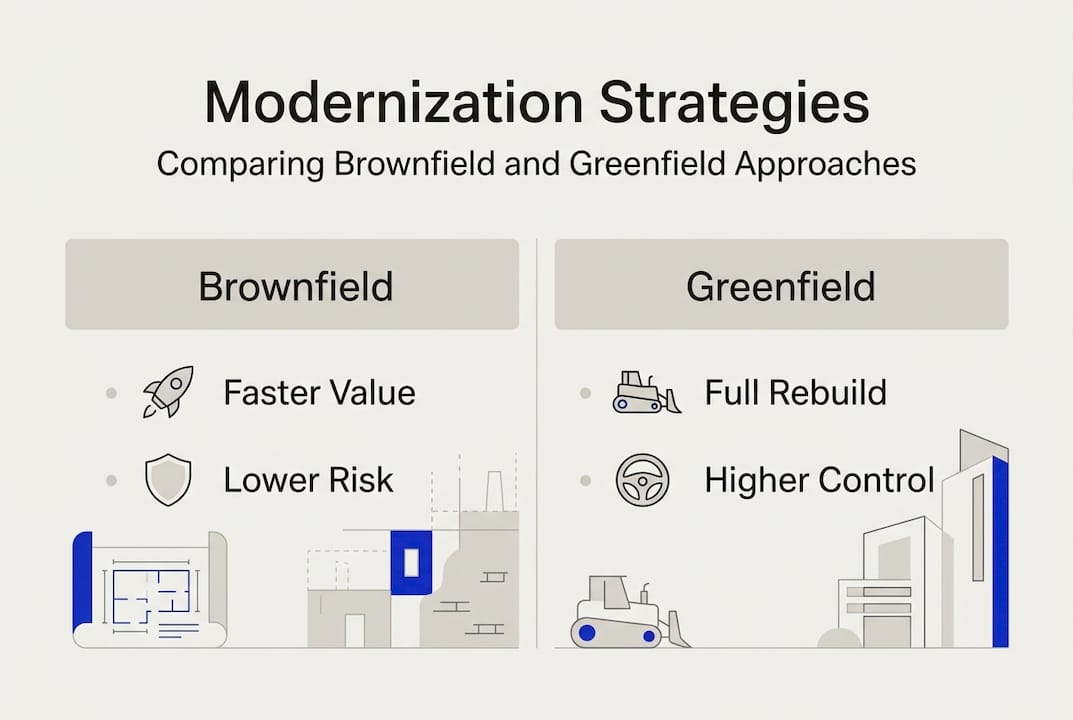
Brownfield modernization involves incremental upgrades to existing systems, preserving core architecture while replacing outdated components systematically. This approach minimizes disruption because the application remains operational throughout the transition. Teams can modernize the frontend while keeping the backend intact, or vice versa. Risk stays low because changes happen in controlled increments with continuous validation.
The brownfield advantage lies in speed to initial value. Teams can modernize high-impact user interfaces within weeks, delivering immediate improvements to customer experience and internal productivity. This quick win generates momentum and stakeholder confidence for subsequent phases. Financial constraints favor brownfield, as costs spread across multiple budget cycles rather than requiring large upfront investment.
Greenfield modernization means building completely new systems from scratch, unconstrained by legacy architecture. This approach enables optimal design decisions, modern patterns, and clean codebases without technical debt. Greenfield projects can adopt microservices, serverless architectures, and cutting-edge frameworks without compromise. The result is a system architected for current needs and future scalability.
However, greenfield carries substantial risk. Development timelines stretch to months or years, during which the legacy system requires ongoing maintenance. Feature parity becomes a moving target as business requirements evolve. The big bang cutover introduces deployment risk and potential downtime. Budget overruns are common as unforeseen complexity emerges.
| Approach | Timeline | Risk Level | Best For | Key Advantage |
|---|---|---|---|---|
| Brownfield | Weeks to months | Low to medium | Budget constraints, operational systems | Continuous delivery of value |
| Greenfield | Months to years | High | Fundamental architecture changes | Optimal design without constraints |
| Hybrid | Varies by component | Medium | Complex systems with mixed needs | Balanced risk and innovation |
AI tools accelerate both approaches significantly. Code generation models like GitHub Copilot reduce boilerplate writing by 40-50%, while AI-powered refactoring tools identify optimization opportunities and suggest architectural improvements. Migration assistants can automatically convert legacy code patterns to modern equivalents, though human review remains essential for business logic validation.
Pro Tip: Start with a brownfield proof of concept modernizing one high-value feature or user flow. Measure the impact on performance, developer productivity, and user satisfaction. Use these metrics to justify broader modernization investment and refine your approach before committing to a full greenfield rebuild.
Hybrid strategies combine both approaches, using greenfield for new features while incrementally modernizing legacy components. This pragmatic middle path lets startups innovate quickly on new capabilities while gradually retiring technical debt. The key is establishing clear boundaries between old and new systems through well-defined APIs and data contracts.
Resource availability guides strategy selection. Startups with limited engineering capacity favor brownfield to maintain feature velocity. Well-funded companies pursuing market disruption may justify greenfield investment for competitive differentiation. The decision should align with business strategy, not just technical preferences. Scalable enterprise development requires matching modernization approach to organizational maturity and market position.
Minimizing risk with web augmentation and incremental modernization
Web augmentation approaches deliver value in days or weeks versus years for full system migration, making them ideal for UX updates without backend overhaul. This tactical modernization strategy enables startups to improve customer-facing interfaces rapidly while deferring expensive backend changes until business value justifies investment.
The augmentation model works by placing a modern web layer in front of legacy systems, intercepting user requests and rendering contemporary interfaces while maintaining existing backend logic and data structures. This separation of concerns means frontend teams can iterate independently using React, Vue, or Svelte without coordinating backend changes. API gateways and backend-for-frontend patterns facilitate this architecture.
Rapid UX improvements drive measurable business outcomes. Modernizing checkout flows can increase conversion rates by 15-25%. Updating dashboards with real-time data visualization improves user engagement and reduces support tickets. Mobile-responsive interfaces expand addressable markets. These wins accumulate quickly, generating ROI that funds subsequent modernization phases.
Time to value becomes the critical metric. Traditional migration projects measure success in years and often fail to deliver promised benefits. Augmentation strategies target specific user journeys or features, delivering improvements within sprint cycles. This iterative approach aligns with agile methodology and provides continuous feedback for course correction.
Implementation follows a systematic process:
- Identify high-impact user flows with poor UX or performance issues that drive customer complaints or churn.
- Design modern interfaces using contemporary frameworks and design systems that reflect current brand standards.
- Build API adapters that translate between modern frontend expectations and legacy backend responses.
- Deploy the new interface alongside the old system using feature flags for gradual rollout and A/B testing.
- Monitor performance metrics, user feedback, and error rates to validate improvements before full cutover.
- Iterate based on data, expanding modernization to additional features as confidence and capability grow.
This methodology reduces risk by limiting blast radius. If issues emerge, feature flags enable instant rollback without downtime. Gradual rollout lets teams identify edge cases in production with minimal user impact. Continuous monitoring provides early warning of integration problems or performance degradation.
| Metric | Legacy System | After Augmentation | Improvement |
|---|---|---|---|
| Page Load Time | 4.2 seconds | 1.1 seconds | 74% faster |
| Mobile Conversion | 2.3% | 3.8% | 65% increase |
| Developer Velocity | 8 story points/sprint | 13 story points/sprint | 63% faster |
| Bug Rate | 12 per release | 4 per release | 67% reduction |
Pro Tip: Use browser-based augmentation tools like micro-frontends or web components to modernize specific page sections without touching surrounding legacy code. This surgical approach maximizes value while minimizing technical risk and coordination overhead.
Incremental modernization supports gradual scaling of both technology and team capacity. As engineers gain experience with modern frameworks through augmentation projects, they build skills applicable to broader modernization efforts. This organic capability development is more effective than training programs because learning happens in production context with real business constraints.
The financial model favors augmentation for startups with limited capital. Instead of a $500,000 greenfield project, teams invest $50,000 to $100,000 per quarter modernizing specific capabilities. This pay-as-you-go approach preserves runway while delivering continuous improvements. Investors view incremental progress more favorably than big-bang projects with binary outcomes.
Architectural evolution becomes manageable. Each augmentation project establishes patterns, conventions, and infrastructure that subsequent efforts can leverage. Shared component libraries emerge. API standards solidify. DevOps pipelines mature. This gradual accumulation of capability eventually enables more ambitious modernization without the risk of starting from scratch. Modern web app development steps provide detailed guidance for this incremental journey.
Learn how Meduzzen accelerates your web modernization journey
Modernizing legacy systems while maintaining product velocity requires specialized expertise and additional engineering capacity. Meduzzen helps startups navigate this transition through tailored web development services designed for rapid modernization without disrupting operations. Our team has guided dozens of companies through successful technology transformations, from initial assessment through production deployment.
Our JavaScript software development expertise spans the modern web ecosystem, including React, Next.js, Vue, Svelte, and TypeScript. We integrate seamlessly into your existing team, providing senior engineers who can architect modernization strategies, mentor junior developers, and accelerate feature delivery. Whether you need a dedicated team for a greenfield rebuild or additional capacity for incremental augmentation, we scale to your needs.
Staff augmentation services solve the talent gap that blocks modernization. Our pre-vetted engineers onboard in days, not months, bringing immediate productivity to your projects. With transparent communication and agile delivery, we help you achieve modernization goals while maintaining focus on core business priorities.
Frequently asked questions
What are the main advantages of modern web technologies?
Modern web technologies deliver 30-40% faster feature shipping through superior developer experience, automated tooling, and built-in performance optimizations. They reduce maintenance costs by 60-70% compared to legacy systems, freeing budget for innovation. TypeScript and modern frameworks catch bugs during development rather than production, improving quality and reducing support costs. These technologies also attract top engineering talent, as developers prefer working with current tools over outdated stacks.
How do modern frameworks speed up development?
Modern frameworks provide hot module replacement for instant feedback, comprehensive TypeScript support for catching errors before runtime, and component-based architectures that enable parallel development. Build tools like Vite compile code in milliseconds instead of minutes, maintaining flow state. Integrated testing utilities and extensive ecosystem libraries eliminate the need to build common functionality from scratch. Deployment platforms offer automatic previews and instant rollbacks, reducing DevOps overhead and accelerating release cycles.
When should a startup choose brownfield vs greenfield modernization?
Choose brownfield when you need quick wins, have budget constraints, or must maintain operational continuity. This incremental approach delivers value in weeks and spreads costs across multiple quarters. Choose greenfield when legacy architecture fundamentally blocks business goals, technical debt exceeds the cost of rebuilding, or you’re pivoting to a new market requiring different capabilities. Hybrid approaches work best for complex systems where some components need complete redesign while others benefit from incremental improvement.
Can legacy systems support AI initiatives?
Legacy systems typically cannot support modern AI initiatives because they lack API-first architecture, real-time data pipelines, and cloud-native patterns required for machine learning workloads. Monolithic designs make it difficult to integrate AI services, and outdated data models prevent effective training. Modernization becomes necessary to enable AI capabilities, though incremental approaches can add AI features to specific modules without full system rewrites. Cloud platforms and microservices architectures provide the flexibility AI initiatives require.
How long does incremental modernization typically take?
Incremental modernization timelines vary based on system complexity and scope, but individual augmentation projects typically deliver value within 4-8 weeks. A complete modernization spanning multiple features or modules usually takes 6-18 months, with continuous delivery of improvements throughout. This contrasts with greenfield rewrites requiring 12-36 months before any production value. The key advantage is continuous progress and risk mitigation rather than a single high-risk cutover event. Teams can adjust strategy based on early results and changing business priorities.