



In this article
Many organizations mistakenly view enterprise application development as simply scaling up traditional software projects. This misconception leads to poor architecture choices, misaligned teams, and costly failures. Enterprise applications demand specialized approaches addressing unique scalability, security, and integration challenges across complex business ecosystems. This guide clarifies what sets enterprise development apart, explores proven team models and architecture patterns, and offers practical strategies to deliver reliable, high-performance systems that drive measurable business outcomes.
Key takeaways
| Point | Details |
|---|---|
| Enterprise apps need specialized architectures | Microservices and modular patterns enable scalability, fault isolation, and independent service deployment at scale. |
| Dedicated teams accelerate delivery | Pre-vetted engineers with aligned goals integrate seamlessly, reduce onboarding time, and improve iteration speed compared to traditional outsourcing. |
| Cloud-native tech boosts agility | Containers, Kubernetes, and hybrid cloud strategies improve deployment speed by 30% and support flexible scaling. |
| Security must be embedded upfront | Integrating compliance frameworks and threat mitigation from design prevents costly retrofits and regulatory penalties in regulated industries. |
| Success requires measurable outcomes | Tracking uptime, response times, user adoption, and ROI ensures systems deliver sustained business value and justify investments. |
Definition and scope of enterprise application development
Enterprise application development involves building scalable, reliable, and secure software systems that support mission-critical operations for large organizations. These applications must handle high transaction volumes, integrate seamlessly with legacy systems and third-party platforms, and maintain performance under diverse workloads. Unlike consumer apps focused on user experience simplicity, enterprise solutions prioritize data integrity, complex business logic, and regulatory compliance.
Typical domains include financial services processing millions of daily transactions, healthcare systems managing patient records across providers, retail platforms coordinating inventory and supply chains, and manufacturing applications controlling production workflows. Each domain imposes unique requirements for uptime, data security, and integration capabilities. Business-critical performance means even brief downtime translates to revenue loss, reputation damage, and operational disruption.
Maintainability becomes paramount as enterprise systems evolve over decades. Code must support continuous updates without breaking existing functionality. Documentation, testing, and modular design enable teams to modify components independently. Organizations invest heavily in these systems expecting them to adapt as business needs change, making long-term architectural decisions essential from the start.
Key characteristics distinguishing enterprise applications:
- Support for thousands of concurrent users across multiple time zones
- Integration with diverse internal systems and external APIs
- Strict security protocols protecting sensitive business and customer data
- Compliance with industry regulations like GDPR, HIPAA, or PCI-DSS
- High availability targets often exceeding 99.9% uptime
- Audit trails and reporting capabilities for governance and analytics
Role and benefits of dedicated development teams
Dedicated developer teams provide long-term alignment with client goals, functioning as extensions of internal organizations rather than external vendors. Engineers immerse themselves in business context, learning domain-specific requirements and company culture. This deep integration enables faster decision-making, reduces miscommunication, and builds institutional knowledge that improves with each project iteration. Unlike transactional outsourcing relationships, dedicated teams prioritize sustained partnership over short-term deliverables.
Faster onboarding and iteration cycles improve agility when adapting to market changes. Pre-vetted specialists bring expertise in .NET technologies, software development technologies, and enterprise patterns without lengthy recruitment processes. Teams establish workflows, communication channels, and technical standards quickly, allowing organizations to scale capacity without sacrificing quality. Iteration speed increases as teams understand codebase architecture and business priorities more thoroughly.
Better communication and transparency emerge from dedicated teams compared to traditional outsourcing. Daily standups, shared project management tools, and direct access to stakeholders create accountability and visibility. Teams proactively surface risks, suggest improvements, and adjust priorities based on real-time feedback. This collaborative approach contrasts with outsourcing models where vendors operate behind information barriers, delivering finished modules without ongoing input.
| Model | Control | Speed | Cost | Best For |
|---|---|---|---|---|
| Dedicated Teams | High alignment and oversight | Fast iterations and onboarding | Moderate to high investment | Long-term projects needing flexibility |
| Outsourcing | Limited control over processes | Variable depending on vendor | Lower initial costs | Well-defined short-term projects |
| In-House | Full control and integration | Slower scaling and hiring | High overhead and benefits | Core competencies and sensitive IP |
Pro Tip: Assess your team structure requirements early. If your project demands continuous evolution, regulatory compliance, or deep business context, dedicated teams outperform transactional outsourcing despite higher upfront costs. The investment pays dividends through reduced rework, better quality, and faster time to market.
Enterprise application architecture patterns and scalability mechanisms
Microservices architecture decomposes applications into independent services, each handling specific business functions like user authentication, payment processing, or inventory management. Services communicate through APIs, enabling teams to develop, deploy, and scale components independently. This modularity supports rapid innovation as developers update services without coordinating across the entire codebase. Organizations adopting microservices report faster release cycles and improved fault isolation compared to monolithic architectures.
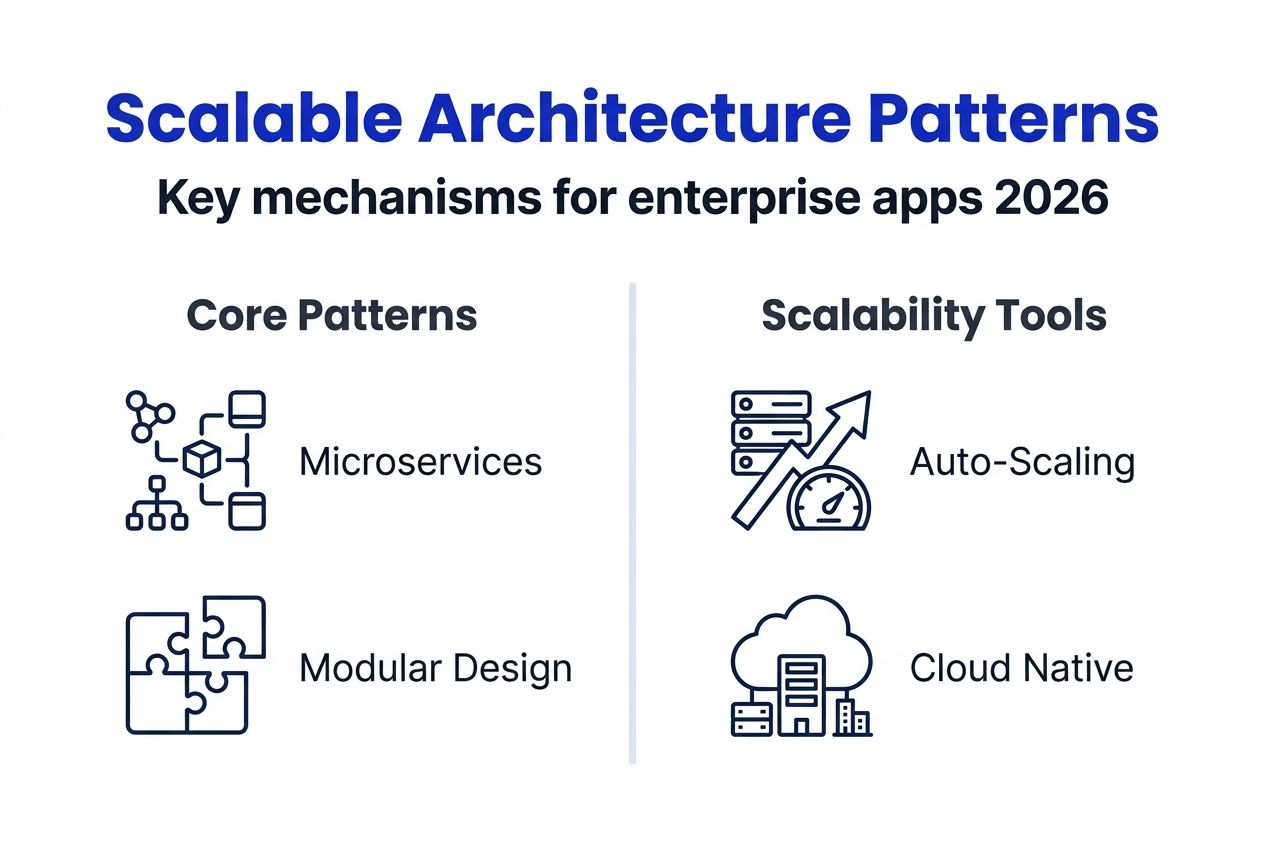
Benefits of modularity extend beyond development speed. When one service fails, others continue operating, preventing system-wide outages. Teams choose optimal technologies for each service based on specific requirements rather than forcing uniform tech stacks. This flexibility proves valuable in enterprises where different departments have varying technical needs and legacy constraints. Modularity also simplifies testing as teams validate individual services rather than entire applications.
Scalability mechanisms like horizontal scaling allow organizations to add server instances handling increased load rather than upgrading hardware vertically. Microservices enable granular scaling where high-demand services receive more resources while low-traffic components run on minimal infrastructure. Fault isolation ensures problems in one service don’t cascade through the system, maintaining overall availability even during localized failures.
By 2026, over 80% of new enterprise projects adopt microservices for scalability and fault isolation, driven by cloud-native tooling and container orchestration.
Why microservices suit enterprise demands:
- Independent deployment cycles reduce coordination overhead across large teams
- Technology diversity allows choosing best tools for specific services
- Fault containment prevents single points of failure from collapsing systems
- Resource optimization through selective scaling of high-demand components
- Easier maintenance as teams focus on bounded service contexts
Enterprises investing in cloud software development leverage these patterns to meet growing user bases and evolving business requirements without costly rewrites.
Modern technology selection and frameworks
Cloud-native approaches prioritize scalability, flexibility, and cost efficiency by designing applications specifically for cloud environments. Organizations benefit from elastic resource allocation, paying only for consumed capacity rather than maintaining fixed infrastructure. Auto-scaling adjusts server instances based on real-time demand, handling traffic spikes during peak periods and reducing costs during low activity. Cloud providers offer managed services for databases, caching, and messaging, reducing operational overhead.

Containers and Kubernetes revolutionized deployment by packaging applications with dependencies into portable units running consistently across environments. Kubernetes orchestrates container lifecycles, managing scaling, load balancing, and health monitoring automatically. This automation reduces manual intervention, minimizes human error, and accelerates deployment frequency. Teams push updates multiple times daily with confidence that orchestration handles routing and rollback if issues arise.
Hybrid and multi-cloud strategies combine on-premises infrastructure with public cloud resources, offering flexibility for regulated industries requiring data sovereignty. Organizations distribute workloads across providers to avoid vendor lock-in and optimize costs. Multi-cloud architectures also improve resilience as systems fail over to alternative providers during outages. Organizations migrating to cloud-native solutions experience 30% faster deployment times on average, driven by automation and standardized tooling.
Steps to select a technology stack:
- Define business requirements including scalability targets, compliance needs, and integration points.
- Evaluate team expertise and training availability for candidate technologies.
- Assess vendor ecosystems for tooling maturity, community support, and long-term viability.
- Prototype critical components to validate performance and development experience.
- Review total cost of ownership including licensing, infrastructure, and maintenance.
Modern frameworks and tools:
- Container platforms: Docker for packaging, Kubernetes for orchestration
- Cloud providers: AWS, Azure, Google Cloud offering managed services
- API gateways: Kong, Apigee managing service communication and security
- Monitoring: Prometheus, Grafana tracking performance and availability
- CI/CD pipelines: Jenkins, GitLab automating testing and deployment
Enterprises exploring blockchain software or emerging technologies benefit from cloud-native foundations supporting rapid experimentation.
Security and compliance challenges in enterprise systems
Security must be a design priority in enterprise applications handling sensitive customer data, financial transactions, and proprietary business information. Reactive security measures added after development prove costlier and less effective than integrated approaches addressing threats from initial architecture decisions. Threat modeling identifies potential vulnerabilities early, guiding technology choices and access control designs that minimize attack surfaces.
Compliance requirements vary by industry, with financial services adhering to PCI-DSS for payment data, healthcare following HIPAA for patient records, and European operations meeting GDPR standards for privacy. Each framework imposes specific technical controls, audit requirements, and breach notification procedures. Non-compliance results in regulatory penalties, legal liability, and reputation damage that can cripple organizations. Building compliance into development workflows ensures continuous adherence rather than scrambling before audits.
Data privacy and threat mitigation considerations include encryption for data at rest and in transit, role-based access controls limiting user permissions, and logging mechanisms creating audit trails for forensic analysis. Regular security testing through penetration tests and vulnerability scans identifies weaknesses before attackers exploit them. Incident response plans define procedures for containing breaches and notifying affected parties within regulatory timeframes.
Compliance frameworks and security tactics:
- Implement encryption using industry-standard algorithms for sensitive data storage and transmission
- Enforce multi-factor authentication for privileged accounts and administrative access
- Conduct regular security audits and penetration testing by third-party specialists
- Maintain detailed logs capturing user actions, system events, and security incidents
- Establish incident response procedures with defined escalation paths and communication protocols
- Train development teams on secure coding practices and common vulnerability patterns
Pro Tip: Involve security teams during initial architecture planning rather than treating security as a final review stage. Early collaboration identifies risks before they become embedded in code, reducing costly refactoring and ensuring compliance from day one.
Enterprise security investments increased 45% from 2024 to 2026 as organizations prioritize protecting digital assets and customer trust amid rising cyber threats.
Integrating security into enterprise system integration efforts ensures consistent protection across connected platforms.
Common misconceptions and pitfalls in enterprise application development
Misconception one: Enterprise development is just bigger traditional development. Many organizations assume scaling consumer app practices works for enterprise systems, ignoring fundamental differences in architecture complexity, integration requirements, and regulatory constraints. Enterprise applications require distributed systems expertise, data consistency patterns, and security protocols absent from simpler projects. Treating them as scaled versions of traditional software leads to performance bottlenecks, security vulnerabilities, and maintenance nightmares.
Misconception two: Latest technology guarantees success. Adopting cutting-edge frameworks without evaluating business fit creates technical debt and operational risk. Mature, well-supported technologies often outperform newer alternatives lacking robust tooling and community knowledge. Technology choices must align with team capabilities, existing infrastructure, and long-term maintenance considerations. Chasing trends wastes resources on unnecessary rewrites and unproven platforms.
Misconception three: Outsourcing always best for cost and quality. While outsourcing reduces immediate expenses, hidden costs emerge from miscommunication, misaligned incentives, and knowledge transfer gaps. Vendor turnover disrupts project continuity, forcing clients to re-explain requirements and retrain new teams. Quality suffers when vendors prioritize billable hours over sustainable solutions. Dedicated teams with long-term stakes in project success deliver better outcomes despite higher upfront investment.
Studies show 70% of enterprise projects fail due to misunderstandings about architecture needs, team alignment, and security integration from the outset.
Pitfalls and corrective advice:
- Avoid monolithic architectures for systems requiring independent service scaling and frequent updates
- Don’t skip thorough requirements gathering assuming developers infer unstated business logic
- Resist pressure to deliver features without adequate testing and security reviews
- Never ignore technical debt accumulation as it compounds into unmaintainable codebases
- Prevent vendor lock-in by designing portable architectures with abstraction layers
- Ensure continuous stakeholder communication preventing scope drift and misaligned expectations
Critical success factors and metrics for enterprise app delivery
Key uptime and performance benchmarks define whether enterprise applications meet business needs. Most organizations target 99.9% availability, allowing roughly 8 hours of downtime annually. Financial and healthcare systems often require 99.99% uptime, permitting less than one hour of annual downtime. Response time targets vary by function, with critical transactions completing under 200 milliseconds and batch processes meeting defined service level agreements. These metrics directly impact user satisfaction and operational efficiency.
Business impact indicators like ROI and user adoption measure whether technology investments deliver value. ROI calculations compare development and operational costs against productivity gains, revenue increases, and cost savings from automation. User adoption rates reveal whether applications solve real problems or create friction. High adoption with positive feedback validates design decisions, while low usage signals misalignment with workflows or inadequate training.
Continuous monitoring and feedback loops enable proactive issue detection before users experience problems. Automated alerting notifies teams of performance degradation, error rate spikes, or security anomalies requiring investigation. User feedback through surveys, support tickets, and usage analytics guides iterative improvements. Regular retrospectives help teams learn from incidents, refining processes to prevent recurrence.
Role of DevOps and QA in sustaining quality: DevOps practices automate deployment pipelines, infrastructure provisioning, and environment configuration, reducing manual errors and deployment time. Custom DevOps services establish continuous integration and delivery workflows testing code changes automatically before production release. QA teams design comprehensive test suites covering functional requirements, edge cases, and performance scenarios, catching defects early when fixes cost less.
Success factors to track:
- System availability meeting or exceeding SLA commitments across all services
- Response times staying within acceptable ranges under normal and peak loads
- Error rates remaining below thresholds indicating stable, reliable operations
- User adoption trends showing increasing engagement and positive sentiment
- Development velocity measured by feature delivery frequency and cycle time
- Technical debt levels monitored through code quality metrics and refactoring needs
Practical implementation strategies and case studies
Stepwise approach to assemble teams and select architecture begins with defining project scope, identifying required skills, and establishing success criteria. Organizations evaluate whether internal resources suffice or if dedicated teams provide faster ramp-up. Architecture decisions weigh monolithic versus microservices patterns based on anticipated scale, team size, and operational complexity. Proof of concept phases validate critical assumptions before committing to full implementation.
Integration strategies for legacy enterprise systems require careful planning as older platforms often lack modern APIs and documentation. Middleware solutions bridge legacy systems with new applications, translating data formats and protocols. Strangler fig patterns gradually replace legacy components with microservices, reducing migration risk compared to big-bang rewrites. Data synchronization mechanisms maintain consistency across old and new systems during transition periods.
Case study: A European financial services company needed to modernize payment processing while maintaining existing customer interfaces and regulatory compliance. They engaged a dedicated team with fintech software development expertise, implementing a microservices architecture running on Kubernetes. Legacy mainframe systems integrated through API gateways, enabling gradual migration without service disruption. The project delivered 40% faster transaction processing, 99.95% uptime, and reduced infrastructure costs by 25% within 18 months.
Implementation steps:
- Conduct stakeholder workshops defining business objectives, constraints, and success metrics.
- Assemble cross-functional teams including developers, architects, security specialists, and business analysts.
- Design initial architecture with defined service boundaries, data flows, and integration points.
- Establish development workflows including version control, code review, and automated testing.
- Build minimum viable product validating core functionality and gathering user feedback.
- Iterate based on feedback, gradually expanding features while maintaining quality and performance.
Best practices:
- Document architecture decisions explaining rationale for future team members
- Automate repetitive tasks like testing, deployment, and infrastructure provisioning
- Prioritize observability through logging, monitoring, and tracing distributed transactions
- Establish clear communication channels between business stakeholders and technical teams
- Plan for failure by implementing redundancy, backups, and disaster recovery procedures
Pro Tip: Build iterative feedback cycles into your development process. Regular demos and retrospectives keep business stakeholders engaged, surface misunderstandings early, and ensure technical solutions align with evolving business needs. This continuous alignment prevents costly late-stage pivots.
Explore dedicated development solutions at Meduzzen
Applying the strategies outlined requires experienced engineers who understand enterprise complexities and modern technologies. Meduzzen provides web development services and JavaScript software development supporting scalable enterprise applications across industries.
Our staff augmentation services deliver pre-vetted specialists integrating seamlessly into your existing teams. With over 10 years of experience and 150+ engineers, we focus on long-term partnerships, technical excellence, and business-driven results. Contact us to discuss how dedicated teams can accelerate your enterprise application development and deliver measurable outcomes.
FAQ
What is enterprise application development?
Enterprise application development creates scalable, secure software systems supporting mission-critical business operations for large organizations. These applications handle high transaction volumes, integrate with legacy platforms, and maintain performance under diverse workloads while meeting strict regulatory requirements. Unlike consumer apps, enterprise solutions prioritize data integrity, complex business logic, and long-term maintainability across decades of evolution.
Why choose dedicated development teams for enterprise projects?
Dedicated teams provide long-term alignment with business goals, functioning as extensions of internal organizations rather than transactional vendors. Pre-vetted specialists bring domain expertise without lengthy recruitment, enabling faster iteration and better communication than traditional outsourcing. Deep integration into company culture and technical context improves decision-making quality and reduces miscommunication risks throughout project lifecycles.
What architecture patterns ensure scalability in enterprise apps?
Microservices architecture decomposes applications into independent services handling specific business functions, enabling teams to develop, deploy, and scale components independently. This modularity supports fault isolation where service failures don’t cascade system-wide, and horizontal scaling where high-demand services receive additional resources. Over 80% of new enterprise projects adopt microservices by 2026 for these scalability and resilience benefits.
How do modern technologies improve enterprise app performance?
Cloud-native approaches deliver 30% faster deployment through elastic resource allocation, auto-scaling, and managed services reducing operational overhead. Containers and Kubernetes automate deployment orchestration, handling scaling and health monitoring without manual intervention. Hybrid and multi-cloud strategies optimize costs, avoid vendor lock-in, and improve resilience through distributed workloads across providers.
What are common mistakes to avoid in enterprise application development?
Don’t treat enterprise development as scaled traditional software, ignoring fundamental differences in architecture complexity and integration requirements. Prioritize security and compliance from initial design rather than adding protections reactively after development. Ensure technology choices align with business processes, team capabilities, and long-term maintenance needs instead of chasing trends without evaluating fit and sustainability.