In this article
Python Developer Cost in 2026: Real Rates, Hidden Costs, and What You’re Actually Paying For
Business & Strategy
Python developer cost in 2026 goes far beyond hourly rates. This guide breaks down real pricing, hidden costs, and what you actually pay when hiring developers.

Most companies think they understand what a Python developer costs.
They open a platform.
They see a number.
They build a budget around it.
Then the project starts. And the real costs appear.
Delays. Rework. Replacement cycles. Months of roadmap progress lost to a hire that looked affordable on paper but was expensive in practice.
The number on the platform was never the cost.
It was just the first number.
This guide breaks down what Python developers actually cost in 2026 — not the advertised rate, but the real one. If you are ready to hire Python developers and need to know what to actually budget, start here. Including the hidden time, structural risk, and overhead nobody mentions before you sign the contract.
The Three Costs Nobody Talks About
Most pricing conversations focus on the visible rate. The actual hiring decision should be made across all three layers.
The visible rate is what a platform, agency, or recruiter quotes you. The hourly number, monthly retainer, or annual base salary. This is what most budget spreadsheets are built around — and it is the least useful number for making a real decision.
The burden rate is what the visible rate does not include. For in-house employees in the United States, employer taxes, healthcare contributions, retirement matching, equipment provisioning, and software licenses add approximately 28–35% on top of base salary. A developer earning $150,000 per year costs the company closer to $192,000–$200,000 when the full employer burden is calculated. For staff augmentation providers, this burden is absorbed into the billed rate — which is why agency rates always look higher than salary equivalents, and why comparing them directly almost always misleads.
The delivery cost is the hardest to quantify and the most expensive when it goes wrong. It includes time-to-productivity after hire, rework caused by poor architectural decisions, delays from communication friction in distributed teams, and the compounding cost of technical debt introduced by developers who were technically functional but architecturally weak.
A developer who looks affordable on paper can become expensive very quickly if they require heavy oversight, introduce fragile database logic, and deliver far below expected velocity. The math just takes longer to surface.
This is where most hiring decisions fail. Not in the rate negotiation — in the failure to account for what happens after the contract.
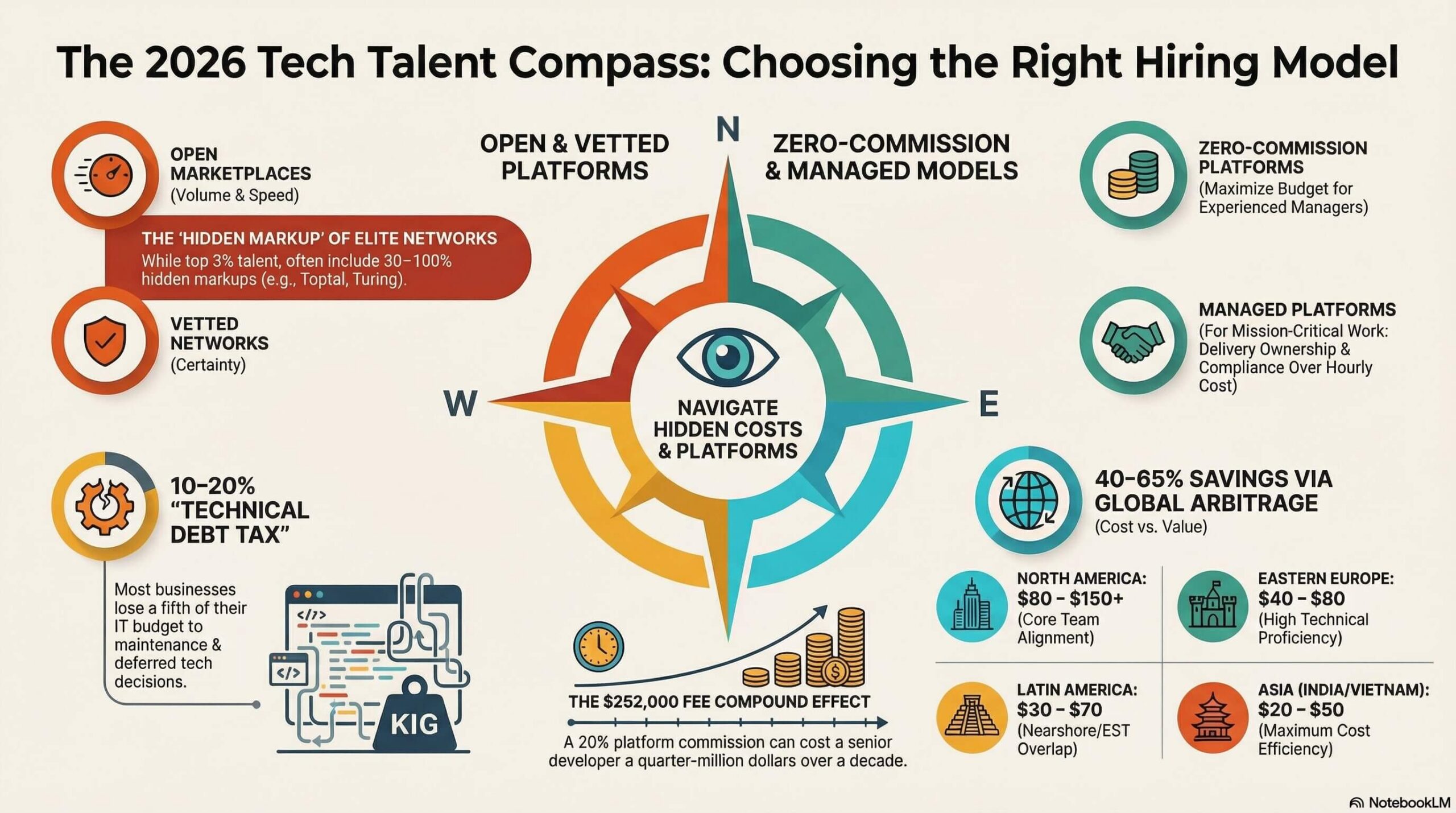
Python Developer Hourly Rates in 2026: Region by Region
These figures represent what companies actually pay when they hire a Python developer through vetted channels: agencies, staff augmentation providers, or talent networks. They are not raw freelance marketplace numbers, and they are not local salary equivalents. They reflect what a company actually pays to access a production-ready engineer through a structured engagement.
United States and Canada
The North American market commands the highest rates globally — justified for specific roles, prohibitive for most execution work.
Mid-level Python developers bill between $80–$130/hour. Senior developers with system design, cloud architecture, or AI integration expertise command $120–$180/hour. Specialist AI and LLM engineers regularly exceed $200/hour.
Base salaries for mid-level US Python developers average $92,000–$128,000 annually. With employer burden applied, total employment cost reaches $140,000–$190,000 per year.
Average time to fill a senior engineering role has stretched to 95 days, with an offer acceptance rate of just 51%. For every two senior engineers offered a role, one declines — forcing the organization to restart a three-month process from scratch.
Western Europe
Western Europe sits 20–30% below US salaries but carries some of the highest employer burden costs globally.
A mid-level Python developer in the UK earns approximately £76,000 (~$96,000 USD). In Germany, the figure sits around €93,000 (~$100,000–$104,000 USD). Mandatory employer social security contributions in France and Germany add 35–48% on top of gross salary — meaning a €80,000 developer costs the employer closer to €115,000.
Billed agency rates: $60–$130/hour depending on seniority.
Germany’s median time to hire is 55 days — the longest of any major tech market. Mandatory notice periods of 4–12 weeks mean the developer cannot start for months even after accepting. Companies needing delivery speed consistently find Western Europe structurally slow to scale through direct hiring alone.
Eastern Europe
Eastern Europe combines strong technical training — particularly in mathematics, algorithms, and computer science — with EU time zone overlap and favorable tax structures that keep rates competitive without compromising quality.
- Mid-level developers: $40–$70/hour
- Senior developers: $60–$100/hour
- Principal AI/cloud architects: up to $130/hour
Ukraine maintains approximately 340,000 active specialists with high concentration in AI development, PyTorch, and distributed systems. Poland houses roughly 600,000 developers and produces 60,000 new tech graduates annually. Bulgaria, Romania, and Georgia round out a region with deep engineering talent and growing international credibility.
Total cost savings against US onshore: 38–50% for comparable engineering quality. Companies that hire Python developers through Eastern European staff augmentation consistently reach productive output within 10–14 days.
Latin America
Latin America’s primary advantage is not cost. It is time zone alignment.
Developers in Brazil, Mexico, Colombia, and Argentina operate within 0–3 hours of US Eastern Standard Time. That means real-time collaboration, synchronous sprint planning, and same-day code reviews — the operational dynamics that determine whether an Agile team actually functions.
Research consistently shows that teams with at least six hours of synchronous overlap complete software projects approximately 23% faster than purely asynchronous teams. That velocity premium is part of what LATAM pricing reflects.
- Mid-level developers: $45–$75/hour
- Senior developers: $65–$100/hour
- AI, fintech, and cloud specialists: +15–25% above standard rates
Total savings vs. US domestic hiring: 60–65%. LATAM attrition rates are lower than Eastern Europe — 15–20% annually versus 25–35% — which reduces the hidden cost of turnover in long-term engagements.
Asia
India and Southeast Asia offer the widest price range and the largest absolute talent pool globally.
- Junior developers: $12–$30/hour
- Mid-level developers: $25–$50/hour
- Senior developers: $40–$80/hour
The 10–14-hour time zone difference with the US creates a purely asynchronous working relationship, extending project timelines for integrated product work. Asia works best for high-volume, well-specified execution managed by teams with mature distributed workflows.
Rate Comparison Table: Billed Rates by Region and Seniority (2026)
| Region | Junior (1–3 yrs) | Mid-Level (3–6 yrs) | Senior (7+ yrs) |
|---|---|---|---|
| United States / Canada | $40–$70/hr | $80–$130/hr | $120–$180+/hr |
| Western Europe | $35–$60/hr | $60–$90/hr | $90–$130+/hr |
| Eastern Europe | $20–$40/hr | $40–$70/hr | $60–$100/hr |
| Latin America | $20–$45/hr | $45–$75/hr | $65–$100/hr |
| Asia / India | $15–$30/hr | $25–$50/hr | $40–$80/hr |
Billed rates through vetted agencies and staff augmentation providers. Not raw freelance marketplace listings.
What Specialization Does to the Price
The numbers above reflect general Python engineering. Specialization applies significant multipliers.
Django / Flask backend is the market baseline — standard APIs, relational databases, traditional SaaS backends. Rates align with regional averages above.
FastAPI developers command a 10–20% premium over Django equivalents. FastAPI requires deep understanding of ASGI, async execution, Pydantic v2, and concurrent request handling. It is increasingly the default for microservices and AI inference endpoints — and the premium reflects genuine scarcity, not branding.
Data engineers add 15–30% above baseline. They design ETL pipelines, manage distributed processing with Spark and Kafka, and architect the data infrastructure that makes analytics and AI possible. The technology surface is broad and the pool of genuinely capable engineers is narrow.
AI and LLM engineers represent the sharpest premium in the market. Companies building production RAG pipelines, managing hallucination risk, and executing MLOps at scale are competing for an exceptionally small pool.
- Mid-level AI engineers: +40–60% above standard backend
- Senior AI architects: +80–100%+ above baseline
- US-market principal AI engineers: $200–$250/hour for RAG and MLOps specialization
Average US base salaries for senior ML engineers have crossed $212,000. The AI engineering market is effectively a separate economy inside the broader Python ecosystem.
Specialization Premium Table
| Role | Mid-Level Premium | Senior Premium | What Justifies It |
|---|---|---|---|
| Backend (Django/Flask) | Baseline | Baseline | Standard web APIs, CMS, traditional SaaS |
| Backend (FastAPI) | +10–15% | +15–20% | ASGI, async, high-performance microservices |
| Data Engineer | +15–25% | +20–30% | ETL orchestration, distributed DBs, cloud infrastructure |
| AI / LLM / RAG Engineer | +40–60% | +80–100%+ | Production RAG, hallucination control, MLOps |
The Freelance Pricing Illusion
Open any major marketplace — Upwork, Toptal, Lemon.io — and search for Python developers for hire, and you will find rates that appear dramatically lower than the agency figures above.
That is the point. Low advertised rates are an acquisition mechanism.
The visible number is designed to get you to register, not to represent the actual cost of the engagement.
Here is what the rate excludes:
Platform commissions reduce what the developer actually receives. Fiverr charges a flat 20% from the first dollar earned. Upwork’s variable fee structure erases thousands from a full-time freelancer’s annual income — practices scrutinized by the Federal Trade Commission for deceptive fee disclosure. Developers who self-fund their entire burden rate — self-employment taxes, healthcare, equipment, the unpaid hours spent bidding — must bill significantly higher than a salaried equivalent just to maintain income parity.
This creates a predictable adverse selection problem. The most capable senior engineers have largely abandoned open marketplaces. They work through vetted networks, establish independent consultancies, or align with staff augmentation providers that offer stable income and professional development. What remains on open platforms skews toward junior talent, junior talent rebranding as senior, or agencies operating under the guise of individual freelancers.
A $50/hour open-marketplace developer can become more expensive than a structured agency or staff augmentation hire once delays, rework, IP risk, and mid-project departures start compounding.
How to Read the Agency Markup
When a staff augmentation agency quotes $70/hour for a developer whose local salary equivalent is $35/hour, the immediate reaction is often to question the margin.
The markup is not arbitrary profit.
The standard industry formula divides the billed rate into roughly three equal parts: one third covers the developer’s gross pay, one third covers back-office operations — HR, payroll infrastructure, non-billable admin, bench time between engagements — and one third represents gross margin.
The salary equivalent you are mentally comparing against does not include employer payroll taxes, healthcare, recruitment fees ($6,200–$30,000 per senior specialized hire), severance liability, or the time burden of a wrong hire. When you hire through a well-run agency, you transfer those costs and risks to the vendor.
For most SaaS companies and growth-stage teams, the math consistently favors structured engagement models over direct in-house hiring for any role that does not require permanent IP ownership.
Vendor Comparison: What You Actually Pay Per Platform (2026)
| Vendor | Model | Typical Billed Rate | Speed to Developer | Risk Reversal |
|---|---|---|---|---|
| Toptal | Elite vetted network | $60–$200+/hr | 1–2 weeks | Trial period |
| Arc.dev | Vetted marketplace | $60–$100+/hr | 72hrs (shortlist only) | $0 until hire |
| Lemon.io | Vetted network | $50–$120+/hr | 48hrs (shortlist only) | 20 risk-free hours |
| Proxify | Staff augmentation | ~$35–$50/hr | 2 days (shortlist only) | Risk-free trial |
| Upwork | Open marketplace | $15–$80+/hr | Immediate | Escrow only |
| Meduzzen | Staff augmentation | $15–$60/hr | 48hrs (the developer) | Structured vetting + onboarding support |
The distinction worth reading carefully: most platforms quote 48 hours to a shortlist of profiles. Meduzzen delivers the matched developer in 48 hours — pre-vetted, ready to integrate into your stack and workflow.
What $15–$60/hr Actually Gets You
This is where the pricing conversation becomes concrete.
Companies that want to hire dedicated Python engineers without the overhead of direct employment use Meduzzen’s model, with engineers across Ukraine, Bulgaria, Poland, Georgia, Estonia, Slovakia, Germany, Netherlands, Spain, Finland, and nine additional countries. The rate range — $15 to $60 per hour depending on seniority and specialization — reflects Eastern European and EU-based talent accessed without the Western sales office markup layered on top.
What that rate includes:
Structured screening. Senior recruiters evaluate skills, experience, and cultural fit using standardized scorecards — not keyword filters or automated pre-screens. The process is designed to identify production-ready engineers rather than candidates who interview confidently but underdeliver in practice.
Onboarding support. Augmented developers do not arrive and immediately consume senior engineering time to get oriented. Meduzzen’s onboarding playbooks reduce the early-engagement overhead that erodes the value of any hire in the first four to six weeks.
EU-based legal and operational infrastructure. Offices across ten European cities. This matters for GDPR compliance, IP assignment enforceability, and for companies that need a vendor with genuine European legal presence — not just a remote matching platform.
No marketplace fragmentation. Developers operate within Meduzzen’s structure — not freelancers split across six client relationships simultaneously. Continuity and ownership are built into the model.
The market charges $60–$130/hour for what Meduzzen delivers at $15–$60/hour.
That gap is not a discount signal. It is a structural advantage built on geography, operating efficiency, and a model that eliminates the unnecessary margin layers — not the engineering quality.
Total Cost of Ownership: Hiring Models Side by Side
| Factor | Freelance | In-House (US) | Toptal / Arc | Meduzzen |
|---|---|---|---|---|
| Rate range | $15–$80+/hr | — | $60–$200+/hr | $15–$60/hr |
| Employer burden | Self-funded | +28–35% | Included | Included |
| Recruitment cost | None | $6,200–$30,000 | None | None |
| Time to first developer | 1–7 days | 65–95 days | 1–2 weeks | 48 hours |
| Time to productive output | 4–8 weeks | 3–5 months | 2–4 weeks | 2–3 weeks |
| Churn risk | High | Low | Low | Low |
| IP / legal protection | Weak | Strong | Medium | Strong (EU-based) |
| Office infrastructure | None | Yes | None | Yes (10+ EU cities) |
When Cheap Becomes Expensive: Three Real Failure Patterns
Not all of the cost of a Python developer is visible before the engagement starts. Some of it only appears after.
The async blockade. A developer uses FastAPI’s async def routing but executes synchronous database queries inside it with a blocking driver. Looks responsive in staging. Under 500 concurrent users at launch, the synchronous I/O blocks the ASGI event loop entirely. A six-hour outage during a marketing launch. The fix cost more in engineering time and customer trust than four months of rate savings.
The race condition. A Django developer fetches inventory, subtracts quantity in Python memory, and calls .save() without row-level locking or atomic transactions. During a flash sale, concurrent threads read the same inventory value simultaneously. The system oversells by 200 units. Refunds, press coverage, a weekend in damage control — none of which appear in the hourly rate.
The silent pipeline failure. A data engineer builds Airflow pipelines without idempotency checks or schema validation. An upstream service renames a field. A bare except block swallows the KeyError and inserts null values into the financial warehouse for a week. All dashboards show green. Executives present corrupted reports to the board.
These are not edge cases. They are predictable outcomes of hiring based on rate without evaluating for production readiness.
The real cost of a Python developer is not what they charge. It is what happens when they are wrong.
The Questions to Ask Before Agreeing to Any Rate
Price negotiation is the wrong starting point.
Before you discuss rate, these questions determine whether the rate is even relevant.
What does the evaluation actually measure? A platform that promises top-tier talent but evaluates through automated keyword matching and brief video screens is not selling quality. It is selling speed, packaged as quality. Ask exactly how candidates are screened — by whom, using what criteria, across how many stages.
What does onboarding look like? The rate covers the developer’s time. It does not cover the internal management capacity required to direct, review, and integrate that developer. If you pay $60/hour but consume 20% of a senior engineer’s weekly capacity supervising the work, your effective cost is significantly higher than the invoice suggests.
What is the contractual risk structure? IP assignment, NDA enforceability, and replacement guarantees vary dramatically between geographies and engagement models. A low rate with weak contractual protections is not cheap. It is underpriced risk.
What is the track record on work like yours? Five years maintaining legacy systems and three years building greenfield SaaS products are not equivalent seniority regardless of what the profile says. Ask for examples of similar engagements, not just a list of technologies.
Conclusion
The rate conversation in Python hiring is almost always the wrong conversation.
The right one is about what you are building, what engineering decisions will define whether it succeeds or fails, and what kind of engineer you need to make those decisions correctly.
Once that is clear, pricing becomes a function of matching the right capability to the right model. Eastern Europe for algorithmic depth and backend complexity. Latin America for synchronous nearshore velocity. Specialist AI talent wherever the evaluation confirms the specific RAG, MLOps, or data infrastructure expertise you need.
The cost of a Python developer is not the number on the quote.
It is the sum of every decision they make in production, every architectural choice that either accelerates or constrains your roadmap, and every hire cycle you avoid because the first decision was the right one.
That is what you are buying. Make sure the rate reflects it.
Frequently Asked Questions
How much does it cost to hire a Python developer in 2026?
Cost varies by region, seniority, and hiring model. The most cost-efficient way to hire a Python developer in 2026 is through Eastern European staff augmentation: 40–65% savings vs. US domestic cost. Through vetted channels, mid-level developers bill $40–$90/hour. US-based senior developers bill $120–$180/hour. Meduzzen’s range starts at $15/hour, below every major vetted platform in the market.
What is the difference between an hourly rate and the true cost of a developer?
The hourly rate covers billed time. True cost includes employer burden (taxes, benefits, equipment), recruitment fees, onboarding friction, time-to-productivity, management overhead, and the cost of any architectural rework. For a US in-house hire, total annual cost routinely exceeds base salary by 30–40% before any operational costs are factored in.
Why do agency rates look higher than salary equivalents?
Because they absorb costs that would otherwise fall on you — employer taxes, healthcare, recruitment fees ($6,200–$30,000 per specialized senior hire), retention programs, bench time, and administrative overhead. When you compare agency rates against true total employment cost rather than base salary, the gap is often smaller than it appears, and frequently favorable when speed, IP protection, and flexibility are included.
Are cheaper developers always a worse choice?
No. But cost savings and quality are not automatically aligned. The risk is hiring based on rate without validating production readiness. The cost of weak architectural decisions does not appear in the rate. It appears in production — often months later, and at multiples of the original savings.
What do AI and LLM engineers cost in 2026?
Significantly more than general backend developers. AI/LLM engineers command a 40–100%+ premium above standard backend rates. Senior ML engineers in the US average over $212,000 in base salary. Principal AI architects billing on contract commonly charge $200–$250/hour for specialized RAG and MLOps work.
How quickly can you get a Python developer started?
In-house hiring averages 65–95 days in the US. Vetted network platforms typically take 1–2 weeks to a signed engagement after delivering an initial shortlist. Meduzzen’s staff augmentation model delivers a vetted, matched developer within 48 hours — not a shortlist of profiles, but the developer.