


In this article
Most software projects never reach their finish line. 67% of software projects fail due to budget overshoots, missed deadlines, or unmet expectations. For startup founders and CTOs, these statistics aren’t just numbers. They represent wasted capital, lost market opportunities, and frustrated teams. Custom software development offers a path forward, delivering tailored solutions that address your unique business challenges. This guide explains what custom software development is, why it matters for scalable growth, and how to avoid the pitfalls that sink most projects.
Key takeaways
| Point | Details |
|---|---|
| Custom software delivers tailored solutions | Purpose-built applications address specific startup needs rather than forcing business processes into generic templates. |
| High failure rates stem from poor planning | Most projects fail because of unclear requirements, scope creep, and inadequate stakeholder communication. |
| Right tech stack choices improve success | Selecting scalable, maintainable technologies with available developer talent increases project reliability. |
| AI automation enhances efficiency | Integrating AI-powered features eliminates manual tasks and reduces errors by up to 30%. |
| Security must start from day one | Building security into the foundation prevents costly fixes and protects sensitive startup data. |
Understanding custom software development and its benefits
Custom software development is the process of designing, building, and maintaining applications specifically for your organization’s unique requirements. Unlike off-the-shelf solutions that serve broad markets with generic features, custom software aligns precisely with your workflows, data structures, and business logic.
The difference matters more than you might think. Off-the-shelf products force you to adapt your processes to their limitations. You pay for features you’ll never use while missing capabilities you desperately need. Custom solutions flip this equation. You get exactly what your business requires, nothing more, nothing less.
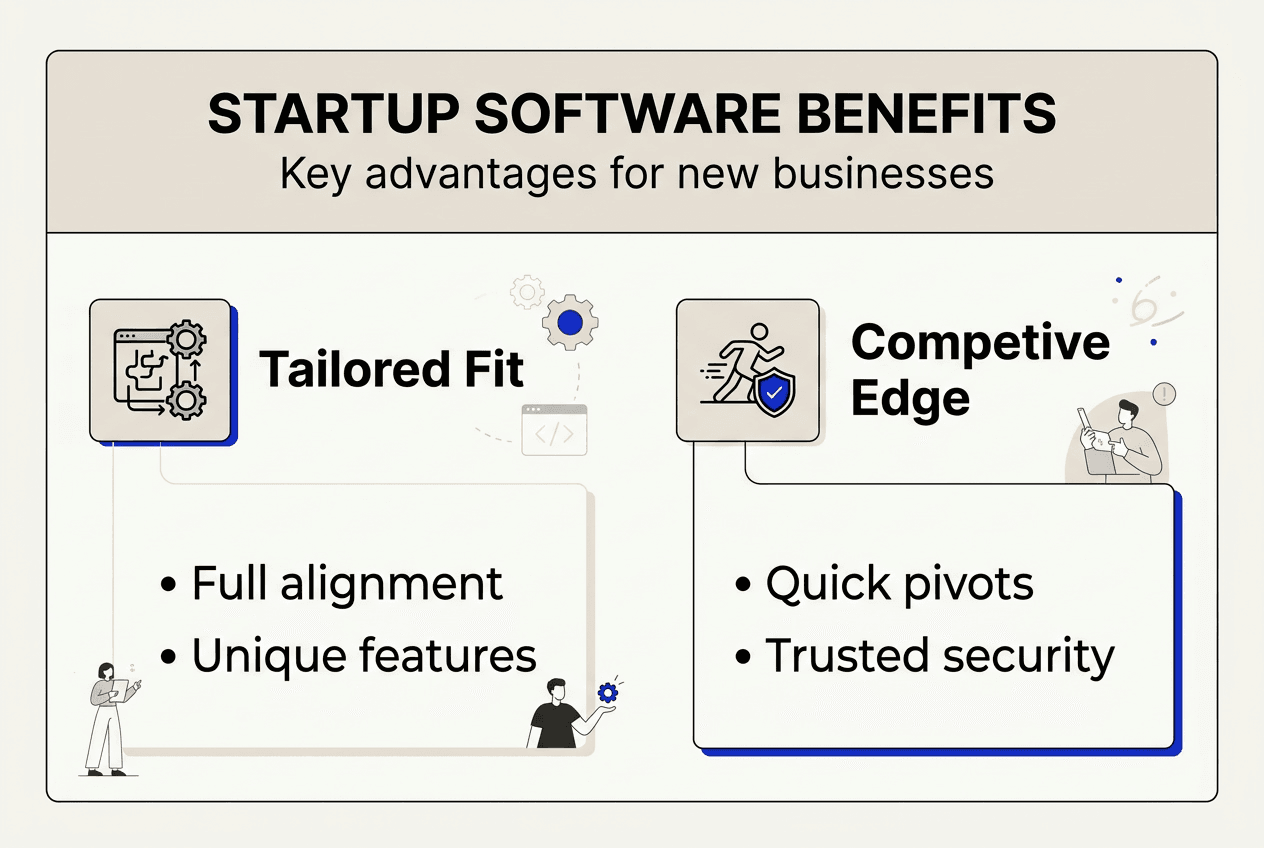
The benefits extend beyond feature alignment. Custom software development allows for tailored solutions, improving user satisfaction and operational efficiency by 20-30% compared to off-the-shelf software. Your team works faster because the interface matches their mental models. Integration becomes seamless because you control every API and data connection.
For startups, custom software delivers competitive advantages that generic tools cannot match. You can pivot quickly when market conditions change. You own your intellectual property completely. You scale without license restrictions or per-user fees that balloon as you grow.
Consider how custom government software development enables agencies to meet specific compliance requirements while serving citizens effectively. Or how custom PHP software development services help businesses build robust web applications tailored to their exact specifications.
Pro Tip: Focus your development efforts on solving specific pain points that directly impact revenue or operational efficiency. Generic features add complexity without value. Start with the one capability that will transform your core business process, then expand from there.
Key advantages for growing startups include:
- Complete control over features, timelines, and technology choices
- Seamless integration with existing systems and workflows
- Ability to iterate based on real user feedback and business metrics
- No vendor lock-in or restrictive licensing models
- Scalability designed into the architecture from the start
Common challenges in custom software development and how to avoid them
Understanding benefits is one thing. Navigating the minefield of custom software projects is another. The statistics tell a sobering story about why so many initiatives crash and burn.

67% of software projects fail due to budget overruns, delays, or unmet goals. These failures share common root causes. Poor planning tops the list. Teams rush into development without clearly defining requirements or success criteria. Communication breaks down between technical teams and business stakeholders. Nobody wants to be the person who says the emperor has no clothes when scope silently expands.
Scope creep kills projects slowly. It starts innocently. A stakeholder suggests one small feature. The team agrees because it seems minor. Another request follows. Then another. Before anyone realizes what’s happening, nearly 50% of projects experience scope creep that derails timelines and budgets.
Feature creep operates differently but causes similar damage. This happens when teams add capabilities they think users might want someday. The intentions are good. The results are disastrous. In SaaS, up to 80% of new features go unused by customers. Every unused feature represents wasted development time, increased complexity, and maintenance burden.
“The best code is no code at all. Every line you write is a line you have to maintain, debug, and eventually refactor. Focus ruthlessly on what delivers measurable business value.”
Preventing these challenges requires discipline and clear processes. Start with detailed requirements gathering. Document not just what you want to build, but why it matters and how success will be measured. Involve all stakeholders early, including developers, designers, and end users.
Establish a formal change control process. Every new feature request must answer three questions: What business problem does this solve? What is the cost in time and resources? What existing priorities will this displace? If you can’t answer all three clearly, the feature doesn’t make the cut.
For complex projects involving modern frameworks, JavaScript software development expertise helps teams avoid common pitfalls. Similarly, custom C software development services provide performance-critical solutions when speed matters most.
Pro Tip: Schedule monthly scope review meetings with all stakeholders. Walk through the current feature list and ruthlessly cut anything that hasn’t delivered measurable value. This regular pruning prevents creep before it becomes a crisis.
Best practices to keep projects on track:
- Define clear acceptance criteria for every feature before development starts
- Use time-boxed sprints to force prioritization decisions
- Implement automated testing to catch issues early
- Maintain transparent communication channels between all team members
- Track metrics that matter: user engagement, business KPIs, not just features shipped
Choosing technology stacks and methodologies for scalable custom software
Your technology choices today determine your startup’s technical ceiling tomorrow. Select poorly and you’ll hit scaling limits just as growth accelerates. Choose wisely and your infrastructure becomes a competitive advantage.
Choosing the right technology stack is crucial for scalability, performance, and reliability. But what makes a stack “right” for your situation? Three factors matter most: scalability to handle growth, maintainability so you’re not constantly rewriting code, and developer availability so you can actually hire people who know the technologies.
Consider a real example. Pulse AI Solutions built their business management platform using Python with FastAPI for the backend, Next.js for the frontend, Azure SQL for data persistence, and Microsoft Azure for cloud infrastructure. This stack delivered speed, modern developer experience, and enterprise-grade reliability.
The methodology you choose matters as much as the technology. Agile methodologies like Scrum are used by 70% of organizations to enable iterative development and adaptability. Agile works because it embraces the reality that requirements change. You build in short cycles, gather feedback, and adjust course based on real user data rather than upfront assumptions.
Compare this to waterfall approaches where you define everything upfront, spend months building, and hope you got it right. For startups operating in uncertain markets, that rigidity is a death sentence.
| Technology Category | Popular Options | Best For | Key Considerations |
|---|---|---|---|
| Backend Framework | Python/FastAPI, Node.js, .NET Core | API development, business logic | Performance needs, team expertise |
| Frontend Framework | React, Next.js, Vue.js | User interfaces, web apps | SEO requirements, interactivity |
| Database | PostgreSQL, Azure SQL, MongoDB | Data persistence | Relational vs document model |
| Cloud Platform | AWS, Azure, Google Cloud | Hosting, infrastructure | Cost, regional availability |
| Development Methodology | Agile/Scrum, Kanban | Project management | Team size, release frequency |
For Microsoft-focused environments, custom .NET software development services provide enterprise integration and robust tooling. Broader needs might align with comprehensive custom software development services that span multiple technology stacks.
Key factors for technology selection:
- Community size and ecosystem maturity for long-term support
- Performance characteristics that match your application requirements
- Security track record and update frequency
- Cost of hosting and infrastructure at scale
- Learning curve for your existing team or new hires
Explore detailed technology stack selection insights to see what successful companies use and why. The patterns reveal what works at different scales and in various industries.
Enhancing efficiency and security with AI and best practices in custom software
AI isn’t just hype anymore. It’s a practical tool that eliminates tedious work and reduces errors in custom software. The question isn’t whether to use AI, but how to integrate it effectively from the start.
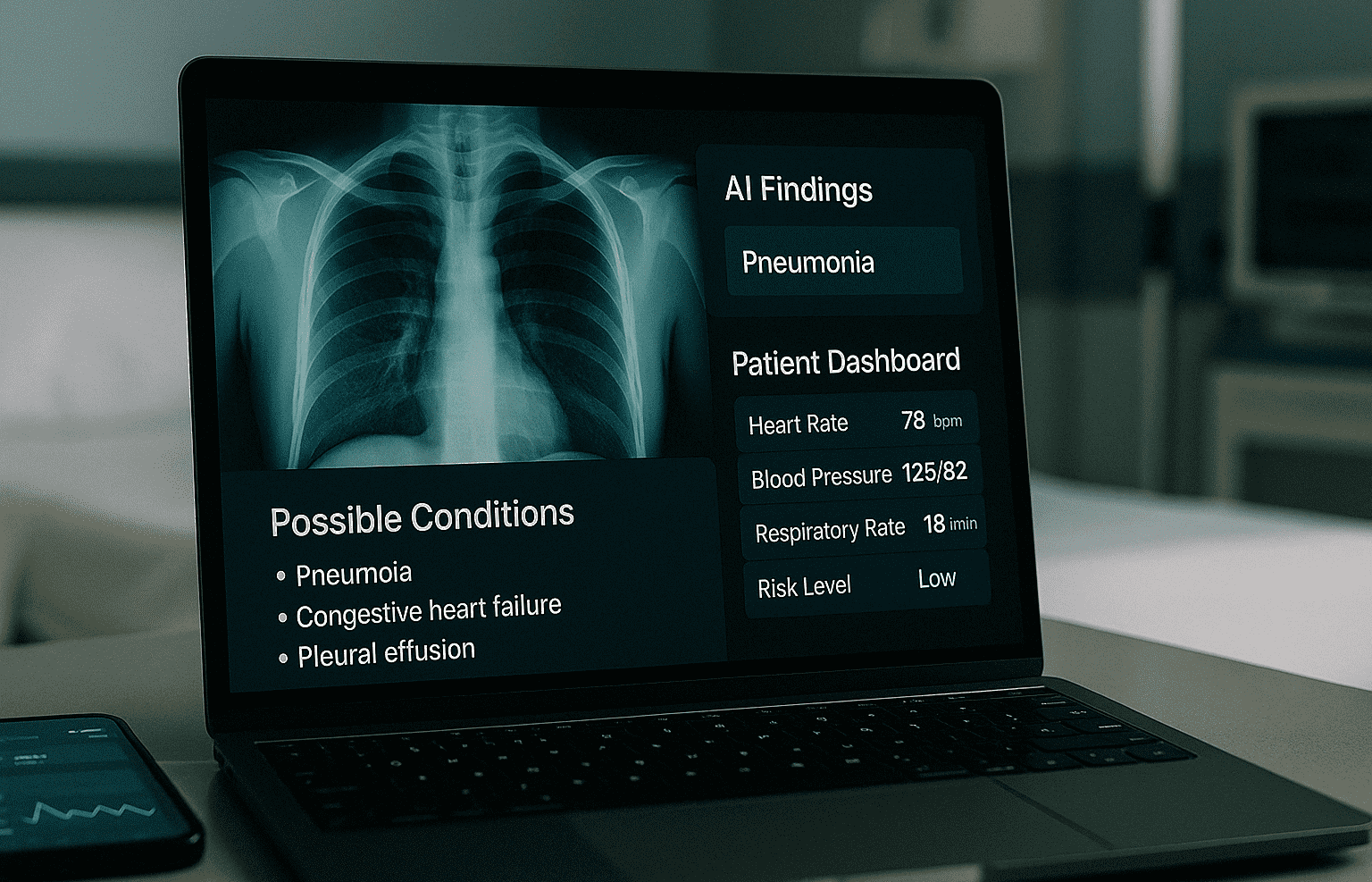
AI-powered automation in custom software can eliminate manual tasks and improve accuracy, as demonstrated by PawPlannerAI. This pet care management platform replaced hours of manual data entry with intelligent automation. Staff members who previously spent entire afternoons updating records now focus on customer service and business growth.
The impact shows up in measurable ways. Manual processes that took 2-3 hours now complete in minutes. Error rates drop dramatically when AI handles repetitive data validation and formatting. Your team reclaims time for strategic work that actually moves the business forward.
Security demands equal attention from day one. Too many startups treat security as something to add later, after they’ve achieved product-market fit. This backwards thinking creates technical debt that becomes exponentially more expensive to fix. Security should be prioritized from the beginning with regular audits and penetration testing.
Start with the basics: encrypted data transmission, secure authentication, role-based access controls. Then layer on more sophisticated protections: regular security audits, automated vulnerability scanning, incident response procedures. These aren’t optional extras. They’re fundamental requirements for any software handling customer data or business-critical operations.
| Process Type | Manual Approach | AI-Automated Approach | Improvement |
|---|---|---|---|
| Data entry | 2-3 hours per day | 10-15 minutes per day | 90% time reduction |
| Error rate | 5-8% typical | Under 1% with validation | 85% error reduction |
| Security audits | Quarterly manual reviews | Continuous automated scanning | Real-time threat detection |
| Code reviews | Senior developer time | AI-assisted analysis | 40% faster reviews |
For startups looking to leverage AI capabilities, artificial intelligence services provide expertise in machine learning, natural language processing, and predictive analytics. Specific applications like AI-powered customer service tools show how automation transforms user experiences.
Pro Tip: Integrate security reviews and AI capabilities during the architecture phase, not after you’ve written thousands of lines of code. Retrofitting security or AI features costs 10 times more than building them in from the start. Allocate 15-20% of your initial development budget to security infrastructure and AI integration planning.
Essential security practices for custom software:
- Implement multi-factor authentication for all user accounts
- Encrypt sensitive data both in transit and at rest
- Conduct regular penetration testing by third-party security experts
- Maintain detailed audit logs for all system access and changes
- Create incident response plans before you need them
The combination of AI efficiency gains and robust security creates software that scales safely. Your users trust the platform because it protects their data. Your team operates efficiently because AI handles routine tasks. Your business grows without the technical debt that cripples so many startups.
Explore Meduzzen’s custom software development services
Building custom software that scales requires more than good intentions. It demands experienced engineers who’ve solved these problems before. Meduzzen brings over 10 years of expertise and 150+ pre-vetted engineers specializing in Python, AI, DevOps, Cloud, and modern web technologies.
We’ve delivered scalable SaaS platforms, AI-powered solutions, and enterprise systems for FinTech, Healthcare, Logistics, EdTech, Travel, and Real Estate industries. Our engineers integrate seamlessly into your team, ensuring fast onboarding and transparent communication throughout the development process.
Whether you need end-to-end product development or want to augment your existing team with specialized talent, Meduzzen web services provide the technical expertise and business understanding to turn your vision into production-ready software. Our staff augmentation services let you scale your development capacity without the overhead of full-time hiring.
User experience makes or breaks software adoption. Our custom UI/UX services ensure your application not only functions flawlessly but delights users with intuitive interfaces that drive engagement and retention. Partner with Meduzzen to build custom software that grows with your startup.
Frequently asked questions about custom software development
What industries benefit most from custom software?
FinTech, Healthcare, Logistics, EdTech, Travel, and Real Estate see the strongest ROI from custom solutions. These industries have complex regulatory requirements, unique workflows, and competitive pressures that generic software cannot address. Any business with specialized processes or data handling needs benefits from custom development.
How long does a typical custom software project take?
Most projects require 3-6 months for an MVP and 9-12 months for a full production release. Timeline depends on complexity, team size, and how clearly you’ve defined requirements. Agile methodologies let you release features incrementally rather than waiting for complete builds.
What are the cost factors influencing custom development?
Team composition, technology complexity, integration requirements, and project scope drive costs. A simple web application with standard features might cost $50,000-$100,000. Enterprise systems with AI capabilities, complex integrations, and high security requirements can exceed $500,000. Staff augmentation often provides better cost efficiency than building internal teams from scratch.
How can startups manage feature requests effectively?
Implement a formal change request process requiring business justification for every feature. Use a prioritization framework like RICE (Reach, Impact, Confidence, Effort) to evaluate requests objectively. Schedule regular backlog grooming sessions to remove low-value items before they consume resources.
Is custom software always better than off-the-shelf solutions?
No. Off-the-shelf works well for commodity functions like email or accounting where your needs match standard workflows. Custom software makes sense when your competitive advantage depends on unique capabilities, when integration complexity exceeds the cost of building custom, or when off-the-shelf licensing costs will exceed custom development within 2-3 years. Evaluate total cost of ownership over 5 years, not just initial price tags.
Recommended
Author