In this article
What is Python development: a 2026 guide for startups
Tech & Infrastructure
Discover how Python development accelerates startup growth in 2026. Learn framework choices, team augmentation strategies, and scalability patterns for modern SaaS products.

Python powers over 60% of new startup tech stacks in 2026, yet many founders remain uncertain about its true capabilities for scaling applications. This guide clarifies what Python development entails, how it accelerates product iteration, and why strategic team augmentation with Python engineers can transform your startup’s technical capacity and competitive position.
Key takeaways
| Point | Details |
|---|---|
| Python development scope | Building web backends, AI features, and scalable SaaS products using Python’s extensive ecosystem and frameworks. |
| Startup speed advantage | Python reduces development time by approximately 40% compared to traditional enterprise languages through rapid prototyping. |
| Framework choices matter | Django suits enterprise SaaS, Flask enables fast MVPs, each affecting long-term scalability and team productivity differently. |
| Performance myths debunked | Async frameworks and architectural optimization enable Python to handle millions of requests despite common misconceptions. |
| Strategic team scaling | Pre-vetted Python engineers reduce onboarding time by 30% while providing flexibility to scale without full-time hiring overhead. |
Introduction to Python development
Python development refers to building software products using the Python programming language and its rich ecosystem of libraries, frameworks, and tools. In 2026, Python ranks as one of the top three programming languages globally, particularly dominant in startup environments where speed and versatility drive competitive advantage.
Startups leverage Python across multiple critical domains. Web backend development powers user-facing applications and API services. AI and machine learning capabilities accelerate product innovation through intelligent features. Data processing pipelines handle analytics and business intelligence at scale.
The Python ecosystem offers startups a critical advantage: comprehensive libraries that eliminate rebuilding common functionality from scratch. This translates directly to faster feature delivery and reduced engineering costs. Django for full-featured web applications, Flask for lightweight services, and specialized libraries like TensorFlow for AI create a complete development toolkit.
Python’s readability and straightforward syntax lower the barrier for team collaboration. New engineers onboard faster, codebases remain maintainable as teams grow, and technical debt accumulates more slowly than with complex languages. For founders without deep technical backgrounds, Python’s clarity makes strategic technology decisions more accessible.
Key characteristics that define Python development in startups:
- High-level language requiring less boilerplate code than Java or C++
- Interpreted execution enabling rapid testing and iteration cycles
- Strong typing support introduced in recent versions improving code reliability
- Massive open-source community providing solutions and support
- Cross-platform compatibility simplifying deployment across environments
The language continues evolving with performance improvements and modern features while maintaining backward compatibility. This stability matters for startups planning multi-year product roadmaps without constant rewrites.
Python’s advantage for startups and scalability
Startups choosing Python gain measurable advantages in both development velocity and economic efficiency. Research shows Python reduces overall development time by approximately 40% compared to statically typed enterprise languages, enabling faster market entry and customer feedback cycles.

The extensive library ecosystem serves as a force multiplier for small teams. Instead of building authentication systems, payment processing, or API integrations from scratch, engineers integrate proven packages like Django REST Framework or Stripe SDK. This architectural approach transforms months of custom development into days of configuration and integration work.
Economic factors strengthen Python’s startup appeal. Python developers have average salaries 20% lower than Java developers, offering startups cost efficiency in hiring while accessing a large talent pool. The global Python community includes millions of active developers, making recruitment and team scaling significantly more manageable than niche languages.
For SaaS application development, Python’s rapid prototyping capabilities prove invaluable. Founders can validate product concepts with functional MVPs in weeks rather than months. Once validation occurs, the same Python codebase scales through architectural improvements rather than complete rewrites.
Scalability advantages specific to Python:
- Async frameworks like FastAPI handle concurrent requests efficiently
- Microservices architecture enables horizontal scaling of specific components
- Cloud-native deployment simplifies infrastructure management and auto-scaling
- Mature caching solutions reduce database load at high traffic volumes
- Performance profiling tools identify bottlenecks before they impact users
Companies building web and SaaS applications frequently compare Python with alternatives like Ruby. While both offer rapid development, Python’s broader ecosystem and AI capabilities provide additional strategic flexibility as product requirements evolve.
Resource utilization improves dramatically with Python’s efficient development cycle. Small teams ship features faster, reducing the time capital remains locked in development before generating revenue. This velocity advantage compounds over time, enabling startups to iterate toward product-market fit while competitors remain in development.
Popular Python frameworks and tools for scaling
Framework selection fundamentally impacts both immediate development speed and long-term scalability. Django and Flask represent the two dominant approaches, each optimizing for different startup scenarios and team structures.
Django provides a batteries-included framework ideal for enterprise SaaS products requiring rapid feature development. Its built-in admin interface, ORM, authentication system, and form handling eliminate thousands of lines of custom code. Large teams benefit from Django’s opinionated structure, which enforces consistent patterns across the codebase.
Flask takes the opposite approach as a lightweight microframework. It provides routing and templating while leaving architecture decisions to developers. This flexibility suits MVPs, microservices, and teams preferring explicit control over every component. Startups pivoting frequently often choose Flask to avoid fighting framework constraints.
| Framework | Best For | Team Size | Learning Curve | Scalability Pattern |
|---|---|---|---|---|
| Django | Enterprise SaaS, content platforms | 5+ engineers | Moderate | Monolith to modular monolith |
| Flask | MVPs, APIs, microservices | 2-5 engineers | Low | Microservices from start |
| FastAPI | High-performance APIs, async workloads | 3-8 engineers | Moderate | Async microservices |
FastAPI emerged as a modern alternative combining Flask’s simplicity with async performance and automatic API documentation. Startups building API-first products or integrating real-time features increasingly adopt FastAPI for its speed advantages and developer experience improvements.
Framework choice creates lasting consequences. Django projects naturally evolve toward modular monoliths, where related features group into semi-independent apps within one codebase. Flask and FastAPI projects typically start as microservices, distributing functionality across multiple deployable units from day one.
Tradeoffs between these approaches:
- Django accelerates initial development but increases complexity as codebases grow
- Flask requires more upfront architecture decisions but offers greater long-term flexibility
- FastAPI delivers superior performance for API workloads but has a smaller ecosystem than Django
- Team experience matters more than framework features for most startup scenarios
Pro Tip: Choose Django if your team lacks senior architects and needs guardrails. Choose Flask or FastAPI if you have experienced engineers who value architectural control over built-in features.
Framework selection should align with your team’s skillset and product complexity rather than industry hype. A Django monolith maintained by three experienced engineers outperforms a poorly architected Flask microservices deployment every time.
Common misconceptions about Python in production
Python faces persistent skepticism about production performance, yet these concerns typically reflect outdated information or misunderstanding of modern architectural patterns. The myth that Python cannot handle high-load environments contradicts extensive evidence from companies running Python at massive scale.
Async frameworks fundamentally changed Python’s performance profile. FastAPI, Sanic, and async Django views handle millions of concurrent requests through non-blocking I/O operations. These frameworks transform Python from a synchronous language into an efficient concurrent system matching Node.js performance characteristics.
The real performance bottleneck in most applications occurs at the database or external API layer, not Python execution speed. Proper caching strategies using Redis, database query optimization, and CDN integration matter far more than raw language speed. Companies blaming Python for performance issues typically have architectural problems, not language limitations.
Key misconceptions and realities:
- Myth: Python is too slow for production. Reality: Architectural optimization and async patterns enable enterprise-scale performance.
- Myth: Global Interpreter Lock prevents true parallelism. Reality: Multiprocessing and async I/O bypass GIL limitations for most use cases.
- Myth: Python cannot scale horizontally. Reality: Stateless services scale infinitely across containers and serverless platforms.
- Myth: Type safety requires compiled languages. Reality: Python type hints and mypy provide compile-time checking without sacrificing flexibility.
Instagram serves hundreds of millions of users on a Django backend. Dropbox rebuilt core infrastructure in Python for maintainability. Netflix uses Python extensively for content delivery and recommendation systems. These examples demonstrate Python’s viability at the highest scale levels.
Proper engineering practices maximize Python’s capabilities. Load testing identifies bottlenecks before production deployment. Profiling tools like cProfile pinpoint expensive operations for optimization. Monitoring solutions track performance degradation as traffic grows. These practices matter more than language choice for most startups.
The perception gap between Python’s capabilities and common beliefs creates opportunity. Startups leveraging modern Python architectures compete effectively against companies using supposedly faster languages while shipping features more rapidly.
Applications in AI and product innovation
Python dominates AI and machine learning development, creating unique advantages for startups building intelligent products. The language’s extensive AI libraries and frameworks reduce the typical prototype to production cycle by approximately 50%, enabling faster competitive differentiation through innovative features.
Startups leverage Python for AI applications across multiple domains. Natural language processing powers chatbots and content analysis. Computer vision enables image recognition and automated quality control. Predictive analytics inform business decisions and user behavior modeling. Recommendation engines personalize user experiences at scale.
The AI ecosystem built on Python eliminates months of research and custom implementation. TensorFlow and PyTorch provide deep learning frameworks. Scikit-learn offers traditional machine learning algorithms. Pandas handles data manipulation. NumPy accelerates numerical computations. This integrated stack transforms AI development from research projects into production features.
Companies incorporating artificial intelligence services into their products gain measurable market advantages. Intelligent features differentiate products in crowded markets. Automation reduces operational costs while improving accuracy. Predictive capabilities enable proactive rather than reactive business strategies.
Python’s AI advantages for startups:
- Rapid experimentation with multiple algorithms before committing to production
- Jupyter notebooks enable collaborative model development and stakeholder communication
- Model deployment through REST APIs integrates AI into existing applications seamlessly
- Pre-trained models accelerate time to value without building from scratch
- Active research community provides cutting-edge techniques and implementations
The language bridges the gap between research and production more effectively than alternatives. Data scientists prototype models in Python, then engineers deploy those same models into production systems without translation or reimplementation. This continuity eliminates the traditional handoff friction between research and engineering teams.
Startups building AI-first products or augmenting existing applications with intelligent features find Python’s ecosystem indispensable. The combination of rapid development, extensive libraries, and production readiness creates competitive advantages that compound over time as products evolve and improve.
Team augmentation with Python engineers
Strategic team augmentation solves a critical startup challenge: scaling engineering capacity quickly without the overhead and risk of traditional hiring. Pre-vetted Python engineers integrate into existing teams, reducing typical onboarding time by approximately 30% while providing flexibility to scale up or down based on project demands.
Startups face constant pressure to ship features faster while maintaining quality. Full-time hiring involves lengthy recruitment, onboarding, and cultural integration processes. Team augmentation bypasses these delays by providing experienced engineers who contribute immediately to active projects.
The augmentation model works through several integration approaches:
- Dedicated team members work exclusively on your product, functioning as remote employees
- Project-based specialists tackle specific features or technical challenges with defined scopes
- Part-time consultants provide expertise during architecture decisions or performance optimization
- Surge capacity engineers join temporarily during critical development sprints or product launches
Pre-vetting solves the quality concern that makes founders hesitant about external engineers. Companies like Meduzzen maintain pools of senior Python developers with verified experience in Python software development, enabling startups to access senior Python developer talent without lengthy technical interviews.
Staff augmentation services reduce several risks inherent in rapid team scaling. Quality dilution often occurs when companies hire too quickly without proper vetting. Knowledge silos form when new engineers lack context. Communication overhead increases exponentially with team size. Augmentation mitigates these risks through experienced engineers who integrate professionally into existing workflows.
Pro Tip: Start augmentation with one senior engineer for 2-3 months to evaluate fit and establish integration patterns before scaling to larger augmented teams.
The economic advantages extend beyond salary savings. Augmented engineers eliminate recruiting costs, reduce benefits overhead, and provide flexibility to adjust capacity without layoffs. Startups optimize cash flow by paying only for active engineering hours rather than maintaining fixed salary commitments during uncertain revenue periods.
Successful augmentation requires clear communication protocols and defined responsibilities. Engineers need access to documentation, code repositories, and communication channels from day one. Regular sync meetings ensure alignment with product goals. Code review processes maintain quality standards across both internal and augmented team members.
Conceptual framework for Python development in startups
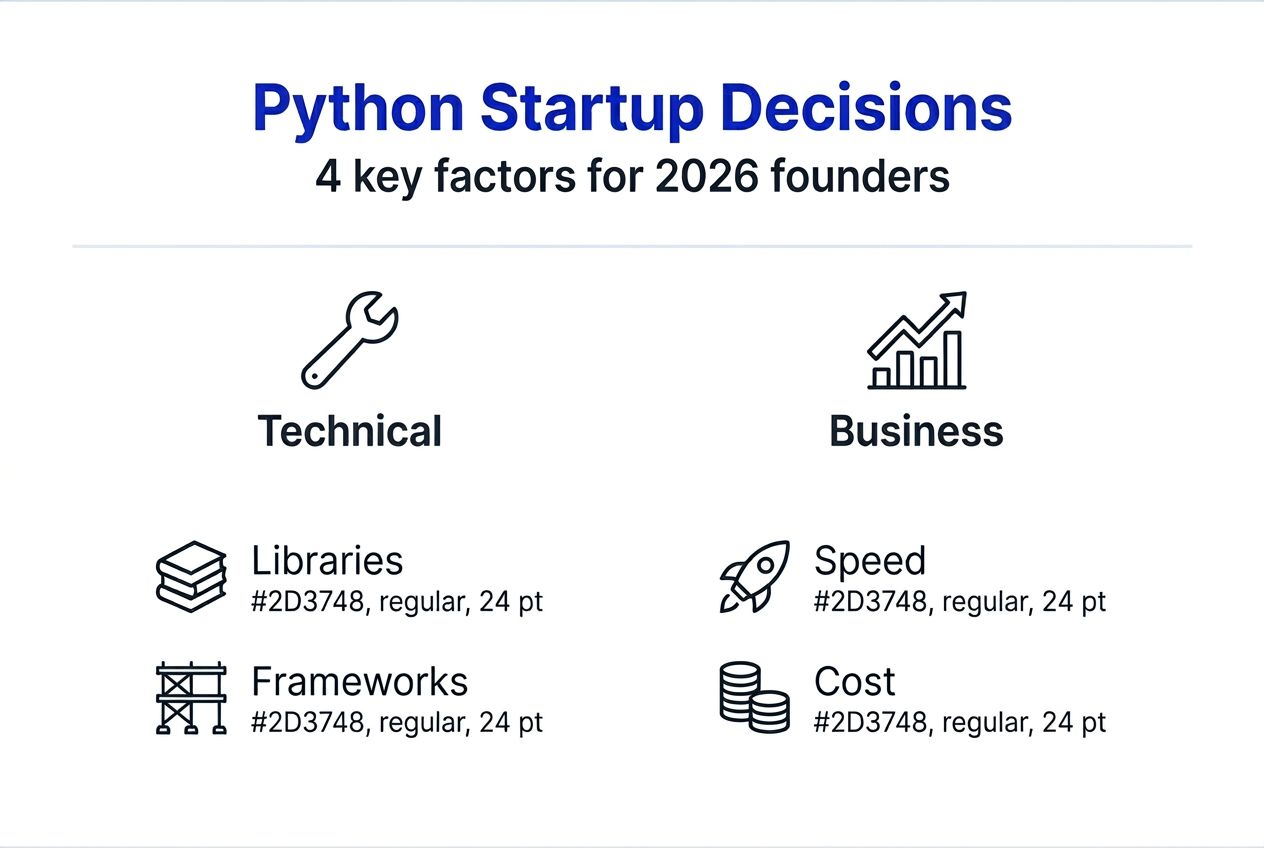
A practical framework helps founders and product managers make informed Python development decisions by integrating language capabilities, ecosystem strengths, team dynamics, and scalability considerations into one coherent model.
The framework balances four interdependent dimensions. Technical capabilities determine what your product can accomplish. Ecosystem support influences how quickly you can build features. Team composition affects execution quality and velocity. Architectural choices impact long-term scalability and maintenance costs.
| Decision Factor | Evaluation Criteria | Impact on Startup |
|---|---|---|
| Framework selection | Team experience, product complexity, timeline | Development speed, maintainability |
| Team structure | Internal vs augmented, senior vs junior mix | Quality, velocity, costs |
| Architecture pattern | Monolith vs microservices, sync vs async | Scalability, deployment complexity |
| Technology stack | Database, caching, hosting, monitoring | Performance, operational overhead |
Successful Python adoption follows a predictable progression. Initial MVP development prioritizes speed over optimization, using frameworks like Flask for rapid validation. Once product-market fit emerges, teams refactor toward scalable architectures with proper caching, database optimization, and monitoring. Mature products evolve into modular systems balancing maintainability with performance.
Common failure points emerge when startups skip critical framework considerations:
- Choosing complex architectures before validating product demand wastes resources
- Neglecting monitoring and observability creates blind spots during scaling challenges
- Under-investing in automated testing accumulates technical debt that slows future development
- Ignoring database optimization until performance problems emerge creates user experience issues
Real-world application of this framework guides specific decisions. A fintech startup building transaction processing might choose Django for built-in security features and regulatory compliance tools. A social platform optimizing for real-time interactions would select FastAPI for async performance. An AI-focused product would prioritize seamless integration with machine learning libraries.
The framework supports proactive planning rather than reactive problem-solving. Anticipating scalability needs before they become critical enables gradual, manageable improvements. Understanding team augmentation options before capacity constraints emerge prevents project delays. Evaluating framework tradeoffs during initial architecture decisions avoids costly rewrites later.
Decision criteria within the framework:
- Product complexity: Simple CRUD apps vs real-time platforms vs AI-heavy applications
- Team size and experience: Junior-heavy teams benefit from opinionated frameworks
- Timeline pressure: MVP urgency vs long-term product development
- Scalability requirements: Expected user growth and performance demands
- Budget constraints: Development costs vs infrastructure vs team augmentation
This integrated approach transforms Python development from a series of isolated technical decisions into a cohesive strategy aligned with business objectives. Founders gain confidence making technology choices that support both immediate needs and long-term growth.
How Meduzzen supports your Python development needs
Scaling your startup’s technical capabilities requires more than just hiring developers. You need experienced teams who understand modern Python software development patterns and can integrate seamlessly into your existing workflows without lengthy onboarding periods.
Meduzzen specializes in helping startups accelerate product development through strategic staff augmentation services with pre-vetted Python engineers. Our teams bring over 10 years of experience building scalable SaaS application development solutions across fintech, healthcare, and enterprise software.
We understand the challenges founders face when scaling engineering capacity. Our engineers integrate into your team within days, not months, bringing expertise in Django, Flask, FastAPI, and modern Python architectures. Whether you need dedicated team members or project-based specialists, we provide the flexibility to scale your development capacity while maintaining quality and velocity.
Frequently asked questions
What is Python development used for in startups?
Python development builds web backends, APIs, AI features, and data processing systems that power modern SaaS products. Startups use Python for rapid MVP development, then scale those same codebases into production systems serving millions of users. The language’s versatility enables teams to handle diverse technical requirements without switching languages.
Can Python handle high-traffic production environments?
Modern Python architectures using async frameworks like FastAPI handle millions of concurrent requests efficiently through non-blocking I/O operations. Companies like Instagram and Dropbox run Python at massive scale by implementing proper caching, database optimization, and horizontal scaling patterns. Performance bottlenecks typically occur at infrastructure layers rather than Python execution speed.
How does team augmentation work for Python projects?
Team augmentation provides pre-vetted Python engineers who integrate into your existing development team as dedicated or project-based resources. Engineers gain access to your codebase, communication channels, and workflows from day one, contributing to active sprints immediately. This model provides flexibility to scale capacity up or down based on project demands without long-term hiring commitments.
Should startups choose Django or Flask for new projects?
Django suits teams building feature-rich SaaS products who benefit from built-in authentication, admin interfaces, and ORM capabilities. Flask works better for MVPs, microservices, or teams preferring architectural control over convention. Your team’s experience level and product complexity matter more than framework features for most startup scenarios.
How does Python compare to other languages for AI development?
Python dominates AI and machine learning through its extensive ecosystem of libraries like TensorFlow, PyTorch, and scikit-learn. The language enables data scientists to prototype models that engineers deploy directly into production without translation. This continuity between research and production reduces typical AI development cycles by approximately 50% compared to languages requiring separate implementation phases.