


Swarm Navigation
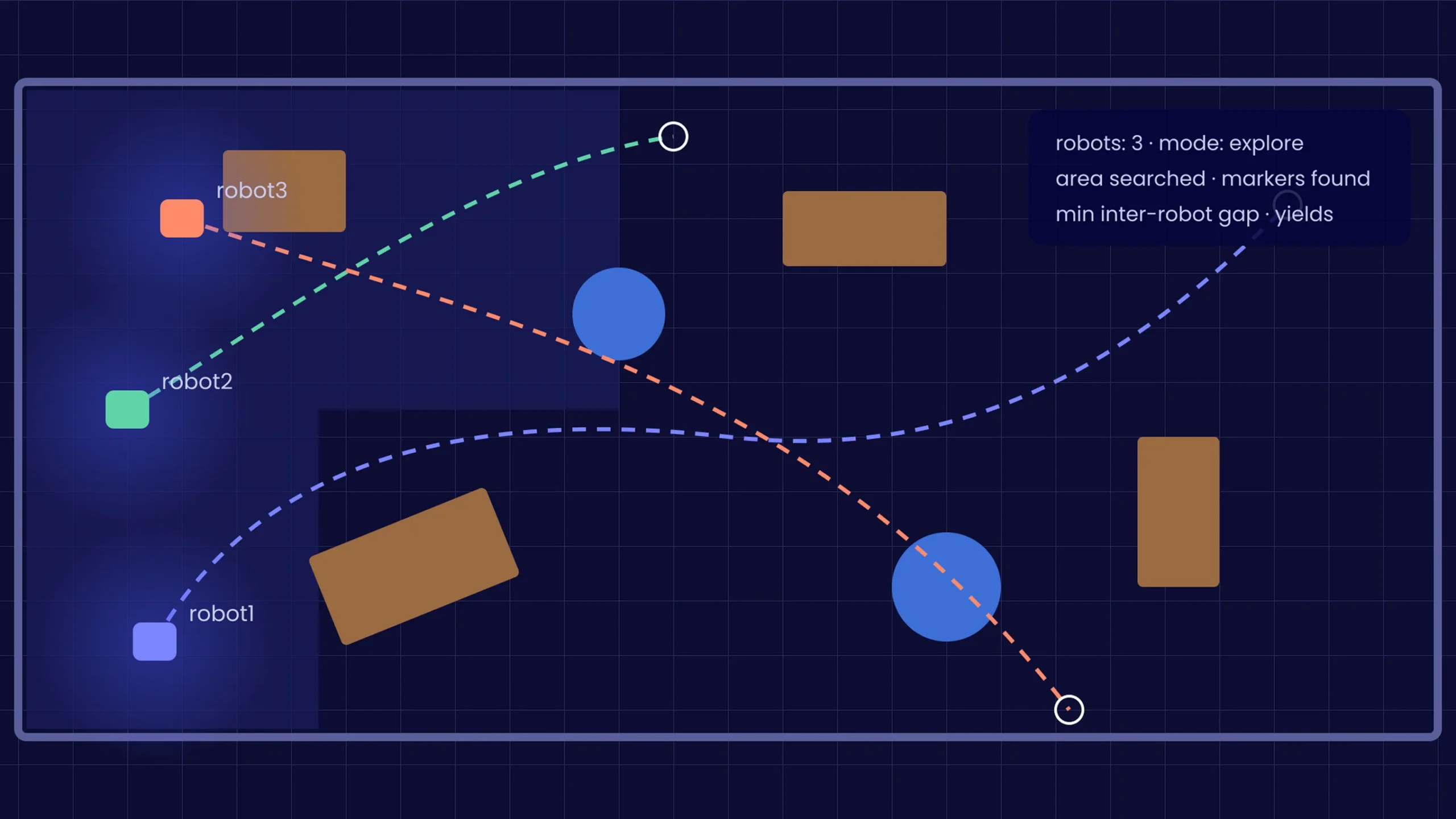
Illustrative UI
OUR Process
CONTEXT
Ground robots are moving from remote-controlled vehicles to autonomous teams. In defense, reconnaissance UGVs need to orient themselves in unknown terrain, travel from point A to point B and collect information without constant operator input. In facility automation, several cleaning robots in one building should divide the space instead of duplicating work and getting in each other's way.
Both cases share the same hard problem: not navigating one robot, but coordinating many. We built a proof of concept to show we can deliver that software layer.
Before | Single robot

One robot covers the whole area alone — slow, and a single point of failure.
After | Coordinated swarm

Robots share one map, split the zones and keep a safe distance from each other.
Project goals
The PoC had to let several ground robots localize in an unknown space, build a map, plan routes from A to B, divide tasks between them and avoid both obstacles and each other — all in a reproducible simulation that runs on regular developer laptops.
Most ground robot vendors build hardware first and treat autonomy as a single-vehicle feature. Coordinating several units — sharing a map, splitting an area, negotiating right of way — is usually missing or hard-wired to one platform. Testing it on real robots is also slow and expensive.
We built a hardware-agnostic ROS 2 software stack and validated it in Gazebo Harmonic. Each robot runs LiDAR-based SLAM and the Nav2 navigation stack in its own namespace; a coordination layer assigns goals and exploration zones, tracks the distance between robots and makes them yield to each other. Sensor parameters (LiDAR range, noise, robot size) are configurable, so the same code can be tuned for a recon UGV or an indoor cleaning robot.
KEY FEATURES
Autonomous localization and mapping with 2D LiDAR SLAM — robots orient themselves without GPS.
Point-to-point navigation with Nav2: route planning, obstacle avoidance and recovery behaviours.
Multi-robot coordination: shared exploration, zone assignment, distance control and yielding.
Hardware-agnostic and simulation-first: configurable robot models, no proprietary hardware needed.
RESULTS
The proof of concept runs 3 autonomous robots in parallel: they map the arena, explore it together, detect target markers and reach their goals while keeping a safe distance from each other. 3 robots are coordinated in one scene, with live area coverage tracking and live monitoring of the min inter-robot gap & yields. Every run reports live metrics, so behaviour can be compared between algorithm versions — with 0 own hardware required.