


Supervisor Agent
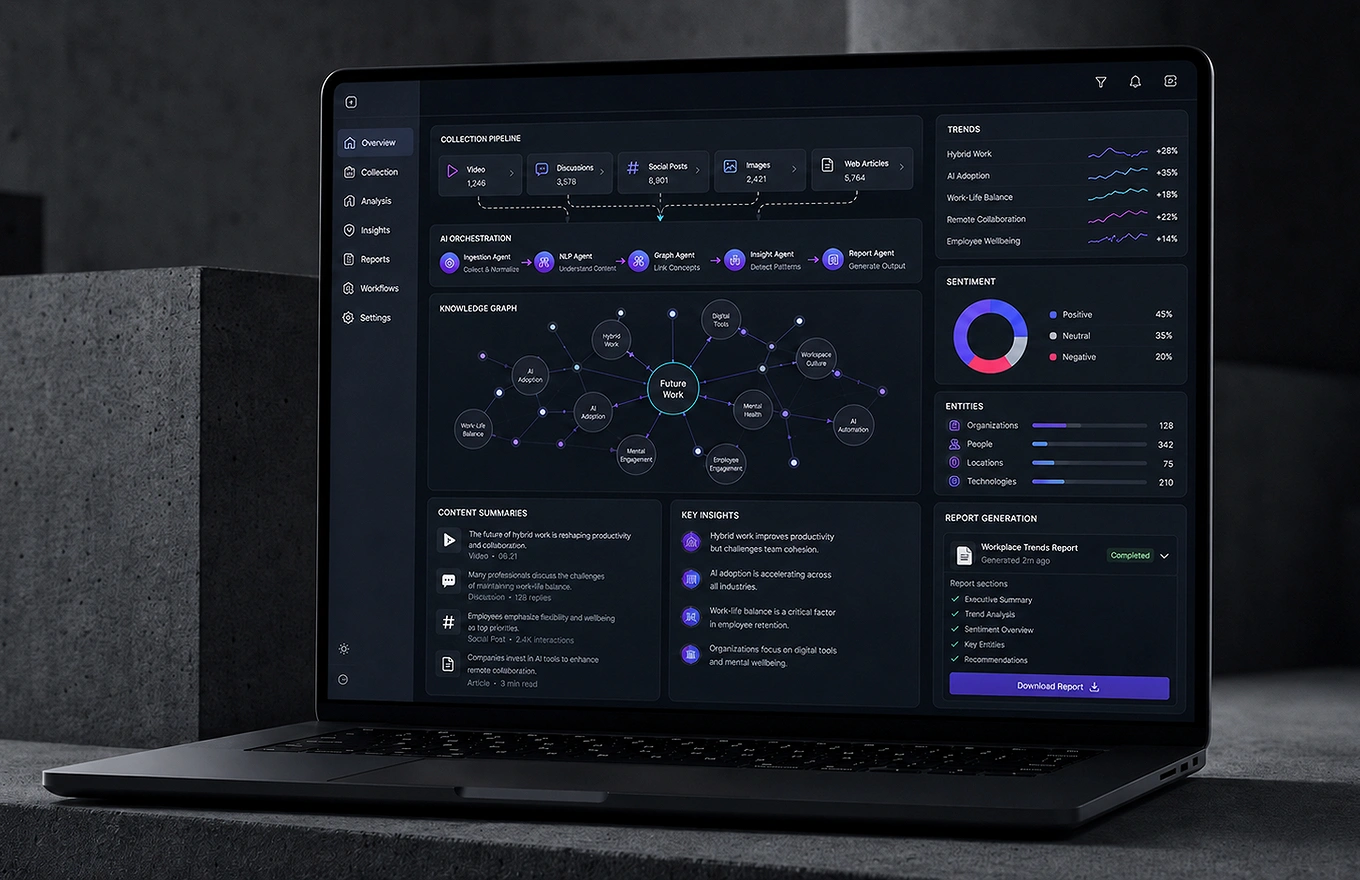
Illustrative only — actual UI under NDA
OUR PROCESS
CHALLENGE
Traditional AI agents handle simple requests well — "Find information about X" — but most real-world tasks require multiple actions and decisions: finding information, comparing options, applying business rules, generating a report, and delivering a recommendation. A single-step agent has no way to decide which tools to use, when to use them, or how to combine the results. The challenge: how do you enable an AI agent to solve a complex, multi-step task from one user request?
AI-Powered Task Planning | Illustrative only — actual UI under NDA

Dynamic Tool Orchestration | Illustrative only — actual UI under NDA

Project goals
Build an orchestration pattern that lets an AI agent understand a complex goal, decide which tools or agents it needs, execute and evaluate actions iteratively, and deliver a complete result — instead of stopping
after a single action.
A single-step agent can retrieve information, but it can’t reliably chain that into a full workflow — comparing options, applying rules, and producing a final report all require decisions a basic agent isn’t built to make. Without a mechanism to plan and sequence its own actions, it’s limited to answering one narrow request at a time.
We built a Supervisor Agent — a central controller that understands the user’s goal, decides which tools or agents are required, executes actions iteratively, evaluates intermediate results, and continues until the task is actually complete. Instead of a fixed sequence, the Supervisor makes that decision dynamically for every request.

KEY FEATURES
Dynamic tool selection that adapts to what each request actually needs
Iterative execution that evaluates results after every step
Complex, multi-step workflows completed from a single user prompt
Domain-agnostic architecture that scales across industries without rebuilding
RESULTS
The Supervisor Agent turns AI from a simple response generator into a system that plans, executes, and coordinates complex workflows on its own. Instead of stopping after one action, it reliably completes multi-step tasks — search, compare, report — from a single request, and the same architecture scales across different business domains without being rebuilt for each one.