


People Detection
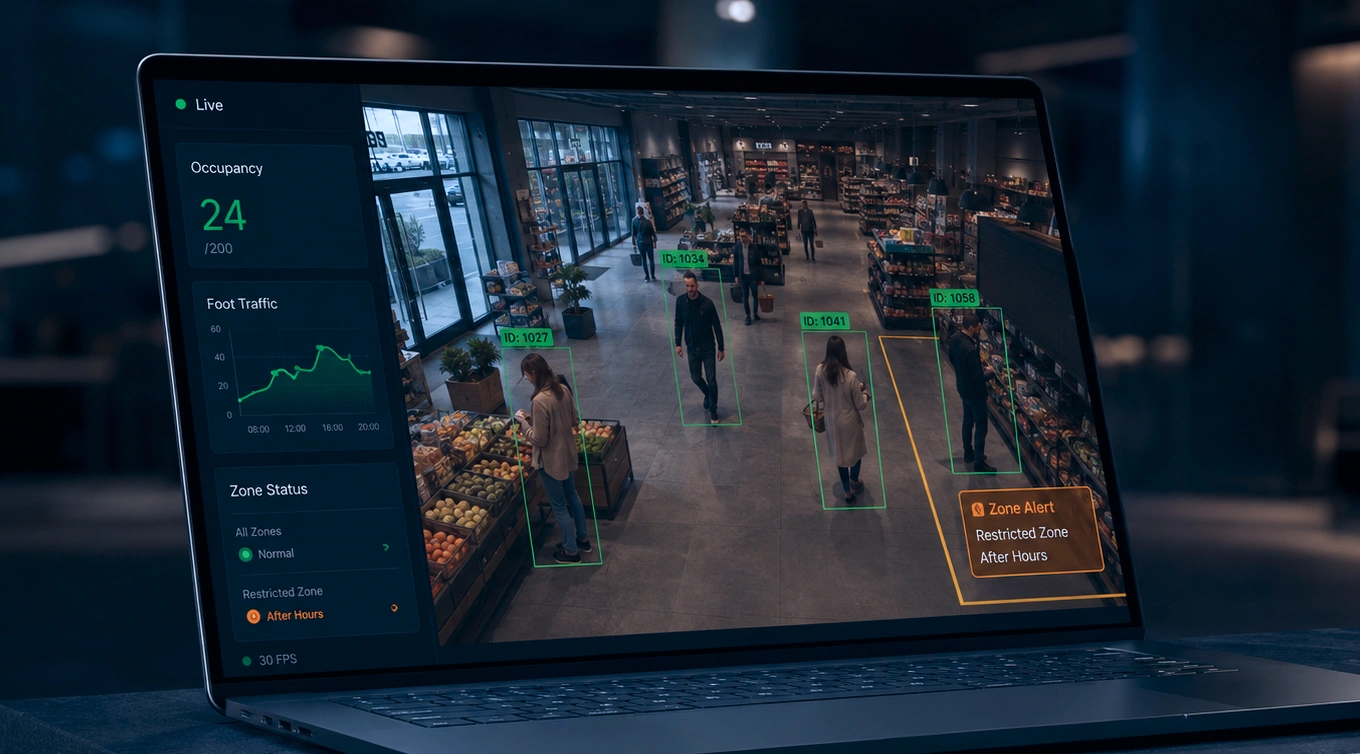
Illustrative UI
OUR PROCESS
Client
European retail chain operates 40+ grocery and homeware stores across three countries. Every location already runs CCTV for loss prevention, but the footage was only ever reviewed after an incident — traffic patterns, staffing needs, and after-hours access were effectively invisible. European retail chain wanted that existing camera investment to start producing usable, real-time data.
Before | Raw stream
Footage exists, but nobody is watching it live.
After | AI detection on
Every person detected, tracked and counted in real time.
Project goals
Turn 40+ idle camera feeds into a live signal client could actually act on.
The engine needed to run on the cameras already installed in every store, hold real-time speed without new hardware, and turn raw video into occupancy counts, zone alerts and after-hours intrusion events — without asking store managers to watch a single extra screen.
CCTV footage was reviewed only after something went wrong. There was no way to know current occupancy, no alerts on after-hours entry, and no data connecting foot traffic to staffing or layout decisions. Existing NVR software could record video but couldn’t interpret it.
A YOLO-based detection layer was deployed directly against each store’s existing RTSP streams, running on a small on-site box per location. It tracks every person in frame, publishes live occupancy and zone events over a simple API, and fires instant alerts the moment someone enters a restricted area after closing.

KEY FEATURES
Real-time detection and tracking at 30+ FPS per stream, holding accuracy above 95% across varied store lighting.
Zone-based rules for occupancy limits, restricted areas and after-hours intrusion, each with configurable instant alerts.
No new hardware: the engine runs against each store's existing RTSP/ONVIF cameras and NVR, deployed as a small on-site container.
Structured events exposed over REST and WebSocket APIs, ready to feed a dashboard, a BI tool, or Cient's existing systems.
RESULTS
In an early pilot across three stores, the engine ran stably on existing camera hardware and gave Nordholm its first live view of foot traffic and after-hours activity — replacing a fully manual, after-the-fact review process. Store teams could see current occupancy and zone alerts as they happened instead of finding out the next morning.