


In this article
Python engineers drive startup growth: speed and scale
Business & Strategy
Apr 3, 2026
11 min read
Learn how Python engineers and staff augmentation drive startup growth, cut costs by 25%, and accelerate development timelines by up to 40%.

Most founders treat engineering as a cost center. They pour energy into product vision, go-to-market strategy, and fundraising, then wonder why their growth stalls at the execution layer. The truth is harder to sit with: your engineers are not just building features, they are building the velocity of your entire business. Python powers 60%+ of new startup stacks and reduces development time by 40%, which means the language your team codes in and the people writing that code are direct inputs to your growth rate. This guide breaks down why Python engineers and smart augmentation strategies are among the highest-leverage decisions a founder or CTO can make.
Key Takeaways
| Point | Details |
|---|---|
| Python powers rapid growth | Skilled Python engineers help startups build and scale products 40% faster and at lower cost. |
| Staff augmentation boosts flexibility | Augmenting with Python engineers gives you 25-30% faster development and 25% lower costs. |
| Right methodology drives outcomes | Use agile, DevOps, and revenue-aligned metrics to let engineering teams create measurable business impact. |
| Versatility over specialization | Generalist Python engineers combined with augmentation help startups grow efficiently in uncertain markets. |
Why software engineers are a startup’s growth engine
Every business idea eventually hits the same wall: someone has to build it. Not plan it, not pitch it, not design a slide deck about it. Build it. And the speed at which that happens determines whether you capture a market window or watch a competitor do it first.
Software engineers are the ones who enable rapid iteration from MVP to scaling production systems. That sentence sounds obvious until you watch a startup lose six months because their engineering team was under-resourced, misaligned, or simply not skilled enough for the problem at hand. Time is the one thing you cannot buy back.
Engineering shapes more than just the product. It shapes user experience, system stability, and the pace at which your team can respond to market signals. A slow deployment cycle means slow learning. Slow learning means slow growth. In the SaaS and AI era, the companies that win are the ones that can ship, measure, and adapt faster than anyone else.
Here is what high-performing engineering teams actually do for a startup:
- Turn ambiguous product requirements into working, testable software quickly
- Maintain system reliability so growth does not break the product
- Build scalable architecture that does not need to be rebuilt every funding round
- Reduce technical debt so future features cost less to ship
- Integrate AI and data capabilities that create defensible product advantages
“The best engineering teams do not just write code. They compress time. Every sprint is a bet on your growth trajectory.”
Python has become the language of choice for startups that want to move fast without sacrificing quality. The advantages Python brings to startups are well documented: readable syntax, an enormous library ecosystem, and strong community support for AI, data science, and backend development. When you need to accelerate with Python web development, you are choosing a tool that compounds your team’s output over time.
The impact of Python engineers: Speed, cost, and versatility
Python is not just popular. It is strategically advantageous. The language reduces development time by 40% versus other languages and lowers hiring costs by approximately 20% compared to Java developers. For a startup operating with constrained capital and aggressive timelines, that gap matters enormously.

Consider what a 40% reduction in development time means in practice. A feature that would take ten weeks in another language takes six in Python. Multiply that across a year of product development and you have months of additional runway, more iterations, and a faster path to product-market fit.
| Metric | Python teams | Java/C++ teams |
|---|---|---|
| Avg. development speed | 40% faster | Baseline |
| Hiring cost differential | ~20% lower | Baseline |
| AI/ML integration ease | Native (TensorFlow, PyTorch) | Requires additional tooling |
| MVP-to-production cycle | 6 to 10 weeks | 10 to 18 weeks |
| Library ecosystem for SaaS | Extensive (Django, FastAPI) | Moderate |
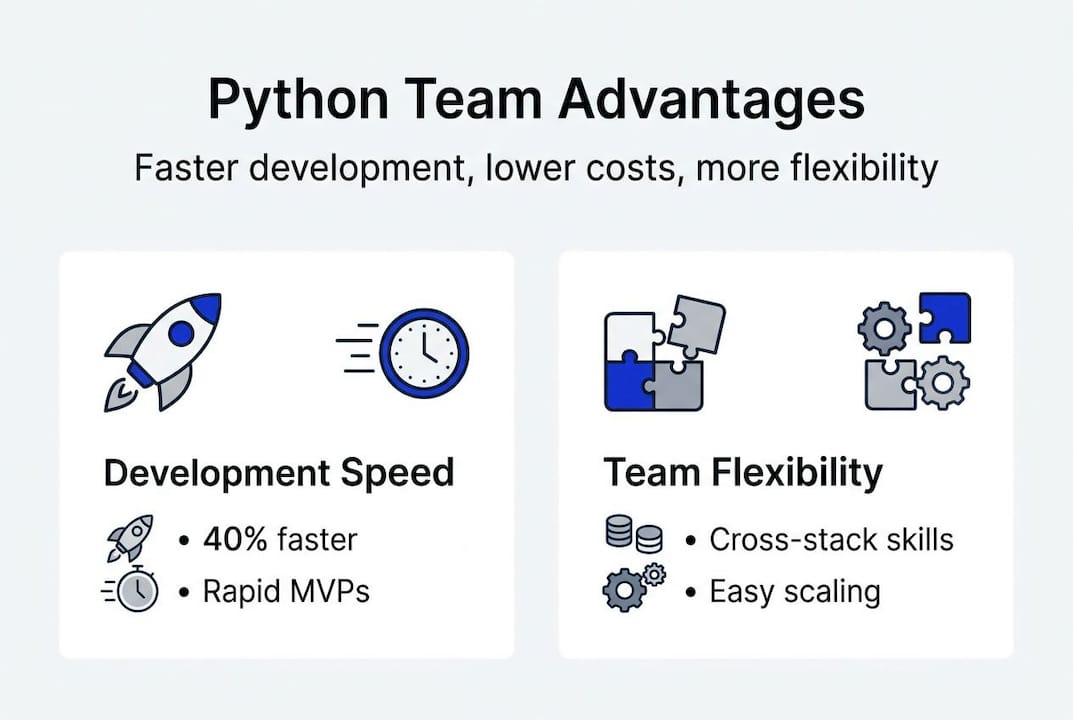
Python engineers who work across backend, data pipelines, and AI integrations give startups a rare kind of flexibility. You are not hiring a specialist for one narrow task. You are hiring someone who can move with your product as it evolves. That versatility is especially valuable in the early and mid-growth stages, when the roadmap changes faster than any org chart can keep up with.
For SaaS founders specifically, Python’s scalability and efficiency in 2026 make it the practical choice for building multi-tenant platforms, API-first architectures, and AI-powered features. The cost breakdown for Python engineers also shows that offshore and nearshore Python talent delivers strong output at rates that keep burn manageable.
The engineers who deliver the most ROI are not necessarily the most specialized. They are the ones who take ownership of outcomes, not just tasks.
Pro Tip: When you hire Python developers, prioritize engineers who have shipped production systems end-to-end, not just those who can pass algorithm tests. Ownership-driven engineers compound your team’s output in ways that narrow specialists rarely do.
Staff augmentation strategies for fast, flexible growth
Knowing the value of Python talent is one thing. Deploying it efficiently is another. Most startups under 50 full-time employees cannot afford the time or cost of traditional hiring for every engineering need. The average time-to-hire for a senior engineer in the US or Europe runs 60 to 90 days. In a growth sprint, that is an eternity.
Staff augmentation solves this by giving you access to pre-vetted Python developers for hire on a timeline that matches your business rhythm, not a recruiter’s calendar. Staff augmentation can yield a 25 to 30% velocity increase and a 25% reduction in operational costs compared to equivalent full-time hiring.
| Factor | Staff augmentation | Direct full-time hire |
|---|---|---|
| Time to onboard | 1 to 2 weeks | 60 to 90 days |
| Cost flexibility | Scale up or down | Fixed salary + benefits |
| Skill specificity | Match to project need | Generalist or specialist |
| Risk | Lower (contract-based) | Higher (severance, equity) |
| Best for | Sprints, MVPs, skill gaps | Core long-term ownership |
Here is a practical process for integrating augmented Python engineers into your existing team:
- Define the specific skill gap or workload spike you are addressing before you search
- Source pre-vetted Python developers for hire through a specialized partner, not a general job board
- Run a structured two-day technical onboarding that covers your codebase, architecture decisions, and team norms
- Assign a dedicated internal point of contact so the augmented engineer has a clear escalation path
- Set sprint-level goals with clear acceptance criteria so output is measurable from week one
- Review fit and output at the 30-day mark and adjust scope or team composition accordingly
Pro Tip: Use staff augmentation for skill gaps and workload spikes. Do not use it as a workaround for a broken hiring process. If you find yourself permanently augmenting the same role, it is time to hire a a Python developer full-time for that function.
For teams exploring Python software development models, the hybrid approach, where a small core team owns architecture and a flexible augmented layer handles feature velocity, tends to outperform both fully in-house and fully outsourced models.
Key engineering methodologies: Metrics and team practices for actual business growth
Building the right team model only works when it runs on the right practices. High-growth engineering teams do not just ship fast. They ship with intention, measure what matters, and build systems that get better over time.
The most effective teams connect engineering output directly to revenue. Not just “we shipped 12 features this quarter” but “those features reduced churn by 8% and contributed $200K in ARR.” That framing changes how engineers prioritize and how founders evaluate progress.
Benchmarks for high-growth SaaS teams show that healthy engineering organizations at the 20 to 50 employee stage maintain cycle times between 24 and 72 hours, deploy 3 to 10 times per week, and generate approximately $129K in ARR per engineer. If your numbers are significantly below these, the bottleneck is usually process, not people.
Practices that separate high-performing teams from average ones:
- Agile with real retrospectives: Not just standups, but honest reviews of what slowed the team and why
- CI/CD pipelines: Continuous integration and continuous delivery reduce deployment risk and accelerate feedback loops
- Revenue-linked sprint planning: Each sprint should connect to a measurable business outcome, not just a feature list
- Technical debt budgets: Allocate 15 to 20% of sprint capacity to debt reduction so it does not compound into a crisis
- Cross-functional pods: Pair engineers with product and data colleagues so decisions happen faster and with better context
“Cycle time is the heartbeat of your engineering org. If it is slow, everything downstream is slow: feedback, learning, growth.”
Retention matters too. Engineers who understand the business context of their work stay longer and contribute more. Career ladders, clear ownership, and secure development practices that reduce firefighting all contribute to an environment where good engineers want to stay. The scaling engineering checklist for 2026 covers the structural decisions that make this possible as your team grows.
A founder’s perspective: What most miss about engineers, Python, and real growth leverage
Here is something we see repeatedly across startups in Europe and the US: founders over-invest in permanent hires too early, then scramble when the roadmap shifts. They hire five senior engineers for a phase that needs three, then face painful conversations when priorities change. Permanence feels like commitment. But under 50 employees, it is often just rigidity.
The startups that scale fastest treat their engineering capacity like a living system. They maintain a small, high-trust core team that owns architecture and product direction. Then they bring in versatile, ownership-driven Python engineers through augmentation for specific sprints, new feature domains, or AI capability builds. The compounding effect is real: each augmented sprint adds capability without adding permanent overhead.
Staffing up with narrow specialists too soon is another common mistake. A team of five specialists with no overlap creates bottlenecks the moment one person is unavailable. Python’s versatility makes it easier to hire engineers who can move across backend, data, and API layers, which keeps the team resilient.
Knowing when to shift from augmentation to full-time hiring is the real skill. When a function becomes central to your product’s core loop, that is the signal to hire a Python developer permanently. Until then, flexibility is your competitive advantage. You can learn more about evaluating Python engineers before making that call.
Ready to accelerate with Python experts and flexible team models?
If this guide has shifted how you think about engineering as a growth lever, the next step is straightforward: find the right partners to put it into practice.
At Meduzzen, we help startups and growing businesses across Europe and the US scale with pre-vetted Python engineers who integrate fast, communicate clearly, and deliver predictably. Whether you need dedicated Python development services, a flexible staff augmentation solution for a specific sprint, or end-to-end web development services, we have the team and the track record to support your growth. Let’s build something that compounds.
Frequently asked questions
How do Python engineers reduce time to market for startups?
Python’s frameworks and libraries let engineers build prototypes and scale them faster, cutting development time by 40% compared to most other languages, which means faster feedback and shorter release cycles.
What’s the biggest advantage of staff augmentation for scaling tech teams?
It increases development velocity by 25 to 30% and reduces operational costs by 25%, letting you adapt team capacity to business needs without the delays and fixed costs of full-time hiring.
What engineering KPIs matter most for high-growth SaaS startups?
Focus on cycle time under 72 hours, ARR per engineer at $129K or above, and deployment frequency of 3 to 10 times per week as your core benchmarks.
When should we choose staff augmentation vs. hiring full-time engineers?
Use augmentation for rapid skill needs, workload spikes, or MVPs, and hire full-time when ongoing core product ownership is required. The decision point is usually when a function becomes central to your product’s long-term roadmap.