


In this article
How to Evaluate Python Developers in 2026: A Practical Technical Framework
Business & Strategy
Mar 25, 2026
13 min read
Hiring Python developers in 2026 is no longer about resumes or interviews. This guide gives you a practical evaluation framework to identify production-ready engineers, avoid costly hiring mistakes, and build scalable systems with confidence.

Hiring Python developers in 2026 looks easier than ever.
There are more engineers, more platforms, and more hiring options than before. On the surface, the market appears full. Companies can search on freelance marketplaces, talent networks, agencies, job boards, and staff augmentation providers, all at once.
But the reality is much harsher.
Many teams still hire quickly and deliver slowly. They fill the role, but not the capability gap. They bring in someone who can write code, yet struggle to ship stable systems, support growth, or handle real production complexity. The result is familiar: delays, rewrites, hidden costs, and another hiring cycle a few months later.
That is the real Python talent paradox.
The problem is not access to developers.
The problem is identifying the right developers.
Python remains one of the most important languages in software, data, and AI. According to Python.org, the language continues to power a wide range of applications, from backend systems to data science and machine learning. At the same time, GitHub’s Octoverse report shows that Python has overtaken JavaScript as the most used language on GitHub, largely driven by AI-related growth. That sounds like good news for hiring. In practice, it makes the market noisier.
There are more Python developers than ever, but not more engineers who can reliably build production-ready systems.
This guide explains how to hire Python developers the right way in 2026. It covers what skills actually matter, how hiring models compare, what real costs look like, and how to reduce hiring risk before it becomes technical debt.
Python became the default language for startups, AI products, automation tools, and scalable backend systems because it is versatile, fast to develop with, and supported by a massive ecosystem. That same versatility is exactly why hiring became more difficult.
A Python developer can mean a backend engineer, a data engineer, an AI engineer, a DevOps-aware product builder, or someone who learned a framework and copied a few tutorials.
Those are not the same hires.
They do not create the same outcomes.
And they should not be evaluated the same way.
If you are planning to hire Python developers in 2026, you need more than a job description and a few interviews. You need a hiring strategy that filters for production readiness, communication, system thinking, and fit for your actual business model.
Why Hiring Python Developers Became a Bottleneck
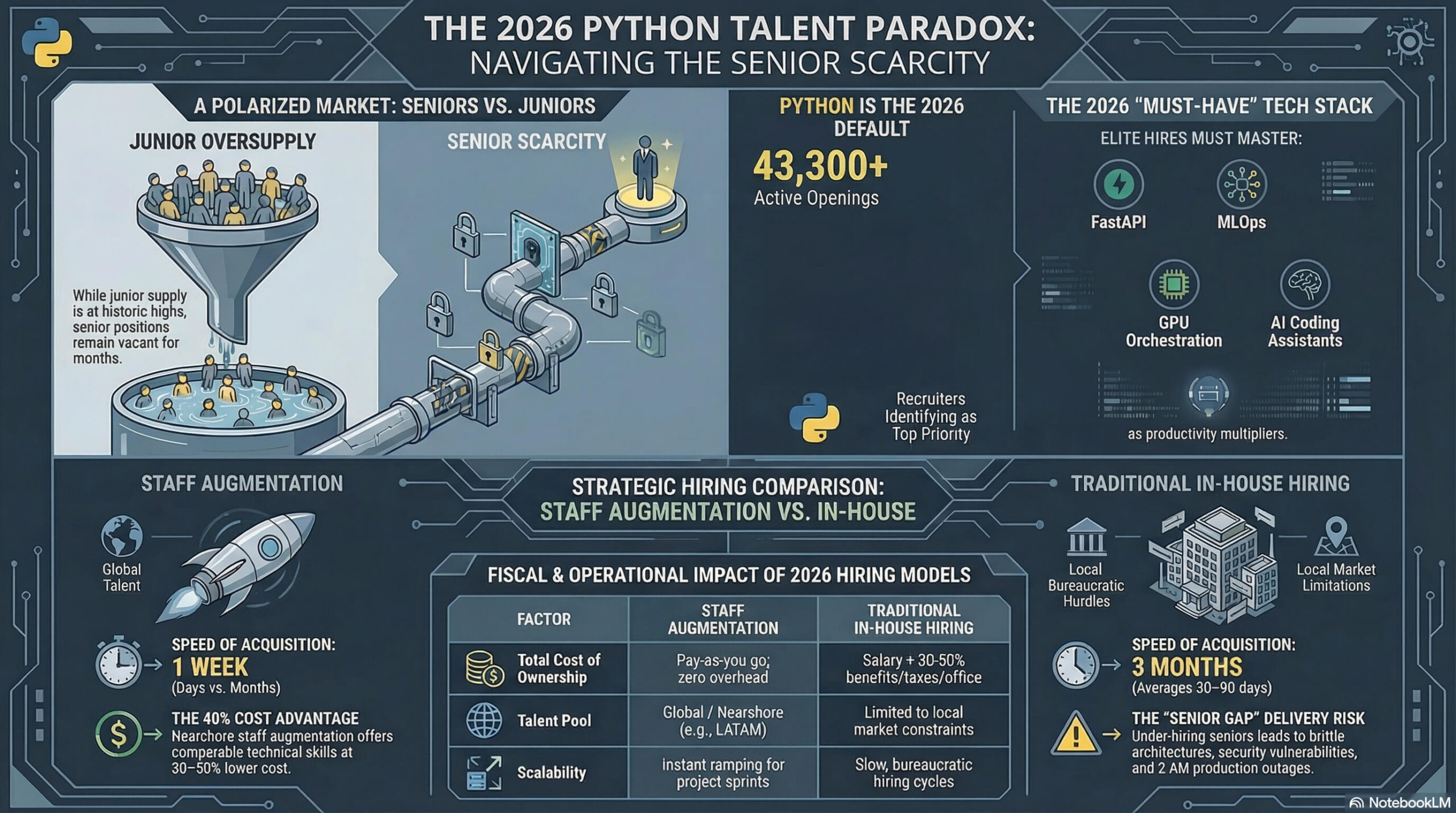
The market is not short on developers. It is short on developers who can handle complexity.
That distinction matters because most companies are not hiring for toy projects. They are hiring for products that need to launch, scale, integrate, and stay stable under pressure. They need developers who understand architecture, performance, observability, reliability, and delivery speed, not just syntax.
That is where the bottleneck appears.
The most common hiring failure today is assuming that Python knowledge equals product readiness. It does not. A developer can know Django or FastAPI and still make decisions that create brittle systems, poor query performance, weak API boundaries, and hard-to-maintain code.
This is why the senior gap matters more than the overall talent pool.
According to the U.S. Bureau of Labor Statistics, employment for software developers, QA analysts, and testers is projected to grow 15% from 2024 to 2034, with strong demand driven by AI, IoT, robotics, and automation. Demand is rising. But the strongest pressure is not on junior roles. It is on engineers who can work with real production systems and translate technical trade-offs into product outcomes.
That is why hiring Python developers became a bottleneck even while supply increased.
You are not competing for “people who know Python”. You are competing for engineers who can prevent outages, reduce rework, and make sound decisions when requirements are incomplete.
This is also why companies that hire based only on cost or speed usually lose twice. First, they lose time during delivery. Then they lose money during replacement, cleanup, and missed opportunities.
Define Your Real Hiring Need First
Most bad hires happen before the first interview.
They happen when the company has not clearly defined what kind of developer it actually needs.
Before you hire Python developers, you need clarity on three things: the type of product, the level of system complexity, and the level of ownership required.
Product type changes the profile you need
If you are building a SaaS application, you need someone who understands APIs, authentication, multitenancy, scalability, and long-term maintainability.
If you are building AI features or workflow automation, you likely need someone closer to artificial intelligence services or data-heavy integrations, with experience in pipelines, embeddings, inference, and evaluation.
If you are expanding existing digital products or internal tools, you may be closer to web development or dashboard development, where delivery speed and product integration matter more than deep AI specialization.
One of the most expensive hiring mistakes is using a generic Python job description for all of these cases.
Complexity determines seniority
A prototype with a narrow scope can often be handled by a solid mid-level engineer under strong guidance.
A product that needs to scale, integrate with third-party systems, or handle sensitive user actions cannot.
That kind of environment requires:
- better architectural judgment
- stronger debugging skills
- clearer communication
- more ownership under uncertainty
If your product must grow, “good enough for now” usually becomes expensive later.
Ownership determines the hiring model
Do you need someone to complete tasks, or someone to own outcomes?
Those are different hires.
If you only need narrow execution for a short list of defined tasks, freelance capacity may work. If you need delivery continuity, accountability, and fast scaling, a structured model like staff augmentation or a dedicated product team is often a better fit.
The clearer your need, the easier it becomes to filter noise.
What Does a Python Developer Actually Do in 2026?
A Python developer in 2026 is rarely just “a coder”.
In serious products, they are responsible for part of the system’s stability, not just feature delivery.
That can include:
- backend architecture
- API design
- performance optimization
- database modeling
- integrations with external services
- cloud deployment support
- data processing
- automation logic
- AI pipeline integration
The stronger the developer, the more they think in systems.
That is why technical capability should not be reduced to frameworks. Yes, experience with Python technology and ecosystem matters. But real value comes from how developers reason about load, failure, maintainability, and trade-offs.
The gap between “can build endpoints” and “can build reliable systems” is where most hiring errors happen.
Key Skills That Actually Matter
Many hiring teams still evaluate Python developers with outdated filters:
- years of experience
- list of frameworks
- generic coding interviews
- buzzwords on LinkedIn profiles
That approach is weak because it measures familiarity, not production capability.
Core technical skills still matter
A strong Python developer should be comfortable with:
- Django, FastAPI, or Flask
- API design and integration patterns
- SQL and data modeling
- background jobs and async workflows
- testing and debugging
- Git-based collaboration
These are expected, not differentiators.
System thinking is the real filter
What separates strong candidates is how they think about:
- data flow
- system boundaries
- failure scenarios
- performance bottlenecks
- scaling patterns
- observability
A candidate who can explain how they would redesign a slow endpoint, partition responsibilities across services, or debug a production incident is usually much more valuable than one who simply names frameworks confidently.
Communication is part of technical quality
This is heavily underestimated.
A developer who cannot explain trade-offs clearly will slow down product teams, confuse priorities, and make reviews harder. Communication is not a “soft bonus”. It is part of execution speed.
This is especially important if you plan to hire remote Python developers or expand a distributed team.
According to the Stack Overflow Developer Survey, developers increasingly work with AI tools, documentation-heavy workflows, and collaborative systems. The ability to reason, explain, and review generated or complex code is becoming more important, not less.
Where Companies Fail When Hiring Python Developers
The biggest mistakes are boring because they are so repeatable.
Hiring based on hourly rate
This is the classic trap.
A cheap developer is not a low-cost developer if they:
- need constant supervision
- introduce fragile logic
- slow down releases
- create future rewrite costs
The real cost of hiring Python developers includes time-to-productivity, quality of decisions, and the price of cleanup.
Overvaluing years over outcomes
Some engineers with five years of repetitive maintenance experience are still weaker than others with three years of strong product delivery.
The right question is not “How many years?”
It is “What kind of systems have they successfully worked on?”
Weak validation
Most interviews are still too theoretical.
They test:
- syntax
- trivia
- LeetCode-style pattern memory
But they do not test:
- debugging messy code
- making system trade-offs
- handling incomplete requirements
- thinking through performance problems
That is why companies often feel confident after interviews and disappointed after onboarding.
Choosing the wrong hiring model
Many companies treat the channel as the strategy. They ask whether to use Upwork, Toptal, Arc, or local hiring, instead of deciding what operating model fits their product, pace, and budget.
That is backward.
The platform matters less than the structure behind the hire.
Hiring Models Explained
The best hiring model depends on what you are optimizing for: speed, control, cost, or scalability.
Freelance hiring
Freelancers can work well for small, isolated, clearly defined tasks.
Pros:
- fast start
- flexible scope
- lower upfront commitment
Cons:
- inconsistent availability
- weak ownership
- variable quality
- higher coordination risk
Good fit:
- one-off technical tasks
- prototypes with low business risk
In-house hiring
In-house teams give you the strongest long-term control.
Pros:
- deeper product context
- stronger internal continuity
- better cultural integration
Cons:
- slow time to hire
- salary plus overhead
- smaller local talent pool
- slow scaling
Good fit:
- long-term internal product organizations
Staff augmentation
This model sits between flexibility and stability.
Pros:
- faster onboarding than in-house
- access to broader talent pool
- more control than agency delivery
- easier scaling up or down
Cons:
- requires clear team processes
- still depends on the quality of the provider
Good fit:
- product teams that need to grow quickly without rebuilding hiring infrastructure
If your goal is to expand capacity fast while keeping product ownership, staff augmentation is often the most balanced option.
Comparison table
| Factor | Freelance | In-House Hiring | Staff Augmentation |
|---|---|---|---|
| Time to hire | 1–7 days | 4–12 weeks or more | 1–2 weeks |
| Upfront commitment | Low | High | Medium |
| Talent pool | Global | Mostly local/regional | Global/nearshore |
| Reliability | Variable | High | High |
| Scalability | Low | Slow | High |
| Management overhead | Medium | High | Medium |
The right choice is not universal. It depends on whether you need speed, continuity, and low-risk expansion.
How Long It Actually Takes to Hire
A lot of marketing around developer hiring is misleading because it confuses “time to shortlist” with “time to productivity”.
Those are not the same thing.
A provider can show you candidates in 48 hours. That does not mean your team is effectively shipping value in 48 hours.
Real hiring time includes:
- requirement clarity
- sourcing
- evaluation
- offer or contract
- onboarding
- context transfer
- productive ramp
As a rough benchmark:
- freelance sourcing may take 1–7 days
- staff augmentation usually takes 1–2 weeks to productive integration
- in-house hiring often takes 30–90 days before real output appears
The more ambiguous your process is, the longer everything takes.
If you want to shorten time-to-hire, the biggest lever is not speed in sourcing. It is clarity in decision-making.
That is one reason content like your developer onboarding guide for startup founders and CTOs is relevant to this ecosystem. Hiring is only the beginning. What happens after the hire affects whether the decision pays off.
Cost of Hiring Python Developers
The price discussion is where most teams become overly simplistic.
Python developer cost varies by:
- region
- seniority
- specialization
- hiring model
- business criticality of the project
Typical market ranges in 2026 often look like this:
- US-based senior developers: $80–150/hour
- Western Europe: $60–120/hour
- Eastern Europe: $35–80/hour
- LATAM: $35–70/hour
But hourly rate alone is not decision-quality data.
Hidden costs matter more than visible rates
You also pay for:
- hiring time
- onboarding friction
- communication overhead
- delays caused by weak ownership
- code cleanup
- release risk
A lower hourly rate can still produce a higher total cost of ownership.
That is why many teams moving from fragmented freelance setups to structured partners eventually focus on cost-efficiency, not cheapest cost.
This is the same logic behind pieces like why product development services matter for startup speed and what is end-to-end development. If your delivery model adds friction, the lowest day rate will not save you.
How to Reduce Hiring Risk
Hiring risk is not eliminated by luck. It is reduced by design.
Validate against real work
Use practical evaluation:
- debug a broken service
- improve a slow query
- review a flawed architecture
- discuss trade-offs on a real scenario
This reveals much more than generic interview questions.
Start with bounded scope
Before scaling a team, validate:
- responsiveness
- communication quality
- code review standards
- ability to work within your workflow
A small initial scope gives you clearer evidence than a long interview process.
Use pre-vetted structures when speed matters
If you need to scale quickly, pre-vetted developers reduce screening time and uncertainty. That does not remove the need for evaluation, but it improves the starting point.
Hire for outcomes, not only tasks
The strongest developers help you:
- reduce delays
- improve system stability
- make better architecture decisions
- move faster with fewer rewrites
That is the real ROI.
Step-by-Step Framework for Evaluating Python Developers
Most companies fail not because they cannot find developers, but because they do not evaluate them correctly.
A strong evaluation process should simulate real production challenges, not theoretical knowledge.
The goal is simple: identify developers who can build, debug, and improve real systems.
Step 1: Validate Core Technical Foundations
Start with fundamentals, but do not over-index on them.
You should confirm:
- Python syntax and best practices
- API development and backend logic
- database interaction and data modeling
These are baseline requirements, not differentiators.
A candidate who struggles here is not ready.
A candidate who excels only here is still not enough.
Step 2: Test Real-World Problem Solving
This is the most important filter.
Instead of abstract questions, use tasks like:
- debug a broken API endpoint
- optimize a slow database query
- design a simple service under constraints
This reveals how the developer thinks under real conditions.
If a developer cannot solve practical problems, they cannot build production systems.
Step 3: Evaluate System Design Thinking
For mid-level and senior roles, system thinking is critical.
You should assess how they:
- structure services and responsibilities
- handle scaling and performance
- design APIs and data flow
- think about failure and edge cases
Ask questions like:
“What happens if this service gets 10x traffic tomorrow?”
The answer matters more than syntax.
Step 4: Review Code Quality and Maintainability
Look beyond “working code”.
Focus on:
- readability and structure
- testing approach
- error handling
- consistency
Clean code reduces long-term cost more than fast code.
Step 5: Assess Communication and Decision-Making
Strong developers explain trade-offs clearly.
They can justify:
- why they chose one approach over another
- what risks exist
- what they would improve later
This directly affects team speed and product quality.
Quick Evaluation Scorecard
The table below shows how each hiring model compares across speed, cost, and scalability.
| Area | What to Look For |
|---|---|
| Core skills | Python, APIs, data handling |
| Problem solving | Real-world tasks |
| System design | Architecture thinking |
| Code quality | Maintainability |
| Communication | Clarity and reasoning |
Common Evaluation Mistakes
- relying only on coding tests
- ignoring system design
- skipping real-world scenarios
- overvaluing years of experience
Final Insight
Strong Python developers are not identified by what they know.
They are identified by how they think, decide, and solve problems under real constraints.
Conclusion
Hiring Python developers in 2026 is not hard because there are too few developers.
It is hard because there are too many options and too little clarity.
The companies that hire well do a few things differently:
- they define the role properly
- they evaluate real-world capability
- they choose the hiring model that matches the business
- they optimize for outcomes, not just rate
Everyone else tends to optimize for the wrong thing first and pay for it later.
If your goal is to build scalable systems, launch faster, and avoid the cost of weak hiring decisions, then the real advantage is not speed alone.
It is disciplined selection.
Frequently Asked Questions
What is the best way to hire Python developers?
The best approach is to define your real product need first, then evaluate developers using practical, real-world scenarios. For teams that need speed and flexibility, structured models like staff augmentation often offer the best balance of speed, quality, and control.
How much does it cost to hire Python developers?
It depends on region, experience, and hiring model. In 2026, rates commonly range from around $35/hour in lower-cost markets to $150/hour for senior US-based engineers, but total cost depends more on quality and delivery outcomes than rate alone.
How long does it take to hire a Python developer?
Freelance hiring can happen in days, while in-house hiring often takes 4–12 weeks or more. Staff augmentation models commonly reduce productive hiring time to 1–2 weeks.
What skills should a Python developer have in 2026?
Strong Python fundamentals still matter, but the most valuable developers also bring system design, API architecture, scalability thinking, debugging ability, and communication skills.
Is it better to hire in-house or outsource Python development?
It depends on your stage and goals. In-house hiring offers long-term control, while structured outsourcing or staff augmentation offers faster access to talent and more flexibility when scaling product teams.