


In this article
Python in web development: scale startups 45% faster
Business & Strategy
Mar 22, 2026
8 min read
Discover how Python accelerates web development for startups with scalable frameworks, seamless API integration, and proven best practices for CTOs in 2026.

Many CTOs assume Python is too slow for serious web development, dismissing it as a scripting language better suited for data science. That misconception costs startups valuable time and resources. Python powers some of the world’s most scalable web platforms, from Instagram to Spotify, handling billions of requests daily. For startup founders and technical leaders, Python offers rapid development cycles, robust frameworks, and seamless integration with modern frontend technologies. This guide reveals how Python accelerates web development, supports scalable architectures, and delivers the flexibility growing businesses need to compete.
Key Takeaways
| Point | Details |
|---|---|
| Rapid development cycles | Python enables faster product validation through clean syntax and a rich ecosystem that reduces boilerplate. |
| Scalable architecture | Python powers highly scalable platforms and handles billions of requests daily when architected properly. |
| Framework tradeoffs | Django provides a comprehensive set of built in features with an ORM, admin interface, and authentication. |
| Frontend API integration | Python frameworks and tools deliver strong integration with modern frontends and APIs for cohesive web apps. |
| FastAPI performance edge | Start new web projects with FastAPI for automatic API documentation and native async support, offering significantly better performance for IO bound workloads. |
Understanding Python’s role in modern web development
Python’s design philosophy prioritizes code readability and developer productivity. The language’s clean syntax reduces cognitive load, allowing engineers to focus on solving business problems rather than wrestling with complex language constructs. This simplicity translates directly to faster development cycles, a critical advantage for startups racing to validate product-market fit.
The Python ecosystem includes over 400,000 packages covering virtually every web development need. From database connectors to authentication systems, developers rarely build from scratch. The standard library alone provides robust modules for HTTP servers, URL parsing, JSON handling, and email processing. Third-party packages extend these capabilities exponentially, offering production-ready solutions for caching, task queuing, WebSocket support, and API documentation.
Two frameworks dominate Python web development: Django and Flask. Django follows a batteries-included approach, bundling an ORM, admin interface, authentication system, and templating engine into a cohesive framework. Flask takes the opposite approach, providing a lightweight core that developers extend with carefully chosen libraries. Both frameworks support rapid prototyping and scale effectively when architected properly. The choice between them depends on project requirements and team preferences rather than technical limitations.
The Python community actively contributes to web development innovation. Stack Overflow hosts over 2 million Python questions, providing instant access to solutions for common challenges. GitHub repositories demonstrate production patterns, from microservice architectures to serverless deployments. This collaborative ecosystem accelerates problem-solving and reduces the risk of technical dead ends.
Pro Tip: Start new web projects with FastAPI if you need automatic API documentation and native async support. It combines Flask’s simplicity with Django’s robustness while delivering 200-300% better performance for I/O-bound operations.
Popular Python web frameworks and their impact on scalability
Django ships with everything needed to build complex web applications. Its ORM abstracts database operations across PostgreSQL, MySQL, and SQLite, allowing developers to switch databases without rewriting queries. The built-in admin interface generates CRUD operations automatically, saving weeks of development time. Django’s middleware system handles cross-cutting concerns like authentication, CSRF protection, and request logging through a clean pipeline architecture.

Flask’s micro-framework philosophy appeals to teams wanting granular control. Starting with just routing and templating, developers add exactly what they need: SQLAlchemy for databases, Marshmallow for serialization, Celery for background tasks. This modularity prevents bloat in microservice architectures where each service handles a specific domain. Flask’s simplicity also makes it ideal for API-only backends serving React or Vue frontends.
Framework selection significantly impacts long-term maintainability. Django and Flask offer different trade-offs between convention and flexibility. Django’s opinionated structure enforces consistency across large teams, reducing onboarding time for new engineers. Flask’s flexibility allows experienced teams to craft architectures perfectly suited to their domain, but requires more discipline to maintain consistency.
| Framework | Best For | Scalability Approach | Learning Curve |
|---|---|---|---|
| Django | Full-featured web apps, admin panels | Horizontal scaling with load balancers | Moderate |
| Flask | APIs, microservices, custom architectures | Service-oriented architecture | Low |
| FastAPI | High-performance APIs, async workloads | Native async/await, automatic docs | Low-Moderate |
| Tornado | Real-time features, WebSockets | Async I/O, long-lived connections | Moderate-High |
Scalability depends more on architecture than framework choice. Both Django and Flask power applications serving millions of users when combined with proper caching strategies, database optimization, and horizontal scaling. Instagram runs Django at massive scale by implementing aggressive caching layers, database sharding, and asynchronous task processing. The framework provides the foundation; engineering discipline delivers scalability.
Pro Tip: Implement database read replicas and Redis caching before optimizing application code. These infrastructure improvements typically yield 5-10x performance gains with minimal code changes, buying time to refactor bottlenecks systematically.
How Python integrates with frontend technologies and APIs
Modern web applications separate backend logic from frontend presentation through API-driven architectures. Python excels at building these API layers, handling data processing, business logic, and database operations while JavaScript frameworks manage user interfaces. This separation enables independent scaling, allowing teams to add backend capacity without touching frontend deployments.
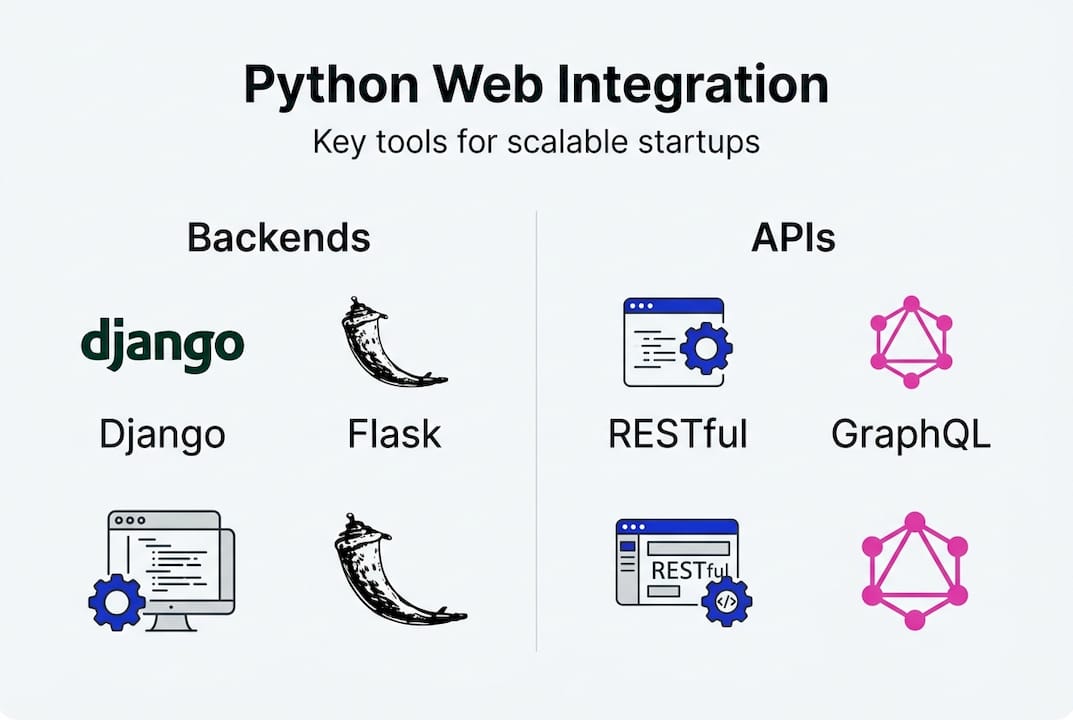
RESTful APIs remain the dominant integration pattern. Python frameworks make REST API development straightforward with built-in serialization, request validation, and response formatting. Django REST Framework extends Django with powerful API capabilities including automatic browsable documentation, authentication schemes, and throttling. Flask-RESTful provides similar functionality for Flask applications. Both frameworks support versioning, pagination, and filtering out of the box.
GraphQL offers an alternative to REST for complex data requirements. Python libraries like Graphene and Strawberry implement GraphQL servers that integrate seamlessly with existing ORMs. GraphQL’s query language lets frontend frameworks request exactly the data they need, reducing over-fetching and minimizing API calls. This efficiency particularly benefits mobile applications operating on limited bandwidth.
Integration patterns for common scenarios:
- Single Page Applications: Python backend serves a REST or GraphQL API, React/Vue/Angular frontend consumes it
- Server-Side Rendering: Python templates render initial HTML, JavaScript enhances interactivity progressively
- Microservices: Python services communicate via HTTP APIs or message queues, each handling specific domains
- Jamstack: Python generates static content at build time, CDN serves it globally with edge functions for dynamic features
Python’s flexibility supports all these patterns without fighting the language. The same Django application can serve traditional HTML templates, REST APIs, and GraphQL endpoints simultaneously. This versatility lets teams evolve architectures incrementally rather than requiring complete rewrites.
- API versioning through URL paths or headers maintains backward compatibility
- Authentication via JWT tokens enables stateless, scalable authorization
- CORS middleware configuration allows controlled cross-origin requests
- WebSocket support through Django Channels or async frameworks enables real-time features
Best practices for leveraging Python in scalable startup web projects
Modular architecture forms the foundation of maintainable web applications. Separate business logic from web framework code, isolating core domain models from HTTP concerns. This separation enables testing business rules without spinning up web servers and allows logic reuse across API endpoints, background tasks, and command-line tools. Structure projects around business capabilities rather than technical layers, grouping related models, services, and views together.
Asynchronous programming dramatically improves performance for I/O-bound operations. Python’s async/await syntax makes concurrent programming accessible without callback hell. FastAPI and aiohttp leverage async natively, handling thousands of concurrent connections on a single server. Even Django added async view support, allowing gradual migration from synchronous code. Use async for database queries, external API calls, and file operations to maximize throughput.
Comprehensive testing prevents regressions and enables confident refactoring. Write unit tests for business logic, integration tests for database interactions, and end-to-end tests for critical user flows. Aim for 80% code coverage on business-critical paths rather than 100% coverage everywhere. Pytest’s fixture system makes test setup clean and reusable. Continuous integration runs tests automatically on every commit, catching issues before they reach production.
Cloud-native deployment patterns maximize scalability and reliability:
- Containerization: Docker packages applications with dependencies, ensuring consistency across environments
- Orchestration: Kubernetes manages container lifecycles, automatically scaling based on load
- Infrastructure as Code: Terraform or CloudFormation defines infrastructure in version control
- Monitoring: Application performance monitoring tracks response times, error rates, and resource usage
- Logging: Centralized logging aggregates logs from distributed services for debugging
Database optimization often delivers the biggest performance improvements. Add indexes to frequently queried columns, use database-level constraints to maintain data integrity, and implement connection pooling to reuse database connections. Profile queries with Django Debug Toolbar or similar tools to identify N+1 query problems. Consider read replicas for read-heavy workloads and caching layers for expensive queries.
Pro Tip: Implement feature flags using services like LaunchDarkly or simple database toggles. This lets you deploy code to production while keeping new features disabled, enabling gradual rollouts and instant rollbacks without redeployment.
Explore Meduzzen’s expert Python web development services
Building scalable web applications requires more than just choosing the right framework. You need experienced engineers who understand architecture patterns, performance optimization, and production operations. Meduzzen’s Python development team brings over 10 years of experience building high-load web platforms for startups and growing businesses across FinTech, Healthcare, and SaaS industries.
Our engineers integrate directly into your team, delivering web development solutions that scale with your business. Whether you need a full development team to build your MVP or specialized expertise to optimize existing systems, we provide pre-vetted Python engineers who understand startup velocity and technical excellence. We’ve helped companies build SaaS platforms serving millions of users, implementing the scalability patterns and best practices covered in this guide.
FAQ
What is the main advantage of using Python in web development?
Python combines exceptional readability with a massive ecosystem of over 400,000 packages, dramatically accelerating development cycles. The language’s clean syntax reduces cognitive overhead, allowing developers to focus on business logic rather than language complexity. Powerful frameworks like Django and Flask provide production-ready components for authentication, database management, and API development, eliminating the need to build infrastructure from scratch. This combination of simplicity and capability makes Python ideal for startups needing to validate ideas quickly while maintaining code quality for long-term growth.
Which Python frameworks are best for scalable web applications?
Django excels for full-featured web applications requiring admin interfaces, built-in authentication, and comprehensive ORM capabilities. Flask and FastAPI work better for microservices, API-only backends, and teams wanting granular architectural control. FastAPI particularly shines for high-performance APIs needing automatic documentation and native async support. The choice depends on project requirements: Django for rapid development of complex applications, Flask for flexibility and simplicity, FastAPI for performance-critical APIs. All three frameworks scale effectively when combined with proper caching, database optimization, and horizontal scaling strategies.
How does Python support API development for modern web apps?
Python frameworks simplify building both RESTful and GraphQL APIs through built-in serialization, request validation, and response formatting. Django REST Framework and Flask-RESTful provide automatic API documentation, authentication schemes, and throttling out of the box. These APIs enable seamless integration with JavaScript frontend frameworks like React, Vue, and Angular, supporting modern single-page application architectures. Python’s async capabilities allow APIs to handle thousands of concurrent connections efficiently, while its strong typing support through type hints improves API reliability and developer experience.
What best practices ensure Python web apps scale effectively?
Implement modular architecture separating business logic from framework code, enabling independent testing and reuse across different contexts. Leverage asynchronous programming with FastAPI or Django’s async views to handle I/O-bound operations concurrently, dramatically improving throughput. Establish comprehensive automated testing covering unit, integration, and end-to-end scenarios to prevent regressions during rapid iteration. Deploy using containerization and orchestration platforms like Docker and Kubernetes for consistent, scalable infrastructure. Add monitoring, centralized logging, and database optimization early rather than waiting for performance problems to emerge in production.