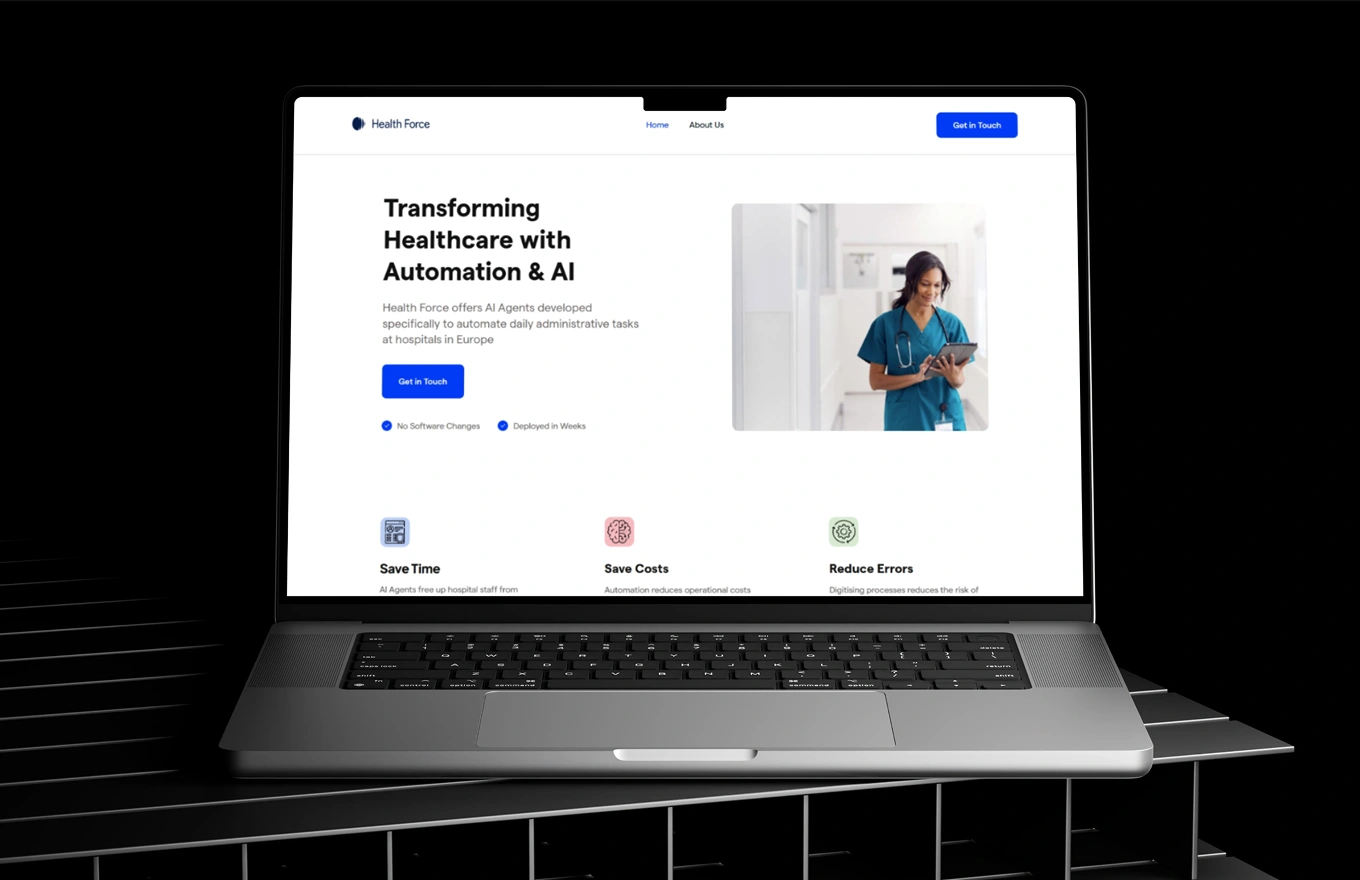
AI & Automation | Web application | UX/UI Design

Health force

Case-Health-force-hero-image.webp
Client Austria-based healthcare & medical claims automation platform provider
Industry Healthcare / Medical Claims & Back-Office Automation
Service Backend Development, Workflow Orchestration, AI Document Processing, RPA/Web Automation, DevOps
Technologies Python 3.11, SQLAlchemy, Alembic, Prefect 3 Playwright, aiohttp, gspread/Google APIs, Exchange, SMB, AWS (Textract, Prefect-AWS), FastAPI pandas, pdfplumber, PyMuPDF, BeautifulSoup4 AWS Bedrock (Claude), Mistral, other LLM clients, fuzzy/rapidfuzz matching
About A Prefect-based automation hub that connects clinical systems, insurance portals, email, spreadsheets, and shared folders into a single back-office platform. It runs specialized flows for disputes, submissions, queue prioritization, reporting, and file sync — reducing manual work while keeping humans in control for critical decisions. A built-in medical document agent processes PDFs (invoices, prescriptions, prior authorizations) using AWS Textract and Mistral OCR, then applies LLMs to classify, extract, and link documents. Results are validated against healthcare business rules and delivered via dashboards and email reports.

OUR Process

Research
Define Workflow
Design Automation
Build Interfaces
Test & Validate
Deploy & Monitor

Client

Healthforce is an Austrian healthcare platform combining medical expertise with advanced technology. Their mission is to streamline hospital operations and reduce the administrative burden on staff through automation.

Case-Health-force-case-image-02.webp
Case-Health-force-case-image-01.webp

Project goals

Replace fragmented manual workflows across multiple portals and spreadsheets with consistent, automated flows. Combine OCR, LLMs, and deterministic rules to boost throughput and accuracy — freeing operators for decisions, not data entry. Standardize states, statuses, and KPIs to make failures explainable and process health trackable. Each business process is built as an independent Prefect-orchestrated service, making it easy to extend with new insurers, portals, or document types.
Problem

Healthcare back-office teams were losing significant time to manual, error-prone work — downloading and reconciling documents across insurer portals, re-entering data between systems, and tracking exceptions in local spreadsheets and email threads. Repetitive tasks like portal logins, batch downloads, and spreadsheet updates left little room for higher-value work. The result was inconsistent claims handling, billing delays, limited traceability, and no feedback loop to improve automation over time.

Solution

A layered automation system connecting clinical systems, insurers, and operators. Each business process runs as an independent Prefect-orchestrated service. Incoming PDFs are OCR'd, classified, and parsed via LLMs tuned for medical billing, with deterministic rules validating documents before submission. Portal automation handles logins, uploads, and downloads, while a relational database serves as the source of truth for all document states — giving operators full visibility into every case at any point.

Home page

Case-Health-force-Page-screemshots-03.webp
Case-Health-force-Page-screemshots-02.webp
Case-Health-force-Page-screemshots-01.webp

COLOR & TYPOGRAPHY

font

Matter

Regular

Bold

#FFFFFF

#BBCEF6

#013BF7

#000000

Responsive Design

Case-Health-force-Adaptive-image-02.webp
Case-Health-force-Adaptive-image-03.webp
Case-Health-force-Adaptive-image-01.webp
Case-Health-force-Adaptive-image-02.webp
Case-Health-force-Adaptive-image-03.webp
Case-Health-force-Adaptive-image-01.webp

key pages

Claims table with search and filtering by status, hospital, and portal. Each claim opens a detailed card with a 7-step processing timeline, automation flow diagram, and attached documents.
Case-Health-force-key-pages-image-02.webp
Case-Health-force-key-pages-image-01.webp
Centralized overview of platform performance — claims statistics, portal efficiency, and scenario breakdown with drill-down into hospitals and statuses. Automatically generates daily reports with key metrics, top errors, and portal breakdowns, delivered as formatted HTML emails.
Case-Health-force-key-pages-image-11.webp
Case-Health-force-key-pages-image-10.webp
Case-Health-force-key-pages-image-09-1-.webp
Case-Health-force-key-pages-image-08.webp
Real-time monitoring of parallel AI agents with a live WebSocket event feed and per-agent performance stats. Includes full pipeline visualization across 7 stages with live progress indicators and a timestamped log viewer for diagnostics.
Case-Health-force-key-pages-image-07.webp
Case-Health-force-key-pages-image-06.webp
Case-Health-force-key-pages-image-05.webp
End-to-end automated pipeline for handling claim disputes: document scraping → OCR → Claude AI classification with confidence scores → data sync. Minimizes manual review of contested claims.
Case-Health-force-key-pages-image-04.webp
Case-Health-force-key-pages-image-03.webp
Case-Health-force-Results-image.webp

Results

The system is designed to maximize automation coverage of repetitive claims tasks, raise first-pass success rates by catching issues before submission, and reduce errors through standardized rules and real-world feedback. Every document and task has a clear status, history, and recovery path — enabling continuous optimization and weekly health checks.

Quick Chat
AI Assistant