


In this article
Real estate automation: streamline property workflows for higher ROI
Business & Strategy
Apr 1, 2026
10 min read
Learn how real estate automation saves 2+ hours daily and delivers 300-500% ROI. A practical guide for investors and developers ready to scale smarter.

Most investors assume automation means handing over control. It doesn’t. The real shift is quieter and more practical: real estate automation uses software tools like RPA and AI to handle repetitive tasks, freeing you to focus on the decisions that actually move the needle. Whether you’re managing a portfolio across the U.S. or scaling development projects in Europe, the question isn’t whether to automate. It’s where to start, what to expect, and how to avoid the traps that derail most implementations.
Key Takeaways
| Point | Details |
|---|---|
| Automation saves time | Real estate automation can save over two hours per day on administrative tasks, allowing focus on higher-value activities. |
| Maximize ROI carefully | Investors and developers can achieve 200-500% ROI within the first year by targeting workflow automation before advanced AI. |
| Human oversight is essential | Automation improves throughput but can’t replace critical human judgment or complex dealmaking. |
| Start with workflow mapping | Successful automation begins by mapping out repetitive tasks and building unified data infrastructure. |
| Risks require attention | Poor implementation and fragmented data can erode trust and compliance, so ongoing oversight is a must. |
What is real estate automation?
At its core, real estate automation is the use of technology to handle tasks that would otherwise require manual effort. That includes robotic process automation (RPA), AI agents, and workflow platforms that connect your tools and trigger actions based on rules or data signals. Think of it as building stability out of chaos: instead of chasing spreadsheets and manually sending follow-up emails, your systems do the predictable work while you focus on strategy.
Real estate automation uses RPA, AI agents, and workflow platforms to automate tasks across the full property lifecycle. The most common applications include:
- Lead routing and qualification: Automatically assign inbound leads to the right agent or pipeline stage based on criteria like location, budget, or property type.
- Tenant onboarding: Trigger document requests, background checks, and welcome sequences the moment a lease is signed.
- Lease management: Set automated reminders for renewals, rent increases, and compliance deadlines.
- Document processing: Extract and organize data from contracts, inspection reports, and financial statements without manual entry.
- Financial reporting: Consolidate income and expense data across properties into structured dashboards.
What automation doesn’t do is equally important. It won’t replace your judgment in a negotiation, resolve a complex dispute with a tenant, or reason through a deal structure with competing variables. Those require human insight. What it does is clear the path so you can get there faster.
“Automation is not about replacing professionals. It’s about giving them back the hours they spend on work that doesn’t require their expertise.”
The maturity spectrum ranges from simple calendar reminders to intent-based AI that predicts tenant churn or flags underperforming assets. Most investors start somewhere in the middle, using property management software to automate communications and reporting before moving toward more sophisticated integrations.
How automation transforms real estate workflows
With a clear understanding of what automation includes, let’s see how it transforms day-to-day real estate operations.
The productivity gains are real and measurable. Empirical benchmarks show that teams save over 2 hours per day, see a 27% increase in sales throughput, and achieve 300 to 500% ROI in year one for commercial real estate. Those aren’t projections. They’re outcomes from teams that mapped their workflows and deployed automation where it counted most.
Here’s how the transformation plays out across common workflows:
- Lead handoff: Automated routing eliminates the gap between inquiry and first contact, cutting response time from hours to minutes.
- Listing research: Teams using tools integrated with platforms like Zillow report saving up to 15 hours per week on manual property research.
- Lease signing: Digital signature workflows reduce turnaround from days to hours, with automatic filing and notification triggers.
- Tenant communications: Scheduled messages for rent reminders, maintenance updates, and renewal offers run without manual input.
- P&L processing: Automated financial consolidation reduces processing time by up to 75%, giving investors faster visibility into portfolio performance.
- Compliance tracking: Automated alerts flag regulatory deadlines, license renewals, and inspection schedules before they become problems.
The payback period for well-scoped automation projects typically runs 3 to 8 months. That’s a short window for a meaningful operational shift. Platforms supporting technology tools in real estate continue to mature, and the digitalization in property sector is accelerating across both residential and commercial markets. Even niche markets are moving fast. For example, digital property sales in Tenerife now leverage automated listing syndication and CRM workflows that were uncommon just three years ago.
Pro Tip: Before deploying any automation tool, map your existing workflows end to end. Identify where time is lost, where errors occur, and where handoffs break down. Automation amplifies what’s already there, so fixing the process first ensures you’re building on solid ground.
Levels of automation maturity and methodology
To fully leverage automation, it’s critical to understand the maturity levels and methodologies that make progress possible.
| Level | Type | Description | Example |
|---|---|---|---|
| 1 | Basic reminders | Time-based triggers | Lease renewal alerts |
| 2 | Rules-based workflows | Conditional logic | Lead routing by budget |
| 3 | Cross-system integrations | Connected platforms | CRM synced to accounting |
| 4 | AI and agentic systems | Intent-based reasoning | Predictive tenant churn |
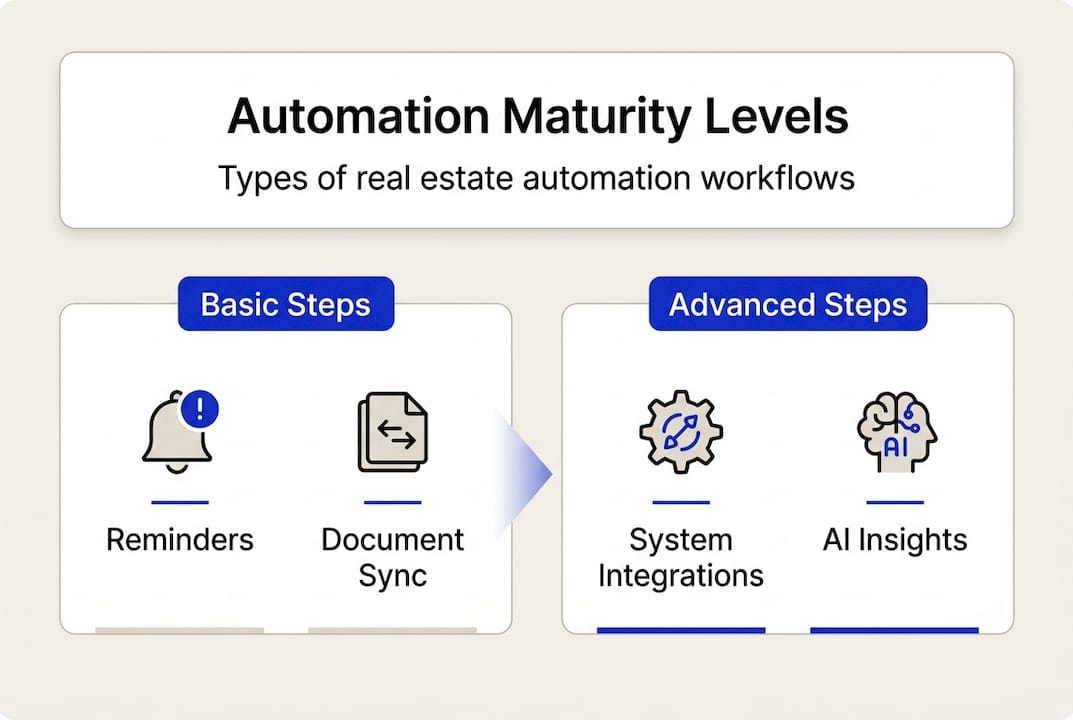
Methodologies include rules-based workflows at Level 2, cross-system integrations at Level 3, and intent-based AI at Level 4, each requiring a different level of data readiness and technical investment. Most teams start at Level 1 or 2 and move up as their data infrastructure matures.
The U.S. and Europe differ meaningfully in where they focus. American investors tend to prioritize lead generation automation and CRM integrations, driven by high transaction volume and competitive markets. European teams often focus more on digitization of paper-heavy processes, compliance workflows, and tenant management. EU PropTech funding lags the U.S., with UK PropTech attracting $23.9B compared to $280B in the U.S., though AI adoption in central Europe sits at 48% and is rising steadily.
For teams building scalable AI solutions, the path forward starts with process mapping, not technology selection. Pilot programs on a single workflow, validate results, then expand. Unified data and clear KPIs are non-negotiable before moving to Level 3 or 4. The ROI at those levels, 200 to 500% in year one, depends entirely on the quality of the foundation beneath them. Teams that skip this step often find themselves with expensive integrations that don’t deliver. The software development for property sector has learned this lesson repeatedly.
Pitfalls, limitations, and the role of human oversight
Even the best automation solutions face limits. Let’s explore those boundaries and how to manage them responsibly.
RPA and agentic AI fail on novel or messy scenarios that require reasoning, and 95% of generative AI projects fail due to poor context and fragmented data. That’s a sobering number. It points to a pattern we see often: teams invest in AI before their data is ready, and the results erode trust rather than build it.
Common failure points include:
- Fragmented data: Automation that pulls from inconsistent or incomplete sources produces unreliable outputs.
- Regulatory blind spots: Automated lease or compliance workflows that don’t account for local law variations create legal exposure.
- Algorithmic bias: AI models trained on historical data can perpetuate pricing or tenant screening patterns that raise fair housing concerns.
- Security gaps: Automated document handling without proper access controls increases the risk of data breaches.
- Over-automation: Removing human touchpoints from sensitive interactions, like eviction notices or dispute resolution, damages relationships and can create liability.
Human oversight isn’t optional. Negotiation, creative dealmaking, and root-cause analysis when something breaks all require judgment that no current system can replicate. The role of automation is to handle the predictable; the role of people is to handle everything else. Staying current on AI trends in software development helps teams understand where the boundaries are shifting and where caution still applies.
For markets with complex regulatory environments, like property sales in the Czech Republic, human review of automated compliance outputs is not just best practice. It’s essential.
A fresh perspective: Why workflow-first beats ‘AI-first’ in real estate
Here’s what we’ve seen consistently across real estate automation projects: the teams that lead with AI ambition often stall, while the teams that lead with workflow discipline quietly build compounding advantages.
The industry hype around AI-first automation is understandable. The demos are impressive. But prioritizing workflow-first means automating repetitive tasks with rules and RPA before pursuing AI reasoning, and building data infrastructure and integrations first. That sequence matters more than the technology itself.
We’ve watched teams chase AI for tasks that a simple rules-based workflow could handle in a fraction of the time and cost. The result is usually the same: delayed ROI, frustrated stakeholders, and a loss of confidence in automation as a whole. Constraint sharpens creativity. When you’re forced to start simple, you learn what your processes actually look like, not what you assume they look like.
The practical advice is this: pick one workflow, automate it cleanly, measure the outcome, and scale from there. Explore property tech trends for 2026 to understand where the market is heading, but don’t let the horizon distract you from the next step. Real ROI in real estate automation is built one validated workflow at a time.
Unlock your automation journey with Meduzzen
If this guide has clarified where automation can genuinely move the needle for your portfolio or development pipeline, the next step is finding the right technical partner to build it right.
At Meduzzen, we work with real estate investors and developers to design and build automation systems that fit your actual workflows, not generic templates. From web automation services and custom AI services to scalable cloud development solutions, our engineers integrate directly into your team and deliver results you can measure. We’ve helped clients across FinTech, Logistics, and Real Estate move from manual bottlenecks to scalable, automated operations. Let’s talk about what that looks like for you.
Frequently asked questions
What tasks in real estate can be automated?
Tasks like lead routing, tenant onboarding, lease management, document processing, and financial reporting can be automated using RPA and AI tools, freeing professionals to focus on higher-value work.
How much ROI can investors expect from real estate automation?
Empirical benchmarks show 300 to 500% ROI within the first year for commercial real estate, alongside daily time savings of over 2 hours per team member.
Does automation fully replace human involvement in real estate?
No. RPA and agentic AI fail on novel scenarios requiring reasoning, so human judgment remains essential for negotiation, dealmaking, and complex problem-solving.
How should I start implementing real estate automation?
Begin by mapping workflows and prioritizing repetitive tasks before adopting advanced AI. Build your data infrastructure first, run a pilot, then scale based on validated results.
Are there risks or drawbacks to real estate automation?
Yes. Poor implementation causes fragmented data and erodes trust, and regulatory or security gaps can create serious liability. Ongoing human oversight is essential throughout.