



In this article
Introduction
Programmatic advertising runs on a chain of specialized systems that buy, sell, route, and auction digital ad inventory in real time. Most people in the industry know the three most common terms: DSP, SSP, and ad exchange. The problem is that these terms are often explained at a surface level.
A lot of content reduces them to simple definitions. A DSP helps advertisers buy ads. An SSP helps publishers sell ads. An ad exchange connects both sides. That is not wrong, but it is incomplete.
In practice, these systems form the operational core of the programmatic advertising ecosystem. Each one handles a different layer of decision-making, inventory flow, auction logic, and reporting. Together, they allow digital advertising platforms to process requests, evaluate targeting rules, run bidding logic, and deliver ads within milliseconds.
Understanding the difference between DSP, SSP, and ad exchange is essential for companies building AdTech products, custom media platforms, or any kind of advertising platform development project. This article explains what each system does, how they work together, and why their architecture matters far more than most high-level industry guides suggest.
What Is the Difference Between a DSP, SSP, and Ad Exchange
At the highest level, these three systems serve different participants in the advertising market.
A Demand-Side Platform (DSP) serves advertisers and agencies.
A Supply-Side Platform (SSP) serves publishers and media owners.
An ad exchange acts as the auction environment where the transaction happens.
That sounds simple, but the difference becomes clearer when you look at the job each platform performs.
| Platform | Primary user | Core role | Main objective |
|---|---|---|---|
| DSP | Advertisers, agencies | Buy impressions programmatically | Maximize campaign performance |
| SSP | Publishers, media owners | Sell and manage ad inventory | Maximize yield and fill rate |
| Ad Exchange | Both sides indirectly | Run auctions between demand and supply | Match bids to impressions efficiently |
This is the basic structure of programmatic advertising technology. But to understand how these systems work in production, you need to go deeper than role labels.
How the Programmatic Advertising Ecosystem Works
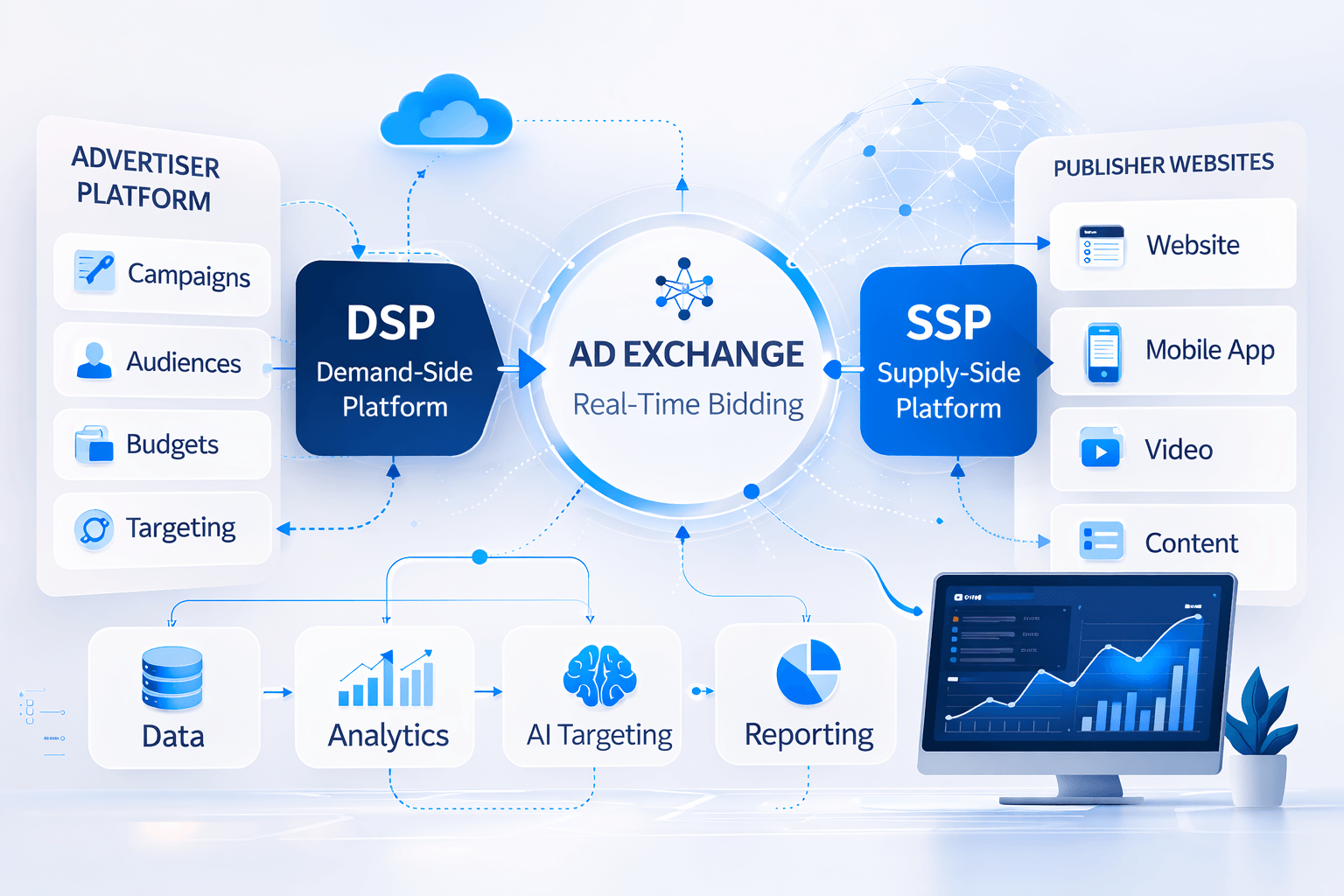
The programmatic ecosystem is built around one central event: an available ad impression.
When a user opens a website or mobile app, the publisher generates an ad opportunity. That opportunity moves through a sequence of systems that determine whether an advertiser wants to bid, how much they are willing to pay, and which ad gets served.
The simplified flow looks like this:
- A user opens a webpage or app.
- The publisher creates an ad request.
- The request is sent to an SSP.
- The SSP sends the request into an ad exchange.
- The exchange distributes the opportunity to multiple DSPs.
- DSPs evaluate the impression and submit bids.
- The exchange chooses the winner.
- The winning creative is delivered to the user.
- Event data is logged for reporting, attribution, and optimization.
This entire sequence often happens in under 100 milliseconds.
That timing constraint is what makes DSP development, SSP development, and exchange architecture far more complex than generic software platforms. These systems are not just interfaces for buyers and sellers. They are high-speed decision environments.
DSP, SSP, and Ad Exchange Workflow
| Step | System | Action |
|---|---|---|
| 1 | Publisher | Generates an ad request |
| 2 | SSP | Packages the inventory and forwards the request |
| 3 | Ad Exchange | Distributes the opportunity to buyers |
| 4 | DSP | Evaluates the impression and returns a bid |
| 5 | Ad Exchange | Selects the winning bid |
| 6 | Ad Server / Delivery Layer | Renders the winning ad |
| 7 | Data Pipeline | Logs impressions, clicks, and performance signals |
Demand-Side Platform (DSP) Architecture
A Demand-Side Platform is the buy-side engine of the system.
Its job is to help advertisers purchase impressions that match campaign goals, audience rules, and budget constraints. A DSP receives bid requests from exchanges, evaluates whether the impression is relevant, calculates a bid value, and returns a bid response.
In real systems, that decision depends on multiple layers of logic:
- campaign targeting rules
- audience segmentation
- budget pacing
- bid strategy
- creative eligibility
- frequency capping
- machine learning models
- performance goals
That is why DSP development is not just about building a campaign dashboard. The dashboard is the visible layer. The real system sits underneath it.
A modern DSP usually includes:
- campaign management services
- targeting and segmentation engine
- bidding engine
- pacing and budget enforcement
- user profile or feature lookup
- ML scoring logic
- reporting and analytics layer
The hardest part is that all of this has to happen fast. A weak DSP architecture introduces too many lookups, too much blocking logic, or too much state dependency in the live bidding path. When that happens, latency grows and auction participation drops.
So architecturally, a DSP is really a real-time pricing engine operating under strict timeout pressure.
Supply-Side Platform (SSP) Architecture
An SSP is the publisher-side infrastructure that manages, packages, and exposes inventory to demand.
Its role is not simply to “send impressions out.” A strong SSP decides how inventory is represented, which demand partners see it, how floor prices are enforced, and how publisher revenue is optimized.
That is why SSP development is fundamentally about yield, routing, and inventory control.
Typical SSP responsibilities include:
- inventory management
- ad request generation
- floor price logic
- partner routing
- private marketplace rules
- demand filtering
- fraud and quality checks
- reporting for publishers
A publisher with weak SSP logic may expose inventory inefficiently, route requests to the wrong partners, or lose revenue due to poor auction control. A strong SSP does the opposite. It structures supply in a way that improves monetization while preserving speed and quality.
In practice, SSP architecture often sits closer to the real inventory source than any other platform in the chain. That makes it critical for metadata quality, request enrichment, and publisher-side control.
Ad Exchange Architecture
An ad exchange is the transactional center of the marketplace.
Its job is to connect incoming supply with eligible demand and run the auction logic that determines the winner. The exchange takes bid requests from SSPs, forwards them to multiple DSPs, receives responses, validates them, enforces timeout rules, and selects the winning bid.
This is where many beginner guides fall short. They describe the ad exchange as a neutral marketplace, which is true in principle, but architecturally it is a high-concurrency routing and auction system.
Its responsibilities typically include:
- request distribution
- demand partner fan-out
- timeout handling
- bid validation
- auction logic
- winner selection
- win / loss signaling
- event logging
At scale, the exchange becomes one of the most performance-sensitive components in the programmatic advertising platform. It cannot behave like a normal API gateway. It must handle a huge volume of parallel buyer responses while enforcing deterministic auction rules.
That is why ad exchange architecture is often where infrastructure quality becomes visible. If the exchange is slow, the whole market interaction becomes weaker.
Why Real-Time Bidding Changes Everything
The reason these systems are architecturally demanding is simple: they operate inside a real-time auction model.
Real-Time Bidding (RTB) forces every system in the chain to respond inside tight latency budgets. The SSP must send the request quickly. The exchange must distribute it efficiently. The DSP must evaluate it and return a bid before the deadline. If any part of the chain is slow, the opportunity is lost.
Typical real-time bidding latency breakdown
| Stage | Typical latency |
|---|---|
| Bid request creation | 5–10 ms |
| Exchange distribution | 5–10 ms |
| DSP evaluation | 20–40 ms |
| Auction decision | 5–10 ms |
| Ad rendering | 30–50 ms |
These ranges vary by environment, but the pattern stays the same: every millisecond matters.
That is why programmatic advertising technology depends so heavily on low-latency infrastructure, in-memory retrieval, efficient network paths, and highly optimized service boundaries.
Data and Analytics Across DSP, SSP, and Exchange Layers
Another reason the DSP / SSP / exchange distinction matters is data.
Each system generates and consumes different kinds of event data.
A DSP cares about bidding outcomes, spend, conversions, and campaign efficiency.
An SSP cares about fill rate, yield, floor behavior, and publisher-side monetization.
An exchange cares about auction flow, win rates, response validity, and market efficiency.
This means the surrounding AdTech data pipelines and analytics systems must collect signals from all three layers and normalize them properly.
Typical event streams include:
- bid requests
- bid responses
- impressions
- clicks
- wins and losses
- conversions
- billing records
- pacing signals
- attribution events
Without reliable data flow, platform operators lose trust in reporting. Without trust, optimization breaks. That is why AdTech analytics is not a reporting add-on. It is part of the operational core of programmatic platforms.
Why Companies Build Custom DSPs, SSPs, and Exchanges
Not every company needs to build these systems from scratch.
But many do.
Organizations often invest in custom advertising platform development when they need tighter control over their data, auction rules, integrations, revenue logic, or platform differentiation.
Examples include:
- a media company building a custom SSP for its publisher network
- an agency building a DSP for a niche buying model
- a retail platform creating a private exchange around its own inventory
- a vertical marketplace needing specialized targeting and reporting logic
This is where custom development becomes strategic. Off-the-shelf tools may help launch operations, but they rarely provide architectural advantage. A custom system can encode the actual economics of the business into the platform.
That is why businesses exploring DSP development or SSP development are usually not just looking for software. They are looking for control.
Frequently Asked Questions About DSP, SSP, and Ad Exchange
What is a DSP in programmatic advertising?
A DSP is a demand-side platform used by advertisers and agencies to buy ad impressions programmatically. It evaluates bid opportunities, applies campaign rules, and submits bids in real time.
What is an SSP in programmatic advertising?
An SSP is a supply-side platform used by publishers to manage and sell ad inventory. It routes requests into the market, applies monetization rules, and helps publishers maximize yield.
What does an ad exchange do?
An ad exchange is the auction layer that connects DSPs and SSPs. It receives supply, distributes bid opportunities to buyers, and determines the winner of the auction.
How do DSP, SSP, and ad exchange work together?
The SSP sends available inventory into the exchange, the exchange distributes the opportunity to DSPs, and the DSPs submit bids. The exchange chooses the winning bid and the ad is served.
Conclusion
DSPs, SSPs, and ad exchanges are not interchangeable labels. They are specialized systems with different roles inside the programmatic advertising ecosystem.
The DSP evaluates demand.
The SSP structures supply.
The exchange coordinates the auction between them.
Together, they form the core transaction architecture behind modern digital advertising.
Understanding how these systems differ is essential for anyone involved in advertising platform development, AdTech strategy, or custom infrastructure design. Because once you look beyond the glossary definitions, the real story is architectural: speed, routing, decision logic, data flow, and auction control.
And that is where programmatic advertising technology becomes a serious engineering problem.