



In this article
Introduction
Digital advertising today is powered by extremely complex software systems. Every time a user opens a website or mobile app, dozens of advertising platforms compete to show the most relevant ad in a fraction of a second. Behind this process lies AdTech software development, the engineering discipline responsible for building scalable advertising infrastructure.
Modern programmatic advertising platforms rely on distributed systems capable of processing millions of requests per second. These systems integrate machine learning models, real-time data pipelines, and automated bidding engines to determine which advertisement should appear for a specific user.
For companies building advertising products, AdTech software development involves designing platforms such as Demand-Side Platforms (DSPs), Supply-Side Platforms (SSPs), ad exchanges, analytics tools, and campaign management systems. Each of these components must operate with extremely low latency while handling enormous volumes of advertising data.
As digital advertising spending continues to grow globally, organizations increasingly invest in custom AdTech solutions that allow them to control their advertising technology stack, optimize campaign performance, and build competitive programmatic platforms.
This article explores the fundamentals of AdTech software development, the architecture behind advertising platforms, and the technologies used to build scalable programmatic ecosystems.
How AdTech software development works
- A user opens a website or mobile app.
- The publisher sends an ad request to a supply-side platform (SSP).
- The SSP forwards the request to an ad exchange.
- The exchange distributes the bid request to multiple DSP platforms.
- Demand-side platforms evaluate the user, campaign targeting, and bid strategy.
- The highest bid wins the real-time auction.
- The winning ad creative is delivered to the user.
The Role of Software Engineering in AdTech Platforms
At its core, AdTech software development focuses on building infrastructure that automates the buying and selling of digital advertising.
Traditional advertising relied on manual negotiations between advertisers and publishers. Programmatic technology transformed this process into an automated system where advertising inventory is bought and sold through software.
Today’s programmatic ecosystem includes multiple platform types:
| Platform | Purpose |
|---|---|
| DSP (Demand-Side Platform) | Allows advertisers to buy advertising inventory |
| SSP (Supply-Side Platform) | Enables publishers to sell their ad space |
| Ad Exchange | Marketplace where advertising auctions occur |
| Ad Server | Delivers ads to websites or applications |
| Analytics Platform | Tracks campaign performance and user behavior |
Building these systems requires advanced expertise in distributed systems, real-time data processing, and high-performance infrastructure. As a result, many organizations partner with an AdTech development company that specializes in advertising platform development.
Core Components of AdTech Software Development
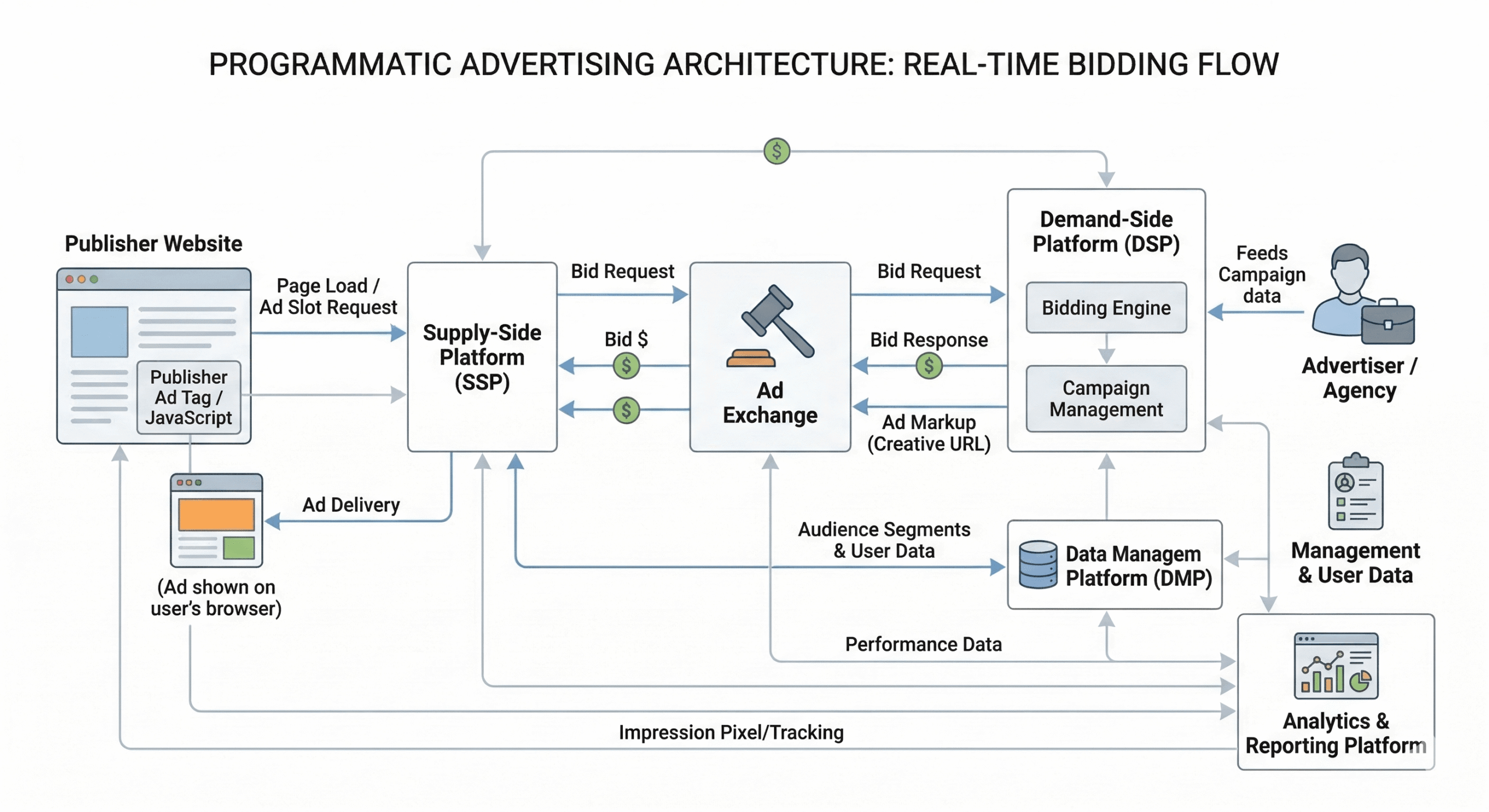
Modern advertising technology platforms consist of multiple interconnected components that together enable programmatic advertising.
Demand-Side Platforms (DSP)
A Demand-Side Platform allows advertisers and agencies to purchase digital advertising inventory automatically. DSPs evaluate incoming ad opportunities and decide whether to place a bid.
Typical DSP architecture includes:
• bidding engines
• user profile databases
• machine learning models
• campaign management systems
• budget pacing algorithms
When a user visits a website, the DSP receives a bid request and evaluates whether the impression matches the advertiser’s targeting criteria.
Supply-Side Platforms (SSP)
A Supply-Side Platform is used by publishers to monetize their advertising inventory.
SSPs perform several critical functions:
• managing available ad inventory
• setting price floors
• filtering advertisers
• forwarding bid requests to exchanges and DSPs
In many SSP development projects, engineers must optimize how inventory is packaged and auctioned to maximize publisher revenue.
Ad Exchanges
Ad exchanges act as the marketplace connecting DSPs and SSPs. They manage auctions that determine which advertiser wins a particular impression.
The exchange processes thousands or millions of requests simultaneously and selects the highest valid bid within strict latency limits.
Real-Time Bidding Infrastructure
One of the most complex aspects of AdTech software development is building a real-time bidding platform.
Real-Time Bidding (RTB), built on the OpenRTB protocol, allows advertisers to bid on individual ad impressions as they become available.
The typical RTB flow works as follows:
- A user loads a webpage.
- The publisher sends a request to the SSP.
- The SSP forwards a bid request to an ad exchange.
- The exchange distributes the request to multiple DSPs.
- Each DSP calculates a bid based on targeting data.
- The exchange selects the winning bid.
- The winning advertisement is displayed.
This entire process typically happens in less than:
100 milliseconds
The speed requirement forces engineers to design extremely optimized AdTech infrastructure.
Typical real-time bidding latency breakdown
| Stage | Typical latency |
|---|---|
| Bid request creation | 5–10 ms |
| DSP evaluation | 20–40 ms |
| Auction decision | 5–10 ms |
| Ad rendering | 30–50 ms |
Data Pipelines in AdTech Platforms
Another essential component of AdTech software development is building scalable AdTech data pipelines.
Advertising platforms generate massive volumes of events, including:
• impressions
• clicks
• conversions
• bidding logs
• campaign performance metrics
To process this data, many AdTech systems rely on streaming architectures built with technologies such as:
• Apache Kafka
• Apache Flink
• ClickHouse
• Redis
• Aerospike
These platforms allow companies to analyze advertising data in real time and deliver AdTech analytics that help marketers optimize campaigns.
For example, machine learning models can analyze historical ad performance to improve audience targeting and increase return on ad spend.
Scalability Challenges in Advertising Platform Development
Building advertising infrastructure introduces several engineering challenges.
Extreme Scale
Major AdTech companies process enormous traffic volumes.
Some industry benchmarks include:
• Criteo processing hundreds of millions of bid requests per second
• The Trade Desk running tens of billions of daily auctions
• large exchanges handling millions of queries per second
Supporting this scale requires horizontally scalable microservices architecture.
Ultra-Low Latency
In RTB environments, every millisecond matters. If a DSP takes too long to respond to a bid request, it simply loses the auction.
Many systems must complete the full bidding decision within:
20–40 milliseconds
To achieve this performance, AdTech platforms use in-memory databases and highly optimized networking layers.
Data Privacy and Compliance
Modern advertising platforms must comply with regulations such as:
• GDPR
• CCPA
• CPRA
This requires privacy-aware identity systems and consent management infrastructure.
Why Businesses Invest in Custom AdTech Solutions
Many companies choose to build their own custom AdTech solutions rather than relying entirely on third-party platforms.
There are several reasons for this shift.
Greater Data Control
Owning the advertising stack allows organizations to maintain control over first-party user data.
Improved Campaign Optimization
Custom systems allow deeper integration between advertising platforms and internal analytics tools.
Competitive Differentiation
Companies building innovative advertising products often require unique platform features that generic tools cannot provide.
For this reason, businesses frequently partner with an experienced AdTech development company capable of delivering scalable AdTech development services.
These services typically include:
• DSP development
• SSP development
• advertising platform development
• AdTech analytics platforms
• real-time bidding infrastructure
The Future of AdTech Software Development
The advertising technology industry continues to evolve rapidly. Several trends are shaping the future of AdTech software development.
One major shift is the transition toward cookieless advertising as browsers limit third-party tracking.
New identity frameworks such as UID2 and Privacy Sandbox technologies are emerging to address this challenge.
Another major trend is the increasing use of artificial intelligence in advertising systems. Machine learning models now drive audience segmentation, campaign optimization, and automated bidding strategies.
Finally, modern programmatic advertising platforms are becoming more integrated with broader marketing ecosystems, including analytics platforms, customer data platforms, and real-time reporting dashboards.
As digital advertising continues to expand globally, organizations investing in robust AdTech infrastructure will be better positioned to build scalable, data-driven advertising platforms.
Conclusion
AdTech software development is the engineering foundation behind the modern digital advertising industry. From DSPs and SSPs to real-time bidding engines and large-scale data pipelines, these platforms enable automated advertising transactions that occur billions of times each day.
Building such systems requires deep expertise in distributed systems, machine learning, and high-performance infrastructure. As advertising platforms become more complex and data-driven, businesses increasingly rely on specialized AdTech development services to design and scale their technology stacks.
Companies that invest in advanced advertising platform development gain greater control over their data, improve campaign optimization, and unlock new revenue opportunities in the growing programmatic advertising ecosystem.